How a Development Fund Became a Campaign War Chest—and Why the Supreme Court Finally Noticed
By Louis “Barok” C. Biraogo — October 27, 2026
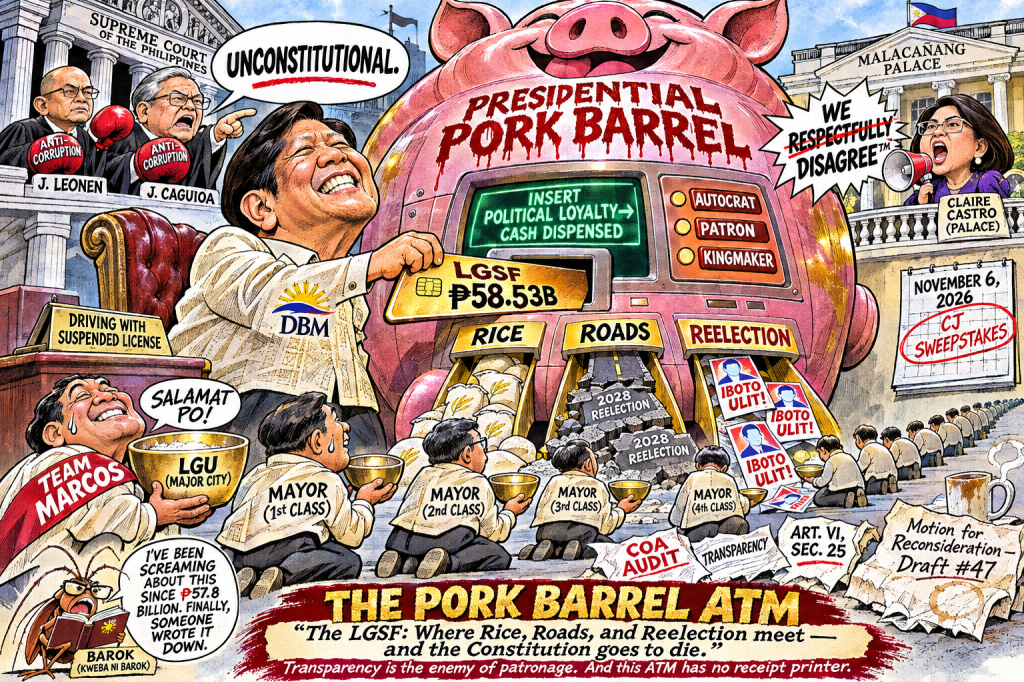
I Have a confession to make, and unlike the Palace’s, it comes with receipts. When I first read Justice Caguioa’s concurring opinion calling the 2024 Local Government Support Fund (LGSF) a “Presidential Pork Barrel,” I felt something I rarely experience in this line of work: genuine, unironic surprise. Not because the conclusion was wrong—I have been screaming about the LGSF’s constitutional defects since it was ₱57.8 billion and growing. But because a sitting Supreme Court justice had finally written it down. In public. With a straight face.
And then, within twenty-four hours, Malacañang announced it would file a Motion for Reconsideration (MR).
Of course it did.

The Ruling That Wasn’t Supposed to Happen
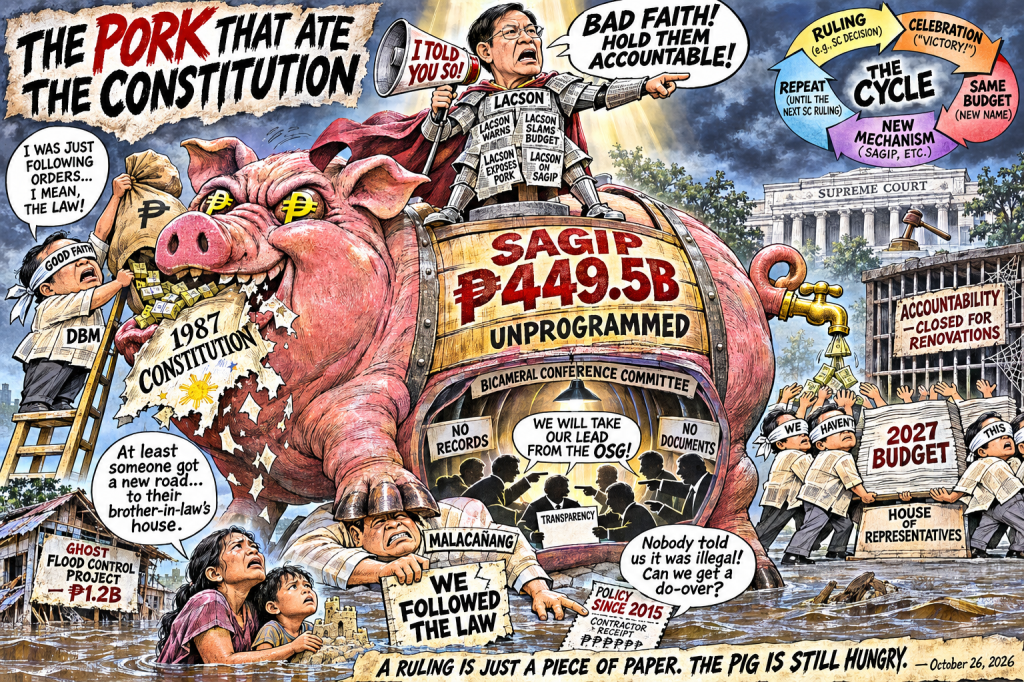
Here is what the Supreme Court actually did on October 20, 2026. It struck down the ₱449.5-billion increase in unprogrammed appropriations in the 2024 budget—the largest single budget violation in Philippine history. It found the bicameral conference committee guilty of operating as a “third chamber,” inserting 43 additional purposes worth over ₱303 billion without records, without explanations, without anything resembling deliberation.
The Court invalidated the ₱449.5-billion increase in unprogrammed appropriations—of which the ₱5-billion LGSF was a part—for violating the constitutional ceiling on congressional increases to the President’s budget. Justice Caguioa, in a separate concurring opinion, went further, characterizing the LGSF provision as a “Presidential Pork Barrel” that resurrected the constitutional defects of the PDAF struck down in Belgica v. Ochoa.
Caguioa’s concurrence went further. He called the LGSF what it is: a presidential slush fund dressed in the borrowed robes of local autonomy. The law, he wrote, “does not contain a special provision detailing the policy underlying the LGSF or establishing meaningful limitations.” The President alone decides “when, how much and to whom to give it.” That, ladies and gentlemen, is not a grant program. That is a patronage ATM with a government logo.
The majority applied the doctrine of operative fact to irreversible programs whose beneficiaries acted in good faith, but explicitly refused to extend that protection to the authors, proponents, and implementors of the unconstitutional provisions, who may invoke good faith only if established before the proper tribunals.
The Ombudsman has been invited to investigate. The Commission on Audit (COA) has been told to audit. The criminal exposure is real.
And yet.
The Palace’s Response: “We Respectfully Disagree”
Within hours of the ruling, Presidential Communications Undersecretary Claire Castro was on the airwaves insisting that the Supreme Court “did not declare unprogrammed appropriations unconstitutional per se.” This is technically true. It is also the kind of defense a man offers when he has been caught with his hand in the cookie jar and wants credit for not having stolen the entire jar.
The administration’s argument, reduced to its essence, is this: We’ve been doing this since 2015. Therefore it is legal. This is not a constitutional argument. It is a tantrum with footnotes.
The Supreme Court’s response, equally reduced, was: You have been doing this since 2015. That is why we are stopping you now.
The Solicitor General has been dispatched to file the MR. The Palace has signaled it will respect whatever the Court ultimately decides. But in the meantime, the 2026 budget continues to be executed under the very provisions the Court has flagged as constitutionally suspect. The government is, in effect, driving with a suspended license while it petitions the traffic court to reconsider.
The ₱5 Billion Question Nobody Wants to Answer
Here is where the LGSF becomes genuinely interesting, in the way that a car crash is interesting.
The ₱5-billion LGSF item in the 2024 budget was part of the ₱449.5-billion increase that the Court invalidated. Caguioa specifically flagged its lack of standards. The majority specifically warned that lump sums have no place in unprogrammed appropriations. And yet, as of this writing, no one has produced a complete accounting of where that ₱5 billion went.
The Department of Budget and Management (DBM) has released partial figures. The COA has announced it will audit. The Ombudsman has been copied on the ruling. But the public still does not know which local government units (LGUs) received funds, which projects were funded, which contractors were paid, or whether any of it was delivered.
This is not an accident. This is the architecture of impunity. The LGSF was designed to be opaque. The “menu” system, the direct presidential release, the absence of legislative guidelines—each of these features exists not despite the opacity but because of it.
Transparency is the enemy of patronage. And the LGSF was, from its inception, a patronage delivery system.
The Chief Justice Sweepstakes and the Politics of Judicial Timing
I am not, by temperament, a conspiracy theorist. I am, however, a close reader of Philippine political incentives. And the timing here is exquisite.
Chief Justice Alexander Gesmundo retires on November 6, 2026. The Judicial and Bar Council has shortlisted five candidates: Leonen, Caguioa, Hernando, Inting, and Zalameda. Leonen, as the most senior, automatically becomes Acting Chief Justice upon Gesmundo’s retirement. Leni Robredo—yes, that Leni Robredo, now Mayor of Naga City—has publicly endorsed Leonen for the permanent position.
And the ruling that bears Leonen’s name as ponente is the most aggressive judicial rebuke of executive budget authority since Araullo v. Aquino III (G.R. No. 209287).
Is the timing coincidental? Perhaps. The Court’s deliberative process is not a political machine, and I have no evidence that any justice timed this decision for maximum institutional advantage. But the effect is unmistakable.
The ruling positions Leonen as the anti-corruption, anti-executive-overreach candidate for Chief Justice. It positions Caguioa—whose concurrence went even further—as the purist. And it places President Marcos in the impossible position of choosing between a justice who has just gutted his budget and two others who signed onto the same result.
Marcos has historical grievances with Leonen dating back to the burial of his father at Libingan ng mga Bayani. He would prefer almost anyone else. But the Court has now made the Chief Justice succession a referendum on budget constitutionality.
Rejecting Leonen would look like retaliation. Appointing him would look like capitulation. Either way, the LGSF ruling has transformed a routine judicial appointment into a political minefield.
The LGSF as Constitutional Stress Test
Let me be precise about what the LGSF represents, because the stakes are higher than a single budget line item.
The LGSF is not merely unconstitutional. It is counter-constitutional. It exists to accomplish precisely what the 1987 Constitution was designed to prevent: the concentration of spending discretion in the executive, shielded from legislative oversight, distributed according to political rather than legal criteria.
- Article VI, Section 25(1) says Congress cannot increase the President’s budget. The LGSF circumvents this by pouring money into unprogrammed appropriations, which are technically not “increased” because they are contingent.
- Article VI, Section 25(6) requires legislative guidelines for discretionary funds. The LGSF has none. The DBM “menu” is an administrative document, not a statute. It can be changed at the President’s pleasure.
- Article VI, Section 24 vests the power of the purse in Congress. The LGSF effectively transfers that power to the President, who decides which LGUs get funded and which do not.
- Article II, Section 28 requires full public disclosure of transactions involving public interest. The LGSF’s distribution records are, at best, fragmentary. At worst, they are nonexistent.
Each of these violations is individually serious. Together, they represent a systematic assault on the constitutional architecture of Philippine fiscal governance.
The Reform That Isn’t Coming
The Supreme Court’s ruling includes a roadmap for reform. Justice Gaerlan’s concurrence proposed specific safeguards for the bicameral conference committee: written records, public proceedings, limits on unrelated provisions, sufficient review time. Caguioa called for the express abandonment of Tolentino v. Secretary of Finance (G.R. No. 115455), the doctrine that allowed the “third chamber” to flourish.
These are excellent proposals. They will almost certainly be ignored.
Why? Because the bicameral conference committee is where the real budget is written. The House version and the Senate version are theater. The bicam is where the deals are cut, the allocations are traded, and the pork is distributed.
Reforming the bicam would require the very people who benefit from it to vote against their own interests. Congress has never been known for that kind of self-abnegation.
The 2027 budget process is already underway. The proposed LGSF for 2027 is ₱58.53 billion—the highest in history. Senator JV Ejercito has promised that the Senate will “respect and comply” with the Supreme Court’s ruling. I believe him. I also believe that “respect and comply” will be interpreted with the same creativity that produced the LGSF in the first place.
What the Operative Fact Doctrine Actually Means
The majority’s application of the operative fact doctrine has been widely misunderstood. It does not mean the money is gone and no one is responsible. It means the Court is not going to order the clawback of funds that have already been spent on projects that have already been built. It is a pragmatic concession to the reality that you cannot un-build a road.
But the Court was explicit: the doctrine “cannot apply to the authors, proponents and implementors” of the unconstitutional provisions “unless there are concrete findings of good faith in their favor by the proper tribunals.” This is not a shield. It is a referral.
The Ombudsman now has jurisdiction to investigate every member of Congress who voted for the 2024 General Appropriations Act (GAA), every DBM official who prepared the LGSF guidelines, every executive official who approved the releases, and every LGU official who received funds without adequate documentation. The Sandiganbayan awaits.
Will any of them be prosecuted? I am not optimistic. The Ombudsman’s office has a long and distinguished history of investigating high-profile cases for exactly as long as it takes for the news cycle to move on.
But the legal exposure is now documented. The precedent is set. The next time someone tries to create a presidential slush fund, they will have to do so with the knowledge that the Supreme Court has already called it what it is.
The Uncomfortable Truth About Local Autonomy
The LGSF’s defenders—including Mayor Zamora of San Juan, who has been the fund’s most enthusiastic cheerleader—argue that it supports local development, funds essential infrastructure, and provides resources that LGUs would otherwise lack, as the Palace itself has maintained.
This is true. It is also irrelevant.
The Mandanas v. Ochoa (G.R. No. 199802) ruling already expanded the National Tax Allotment to ₱1.32 trillion for 2027. LGUs have more automatic, unconditional funding than at any point in Philippine history. The argument that they need a separate, discretionary, President-controlled fund is not a fiscal argument. It is a political one.
The LGSF exists not because LGUs lack resources but because the national government wants leverage over them. It is a tool of dependency, not empowerment. It teaches local officials to look to Malacañang for projects rather than to their own constituents.
It rewards political loyalty rather than fiscal responsibility. It transforms mayors and governors from autonomous local executives into supplicants at the Palace gate.
The Supreme Court has now said that this particular mechanism is constitutionally defective. The question is whether Congress will replace it with something better or merely rename it.
A Prediction, Offered Without Confidence
The Motion for Reconsideration will fail. The Supreme Court does not reverse itself on rulings of this magnitude within weeks of issuance. The 2027 LGSF will be restructured, likely with more specific legislative guidelines, a formula-based allocation system, and a fig leaf of transparency.
The new fund will be called something other than “LGSF.” It will be defended as a “reformed” mechanism. It will function, in practice, very much like the old one.
And in 2028, or 2031, or 2034, another Supreme Court will issue another ruling declaring that the new-and-improved fund is, once again, a presidential pork barrel. And the cycle will continue.
This is not pessimism. It is the observed behavior of Philippine political institutions over the past four decades. The names change. The constitutional provisions remain. The evasion is perpetual.
But here is what is different this time: the Court has explicitly refused to immunize the authors. The operative fact doctrine has been deployed as a sword, not a shield. And for the first time since Belgica, a sitting justice has used the phrase “Presidential Pork Barrel” in an official opinion.
That is not nothing. In Philippine politics, it is almost everything.
The Last Word (For Now)
The ₱5-billion LGSF in the 2024 budget is a rounding error compared to the ₱449.5-billion unprogrammed appropriations increase the Court struck down. But it is the most symbolically important line item in the entire ruling. It represents the principle that Congress cannot delegate its spending power to the President, no matter how noble the stated purpose.
It represents the principle that local autonomy cannot be purchased with national patronage. It represents the principle that the Constitution’s budget provisions are not suggestions.
The Supreme Court has spoken. Malacañang is filing its MR. Congress is preparing its 2027 budget. The Chief Justice succession is underway. The Ombudsman is, presumably, sharpening its pencils.
And somewhere in the DBM, a mid-level bureaucrat is already drafting the guidelines for the 2027 LGSF, carefully avoiding the word “pork” while preserving every discretionary mechanism the Court has now declared unconstitutional.
The more things change.
Louis “Barok” C. Biraogo is the author of the Kweba ni Barok blog. He has been writing about Philippine budget politics since before it was cool, which is to say, since before anyone was reading.
Key Citations
A. Legal & Official Sources
- Araullo v. Aquino III. G.R. No. 209287, Supreme Court of the Philippines, 1 July 2014. LawPhil Project, lawphil.net/judjuris/juri2014/jul2014/gr_209287_2014.html.
- Belgica v. Ochoa. G.R. Nos. 208566, 208493, and 209251, Supreme Court of the Philippines, 19 Nov. 2013. LawPhil Project, lawphil.net/judjuris/juri2013/nov2013/gr_208566_2013.html.
- Mandanas v. Ochoa. G.R. No. 199802, Supreme Court of the Philippines, 3 July 2018. LawPhil Project, lawphil.net/judjuris/juri2018/jul2018/gr_199802_2018.html.
- Supreme Court of the Philippines. SC Holds Unprogrammed Appropriations Subject to Guidelines; Voids Congressional Increases in 2024 and 2025 Budgets. Supreme Court E-Library, 20 Oct. 2026, sc.judiciary.gov.ph/sc-holds-unprogrammed-appropriations-subject-to-guidelines-voids-congressional-increases-in-2024-and-2025-budgets/.
- The 1987 Constitution of the Republic of the Philippines. Official Gazette of the Republic of the Philippines, 2 Feb. 1987, http://www.officialgazette.gov.ph/constitutions/1987-constitution/.
- Tolentino v. Secretary of Finance. G.R. No. 115455, Supreme Court of the Philippines, 25 Oct. 1995. LawPhil Project, lawphil.net/judjuris/juri1995/oct1995/gr_115455_1995.html.
B. News Reports
- Biraogo, Louis “Barok” C. “The P57.8-Billion Bribe: Exposing the LGSF’s Constitutional Cosplay as ‘Empowerment’.” Kweba ni Barok, 22 July 2026, kwebanibarok.com/2026/07/22/the-p57-8-billion-bribe-exposing-the-lgsfs-constitutional-cosplay-as-empowerment/.
- —. “₱58.53B, Zero Receipts: The LGSF Pork Barrel Nobody Wants to Name.” Kweba ni Barok, 2 Oct. 2026, kwebanibarok.com/2026/10/02/%e2%82%b158-53b-zero-receipts-the-lgsf-pork-barrel-nobody-wants-to-name/.
- “Marcos Orders Release of P58 Billion Local Gov’t Support Fund.” Philippine Daily Inquirer, 2026, newsinfo.inquirer.net/2186238/marcos-orders-direct-release-of-p58-billion-local-govt-support-fund.
- “Palace Defends Higher Development Budget for LGUs in 2027.” The Philippine Star, 16 Aug. 2026, http://www.philstar.com/headlines/2026/08/16/2549664/palace-higher-development-budget-lgus-2027.
- Domingo, Katrina. “Marcos Admin to File Motion for Reconsideration vs SC Ruling on Unprogrammed Funds.” ABS-CBN News, 21 Oct. 2026, http://www.abs-cbn.com/news/nation/2026/10/21/marcos-admin-asks-sc-to-reconsider-ruling-on-unprogrammed-funds-1537.
- Leonen, Marvic M.V.F. Dissenting Opinion. Ocampo v. Enriquez, G.R. No. 225973, Supreme Court of the Philippines, 8 Nov. 2016. Inquirer.net, newsinfo.inquirer.net/842566/leonen-marcos-is-no-hero-libingan-burial-illegal/.
- “Ang Hirap Maging Mahirap”: The PAO Scandal That Proves Government Contempt Is Nothing New

- “Far-Off” My Axx: Malacañang’s Claire Castro Drowns in Her Own Legal Gaslighting
- “Forthwith” to Farce: How the Senate is Killing Impeachment—And Why Enrile’s Right (Even If You Can’t Trust Him)
- “HINDI AKO NAG-RESIGN!”

- “I Know Nothing”: Baste Duterte’s Amnesia Defense Meets ₱33M in GenCorp Contracts

- “I’m calling you from my new Globe SIM. Send load!”

- “Mahiya Naman Kayo!” Marcos’ Anti-Corruption Vow Faces a Flood of Doubt

- “Manageable” Debt, Unmanageable Lies: DBM’s ₱21 Trillion Fairy Tale
- “Meow, I’m calling you from my new Globe SIM!”

- “Natrabaho”: One Word, One Ombudsman, and a Judiciary on Trial

- “No Special Jail for Crooks!” Boying Remulla Slams VIP Perks for Flood Scammers

- “Philippine-Controlled” or Yankee Gas Station? The Davao Fuel Depot Farce Exposed





Leave a Reply