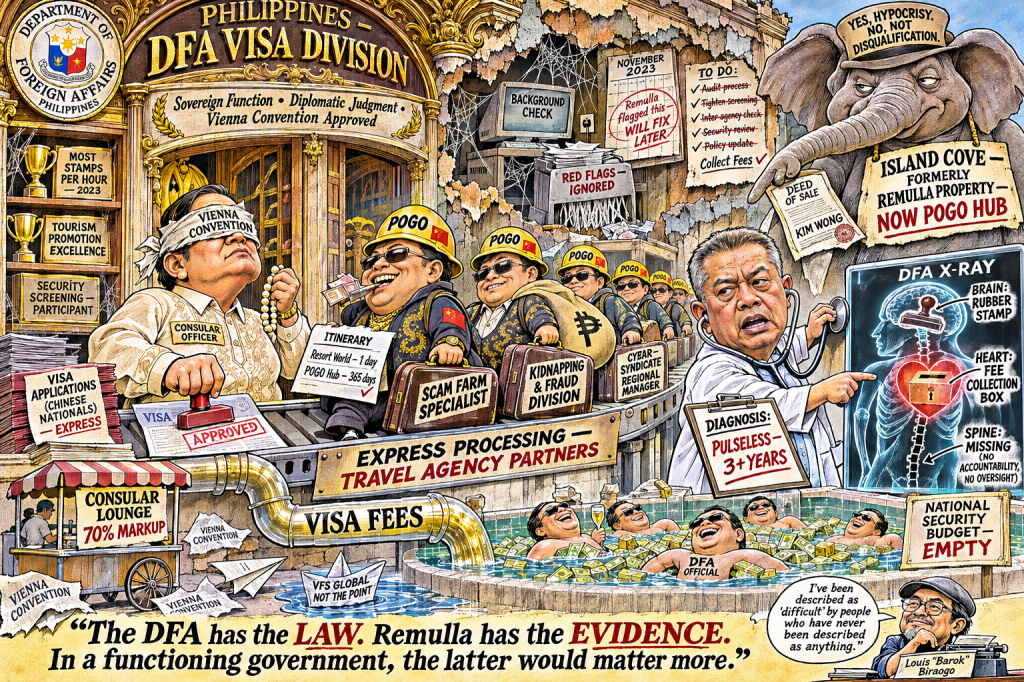
Boying Remulla Called It Clerical. The DFA Called It Sovereign. The POGO Industry Called It an Invitation.
By Louis ‘Barok‘ C. Biraogo | October 27, 2026
GATHER round, children of the chattering classes, and watch me torch the approved narrative: Jesus Crispin Remulla is correct.
Not correct in the way his critics mean—not correct in the sense that he has produced a smoking gun, a ledger, or a named official with a paper trail leading to a Chinese travel agency kickback. He hasn’t. And that, apparently, is the entire basis for the Department of Foreign Affairs (DFA)‘s righteous indignation and the commentariat’s collective pearl-clutching.
A Diagnosis Needs a Pulse, Not a Conviction
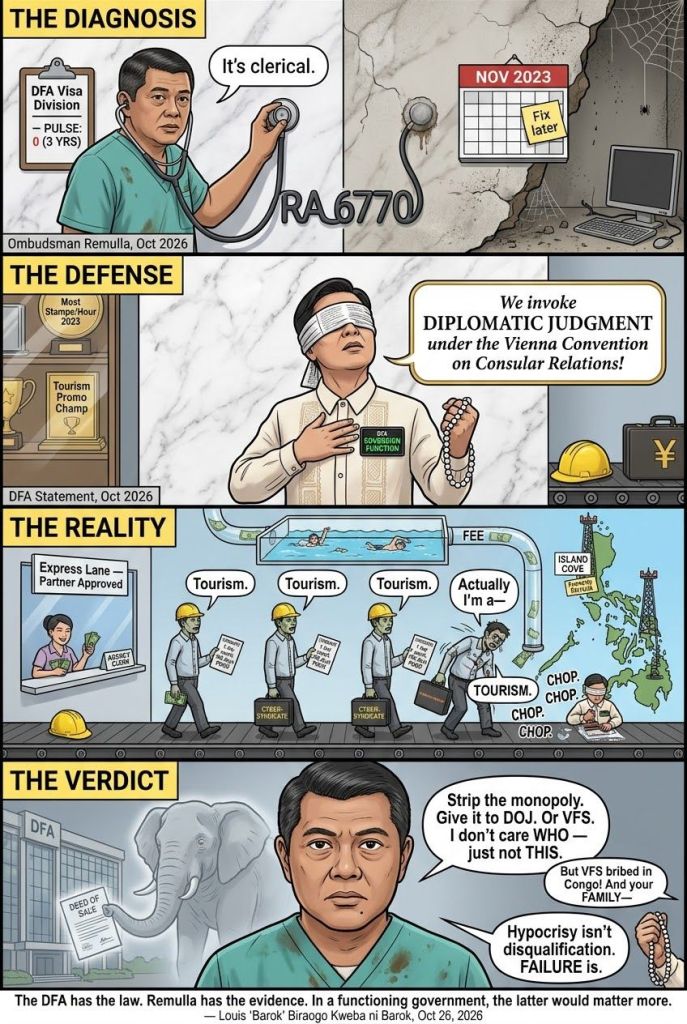
But here’s the thing about being an Ombudsman: you don’t need a conviction to diagnose a disease. You need a pulse. And the DFA’s visa system has been pulseless for years while Chinese nationals connected to Philippine Offshore Gaming Operators (POGOs), scam farms, and cyber-fraud syndicates walked through the front door with paperwork that should have been flagged, scrutinized, and shredded.
Remulla called visa processing “clerical”. The DFA clutched its pearls and invoked the Vienna Convention on Consular Relations. But let’s be honest about what the DFA actually does with visa applications from China: it collects forms. It stamps passports. It collects fees.
And then—if the POGO scandals are any indication—it waves through applicants whose backgrounds were never properly checked because the system was designed for tourism promotion, not national security screening.
The “Sovereign Function” Defense
The DFA says visa issuance is a “sovereign function” requiring “diplomatic judgment.” I’ve seen the results of that judgment. It produced a POGO industry that metastasized into a kidnapping-and-fraud enterprise while consular officers in China were, according to Remulla, “doing business” through travel agencies. If that’s diplomacy, give me clerical work.
VFS Global Is a Red Herring
Now, the DFA’s defenders will scream: VFS Global is worse! And they’ll cite the Lighthouse Reports investigation—the bribery in the Democratic Republic of the Congo (DRC), the data violations, the aggressive upselling, the 70% profit margins. All true. All damning. All irrelevant to the central question.
Because Remulla isn’t marrying VFS Global. He’s asking whether the DFA should be the final arbiter of who enters the country when it has demonstrably failed at that task. The answer is no.
Whether VFS is the replacement or whether the function goes to the Bureau of Immigration under the Department of Justice (DOJ)—that’s a procurement question, not a philosophical one. The Ombudsman’s job is to identify the rot, not to draft the contract.
Three Years of Documented Failure
And the rot is real. Consider what we know:
- In November 2023, when Remulla was Justice Secretary, he already flagged anomalous visas issued to Chinese travelers through travel agencies.
- Three years later, the problem persists.
- The DFA has had three years to demonstrate it fixed its screening.
Instead, it’s reviewing its visa-free policy for Chinese tourists because—surprise—criminal syndicates exploited it. The DFA’s defense is essentially: “We have the legal mandate, and we’re working on it.” That’s not a defense. That’s a confession of institutional paralysis dressed in diplomatic protocol.
Separation of Powers and the Ombudsman’s Mandate
The Ombudsman’s critics also love to invoke separation of powers. “Remulla can’t unilaterally strip the DFA of its functions!” Correct. He can’t. But he can—and did—say the quiet part loud: the DFA’s visa operation is a national security liability, and someone else should do it.
That’s not an executive order. It’s a recommendation from the constitutional body tasked with investigating inefficiency and corruption. If the President and Congress choose to ignore it, that’s their prerogative. But pretending Remulla has no business speaking is an insult to the Office of the Ombudsman’s mandate.
The Island Cove Elephant
Then there’s the elephant in the room that Remulla’s detractors love to parade: Island Cove. Yes, the Remulla family sold property that became the country’s largest POGO hub. Yes, the buyer was linked to Kim Wong, the Bangladesh Bank heist figure. Yes, this creates an appearance problem so thick you could cut it with a notarized deed of sale.
But here’s what the “hypocrisy” crowd misses: hypocrisy is not disqualification. If a former smoker tells you cigarettes cause cancer, the message is still true even if the messenger once bought a pack.
The question isn’t whether Remulla is morally pure. The question is whether his diagnosis of the DFA’s visa system is accurate. And the POGO disaster—the one his family’s former property hosted—is Exhibit A for why the current system failed.
The Debate the DFA Wants
The DFA’s defenders want this to be a debate about Remulla’s motives. They want to talk about VFS Global’s human rights record and Island Cove and separation of powers and the Vienna Convention. Anything to avoid talking about the actual problem: a visa system that let criminal enterprises colonize the country’s immigration infrastructure while diplomats collected fees and called it consular work.
The Verdict: Strip the Monopoly
Remulla is right. The DFA should lose its visa-processing monopoly. Not because VFS Global is a saint—it isn’t—but because the DFA has proven, through years of POGO-enabled chaos, that it cannot be trusted with the front door.
Give the function to the DOJ, where immigration enforcement actually belongs. Subject any private contractor to the most brutal procurement scrutiny imaginable. And let the Ombudsman keep talking, because someone in this government needs to.
The DFA’s statement about “unfairly maligning” its personnel is touching. But the foreign service officers who processed fraudulent applications, who waved through travelers with fake itineraries, who allowed travel agencies to become de facto visa mills—they weren’t maligned. They were described. Accurately.
Conclusion: The Law Versus the Evidence
The Ombudsman is not a king. He cannot reorganize the executive branch by press release. But he can investigate, recommend, and—most importantly—refuse to shut up when an agency with a statutory mandate fails at the one job that matters most: keeping dangerous people out.
The DFA has the law on its side. Remulla has the evidence of failure. In a functioning government, the latter should matter more.
Louis ‘Barok’ C. Biraogo is the proprietor of Kweba ni Barok. He has been described as “difficult” by people who have never been described as anything.
Key Citations
A. Laws, Executive Orders, and Treaties
- Commonwealth Act No. 613. Philippine Immigration Act of 1940. Supreme Court E-Library, elibrary.judiciary.gov.ph/thebookshelf/showdocs/29/36897.
- Executive Order No. 292, s. 1987. Instituting the “Administrative Code of 1987.” Official Gazette, 25 July 1987, www.officialgazette.gov.ph/1987/07/25/executive-order-no-292-s-1987/.
- Republic Act No. 6770. The Ombudsman Act of 1989. Official Gazette, 17 Nov. 1989, www.officialgazette.gov.ph/1989/11/17/republic-act-no-6770/.
- Republic Act No. 12009. New Government Procurement Act. Government Procurement Policy Board, www.gppb.gov.ph/wp-content/uploads/2026/05/IRR-of-RA-12009-1st-Edition.pdf.
- Vienna Convention on Consular Relations. 24 Apr. 1963. United Nations Treaty Series, vol. 596, no. 8638, treaties.un.org/untc/Pages/doc/Publication/UNTS/Volume%20596/volume-596-I-8638-English.pdf.
B. News Articles
- Gaborne, King Kenneth. “DFA Rejects Remulla’s Proposal to Outsource Philippine Visa Processing.” Bilyonaryo News Channel, 26 Oct. 2026, bnc.bilyonaryo.com/dfa-rejects-remullas-proposal-to-outsource-philippine-visa-processing/news/.
- Daily Tribune. “DFA rebukes Remulla over visa issuance remarks…” Facebook, 26 Oct. 2026, facebook.com/share/1ZYcztVpNY/.
- GMA News. “Ombudsman Remulla to Gov’t: Outsource Visa Processing, Strip DFA of Role.” GMA News Online, 24 Oct. 2026, www.gmanetwork.com/news/topstories/nation/1007051/ombudsman-remulla-to-gov-t-outsource-visa-processing-strip-dfa-of-role/story/.
- Ong, Ghio, “‘Visa-free entry likely caused scam hub resurgence’.” Philstar.com, 25 Oct. 2026, https://www.philstar.com/headlines/2026/10/25/2565560/visa-free-entry-likely-caused-scam-hub-resurgence/amp/.
- Pedrajas, Joseph. “DFA Defends Mandate to Issue Visas; Cites Immigration Bureau’s Role in Issuance Process.” Manila Bulletin, 23 Nov. 2023, mb.com.ph/2023/11/23/dfa-defends-mandate-to-issue-visas-amid-alleged-irregularities.
C. Official Websites
- Bureau of Immigration. Bureau of Immigration, Philippines. immigration.gov.ph.
- Department of Foreign Affairs. Department of Foreign Affairs, Republic of the Philippines. dfa.gov.ph.
- Department of Justice. Department of Justice, Republic of the Philippines. doj.gov.ph.
- Lighthouse Reports. Lighthouse Reports. www.lighthousereports.com.
- VFS Global. VFS Global. www.vfsglobal.com.

- ₱9 Billion in ‘Savings’? DILG’s Fire Truck Deal Smells Like Smoke

- ₱8B BBM Pork: CCTV for Every Captain’s Kumpare?

- ₱8.9 Billion, 331 Ghost Police Stations: The TIKAS Scandal Explained

- ₱8.4 Billion, 42,000 Barangays, 1 Election: The “Bawat Barangay Makikinabang” Vote-Buying Masterclass

- ₱75 Million Heist: Cops Gone Full Bandit

- ₱63 to the Dollar: The Only Thing Falling Faster Than the Peso Is the Government’s Credibility

- ₱6.77B Ghost Haunts Duterte: RTC Dismisses Mans Carpio’s Desperate Plea

- ₱6.77 Billion and Zero Cash: The Sara Duterte SALN Math That Doesn’t Add Up

- ₱6.7-Trillion Temptation: The Great Pork Zombie Revival and the “Collegial” Vote-Buying Circus

- ₱58.53B, Zero Receipts: The LGSF Pork Barrel Nobody Wants to Name

- ₱53 Million Man Tells ₱695-a-Day Workers to Stop Being ‘Mayabang’: The Audacity of BSP’s Remolona

- ₱4.4 Billion and a Witness Who Can’t Explain It: The Duterte Impeachment’s Most Expensive Non-Answer









Leave a Reply