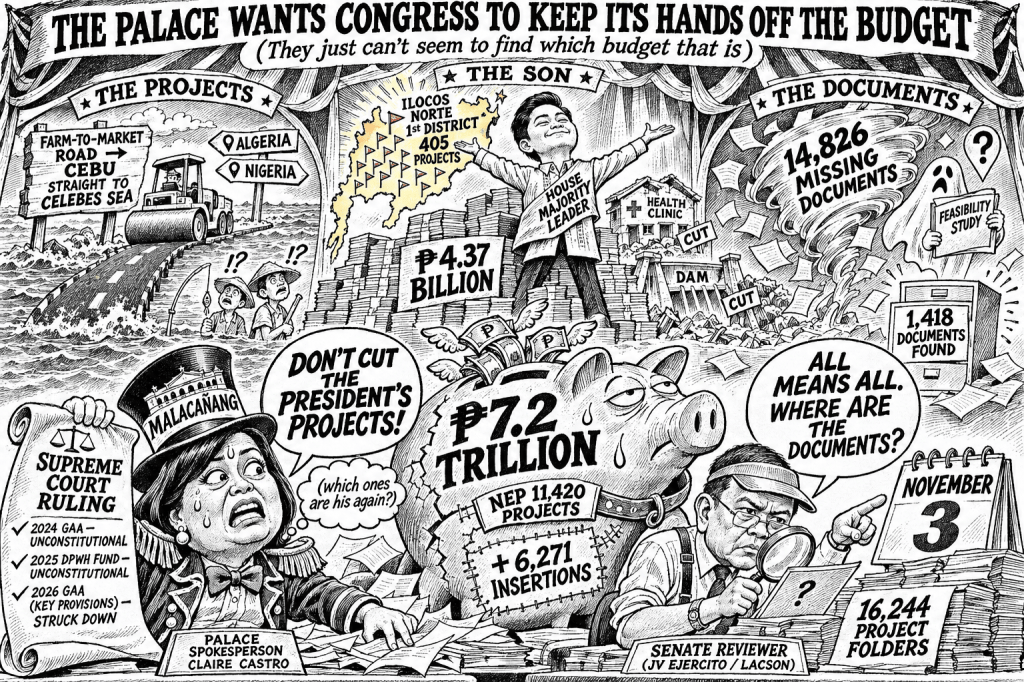
The President proposed 11,420 DPWH projects. The House delivered 16,244. Malacañang is now defending all of them as if they were his.
By Louis “Barok” C. Biraogo — November 2, 2026
THERE is a particular comedy in watching an administration that spent years insisting on the sanctity of the Supreme Court’s budget ruling suddenly discover that the same ruling might not mean what it wanted it to mean.
On October 29, Palace Press Officer Claire Castro delivered what was ostensibly a plea for constitutional discipline: Congress should not cut President Ferdinand Marcos Jr.’s proposed projects from the ₱7.2-trillion 2027 national budget. The Supreme Court, she reminded everyone, had spoken. Lawmakers should fall in line.
It is a beautifully simple argument. Unfortunately for Malacañang, the budget bill the House transmitted to the Senate is not the President’s budget. It is the House’s budget, dressed up in presidential clothing, with roughly ₱1 trillion in extra pockets sewn into the lining.
And the biggest pocket, according to the People’s Budget Coalition (PBC), belongs to the President’s son.
The Math That Malacañang Would Rather You Not Do
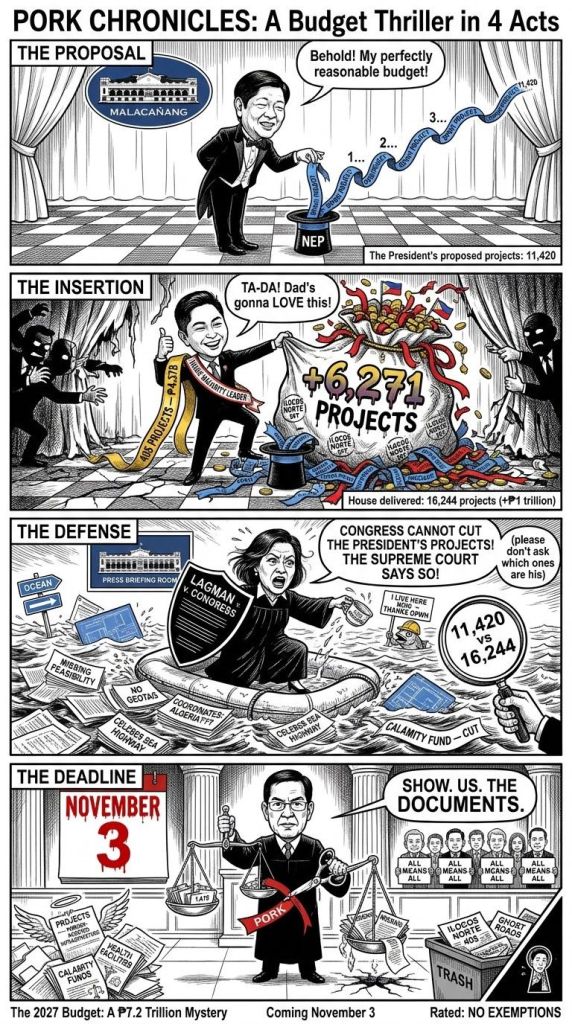
The executive’s original National Expenditure Program (NEP) contained 11,420 Department of Public Works and Highways (DPWH) projects. The House-transmitted General Appropriations Bill contains 16,244. That is 6,271 new projects introduced by lawmakers, per the Senate’s own review. The Senate finance committee found that only 1,418 of those 16,244 projects had supporting documents submitted to the chamber as of late October.
Read that again. Roughly 91 percent of the DPWH projects in the House-approved budget arrived at the Senate without the paperwork that would justify their existence.
The Palace’s response? Congress should not cut the President’s projects.
But which ones, exactly, are the President’s? The 11,420 his budget department vetted? Or the 16,244 the House produced, including the 405 projects worth ₱4.37 billion that went to the First District of Ilocos Norte, represented by House Majority Leader Sandro Marcos?
Castro defended the insertions with a now-familiar formulation: they are not inherently wrong if they benefit the public, are properly executed, and do not involve ghost projects. That is true, as far as it goes. But it is the kind of statement that sounds profound until you realize it is essentially saying “bad things are bad.” The question is not whether completed projects are good. The question is whether projects that arrive without feasibility studies, without geotagged coordinates, without programs of work, and in some cases with coordinates that place them in the Celebes Sea or, more creatively, in Algeria and Nigeria, should be funded on the strength of a legislator’s signature.
Castro also defended slower 2025 spending by explaining that the Department of Budget and Management (DBM) was simply being cautious with projects whose proponents could not provide sufficient justification. This is a remarkable admission. If the DBM withheld releases because proponents could not justify their projects, the administration itself has conceded that the budget process was producing inadequately documented appropriations. And yet, when the Senate proposes to apply the same standard to the House’s 2027 insertions, the Palace suddenly discovers the virtues of legislative deference.
The Supreme Court Ruling That Malacañang Wants to Have It Both Ways On
The Palace’s legal anchor is the Supreme Court’s October 2026 decision in the consolidated cases led by Lagman v. Congress of the Philippines. The Court voided congressional increases to unprogrammed appropriations in the 2024 and 2025 budgets, struck down the SAGIP lump sum, and imposed guardrails on standby funds.
This is a significant ruling. It is also not the ruling the Palace seems to think it is.
The Court held that Congress cannot increase the President’s recommended appropriations beyond constitutional limits. It did not hold that Congress cannot reduce them. Article VI, Section 25(1) of the Constitution prohibits increases. It says nothing about reductions, reallocations, or the power of the legislature to examine, modify, and reject proposed expenditures.
Castro herself acknowledged this, telling reporters that Congress has the constitutional power to increase, reduce, or scrutinize proposed allocations. Having acknowledged it, she then proceeded to argue that Congress should not exercise it. This is not constitutional interpretation. It is negotiation by press conference.
The deeper problem is that the Palace is using the ruling selectively. The same decision that constrains Congress also constrains the Executive. If the Palace wants Congress to respect the Court’s ruling, it might start by ensuring its own proposed budget does not contain the same structural deficiencies the Court identified.
The Senate Has Seen the Documents. Or Rather, It Has Not.
While the Palace was issuing its October 29 appeal, the Senate was doing something rather more concrete: counting.
Senate Finance Committee Chair JV Ejercito disclosed that only 1,418 of the 16,244 DPWH projects had supporting documents submitted to the committee. He flagged ₱266 billion worth of projects for further scrutiny. He set a November 3 deadline for the DPWH to produce the missing paperwork or watch the projects disappear.
Senator Panfilo Lacson then made the political stakes explicit. The majority bloc, he said, supported purging “unwarranted, whimsical, and corruption-prone items.” And he added a phrase that ought to be framed in the Palace briefing room: “ALL MEANS ALL.”
Lacson specifically noted that the Senate would scrutinize the Ilocos Norte First District allocation, the one belonging to the President’s son, which recorded the largest net increase in DPWH projects. This is not an attack on the Marcos family. It is what happens when a legislator’s district receives 405 projects worth ₱4.37 billion while thousands of other projects across the country cannot produce a single feasibility study.
The Senate’s emerging position is not complicated. It is the radical proposition that a project should have documents before it gets money.
The Watchdogs and the Coordinates That Went to Sea
The People’s Budget Coalition’s findings deserve more attention than they have received, partly because they are so specific they cannot be dismissed as generic anti-pork rhetoric.
The coalition identified ₱695 billion in “hard pork,” mostly infrastructure; ₱210 billion in “soft pork,” assistance programs vulnerable to political referral; and ₱112 billion in “shadow pork,” unprogrammed appropriations. It found farm-to-market roads whose coordinates placed them in the Celebes Sea and the Philippine Rise. It found buildings plotted in Algeria and Nigeria. It found 180 health facilities added to the Department of Health budget while the overall health facilities budget was cut.
Ken Abante of the coalition put it with admirable restraint: “We are not saying all of this is corruption. We need this infrastructure, but it should be done right.”
The Palace’s response has been, essentially, that insertions are acceptable if the projects are good. This is a standard no one can verify, because the projects arrive without the documentation that would allow anyone to determine whether they are good. The DPWH has until November 3 to produce the documents. If they exist, the Senate will review them. If they do not exist, the projects should not be funded.
This is not a constitutional crisis. It is a paperwork crisis. And the Palace is defending the paperwork.
The Real Constitutional Question
Strip away the press releases and the Supreme Court citations, and the Palace’s argument comes down to this: the executive branch prepared a budget, and Congress should not substantially alter it.
This is a defensible position in a parliamentary system. The Philippines does not have a parliamentary system. It has a presidential system with a bicameral legislature and a Constitution that gives Congress the power of the purse. The President proposes. Congress disposes. That is the design.
The Supreme Court’s October ruling does not change that design. It constrains one specific abuse: the use of congressional amendments to inflate the total budget beyond the President’s ceiling. It does not transform the NEP into a binding document. It does not make the President’s projects immune from legislative scrutiny. It does not give Malacañang the authority to tell the Senate which projects to keep and which to cut.
If the Palace believes specific executive projects are being unfairly removed, it has a remedy: defend them on the merits. Produce the feasibility studies. Explain why a particular road or hospital or flood-control project is essential. Engage in the ordinary legislative process rather than issuing press statements demanding that Congress abstain.
What it cannot do, credibly, is invoke the Supreme Court’s ruling against congressional overreach while asking Congress to rubber-stamp a House budget that the Court’s own logic would subject to strict scrutiny.
The Sandro Marcos Question That No One in the Palace Wants to Answer Directly
The Palace has defended the Ilocos Norte insertions by arguing that congressional insertions are not inherently wrong. True. Also evasive.
The question is not whether insertions are inherently wrong. The question is whether 405 projects worth ₱4.37 billion in a single district, representing the largest net increase in the country, in the district represented by the President’s son and the House Majority Leader, passes the smell test.
The PBC ranked the Ilocos Norte First District first in DPWH project insertions. The Sixth District of Isabela, represented by Speaker Faustino Dy III, ranked fourth with 147 projects worth ₱1.68 billion. The concentration of infrastructure resources in districts represented by the most powerful members of the House is not a coincidence. It is a pattern.
Castro’s defense was that the insertions would benefit the public if properly executed. But the public benefit of 405 projects in one district, compared to the thousands of projects cut or left undocumented elsewhere, is precisely the question the Senate is entitled to ask—and precisely the question the Palace is trying to preempt by framing any scrutiny as an attack on the President’s development agenda.
What the Palace Is Actually Afraid Of
The October 29 statement was not really about constitutional principle. It was about control.
If the Senate removes the undocumented House insertions, the 2027 budget will look substantially different from the House version. The projects House members inserted for their districts will disappear. The projects the President’s son inserted for Ilocos Norte will be examined. The projects the House added while cutting foreign-assisted infrastructure, calamity funds, and health programs will be compared against the projects that were cut.
This is what budget scrutiny looks like. It is uncomfortable for everyone involved. It is especially uncomfortable for an administration that has spent years insisting it is committed to transparency while defending a budget process that produced 6,271 unvetted projects and 405 projects in the President’s son’s district.
The Palace wants Congress to preserve the President’s projects. But the President’s projects, as transmitted by the House, include projects his own budget department never proposed. They include projects the Senate cannot verify. They include projects whose coordinates are in the sea.
If the Palace is serious about defending the President’s development agenda, it should welcome the Senate’s cleanup. A budget stripped of undocumented insertions is a budget that can be defended on its merits. A budget that includes 6,271 unvetted projects is a budget that invites exactly the kind of scrutiny the Palace is now trying to discourage.
The November 3 Deadline and the Test That Matters
The Senate has given the DPWH until November 3 to produce the missing documents. This is the test that matters, far more than any press conference.
If the documents exist, the projects can be defended. If they do not exist, the projects should be removed. This is not a partisan position. It is not an attack on the President. It is the minimum standard any Filipino taxpayer should expect from a government that spends ₱7.2 trillion of their money.
The Palace’s October 29 statement asked Congress not to cut the President’s projects. The Senate’s response, in effect, has been: show us the projects. Show us the documents. Show us why these 6,271 additions deserve funding while foreign-assisted infrastructure, calamity funds, and health programs were cut.
If the Palace can answer those questions, it will have won the argument. If it cannot, no amount of Supreme Court citation will save it from the conclusion that the 2027 budget is not a development plan. It is a patronage ledger with a presidential cover page.
The Supreme Court’s ruling was a warning to Congress. The Senate’s document review is a warning to everyone. The Palace would do well to listen to both.
Key Citations
A. Official Websites and Court Decisions
- Supreme Court of the Philippines. “SC Holds Unprogrammed Appropriations Subject to Guidelines, Voids Congressional Increases in 2024 and 2025 Budgets.” Judiciary.gov.ph, 20 Oct. 2026, sc.judiciary.gov.ph/sc-holds-unprogrammed-appropriations-subject-to-guidelines-voids-congressional-increases-in-2024-and-2025-budgets.
B. News Articles
- Abante, Kenneth Isaiah, and AJ Montesa. Statements and findings of the People’s Budget Coalition concerning the proposed 2027 national budget. Philstar.com, 26 Oct. 2026, philstar.com/headlines/2026/10/26/2565843/watchdogs-urge-senate-strip-house-insertions-pork-riddled-2027-budget.
- Chi, Cristina. “Watchdogs urge Senate to strip House ‘insertions’ in pork-riddled 2027 budget.” Philstar.com, 26 Oct. 2026, philstar.com/headlines/2026/10/26/2565843/watchdogs-urge-senate-strip-house-insertions-pork-riddled-2027-budget.
- Flores, Helen. “Palace defends budget insertions for Sandro.” The Philippine Star, 28 Oct. 2026, philstar.com/headlines/2026/10/28/2566234/palace-defends-budget-insertions-sandro.
- Laqui, Ian. “SC declares provisions of 2024, 2025, 2026 national budgets unconstitutional.” Philstar.com, 21 Oct. 2026, philstar.com/headlines/2026/10/21/2564572/sc-declares-provisions-2024-2025-2026-national-budgets-unconstitutional.
- “Lacson: Majority bloc backs purging ‘pork’ in 2027 budget.” GMA News Online, 1 Nov. 2026, gmanetwork.com/news/topstories/nation/1007918/lacson-majority-bloc-backs-purging-pork-in-2027-budget/story.
- “Lacson: Majority bloc united in getting rid of ‘pork’ from 2027 budget bill.” Inquirer.net, 1 Nov. 2026, newsinfo.inquirer.net/2334281/lacson-majority-bloc-united-in-getting-rid-of-pork-from-2027-budget-bill.
“Palace supports budget cleanup but nixes cuts.” Manila Standard, 29 Oct. 2026, manilastandard.net/news/314812678/palace-supports-budget-cleanup-but-nixes-cuts.html. - “Palace urges Congress not to cut Marcos projects in 2027 budget.” Philstar.com, 29 Oct. 2026, philstar.com/headlines/2026/10/29/2566518/palace-urges-congress-not-cut-marcos-projects-2027-budget.
- “Senate flags P266-B DPWH projects for further scrutiny.” Philippine News Agency, 26 Oct. 2026, pna.gov.ph/article/senate-flags-p266-b-dpwh-projects-for-further-scrutiny.
- Servallos, Neil Jayson. “Senate could weed out thousands of infrastructure projects in budget.” The Philippine Star, 1 Nov. 2026, philstar.com/headlines/2026/11/01/2567041/senate-could-weed-out-thousands-infrastructure-projects-budget.

- ₱9 Billion in ‘Savings’? DILG’s Fire Truck Deal Smells Like Smoke

- ₱8B BBM Pork: CCTV for Every Captain’s Kumpare?

- ₱8.9 Billion, 331 Ghost Police Stations: The TIKAS Scandal Explained

- ₱8.4 Billion, 42,000 Barangays, 1 Election: The “Bawat Barangay Makikinabang” Vote-Buying Masterclass

- ₱75 Million Heist: Cops Gone Full Bandit

- ₱63 to the Dollar: The Only Thing Falling Faster Than the Peso Is the Government’s Credibility

- ₱6.77B Ghost Haunts Duterte: RTC Dismisses Mans Carpio’s Desperate Plea
- ₱6.77 Billion and Zero Cash: The Sara Duterte SALN Math That Doesn’t Add Up

- ₱6.7-Trillion Temptation: The Great Pork Zombie Revival and the “Collegial” Vote-Buying Circus

- ₱58.53B, Zero Receipts: The LGSF Pork Barrel Nobody Wants to Name
- ₱53 Million Man Tells ₱695-a-Day Workers to Stop Being ‘Mayabang’: The Audacity of BSP’s Remolona
- ₱4.4 Billion and a Witness Who Can’t Explain It: The Duterte Impeachment’s Most Expensive Non-Answer




Leave a Reply