A Solicitor General, a COA Chief, and a COMELEC Commissioner Walk Into a Shortlist…
By Louis ‘Barok’ C Biraogo — November 2, 2026
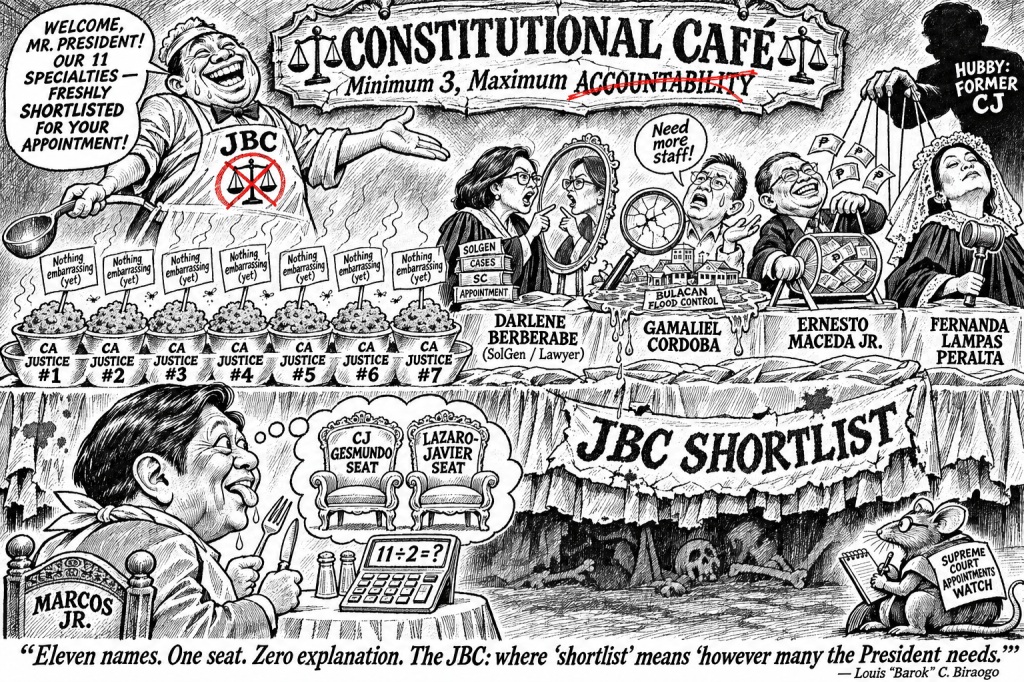
PARDON me while I pick my jaw off the floor. The Judicial and Bar Council (JBC)—supposedly designed to keep political hacks out of the judiciary—has handed President Marcos Jr. eleven people to fill one Supreme Court seat. Eleven. For one vacancy. That’s not a shortlist; that’s a buffet.
We’ve got seven Court of Appeals (CA) justices whose qualification appears to be “didn’t get caught doing anything too embarrassing.” A Solicitor General auditioning to judge whether the government followed the law. A Commission on Audit (COA) Chairperson who couldn’t detect a multi-billion peso flood control scandal on his watch but wants a promotion. A Commission on Elections (COMELEC) Commissioner with a political pedigree longer than his judicial experience. And the wife of a former Chief Justice, because the Philippine judiciary is apparently one big happy family.
Welcome to the JBC’s October Surprise—a shortlist so transparently political it makes Game of Thrones succession look meritocratic.
The Sum of All Suspicions
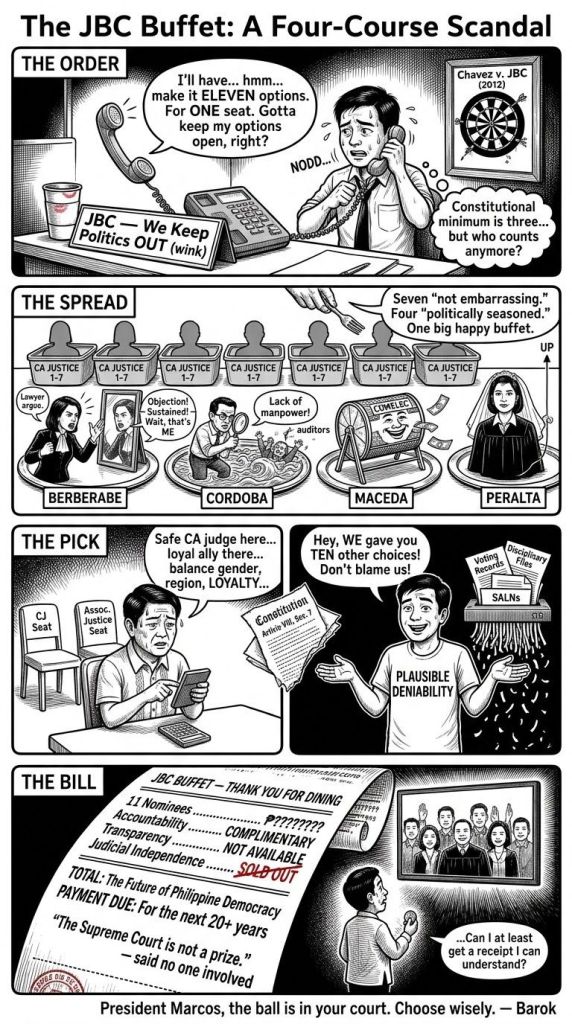
Eleven nominees for one seat. The Constitution requires a minimum of three. The JBC gave nearly four times that. Why?
In Chavez v. JBC (2012), the Supreme Court ruled the JBC must maintain the constitutional balance contemplated by the framers—the Council exists to limit political interference. How does an eleven-person shortlist limit interference? It doesn’t. It maximizes the President’s options while minimizing the JBC’s accountability.
If Marcos picks a disaster, the JBC shrugs: “We gave him ten other choices.” It’s a win-win—for everyone except the Filipino people, who wonder why eleven people are being considered for a job only one can hold.
The Supreme Court Appointments Watch has documented this pattern: the JBC has historically expanded shortlists at the President’s request, including candidates not previously qualified. With eleven names, the question isn’t whether eleven are qualified—it’s whether the JBC is padding the list to accommodate political preferences while maintaining plausible deniability.
The Solicitor General Problem: When Your Lawyer Becomes Your Judge
Darlene Marie Berberabe is a competent lawyer—former UP Law Dean, one of only two women ever to serve as Solicitor General. She’s also the government’s top lawyer, currently representing the Executive before the very Court she wants to join.
Imagine: the Solicitor General argues a case, the Court rules against the government, and she gets appointed to that same Court—now judging cases involving positions she personally advanced. Rule 137, Section 1 of the Rules of Court requires judges to inhibit when impartiality “may reasonably be questioned.” How does a former Solicitor General not have her impartiality questioned when ruling on cases involving the office she just left?
The Constitution permits qualified lawyers to become justices. It does not require the JBC to ignore the obvious. Berberabe was appointed SolGen in May 2025; barely seventeen months later she’s on the Supreme Court shortlist. That’s not a career trajectory; that’s a rocket ship fueled by political convenience.
Cordoba: The Auditor Who Couldn’t Audit
Gamaliel Cordoba chairs the Commission on Audit—the body responsible for exposing corruption. Under his watch, the Philippines discovered a flood control scandal so massive it became a national embarrassment: billions allegedly siphoned through phantom projects while communities flooded year after year.
Cordoba’s response? “Lack of manpower.”
The head of the agency designed to detect government fraud couldn’t detect government fraud because he didn’t have enough people. Now he wants a promotion to the Supreme Court, where he’ll rule on COA decisions and public accountability. This is the judicial equivalent of promoting the fire chief who watched the city burn because he forgot to buy hoses.
There’s more: Philippine Amusement and Gaming Corporation (PAGCOR) controversies (2008-2009) he claims were dismissed; the National Telecommunications Commission (NTC) during the ABS-CBN shutdown; and under his COA watch, Commissioner Mario Lipana’s wife allegedly received hundreds of millions in government contracts—a conflict Cordoba acknowledged but failed to resolve. The JBC looked at this record and said: “Supreme Court material.” What could possibly go wrong?
Maceda: From Politician to Commissioner to Justice—A Career in Three Acts
Ernesto Maceda Jr.’s résumé reads like a political dynasty starter kit: Manila City Council, Vice Mayor, COMELEC Commissioner, now Supreme Court nominee. His defenders cite UP, Ateneo Law, Columbia—fair enough. But a man who spent years in elective office and partisan politics didn’t suddenly develop institutional independence.
In 2013, COMELEC investigated Maceda for allegedly holding a raffle with cash prizes during his senatorial campaign. The case went nowhere, but it illustrates a pattern: Maceda navigated the intersection of politics and governance. Now he’d rule on election disputes and the legality of government actions.
Article VIII, Section 7(3) requires “proven competence, integrity, probity, and independence.” Maceda’s competence isn’t in question. His independence is. The Supreme Court is not a retirement home for former politicians.
Peralta: Because Nepotism Is Only Bad When It’s Proven
Fernanda Lampas Peralta, Presiding Justice of the Court of Appeals, is married to retired Chief Justice Diosdado Peralta. Is that disqualifying? No—marital status isn’t a constitutional disqualifier, and treating it as one would be unfair.
But is it a legitimate subject of scrutiny? Absolutely. The Philippine Judiciary is small and insular; former Chief Justices remain influential. When the wife of a former Chief Justice is elevated, reasonable people ask whether her appointment reflects merit or institutional favoritism.
Her credentials are impressive—years of appellate service, judicial leadership. But credentials aren’t independence. The 2025 Code of Judicial Conduct explicitly recognizes independence must be protected against “influences arising from political, family, social, and professional relationships.” The Code doesn’t say such relationships are disqualifying—it says they require transparency and scrutiny.
So let’s have it: Did her husband participate in her elevation to Presiding Justice? Would her appointment create a judicial dynasty? The fact that we’re asking is the problem. The JBC should have answered before submitting the shortlist.
The Ong Question: When Your Brother Is a Disgraced Judge
Walter Ong has served on the Court of Appeals since 2017 with no major scandals. But his name is attached to another: Gregory Ong, his brother, a former Sandiganbayan justice dismissed over citizenship questions and alleged improprieties. Should Walter be penalized for his brother’s conduct? No—guilt by association isn’t a constitutional principle.
But the JBC’s job is holistic evaluation, including family relationships and potential conflicts. The public has a right to know whether the JBC investigated these connections or simply accepted assurances.
The Vanishing Act: What the JBC Didn’t Tell Us
Here’s what the shortlist doesn’t tell us:
- Which candidates had disciplinary complaints?
- Pending administrative cases?
- Financial red flags?
- Who was interviewed more than once—and why?
- Who received the highest JBC votes?
- Who was included at the last minute?
The JBC need not publish deliberations, but it must ensure transparency sufficient to inspire confidence. An eleven-person list with no explanation isn’t transparency—it’s theater. In Republic v. Sereno (2018), the Court emphasized integrity is a constitutional qualification, not an abstraction.
How can the public verify the verifiers when the JBC releases nothing but names? The October 29 announcement included no voting information, no rationale, no disclosure of conflicts. That’s not inadequate—it’s a missed opportunity to demonstrate the process is more than political theater.
The Political Calculus: Why Eleven Names Matter
President Marcos faces two vacancies: Chief Justice Gesmundo retires November 6, Associate Justice Lazaro-Javier November 16. Two seats, ten days apart. The eleven-person shortlist gives maximum flexibility: a “safe” CA justice for one seat, a politically aligned candidate for the other.
Balance region, gender, background, loyalty. Reward allies, shape the Court for decades.
This isn’t conspiracy theory—it’s the logical consequence of a system giving the President enormous appointment power with minimal accountability. The Constitution requires at least three nominees, not eleven. The JBC chose to expand the list—expanding the President’s options while diluting its own responsibility.
What Should Happen Next
The President has ninety days to fill the Lazaro-Javier vacancy. He should use them wisely.
- First, demand complete documentation for every nominee: Statements of Assets, Liabilities and Net Worth (SALNs), disciplinary records, performance evaluations, investigative reports. The Constitution requires “proven competence, integrity, probity, and independence”—verify, don’t assume.
- Second, conduct independent due diligence on Berberabe, Cordoba, and Maceda. What cases did Berberabe personally handle as SolGen? What COA decisions issued under Cordoba? What COMELEC rulings did Maceda participate in? How will prior roles affect impartiality?
- Third, consider both vacancies together—select candidates whose strengths complement each other, not merely the politically convenient.
- Fourth, commit to transparency. A brief statement explaining selection criteria would restore confidence.
The Bottom Line
The JBC’s eleven-person shortlist is not a triumph of meritocracy. It’s a political document dressed up as constitutional necessity—candidates with genuine qualifications and genuine baggage, options for the President and nothing for the public, eleven names pretending equal qualification when everyone knows some are there for show and others for reasons the JBC won’t disclose.
The Supreme Court is not a prize. It’s an institution entrusted with protecting the Constitution—including from the President who appoints its members. The next Justice should be someone who can rule against the administration that appointed them. Someone who can resist political pressure. Someone who understands judicial independence is not a slogan but a daily practice.
Is that person on the list? Maybe. But the JBC hasn’t given us enough to know. That’s the real scandal: not that the JBC made a bad choice, but that it made eleven choices without explaining any of them.
President Marcos, the ball is in your court. Choose wisely. The future of Philippine democracy depends on it.
Louis “Barok” C. Biraogo is a lawyer and blogger who writes about law, politics, and the peculiar art of Philippine governance. He can be reached at the comments section, where he will be ignoring your death threats.
Key Citations
A. Court Decisions, Laws & Rules
- Constitution of the Republic of the Philippines. 1987. Official Gazette, officialgazette.gov.ph/constitutions/1987-constitution/.
- Chavez v. Judicial and Bar Council. G.R. No. 202242. Supreme Court of the Philippines, 17 July 2012. The LawPhil Project, lawphil.net/judjuris/juri2012/jul2012/gr_202242_2012.html.
- Republic v. Sereno. G.R. No. 237428, 11 May 2018. Supreme Court E-Library, elibrary.judiciary.gov.ph/thebookshelf/showdocs/1/64003.
- Supreme Court of the Philippines. “The 2025 Code of Judicial Conduct and Accountability.” A.M. No. 25-04-04-SC, 11 Nov. 2025, elibrary.judiciary.gov.ph/thebookshelf/showdocs/11/100836.
- Supreme Court of the Philippines. “Rule 137: Disqualification of Judicial Officers.” The LawPhil Project, chief.lawphil.net/courts/rules/rc_137_judicial.html.
- Judicial and Bar Council. “JBC Rules of 2020.” Judicial and Bar Council, jbc.judiciary.gov.ph/wp-content/uploads/2020/01/JBC-2020-01_JBC-Rules.pdf.
B. News Articles
- “JBC Names 11 Nominees to SC Associate Justice Post to Be Vacated Nov. 16 by Justice Lazaro-Javier.” Manila Bulletin, 29 Oct. 2026, mb.com.ph/2026/10/29/jbc-names-11-nominees-to-sc-associate-justice-post-to-be-vacated-nov-16-by-justice-lazaro-javier/.
- “JBC Submits 11 Nominees for Supreme Court Associate Justice Post.” Daily Tribune, 29 Oct. 2026, tribune.net.ph/2026/10/29/jbc-submits-11-nominees-for-supreme-court-associate-justice-post.
- “Chief Justice Gesmundo, Justice Lazaro-Javier to Retire Later This Year.” Abogado, 2 Jan. 2026, abogado.com.ph/chief-justice-gesmundo-justice-lazaro-javier-to-retire-later-this-year/.
- “Berberabe on OSG’s Challenges and Balancing Acts.” Inquirer.net, 26 Dec. 2025, plus.inquirer.net/news/berberabe-on-osgs-challenges-and-balancing-acts/.
“COA Chair: Bulacan Is ‘Epicenter’ of Flood Control Scandal.” ABS-CBN News, 13 Oct. 2025, abs-cbn.com/news/nation/2025/10/13/coa-chair-bulacan-is-epicenter-of-flood-control-scandal-1752.
“COA Chief Cordoba Seeks Supreme Court Seat.” Daily Tribune, 15 Oct. 2026, tribune.net.ph/2026/10/15/coa-chief-cordoba-seeks-supreme-court-seat.
“Commissioner’s Wife Bags Flood Projects, COA Admits Conflict of Interest.” Philstar.com, 12 Sept. 2025, philstar.com/headlines/2025/09/12/2472300/commissioners-wife-bags-flood-projects-coa-admits-conflict-interest.
“Comelec to Probe Maceda’s Alleged Raffle Gimmick During Campaign.” Inquirer.net, 27 Feb. 2013, newsinfo.inquirer.net/365849/comelec-to-probe-macedas-alleged-raffle-gimmick-during-campaign. - “COA Cites ‘Lack of Manpower’ for Unchecked Anomalous Flood Control Projects.” GMA Network, 13 Oct. 2025, http://www.gmanetwork.com/news/topstories/nation/962285/flood-control-anomalies-coa/story/.
C. Official Websites
- Commission on Audit. “Key Officials.” Commission on Audit, www.coa.gov.ph/about-us/key-officials/.
- Commission on Elections. “Commissioner Ernesto Ferdinand P. Maceda, Jr.” COMELEC, 25 Jan. 2025, www.comelec.gov.ph/?r=AboutCOMELEC%2FCommissionMembers%2FCommMacedaProfile.
- Court of Appeals of the Philippines. “Incumbent Justices.” Court of Appeals, ca.judiciary.gov.ph/about/incumbent-justices.
- Supreme Court of the Philippines. “Chief Justice Gesmundo Swears in CA Presiding Justice Lampas Peralta.” 28 Nov. 2024, sc.judiciary.gov.ph/chief-justice-gesmundo-swears-in-ca-presiding-justice-lampas-peralta/.
- Supreme Court of the Philippines. “JBC Submits Short Lists of Chief Justice, SC Associate Justice Nominees.” 29 Oct. 2026, sc.judiciary.gov.ph/jbc-submits-short-lists-of-chief-justice-sc-associate-justice-nominees/.
- “Ang Hirap Maging Mahirap”: The PAO Scandal That Proves Government Contempt Is Nothing New

- “Far-Off” My Axx: Malacañang’s Claire Castro Drowns in Her Own Legal Gaslighting
- “Forthwith” to Farce: How the Senate is Killing Impeachment—And Why Enrile’s Right (Even If You Can’t Trust Him)
- “HINDI AKO NAG-RESIGN!”

- “I Know Nothing”: Baste Duterte’s Amnesia Defense Meets ₱33M in GenCorp Contracts

- “I’m calling you from my new Globe SIM. Send load!”

- “Mahiya Naman Kayo!” Marcos’ Anti-Corruption Vow Faces a Flood of Doubt

- “Manageable” Debt, Unmanageable Lies: DBM’s ₱21 Trillion Fairy Tale
- “Meow, I’m calling you from my new Globe SIM!”

- “Natrabaho”: One Word, One Ombudsman, and a Judiciary on Trial

- “No Special Jail for Crooks!” Boying Remulla Slams VIP Perks for Flood Scammers

- “Philippine-Controlled” or Yankee Gas Station? The Davao Fuel Depot Farce Exposed




Leave a Reply