
Inside the Procurement Loophole That Turned “Financially Incapable” Into “Technically Qualified”
By Louis ‘Barok‘ C. Biraogo — November 4, 2026
PRESENTING a number that ought to send every Filipino taxpayer rummaging through the liquor cabinet: ₱459.262 billion. That is not the cost of a space program, nor is it the GDP of a small island nation.
According to the Commission on Audit (COA), that is the aggregate value of 11,391 infrastructure contracts awarded by the Department of Public Works and Highways (DPWH) to bidders whose financial capacity was, to put it gently, a work of fiction.
THE BLUFF
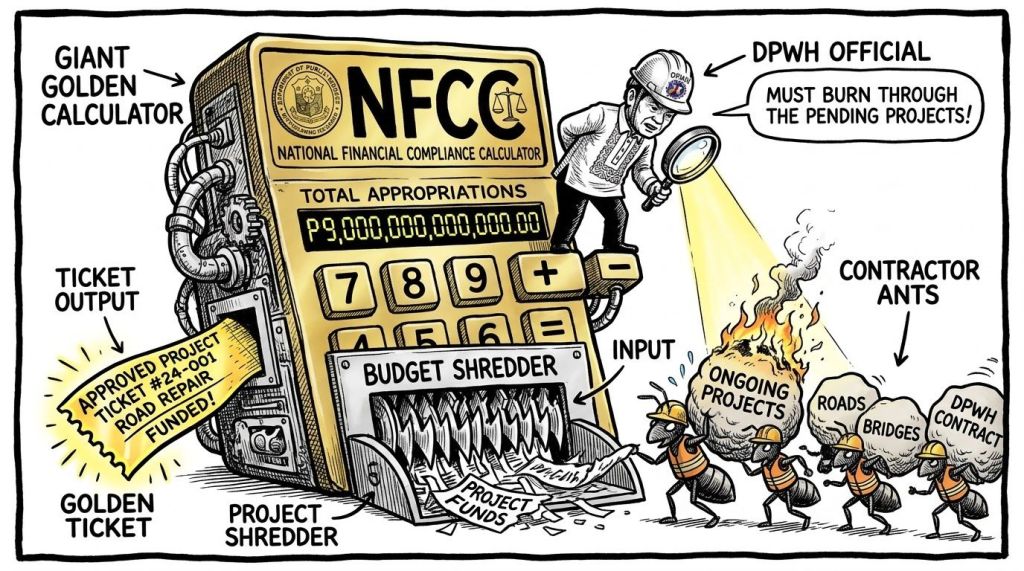
THE FORMULA: Just ignore the hard part.
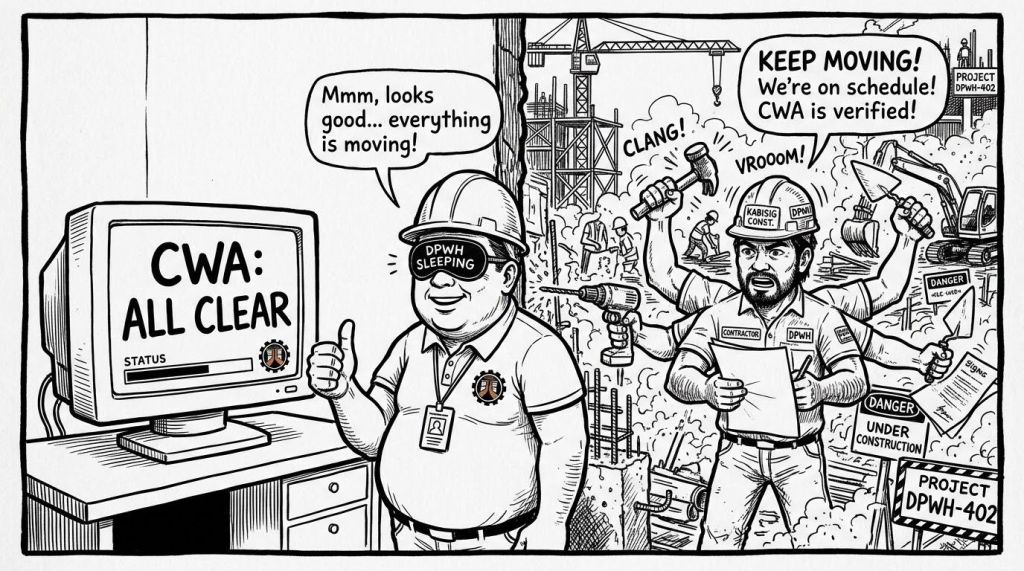
LEFT: “Our System Says You’re Free!”
RIGHT: “Our System Doesn’t Ask.”
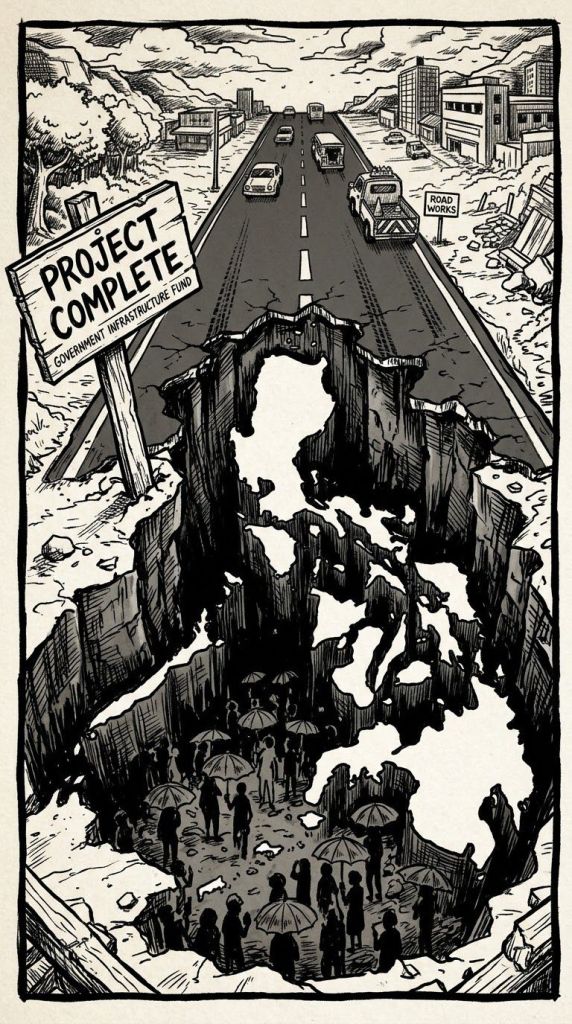
₱459,262,000,000
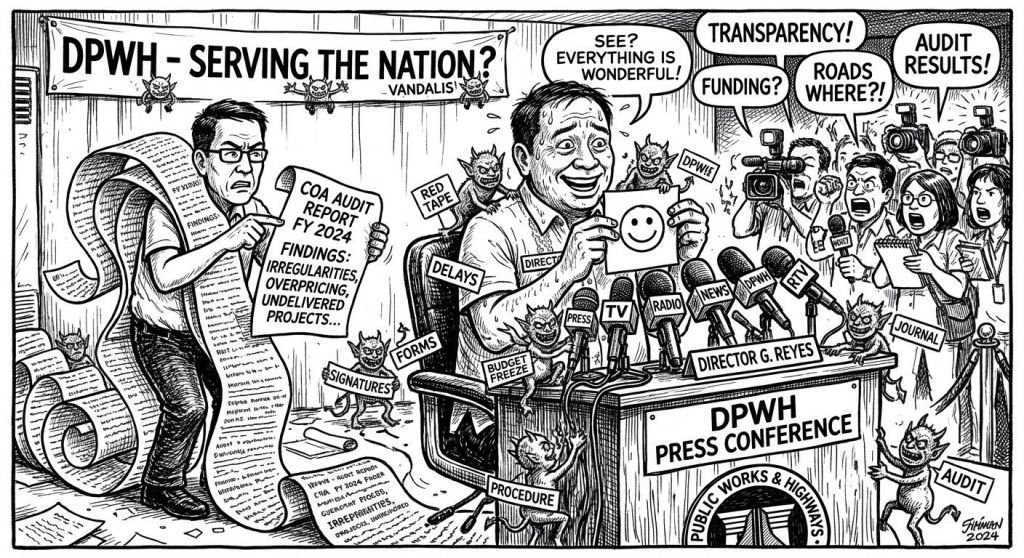
“WE BUILD. WE CARE.”
A Masterclass in Institutional Gaslighting
The COA’s 2025 audit report, released just in time for Halloween, is a masterclass in institutional gaslighting. For twenty months, from January 2024 to August 2025, the DPWH apparently operated under a novel procurement doctrine: “We don’t need to know if you can afford the project; we just need you to say you can.”
The audit sampled 27,094 contracts and found that nearly 42% of them involved bidders who submitted incomplete Statements of Ongoing Government and Private Contracts. This led to incorrect Net Financial Contracting Capacity (NFCC) computations, as reported by Abogado.com.ph.
In English: contractors hid their existing work, inflated their remaining capacity, and the government happily handed them billions.
The NFCC: A Formula for Comedy
The NFCC is not obscure. The formula is printed on bid forms: [(Current Assets – Current Liabilities) x 15] minus the value of all outstanding and uncompleted projects, including awarded-but-not-yet-started contracts.
The rule is simple: if you already owe your soul to three other projects, you cannot promise it to a fourth.
The DPWH, however, apparently believed that “awarded but not yet started” meant “financially irrelevant.” As if a contractor who signs a ₱500-million contract magically does not incur mobilization costs, material procurement obligations, or payroll liabilities until the first backhoe touches dirt. This is not a legal interpretation; it is a fantasy.
COA’s Almost-Too-Perfect Examples
COA’s examples are almost too perfect. Contractor B had an NFCC of ₱226.34 million. Between January 30 and February 5, 2024, it won five contracts totaling ₱675.5 million, roughly three times its original capacity, according to the audit coverage.
Contractor C had an NFCC of ₱189.75 million and won seven contracts worth ₱1.004 billion in just three days, exceeding its capacity by over five times, as Abogado reported.
Either these contractors possess the financial equivalent of bilocation, or the DPWH’s Bids and Awards Committee (BAC) was asleep at the wheel while the Technical Working Group (TWG) was busy admiring the view.
The DPWH Defense: “The Computer Said So”
When confronted, DPWH management offered a defense that would be laughable if it weren’t so expensive. They blamed the Civil Works Application (CWA), the agency’s internal database, which apparently only tracks DPWH-awarded contracts.
If a contractor had ongoing projects with the Department of Transportation, a local government unit, or a private developer, the CWA would not know. The BAC-TWG relied on this system, saw a positive NFCC, and concluded all was well.
This is the procurement equivalent of checking your bank balance at one ATM, seeing ₱1,000, and assuming you can afford a house. The CWA does not know what it does not know.
And the DPWH, by its own admission, had “no independent mechanism to cross-check contractors’ declared commitments against their actual ongoing government projects,” per the COA findings. That is not a system limitation; that is an institutional confession.
The DPWH also cited “time constraints” and “personnel shortages”. Because apparently, the 47,469 contracts awarded over twenty months were processed with such blinding speed that there was simply no time to verify whether the contractor promising to build a bridge was simultaneously building six others. Speed, it seems, is the enemy of integrity.
The Political Backdrop: A Scandal Within a Scandal
This COA finding does not emerge in a vacuum. It arrives amid the flood control scandal that has already consumed the careers of former House Speaker Martin Romualdez, former DPWH Secretary Manuel Bonoan (now a state witness), and dozens of others, including the plunder case filed against Romualdez.
The Ombudsman has filed 39 cases, with 52 individuals charged, including legislators, DPWH personnel, and contractors.
The Independent Commission for Infrastructure (ICI), the fact-finding body created by President Marcos, has referred 65 individuals to prosecutors and helped freeze 6,692 bank accounts worth ₱24.7 billion.
Against this backdrop, the NFCC findings are not an isolated accounting glitch. They are evidence of a procurement culture in which financial eligibility is a box to be ticked, not a standard to be enforced.
The same regions with the highest NFCC deficiencies, Region 4B (Mimaropa) with ₱65.708 billion and Region 10 (Northern Mindanao) with ₱63.559 billion, are regions where infrastructure spending has long been viewed with suspicion, as the audit data shows. This is not proof of collusion, but it is a pattern that demands forensic examination.
The Legal Gray Zone: Negligence or Something Worse?
Here is where the analysis must tread carefully. A COA finding is not a conviction. An inaccurate NFCC does not automatically mean the contractor was financially incapable of performing; it means the contractor failed to disclose and the DPWH failed to verify.
The distinction matters for criminal liability under Section 3(e) of Republic Act (RA) 3019, which requires manifest partiality, evident bad faith, or gross inexcusable negligence.
The DPWH’s defense, that they relied on the CWA in good faith, might mitigate individual liability for low-level BAC members. But it does not explain why senior management tolerated a system that only looked inward.
The question investigators must answer is not merely “who signed the post-qualification reports?” but “who designed a verification process that was structurally incapable of verifying?”
The Reforms That Will Probably Not Happen
COA’s report, as thorough as it is, will likely gather dust alongside previous audit observations unless three things occur:
- First, the Ombudsman must pursue individual accountability beyond the usual sacrificial lambs of BAC chairs and TWG members. The people who approved the CWA’s specifications, who decided that cross-agency verification was optional, and who ignored the structural vulnerability must be identified.
- Second, Congress must fund, and not merely legislate, a national contractor registry that integrates data from all procuring entities, not just the DPWH.
- Third, the Government Procurement Policy Board (GPPB) must clarify that “positive NFCC” is not a defense; the NFCC must meet or exceed the Approved Budget for the Contract (ABC) after all outstanding commitments are deducted, consistent with RA 9184.
Until then, the ₱459.262 billion will remain what it is: not a proven loss, but a proven risk. A risk that contractors with more ambition than capital were handed public money to build roads, bridges, and flood controls that may never be completed, or may be completed so poorly that they collapse in the first storm.
The DPWH’s motto, if I recall, is “We build, we care.” Based on this audit, they might want to add a third clause: “We verify—eventually, and only if someone forces us to.”
Key Citations
A. Official Websites and Documents
- Department of Public Works and Highways. “DO 037 S2014.” DPWH, dpwh.gov.ph/DPWH/sites/default/files/issuances/DO_037_S2014.pdf.
- Office of the Ombudsman. “Press Release: Ombudsman Vows No Exemptions in Corruption Probe, Calls for Review on ‘Plunder Ruling.’” Ombudsman.gov.ph, 13 Oct. 2026, www.ombudsman.gov.ph/?p=134851.
- Republic of the Philippines. Republic Act No. 3019: Anti-Graft and Corrupt Practices Act. Senate of the Philippines Issuances Library, issuances-library.senate.gov.ph/legislative%2Bissuances/Republic%20Act%20No.%203019.
- Republic of the Philippines. Republic Act No. 9184: Government Procurement Reform Act. Chan Robles Virtual Law Library, chanrobles.com/republicactno9184.htm.
B. News Articles
- Abogado.com.ph. “COA: Contractors with Doubtful Financial Capacity Bagged P459B in DPWH Projects.” Abogado, 2 Nov. 2026, abogado.com.ph/coa-contractors-with-doubtful-financial-capacity-bagged-p459b-in-dpwh-projects/.
- Philstar. “125-Day Report Submitted, Marcos to Decide ICI’s Fate Soon.” Philstar.com, 6 Feb. 2026, www.philstar.com/headlines/2026/02/06/2506222/125-day-report-submitted-marcos-decide-icis-fate-soon.
- Philstar. “Ombudsman Files Plunder Case vs Romualdez over Flood-Control Scandal.” Philstar.com, 7 Sept. 2026, www.philstar.com/headlines/2026/09/07/2554626/ombudsman-files-plunder-case-vs-romualdez-over-flood-control-scandal.

- ₱9 Billion in ‘Savings’? DILG’s Fire Truck Deal Smells Like Smoke

- ₱8B BBM Pork: CCTV for Every Captain’s Kumpare?

- ₱8.9 Billion, 331 Ghost Police Stations: The TIKAS Scandal Explained

- ₱8.4 Billion, 42,000 Barangays, 1 Election: The “Bawat Barangay Makikinabang” Vote-Buying Masterclass

- ₱75 Million Heist: Cops Gone Full Bandit

- ₱63 to the Dollar: The Only Thing Falling Faster Than the Peso Is the Government’s Credibility

- ₱6.77B Ghost Haunts Duterte: RTC Dismisses Mans Carpio’s Desperate Plea
- ₱6.77 Billion and Zero Cash: The Sara Duterte SALN Math That Doesn’t Add Up

- ₱6.7-Trillion Temptation: The Great Pork Zombie Revival and the “Collegial” Vote-Buying Circus

- ₱58.53B, Zero Receipts: The LGSF Pork Barrel Nobody Wants to Name
- ₱53 Million Man Tells ₱695-a-Day Workers to Stop Being ‘Mayabang’: The Audacity of BSP’s Remolona
- ₱4.4 Billion and a Witness Who Can’t Explain It: The Duterte Impeachment’s Most Expensive Non-Answer




Leave a Reply