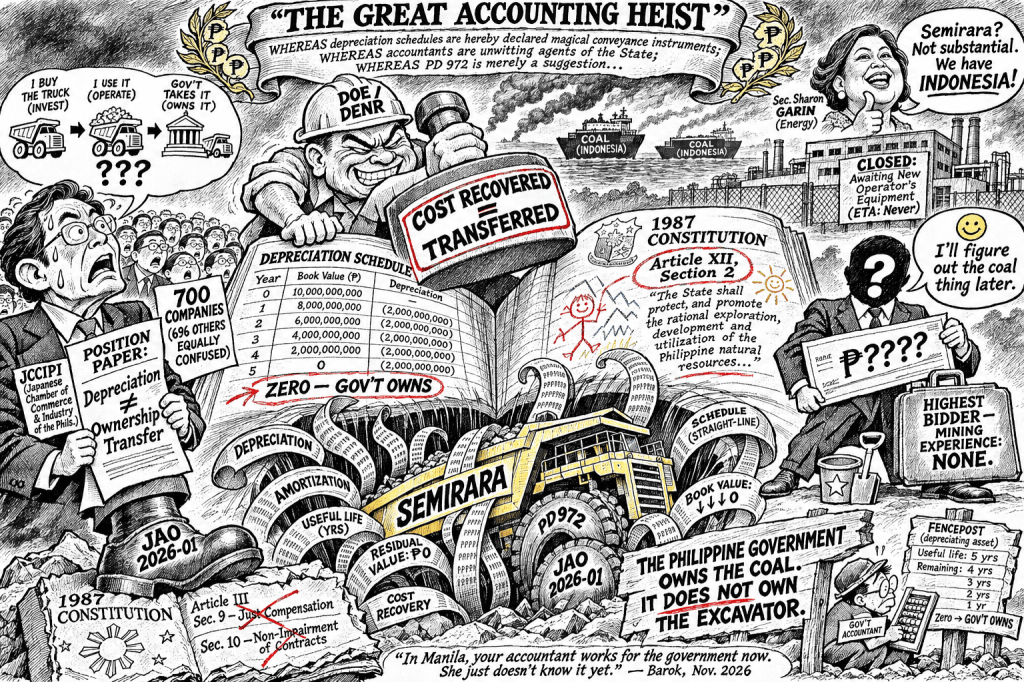
Japan’s chamber discovers that in Manila, accounting entries now transfer property rights.
By Louis ‘Barok‘ C. Biraogo — November 3, 2026
CONSIDER a hypothetical that isn’t hypothetical at all.
You buy a truck. You depreciate it over five years. Book value hits zero. You’ve “recovered” your capital through accounting entries. One day, a government agency knocks: “Nice truck. We’ll take it now. You’ve already expensed it.”
You’d laugh. Then you’d call a lawyer. Then you’d realize the government has unlimited patience, and the truck is already gone.
This is the legal theory behind Section 6.10 of Joint Administrative Order No. 2026-01 (JAO), issued by the Department of Energy (DOE) and the Department of Environment and Natural Resources (DENR). And it took the Japanese Chamber of Commerce and Industry of the Philippines (JCCIPI)—representing nearly 700 companies and over 300,000 Filipino workers—to point out that the emperor’s new property doctrine has no clothes.
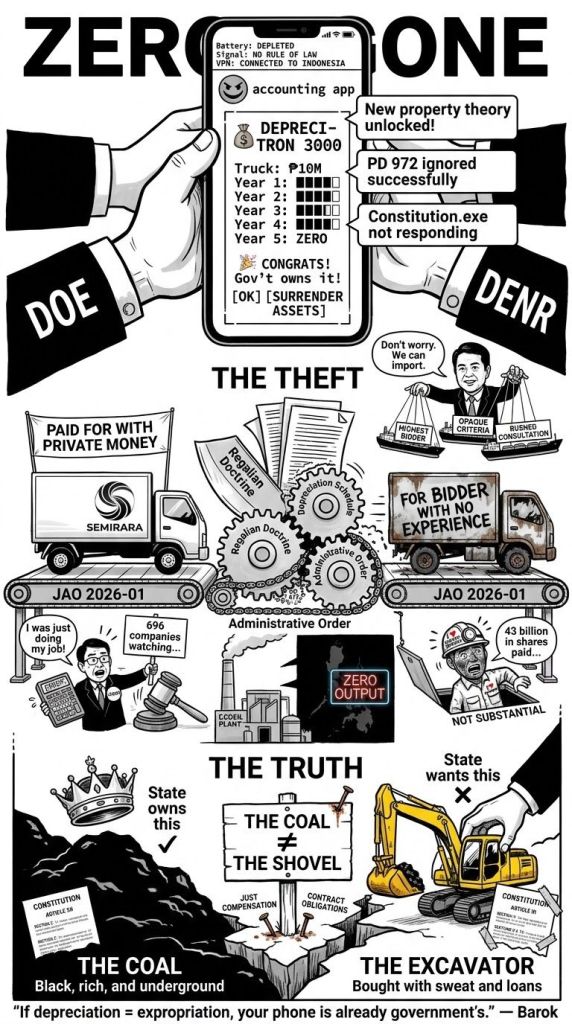
The Asset-Surrender Rule: A Masterclass in Legal Alchemy
The JAO requires existing contract holders who wish to join competitive bidding for areas they currently operate to “properly account for all assets, equipment and facilities… that have been cost recovered, amortized, or depreciated” and turn them over to the government at contract end.
Read that again. The trigger is not “government-owned.” It is not “contractually required to revert.” It is accounting.
In the government’s newly discovered legal universe, a depreciation schedule is a conveyance instrument. Your accountant has been quietly transferring your property rights to the State every time she books a monthly depreciation entry. Who knew?
JCCIPI’s October 30 position paper makes the obvious point that apparently needed making: “The recovery, amortization or even depreciation of operational assets should not be the basis for the eventual transfer of ownership to the government.” The chamber warned the rule could “weaken corporate balance sheets, curb borrowing capacity, restrict future project financing, and erode shareholder value for publicly listed miners.”
But why does the government need this rule at all? And why now?
The Semirara Problem
The answer has a name: Semirara Mining and Power Corporation.
Semirara operates the country’s largest coal mine under Coal Operating Contract No. 5, expiring July 2027. It has paid ₱43.4 billion in government share and ₱3.7 billion in taxes from 2021 through the first half of 2026. It is, by any measure, a significant contributor to the public purse.
But the Department of Justice has opined that the 50-year contract cannot be renewed and must go through competitive bidding. The DOE, seizing the moment, designed a framework in which the highest financial bid is the sole ranking factor after a pass-or-fail eligibility stage. And crucially, the incumbent must surrender its assets if it wants to participate.
Semirara’s response was blunt: “We are the only company covered by this rule. This is unfair and basically bars us from bidding.” The company noted that Presidential Decree No. 972 (Coal Development Act of 1976) provides that the operator may remove its assets within one year after contract termination. The government’s new rule effectively rewrites that statute through an administrative order.
Semirara also warned that the practical consequence could be zero coal output when a new operator takes over in July, because the winning bidder would need to procure hundreds of heavy equipment units, employ and train thousands of workers, and secure billions in financing—all by a deadline that assumes continuity rather than chaos.
The DOE’s response? Energy Secretary Sharon Garin downplayed the impact: “Semirara is not substantial enough to affect our supply, but our coal is coming from Indonesia.”
Let that sink in. The government’s position is that the country’s largest domestic coal producer is expendable because we can always import. This is the same government that has spent years touting energy security. Apparently, energy security means shipping coal from Indonesia while alienating the one company that actually mines it here.
The Legal Fiction at the Heart of the JAO
The government will invoke the Regalian Doctrine—Article XII, Section 2 of the 1987 Constitution—which states that all minerals and other natural resources are owned by the State. The Supreme Court upheld this in La Bugal-B’laan Tribal Association, Inc. v. Ramos, affirming the State’s “full control and supervision” over resource exploitation.
But the Regalian Doctrine does not say the State owns the trucks, excavators, conveyors, power plants, and processing facilities a private company bought with private money to extract those resources.
The distinction is not subtle. It is the difference between owning the coal in the ground and owning the shovel used to dig it out.
The Supreme Court has held that mining permits are privileges, not vested rights—that the State may alter, modify, or amend them when public interest requires. True. But there is a difference between regulating the terms of a privilege and confiscating the physical assets a company purchased to exercise it. The government’s strongest precedents support its authority to regulate; they do not support its authority to appropriate.
JCCIPI asks the question the DOE has yet to answer: “What is the legal basis for the requirement?” The chamber notes that some members joined previous bidding rounds without any asset-surrender requirement, and that the “sudden shift in the rules would create regulatory instability.”
This is not abstract. If the government can retroactively declare that your depreciated equipment belongs to the State, what other accounting entries will it decide constitute transfers of title? Will a fully amortized loan mean the bank owns your house?
The Chamber of Mines Joins the Fray—And Raises the Stakes
JCCIPI is not alone. The Chamber of Mines of the Philippines (COMP) and the Philippine Nickel Industry Association (PNIA) issued a joint statement warning the JAO “introduces regulatory uncertainty” and “investment risks.” They flagged:
- The asset-surrender requirement for incumbent operators
- Bidding rules that factor in closure liabilities and asset costs in ways that may disadvantage existing operators
- Evaluation criteria giving insufficient weight to technical expertise, operational track record, and environmental performance
The COMP/PNIA statement also invoked the “Pax Silica” initiative—the government’s push for critical minerals investment—warning that “the country must not let this golden opportunity pass for questionable and even illusory gains.”
Translation: the government is so eager to extract a few more pesos from the Semirara bidding that it may scare off the investors it needs for the next decade of mineral development.
DMCI Holdings Chairman Isidro Consunji was even more direct, saying the JAO violates existing mining contracts and that he is considering legal action. He noted the public consultation appeared “abbreviated” and “rushed.”
The Bidding Framework: Highest Bidder Wins, Competence Optional
If the asset-surrender provision is legally dubious, the bidding framework it supports is economically reckless.
After bidders pass a pass-or-fail eligibility stage, the highest financial offer wins. Technical capability, operational experience, and environmental performance are secondary—or, as COMP and PNIA suggest, given “insufficient weight.”
This framework would govern the award of Semirara, a mine requiring the pumping of “the equivalent of 12 Olympic-size swimming pools or Pasig River’s torrent every hour just to get to the coal.” The winning bidder, under the DOE’s rules, does not need mining experience. It only needs money.
Semirara’s warning deserves full quotation: “The end result is zero coal production when another outfit takes over in July next year and that means zero royalty payment to the government, which defeats the very objective of the bidding to raise as much funds for the government.”
The DOE’s response, again, is that imports can fill the gap. A remarkable admission: the framework is designed to maximize upfront financial offers, even if the practical result is production collapse and increased reliance on foreign coal.
Who Benefits?
This is where the analysis becomes uncomfortable.
The JAO was issued after the bidding process for Semirara had already been launched. It introduces requirements that specifically disadvantage the incumbent. It creates a framework in which a new entrant—with no mining experience, no equipment, no operational track record—can win the country’s largest coal mine by simply offering the highest number.
Who might that new entrant be? The DOE has not said. Bidding rules reportedly keep award values confidential. Evaluation criteria beyond the financial bid are opaque. The consultation was, according to DMCI’s chairman, rushed.
None of this is evidence of corruption. But it is evidence of a process designed to produce a predetermined outcome—or at least an outcome the incumbent cannot easily contest.
JCCIPI’s warning about “regulatory predictability and the consistent treatment of existing operators” is not just a plea for fairness. It is a warning that investors—Japanese and otherwise—are watching how the Philippines treats companies that have already committed capital under existing rules. If the answer is “we will take your equipment and give it to someone else,” the next investor will think twice.
The Constitutional Problem Nobody Wants to Discuss
Section 9, Article III of the 1987 Constitution provides that private property shall not be taken for public use without just compensation. Section 10 prohibits laws impairing the obligation of contracts.
The government will argue no taking occurs because assets revert under the JAO’s terms, and the JAO is a valid exercise of police power. But the JAO is not a law; it is an administrative order. And the Supreme Court has held that administrative regulations cannot exceed the authority granted by the statute they implement, cannot override legislation, and cannot create new substantive rights or obligations not found in the enabling law.
If PD 972 allows the operator to remove its movable assets within one year after termination, the DOE cannot use a JAO to declare those assets government property immediately upon cost recovery. That is not regulation. That is legislation by fiat.
The government’s fallback—that it needs the assets for continuity of operations—is a policy justification, not a legal one. If the government wants a successor to use the incumbent’s infrastructure, it can negotiate a purchase, arrange a lease, or provide just compensation. It cannot simply declare that depreciation equals expropriation.
The Broader Warning
JCCIPI represents companies invested in artificial intelligence, mineral processing, semiconductors, and energy infrastructure—not just coal. Its intervention signals that the JAO’s asset-surrender theory is being watched far beyond mining.
If the Philippines establishes the principle that private assets used in regulated industries can be appropriated through administrative order when the government decides the investor has “recovered” their cost, every long-term investment becomes vulnerable. Power plants. Transmission facilities. Ports. Telecommunications infrastructure. All can be recharacterized as “cost-recovered” and therefore subject to turnover.
This is not a hypothetical slippery slope. It is the logical extension of the government’s argument.
What Should Happen
The DOE and DENR should immediately clarify that depreciation, amortization, and cost recovery do not, by themselves, transfer ownership. They should amend Section 6.10 to align with PD 972’s express provisions allowing removal of movable assets within one year after termination. They should establish an independent valuation mechanism for any assets the government genuinely needs for transition, with compensation where constitutionally required. And they should revise bidding criteria to give meaningful weight to technical capability, operational experience, and environmental performance—not just the highest check.
None of this requires abandoning the government’s legitimate interest in maximizing public benefit from natural resources. It requires only that the government pursue that interest through lawful means, not through an administrative sleight of hand that confuses accounting with ownership.
The Final Word
The Philippine government owns the coal. It does not own the excavator.
If the DOE and DENR cannot understand this distinction, they should not be writing rules that govern billions of pesos of private investment. And if they persist in conflating depreciation with expropriation, they should not be surprised when the Japanese Chamber—and every other investor with a long memory and a competent lawyer—decides that the Philippines is not a place where property rights mean what the dictionary says they mean.
The national patrimony deserves protection. So does the rule of law. The JAO protects neither.
Key Citations
A. Legal & Official Sources
- The 1987 Constitution of the Republic of the Philippines. Official Gazette of the Republic of the Philippines, 1987, http://www.officialgazette.gov.ph/constitutions/1987-constitution/.
- Presidential Decree No. 972. An Act to Promote an Accelerated Exploration, Development, Exploitation, Production and Utilization of Coal (Coal Development Act of 1976). 28 July 1976, lawphil.net/statutes/presdecs/pd1976/pd_972_1976.html.
- DOE and DENR Joint Administrative Order No. 2026-01. Providing for the Framework for the Evaluation and Award of Contracts and Agreements Involving Confirmed Resources (National Interest Evaluation Framework). 28 Sept. 2026, http://www.officialgazette.gov.ph/2026/09/28/doe-and-denr-joint-administrative-order-no-2026-01/.
- La Bugal-B’laan Tribal Association, Inc. v. Ramos. G.R. No. 127882, 27 Jan. 2004. LawPhil, lawphil.net/judjuris/juri2004/jan2004/gr_127882_2004.html.
- Southeast Mindanao Gold Mining Corp. v. Balite Portal Mining Cooperative. G.R. No. 135190, 3 Apr. 2002. ChanRobles Virtual Law Library, chanrobles.com/scdecisions/jurisprudence2002/apr2002/135190.php.
B. News Reports
- BusinessWorld Online. “Mine Asset Surrender Rule to Damage Investor Confidence — Japan Chamber.” 1 Nov. 2026, bworldonline.com/economy/2026/11/01/790605/mine-asset-surrender-rule-to-damage-investor-confidence-japan-chamber/.
- BusinessWorld Online. “Miners Say New Rules Threaten to Raise Costs, Deter Potential Interest from Pax Silica Investors.” 22 Oct. 2026, bworldonline.com/economy/2026/10/22/788760/miners-say-new-rules-threaten-to-raise-costs-deter-potential-interest-from-pax-silica-investors/.
- BusinessWorld Online. “DMCI Says Order Issued by DoE, DENR Puts Gov’t in Breach of Mining Contracts.” 27 Oct. 2026, bworldonline.com/economy/2026/10/27/789727/dmci-says-order-issued-by-doe-denr-puts-govt-in-breach-of-mining-contracts/.
- Inquirer.net. “Japanese Business Chamber Questions DOE-DENR Asset-Surrender Rule.” 1 Nov. 2026, business.inquirer.net/619242/japanese-business-chamber-questions-doe-denr-asset-surrender-rule.
- Manila Bulletin. “Semirara Warns DOE Bidding Rules Risk Zero Coal Output, Higher Power Rates.” 7 Oct. 2026, mb.com.ph/2026/10/07/semirara-warns-doe-bidding-rules-risk-zero-coal-output-higher-power-rates.
- Philstar.com. “Japanese Investors Flag New Mining Auction Rules.” 2 Nov. 2026, philstar.com/business/2026/11/02/2567162/japanese-investors-flag-new-mining-auction-rules/amp/.
- Philippine Stock Exchange Edge. “Semirara Mining and Power Corporation Disclosure.” 7 Oct. 2026, edge.pse.com.ph/downloadHtml.do?file_id=1974981.
- ₱9 Billion in ‘Savings’? DILG’s Fire Truck Deal Smells Like Smoke
- ₱8B BBM Pork: CCTV for Every Captain’s Kumpare?
- ₱8.9 Billion, 331 Ghost Police Stations: The TIKAS Scandal Explained

- ₱8.4 Billion, 42,000 Barangays, 1 Election: The “Bawat Barangay Makikinabang” Vote-Buying Masterclass

- ₱75 Million Heist: Cops Gone Full Bandit

- ₱63 to the Dollar: The Only Thing Falling Faster Than the Peso Is the Government’s Credibility

- ₱6.77B Ghost Haunts Duterte: RTC Dismisses Mans Carpio’s Desperate Plea
- ₱6.77 Billion and Zero Cash: The Sara Duterte SALN Math That Doesn’t Add Up

- ₱6.7-Trillion Temptation: The Great Pork Zombie Revival and the “Collegial” Vote-Buying Circus

- ₱58.53B, Zero Receipts: The LGSF Pork Barrel Nobody Wants to Name
- ₱53 Million Man Tells ₱695-a-Day Workers to Stop Being ‘Mayabang’: The Audacity of BSP’s Remolona
- ₱4.4 Billion and a Witness Who Can’t Explain It: The Duterte Impeachment’s Most Expensive Non-Answer




Leave a Reply