Why “Leni Is Closing In” Is the Most Expensive Lie in Philippine Politics — And Who’s Paying for It
By Louis ‘Barok‘ C. Biraogo — November 4, 2026
MANILA’S political press corps has a weakness for the horserace. Give them a poll with two names and a narrowing gap, and they will write you a thriller. Last week, the storyline was irresistible: Leni Robredo, the woman who says she isn’t running, was “closing in” on Sara Duterte, the woman who is running but might not be eligible by the time voters reach the ballot. The headline wrote itself.
Except the headline was a lie. Not a fabrication, mind you—the numbers are real, or at least as real as any survey conducted by a private firm with undisclosed clients can be. But the story the numbers told was not the story the headlines sold. And the gap between what the data actually says and what the political class wants you to believe is where the real scandal of Philippine democracy lives.
The Arithmetic Behind the “Narrowing” Gap
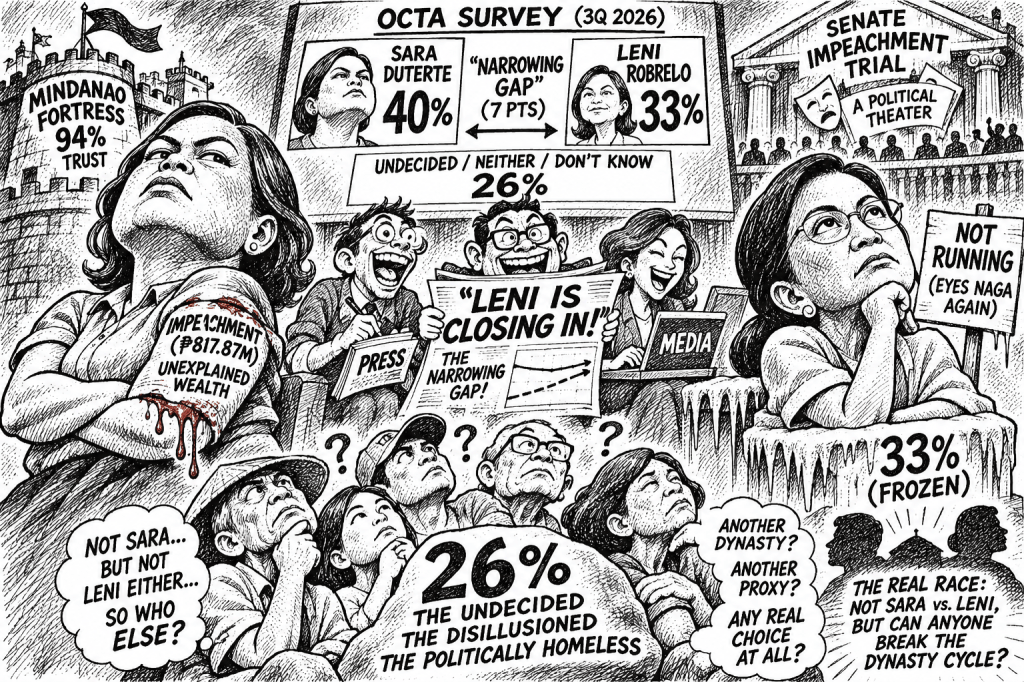
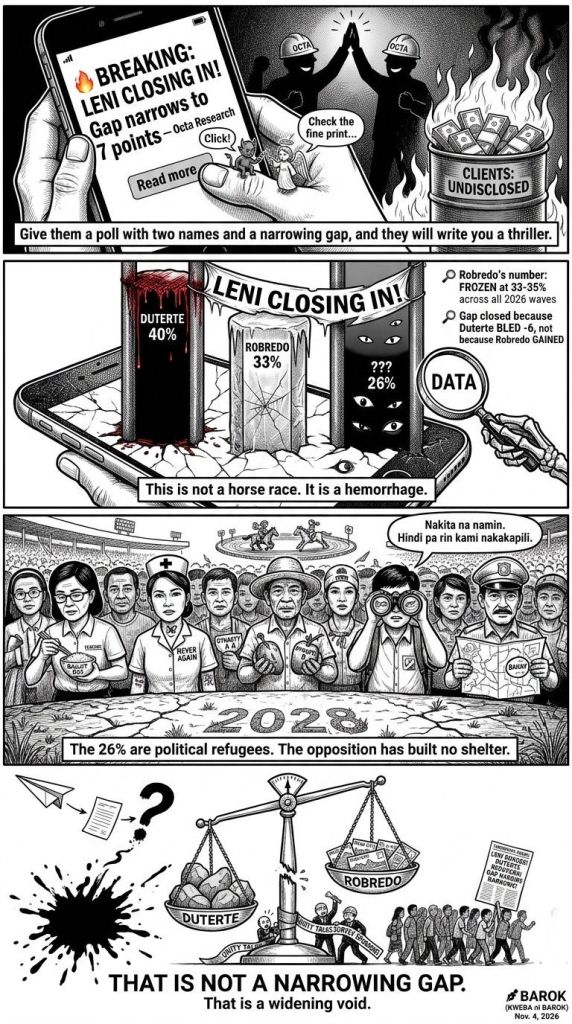
Start with the arithmetic, because arithmetic is where propaganda goes to die. Octa Research’s third-quarter survey shows Duterte at 40 percent, Robredo at 33, and a whopping 26 percent choosing neither, undecided, or “don’t know.” The seven-point gap is the narrowest Octa has recorded. The Inquirer and ABS-CBN dutifully reported this as a “narrowing.”
But Octa itself admitted the obvious: Robredo’s number has been frozen at roughly 33 to 35 percent across all three 2026 waves. Duterte’s fell six points. The gap didn’t close because Robredo gained. It closed because Duterte bled.
This is not a horse race. It is a hemorrhage, and the political press is either too lazy or too compromised to say so.
The 26 Percent Nobody Is Writing About
The 26 percent uncommitted bloc is the only number that matters, and no one is writing about it because it doesn’t fit the two-candidate screenplay. These are not Robredo converts. Octa’s own language is damning: voters moving away from Duterte are “holding back from a choice rather than shifting to Mayor Robredo”.
Translation: they have seen enough of Duterte to recoil, but they have not seen enough of anyone else to commit. They are political refugees, and the opposition has built no shelter for them.
Robredo’s Refusal and the Hypothetical Voter
Why would they commit to Robredo? She has spent the past year telling anyone who will listen that she has no intention of running for national office. In April, she told a radio interviewer in Bicol, “I am certain about myself that I will no longer run for any national position,” adding that a return to the national scene is “far from my horizon.” She plans to seek a second term as mayor of Naga City.
This is either refreshingly honest or politically suicidal, depending on whether you believe her. The survey respondents clearly don’t. They are answering a hypothetical about a candidate who has explicitly refused the premise of the question.
Duterte’s Lead: Impeachment, Approval and a Regional Fortress
Now consider the other side of the ledger. Sara Duterte’s 40 percent is treated as a commanding lead, and in a fragmented field it might be. But she is under impeachment trial for alleged unexplained wealth totaling ₱817.87 million—a figure that should end political careers in any functioning accountability system.
The prosecution, in a move that reeks of strategic desperation rather than confidence, withdrew three of four impeachment articles in October, leaving only the financial allegations. The official explanation was to prevent the trial from dragging into 2027. The unofficial explanation writes itself: they were losing on the other charges, or they feared the defense would filibuster them into irrelevance.
And yet Duterte retains 54 percent approval and 55 percent trust nationally, per Pulse Asia. She commands 94 percent trust in Mindanao. These are not the numbers of a politician in freefall. They are the numbers of a politician whose regional fortress is intact while her national coalition softens.
The Octa survey’s Mindanao breakdown—71 percent Duterte, 2 percent Robredo—is not a political statistic. It is a demographic fact of life, a reminder that the Philippines is not one electorate but several, and that the Duterte brand is less a political preference in the south than a form of identity.
Who Polls the Pollsters?
The polling industry itself deserves scrutiny. Octa is a private firm. Its funding sources are not transparent. Its “non-profit and independent” self-description is precisely the kind of label that should invite skepticism rather than foreclose it.
Competing pollsters tell different stories: Pulse Asia showed Duterte’s approval in the 50s; Octa’s head-to-head has her at 40. These are not minor discrepancies. They are different realities, produced by different methodologies, question wordings, and sampling frames, and each camp cites the poll that flatters it. The public is left to choose its own adventure.
The Impeachment Trial as Political Theater
Then there is the impeachment trial’s political economy. The Senate’s net trust on handling the trial fairly is negative seven. Forty-two percent of Filipinos follow the trial closely; the rest are either distracted or disgusted. Mindanao respondents are more likely to say the trial is moving too fast than too slow.
These are not the markings of a public demanding accountability. They are the markings of a public that has already decided the trial is theater, and is waiting to see which actor takes the final bow.
The “Unity” Farce
The Marcos-opposition “unity” rumors add another layer of farce. Senator Risa Hontiveros has floated the idea of anti-Duterte forces coalescing, and former Senator Franklin Drilon has entertained a tactical alliance with Marcos loyalists. But the Palace says no talks have occurred.
And labor leader Luke Espiritu has already labeled the concept a “kiss of death,” arguing that an opposition that campaigned on “Never Again” cannot morally align with the Marcoses to stop the Dutertes. He is right, and he is also irrelevant, because Philippine politics has never been particularly troubled by moral consistency.
What the Survey Actually Reveals
Here is the uncomfortable truth the survey actually reveals: neither Duterte nor Robredo can claim a mandate. Duterte leads because her regional base is impervious to national scandal, not because a majority of Filipinos wants her to be president. Robredo polls at 33 percent because she is the default receptacle for anti-Duterte sentiment, not because she has built a national coalition.
The 26 percent who choose neither are the largest single bloc in the electorate, and they are politically homeless.
The Real Race for 2028
The real winner of the 2028 election, if current trends hold, will not be the candidate with the most enthusiastic supporters. It will be the candidate who can convince the disillusioned that politics is not merely a choice between two dynasties and their proxies. Neither Duterte nor Robredo has demonstrated the capacity or the willingness to make that case. Duterte’s entire political identity is inherited. Robredo’s is reactive.
The polling firms will keep producing horserace numbers because horserace numbers sell newspapers and generate clicks. The political camps will keep citing the polls that flatter them. And the 26 percent will keep waiting, watching the same two families trade power back and forth, wondering when someone will offer them something worth voting for.
That is not a narrowing gap. That is a widening void. And no survey can measure what fills it, because no one has tried.
Key Citations
A. News Articles
- ABS-CBN News. “OCTA Survey Shows ‘Narrowing’ Gap between Duterte and Robredo’s 2028 Presidential Numbers.” ABS-CBN, 3 Nov. 2026, www.abs-cbn.com/news/nation/2026/11/4/octa-narrowing-gap-between-duterte-robredo-2028-presidential-numbers-1155.
- Cebu Daily News. “OCTA Presidential Survey: Gap between Sara Duterte, Leni Robredo Narrows.” Cebu Daily News, 3 Nov. 2026, cebudailynews.inquirer.net/782063/octa-presidential-survey-gap-between-sara-duterte-leni-robredo-narrows/amp.
- Daily Tribune. “Marcos-Kakampink ‘Alliance’ Sparks ‘Kiss of Death’ Debate.” Daily Tribune, 10 Mar. 2026, tribune.net.ph/2026/03/11/marcos-kakampink-alliance-sparks-kiss-of-death-debate.
- GMA Network. “Pulse Asia: Marcos’ Trust, Approval Ratings Slightly Up; Sara Duterte’s Slip.” GMA News Online, 14 Oct. 2026, www.gmanetwork.com/news/topstories/nation/1006012/pulse-asia-marcos-trust-approval-ratings-slightly-up-sara-duterte-s-slip/story/.
- Inquirer.net. “Pulse Asia Survey: Sara Duterte Retains Majority Approval and Trust.” Inquirer.net, 14 Oct. 2026, newsinfo.inquirer.net/2324124/pulse-asia-survey-sara-duterte-retains-majority-approval-and-trust/.
- Manila Times. “Palace Says No Coalition Talks Yet with Opposition.” The Manila Times, 18 Feb. 2026, www.manilatimes.net/2026/02/19/news/national/palace-says-no-coalition-talks-yet-with-opposition/2280516.
- Povadora, Neil. “Leni Robredo Shuns National Post, Eyes Naga Again in 2028.” Cebu Daily News, 20 Apr. 2026, cebudailynews.inquirer.net/719099/leni-robredo-shuns-national-post-eyes-naga-again-in-2028.
B. Reports & Official Sources
- Congress of the Philippines. “Chua: Dropping 3 Charges vs VP Sara a ‘Legal Strategy’ to Prevent Trial from Dragging into 2027.” Congress.gov.ph, 16 Oct. 2026, congress.gov.ph/media/press-releases/10328.
- Social Weather Stations. “42% of Adult Filipinos Follow Closely the Senate Impeachment Trial of Vice President Sara Duterte.” SWS.org.ph, 21 Oct. 2026, sws.org.ph/social-weather-report-42-of-adult-filipinos-follow-closely-the-senate-impeachment-trial-of-vice-president-sara-duterte/.
- Social Weather Stations. “Third Quarter 2026 Social Weather Survey: Impeachment Trial of VP Sara Duterte.” SWS.org.ph, Oct. 2026, sws.org.ph/wp-content/uploads/2026/10/pr20261022-SWR2026-III-Impeachment-trial-of-VP-Sara-Duterte_Part-1-media-release.pdf.
- ₱9 Billion in ‘Savings’? DILG’s Fire Truck Deal Smells Like Smoke

- ₱8B BBM Pork: CCTV for Every Captain’s Kumpare?

- ₱8.9 Billion, 331 Ghost Police Stations: The TIKAS Scandal Explained

- ₱8.4 Billion, 42,000 Barangays, 1 Election: The “Bawat Barangay Makikinabang” Vote-Buying Masterclass

- ₱75 Million Heist: Cops Gone Full Bandit

- ₱63 to the Dollar: The Only Thing Falling Faster Than the Peso Is the Government’s Credibility

- ₱6.77B Ghost Haunts Duterte: RTC Dismisses Mans Carpio’s Desperate Plea
- ₱6.77 Billion and Zero Cash: The Sara Duterte SALN Math That Doesn’t Add Up

- ₱6.7-Trillion Temptation: The Great Pork Zombie Revival and the “Collegial” Vote-Buying Circus

- ₱58.53B, Zero Receipts: The LGSF Pork Barrel Nobody Wants to Name
- ₱53 Million Man Tells ₱695-a-Day Workers to Stop Being ‘Mayabang’: The Audacity of BSP’s Remolona

- ₱491-M Right-of-Way Scam: DPWH Paid for Ghost Land, Ombudsman Finally Notices








Leave a Reply