Sandro Marcos’ Ilocos Norte District Jumped from ₱369 Million to ₱4.74 Billion Overnight—And the Supporting Documents Are Somehow Missing
By Louis ‘Barok‘ C. Biraogo — October 27, 2026
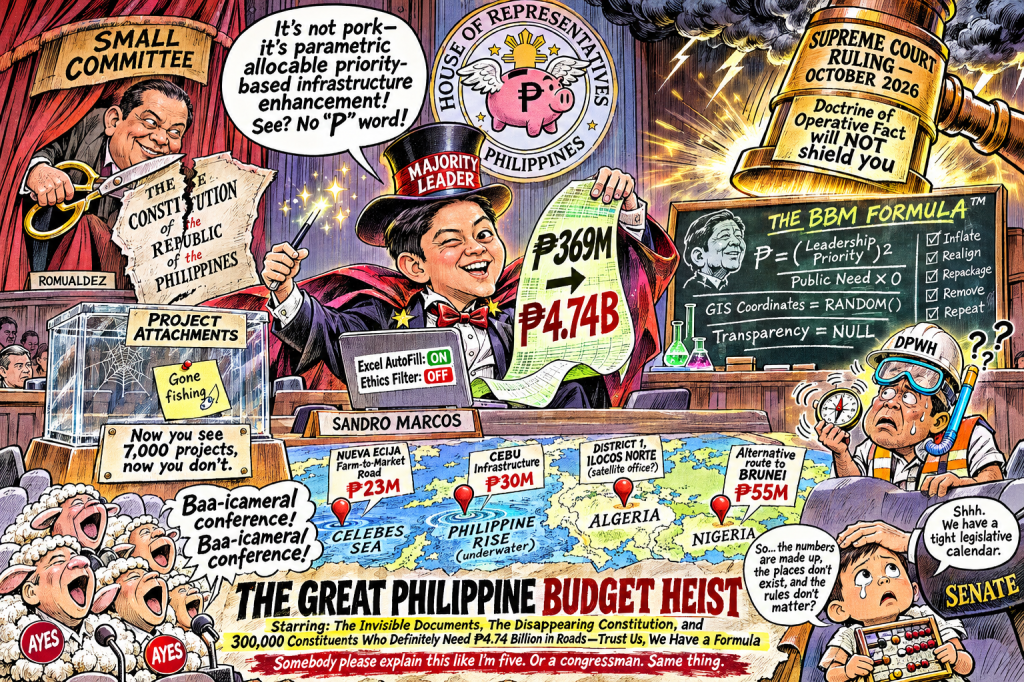
SOMEBODY please explain this to me like I’m a five-year-old—or a congressman, same thing. The House of Representatives, led by the son of the President and his merry band of appropriations wizards, looked at the 2027 National Expenditure Program and decided that Ilocos Norte’s First District—population roughly 300,000, represented by one Sandro Marcos—desperately needed a 1,187% increase in Department of Public Works and Highways (DPWH) funding. From ₱369 million to ₱4.74 billion.
Because nothing says “fiscal prudence” like a twelve-fold jump in public works funding for the district of the Majority Leader, who happens to be the President’s eldest son.
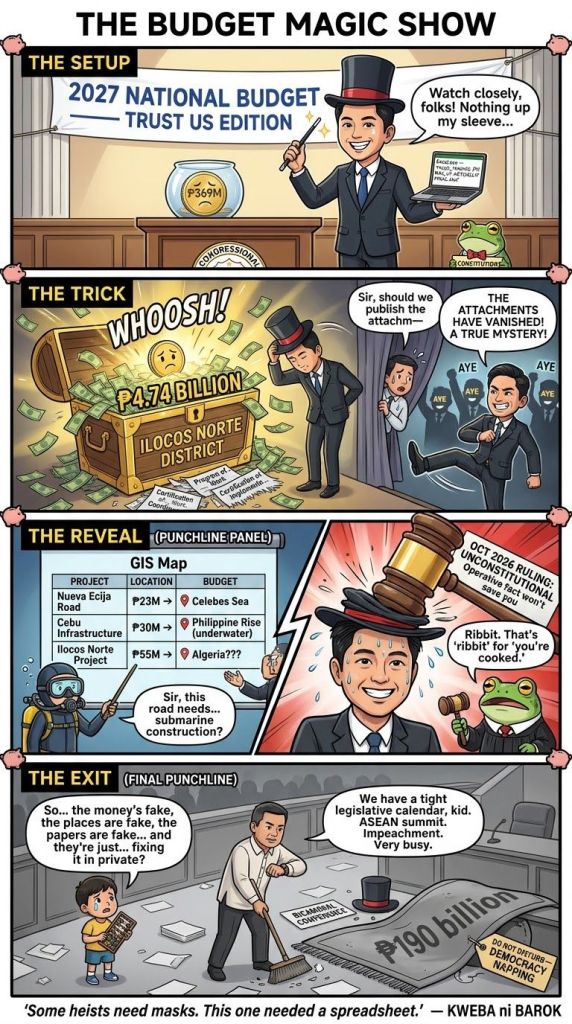
And the best part? Nearly 7,000 projects worth ₱190 billion were inserted into the budget without published project attachments. No programs of work. No certifications of implementability. No coordinates. Just a line item, an amount, and a prayer that the Senate won’t ask too many questions.
This isn’t a budget. This is a blank check with a bow on top.
The Constitutional Violation Nobody Wants to Name
Article VI, Section 25(1) of the 1987 Constitution is painfully clear: “The Congress may not increase the appropriations recommended by the President for the operation of the Government as specified in the budget.”
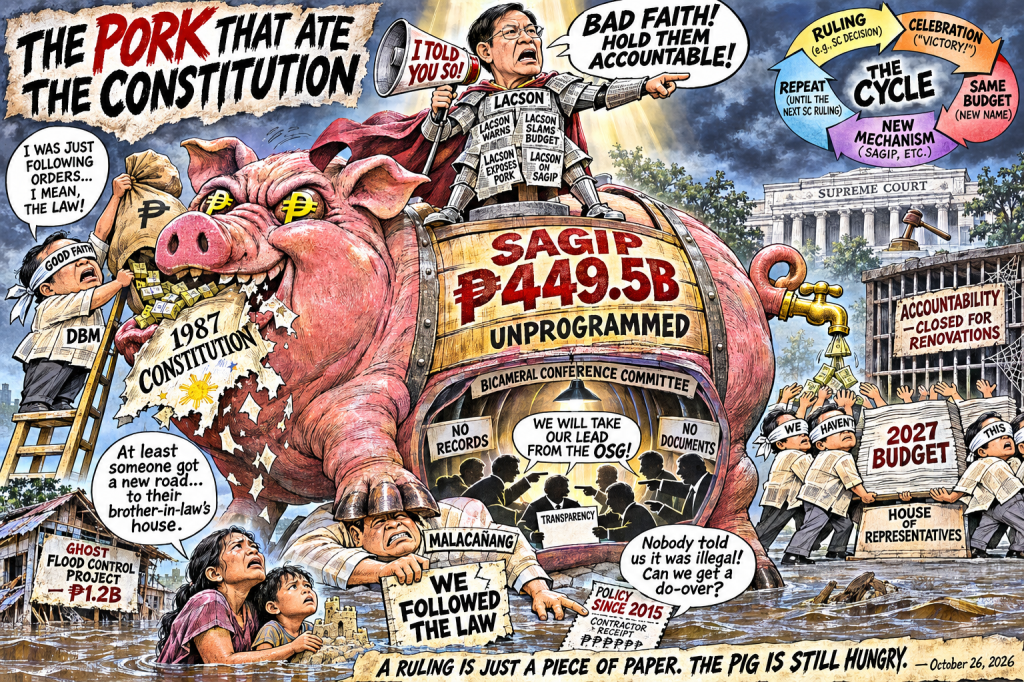
Now, defenders of the House will tell you that Congress can reallocate within the President’s total proposal. Fine. But when the Supreme Court declared the 2024 and 2025 budgets unconstitutional just last week for doing exactly this—increasing unprogrammed appropriations by ₱449.5 billion and the DPWH Special Road Fund by ₱17.99 billion beyond presidential recommendations—you’d think the House would have learned something.
You’d be wrong.
The October 2026 Supreme Court ruling wasn’t subtle. It explicitly warned that the doctrine of operative fact “does not shield authors, proponents, or implementors from criminal, civil, or administrative liability”. That’s judicial language for: we will come for you.
And yet here we are, six days after that ruling was published, watching the House leadership defend a budget insert that makes the PDAF era look like a rounding error.
The “BBM Formula”: Pork Barrel by Spreadsheet
The Philippine Center for Investigative Journalism (PCIJ) dropped a bombshell last year that should have ended careers. A DPWH document revealed the “Baselined, Balanced and Managed Parametric Formula”—the BBM Formula—used since 2023 to distribute “allocable funds” to congressional districts.
The top recipient from 2023 to 2025? Sandro Marcos’ district, at ₱15.8 billion. Second place? Martin Romualdez, at ₱14.4 billion.
The formula, according to former DPWH officials, was understood by only a handful of people. One lawmaker called it “a blueprint for plunder” that explicitly considered the “priorities of leaders of the national government and the legislature.”
Read that phrase again: priorities of leaders. Not “development needs.” Not “poverty incidence.” Not “infrastructure deficit.” Priorities of leaders.
This is what happens when you let the executive and legislative branches collude on a parametric formula that nobody outside a locked DPWH office can decipher. Reports on the DPWH budget formula show how billions are shifted, cut, and rewarded.
The Geography Problem
Here’s where it gets genuinely absurd. The People’s Budget Coalition (PBC) found that some of the House-inserted farm-to-market roads have coordinates that point to the Celebes Sea, the Philippine Rise (an undersea feature), and—I am not making this up—Algeria and Nigeria.
A ₱23-million road intended for Nueva Ecija mapped in Benham Rise. A ₱30-million Cebu allocation plotted in waters near Indonesia. A ₱55-million project in waters off Brunei.
Either the DPWH’s Geographic Information System (GIS) team is staffed by particularly creative cartographers, or someone is testing whether anyone actually checks these things before money flows. Given that the projects lack published attachments entirely, I’m going with the latter.
Ken Abante of the PBC put it best: “Sa budget na pinaghirapang buwis ng taong bayan bawal magka-typo”—you don’t get to have typos in a budget built from taxpayers’ hard-earned money.
The Senate’s Choice: Clean It Up or Own It
Senate Finance Committee Chair JV Ejercito has signaled he’d rather fix this in bicameral conference than recall the budget, citing the tight legislative calendar, the Vice President’s impeachment trial, and the Association of Southeast Asian Nations (ASEAN) Summit. Translation: we don’t have time for a constitutional crisis, so let’s just quietly delete the worst parts and pretend this never happened.
But here’s the problem with that approach. The Supreme Court didn’t just invalidate the amounts in the 2024 and 2025 budgets. It invalidated the process—the closed-door small committee, the lack of transparency, the last-minute insertions. Ejercito promises the bicam will be televised and transparent. That’s lovely. But a televised horse-trade is still a horse-trade.
The PBC’s demand is simpler: remove the projects without published attachments. If the House can’t produce the programs of work, the certifications of implementability, the coordinates that don’t point to Algeria, then those projects shouldn’t exist in the final budget.
The Senate has the constitutional authority to amend the House version. It has the recent Supreme Court precedent. It has public outrage over the flood control scandal still fresh in everyone’s memory. What it lacks, apparently, is the appetite to use any of it.
The Palace’s Response: “We Respectfully Disagree”
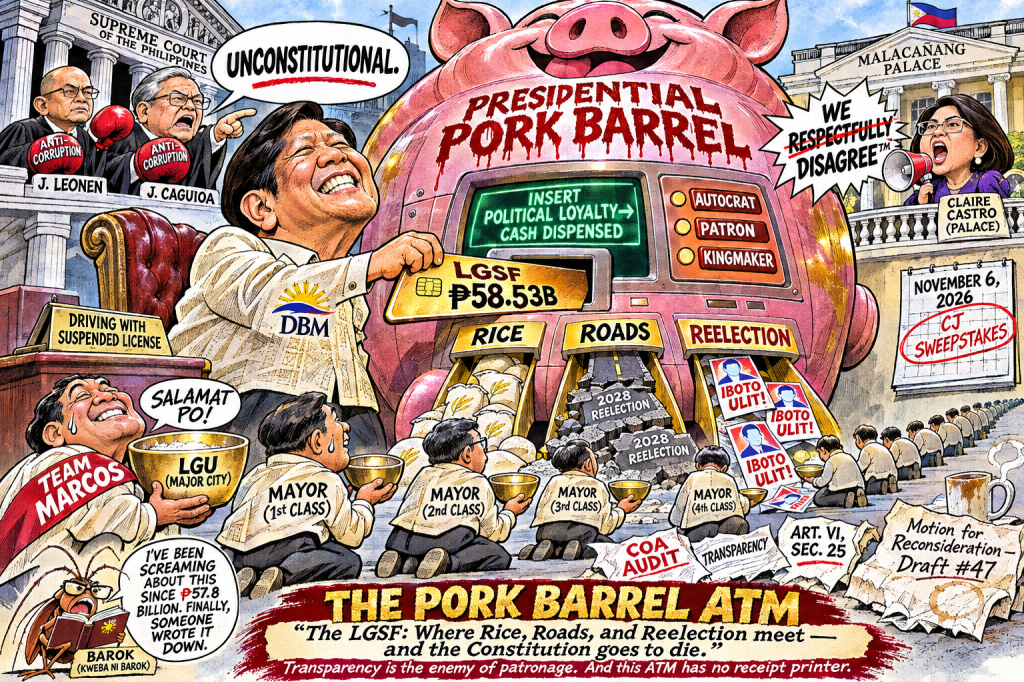
When the Supreme Court struck down the budget increases last week, Malacañang’s response was to disagree and direct the Solicitor General to seek reconsideration. The Palace argues that the Court’s conditions render unprogrammed appropriations “inutil” (useless) and that the executive was merely following the rules Congress set.
Here’s the thing about “following the rules”: when the rules themselves violate the Constitution, following them isn’t a defense. It’s a confession.
And when the President’s own son is the primary beneficiary of the budget insertions that the Supreme Court’s ruling implicitly condemns, the Palace’s insistence that there’s “no basis for holding the President accountable” rings about as hollow as a multipurpose building with no foundation.
What This Actually Is
Let’s strip away the legal jargon and the procedural niceties. Here’s what’s happening:
- The House of Representatives, under the leadership of the President’s son and his allies, has inserted nearly ₱190 billion in projects that cannot be scrutinized because the supporting documents don’t exist—at least not publicly.
- The district of the Majority Leader received a funding increase so disproportionate it defies any objective needs assessment.
- The same patterns that produced the flood control scandal—opaque allocations, political beneficiaries, missing documentation—are repeating themselves in real time.
The People’s Budget Coalition has done the work. They’ve produced the data. They’ve mapped the coordinates. They’ve identified the patterns. And they’ve explicitly said they’re not alleging corruption—only that the lack of transparency makes corruption impossible to rule out.
That’s not an accusation. That’s an invitation. Prove them wrong.
Publish the attachments. Release the programs of work. Explain why Ilocos Norte’s First District needs a twelve-fold increase while foreign-assisted infrastructure projects like the Metro Manila Subway and the North-South Commuter Railway take ₱130 billion in cuts. Show us the coordinates that don’t point to the ocean.
The House won’t do any of that. You know how I know? Because they haven’t. The projects were inserted without documentation. The documents that do exist are riddled with errors so egregious they’re either criminal negligence or deliberate obfuscation.
And the response to scrutiny has been to hide behind the bicameral process and the President’s veto power—two mechanisms that have historically been used to preserve pork, not eliminate it.
The October Surprise Nobody Wanted
The Supreme Court’s October 2026 ruling was supposed to be a turning point. It declared budget increases beyond presidential recommendations unconstitutional. It warned that the doctrine of operative fact wouldn’t shield anyone. It explicitly addressed the mechanisms that have allowed Congress to circumvent spending limits for years.
Six days later, the House sent a budget to the Senate with ₱190 billion in undocumented insertions and a ₱4.38 billion windfall for the Majority Leader’s district.
If the Senate doesn’t strip these provisions—if the bicam preserves even a fraction of them—then the Supreme Court’s ruling will have accomplished exactly nothing. It will be a piece of paper with nice language, cited in law school classrooms and ignored in the halls of Congress.
The budget is the most consequential piece of legislation any government passes. It determines who gets healthcare, who gets roads, who gets schools, and who gets nothing. When the process by which it’s assembled is deliberately opaque, when the beneficiaries are the families and allies of the people writing it, and when the documentation that would allow verification simply doesn’t exist, you don’t have a budget. You have a heist with legislative cover.
The PBC’s tracker is live. The data is public. The Supreme Court has spoken. The only question now is whether the Senate has the spine to act on any of it.
I won’t be holding my breath.
Key Citations and Further Reading
A. Court Decisions
- Araullo v. Aquino III. G.R. No. 209287, Supreme Court of the Philippines, 1 July 2014. https://lawphil.net/judjuris/juri2014/jul2014/gr_209287_2014.html.
- Belgica v. Ochoa, Jr. G.R. No. 208566, Supreme Court of the Philippines, 19 Nov. 2013. https://lawphil.net/judjuris/juri2013/nov2013/gr_208566_2013.html.
- Lagman v. Medialdea. G.R. No. 243522, Supreme Court of the Philippines, 19 Feb. 2019. https://lawphil.net/judjuris/juri2019/feb2019/gr_243522_2019.html.
B. Constitution and Statutes
- Philippines. 1987 Constitution of the Republic of the Philippines. Art. VI, §§ 24–27; Art. IX-D; Art. XI, § 13(1). Official Gazette of the Republic of the Philippines, www.officialgazette.gov.ph/constitutions/1987-constitution.
- Philippines. Executive Order No. 292, Administrative Code of 1987. Book VI, ch. 4, § 25. Lawphil, lawphil.net/executive/execord/eo1987/eo_292_1987.html.
- Philippines. Republic Act No. 3019, Anti-Graft and Corrupt Practices Act. § 3(e), (g). Lawphil, lawphil.net/statutes/repacts/ra1960/ra_3019_1960.html.
- Philippines. Republic Act No. 6713, Code of Conduct and Ethical Standards for Public Officials and Employees. § 4. Lawphil, lawphil.net/statutes/repacts/ra1989/ra_6713_1989.html.
- Philippines. Republic Act No. 6770, Ombudsman Act of 1989. Lawphil, lawphil.net/statutes/repacts/ra1989/ra_6770_1989.html.
- Philippines. Republic Act No. 7080, Plunder Law. Lawphil, lawphil.net/statutes/repacts/ra1991/ra_7080_1991.html.
- Philippines. Republic Act No. 12009, New Government Procurement Act. Lawphil, lawphil.net/statutes/repacts/ra2024/ra_12009_2024.html.
- Philippines. Act No. 3815, Revised Penal Code. Arts. 171–172, 217–219. Lawphil, lawphil.net/statutes/acts/act1930/act_3815_1930.html.
C. News Articles and Investigative Reports
- “Ayusin Na Lang sa Bicam! JV Ejercito Rejects Call to Recall 2027 Budget.” POLITIKO, 22 Oct. 2026, politiko.com.ph/ayusin-na-lang-sa-bicam-jv-ejercito-rejects-call-to-recall-2027-budget.
- Chi, Cristina. “Watchdogs Urge Senate to Strip House ‘Insertions’ in Pork-Riddled 2027 Budget.” Philstar.com, 26 Oct. 2026, qa.philstar.com/headlines/2026/10/26/2565843/watchdogs-urge-senate-strip-house-insertions-pork-riddled-2027-budget.
- “House Increases DPWH Budget for Sandro Marcos’ District by P4.3B – Watchdog.” Rappler, 26 Oct. 2026, www.rappler.com/philippines/dpwh-budget-sandro-marcos-district-jumps-billions-house-bill-2027-watchdog.
- “How to Track Insertions in House-Approved 2027 Budget.” Rappler, 26 Oct. 2026, www.rappler.com/philippines/tracker-house-representatives-2027-budget-insertions.
- “Magalong Urges COA, Ombudsman to Probe Voided National Budgets.” Inquirer.net, 26 Oct. 2026, newsinfo.inquirer.net/2330559/magalong-urges-coa-ombudsman-to-probe-voided-national-budgets.
- “Marcos Must Be Held Accountable for SC Ruling on Previous Budgets – Solon.” Inquirer.net, 21 Oct. 2026, newsinfo.inquirer.net/2328403/marcos-must-be-held-accountable-for-sc-ruling-on-previous-budgets-solon.
- “SC Declares 2024, 2025 Budgets, 2026 Special Provisions ‘Unconstitutional.’” ABS-CBN News, 20 Oct. 2026, www.abs-cbn.com/news/nation/2026/10/20/sc-declares-2024-2025-budgets-2026-special-provisions-unconstitutional-1913.
- “Senate Urged to Scrap House GAA Infrastructure Insertions.” Philstar.com, 20 Oct. 2026, www.philstar.com/headlines/2026/10/20/2564441/senate-urged-scrap-house-gaa-infrastructure-insertions.
- “Watchdog: House-Approved 2027 Nat’l Budget Not ‘People-Centered.’” ABS-CBN News, 18 Oct. 2026, www.abs-cbn.com/news/nation/2026/10/18/watchdog-house-approved-2027-nat-l-budget-not-people-centered-2050.
D. PCIJ Investigation and Related Coverage
- “Allocables Are the New Pork and Sandro Marcos and Martin Romualdez Are the Pork Barrel Kings.” PCIJ.org, 29 Nov. 2025, pcij.org/2025/11/29/allocables-are-the-new-pork.
- “BBM Formula under Fire: Marcos Hand in the Flood Control Mess Undeniable – Makabayan Bloc.” POLITIKO, 3 Feb. 2026, politiko.com.ph/bbm-formula-under-fire-marcos-hand-in-the-flood-control-mess-undeniable-makabayan-bloc.
- “DPWH Budget Formula Exposes How Billions Are Shifted, Cut, and Rewarded.” Daily Tribune, 24 Dec. 2025, tribune.net.ph/2025/12/24/dpwh-budget-formula-exposes-how-billions-are-shifted-cut-and-rewarded.
- “First Family Open to Lifestyle Check amid Fund Concerns – Palace.” Philippine News Agency, 2 Dec. 2025, www.pna.gov.ph/index.php/articles/1264393.
- “First Family Open to Lifestyle Check —Palace.” GMA Network, 2 Dec. 2025, www.gmanetwork.com/news/topstories/nation/968197/marcos-first-family-lifestyle-check/story.
- “PCIJ: From 2023 to 2025, Marcos Kin Received Highest Amount of ‘Allocable Funds,’ a New Form of Pork Barrel.” Center for Media Freedom and Responsibility, 15 Dec. 2025, cmfr-phil.org/media-ethics-responsibility/journalism-review/pcij-from-2023-to-2025-marcos-kin-received-highest-amount-of-allocable-funds-a-new-form-of-pork-barrel.
E. Budget Transparency and Digital Tools
- “AI, Online Tracker Boost Public Scrutiny of National Budget.” Cebu Daily News, 26 Oct. 2026, cebudailynews.inquirer.net/779168/ai-online-tracker-boost-public-scrutiny-of-national-budget.
- “Senate Expands Public Access to AI-Assisted Budget Scrutiny.” The Chronicle, 26 Oct. 2026, thechronicle.com.ph/senate-expands-public-access-to-ai-assisted-budget-scrutiny.

- ₱9 Billion in ‘Savings’? DILG’s Fire Truck Deal Smells Like Smoke

- ₱8B BBM Pork: CCTV for Every Captain’s Kumpare?
- ₱8.9 Billion, 331 Ghost Police Stations: The TIKAS Scandal Explained

- ₱8.4 Billion, 42,000 Barangays, 1 Election: The “Bawat Barangay Makikinabang” Vote-Buying Masterclass
- ₱75 Million Heist: Cops Gone Full Bandit

- ₱63 to the Dollar: The Only Thing Falling Faster Than the Peso Is the Government’s Credibility

- ₱6.77B Ghost Haunts Duterte: RTC Dismisses Mans Carpio’s Desperate Plea
- ₱6.77 Billion and Zero Cash: The Sara Duterte SALN Math That Doesn’t Add Up

- ₱6.7-Trillion Temptation: The Great Pork Zombie Revival and the “Collegial” Vote-Buying Circus

- ₱58.53B, Zero Receipts: The LGSF Pork Barrel Nobody Wants to Name
- ₱53 Million Man Tells ₱695-a-Day Workers to Stop Being ‘Mayabang’: The Audacity of BSP’s Remolona
- ₱4.4 Billion and a Witness Who Can’t Explain It: The Duterte Impeachment’s Most Expensive Non-Answer




Leave a Reply