
Featuring Special Guest Stars Article VII, Section 9 (Uninvited), the Constitution (Ignored), and Common Sense (Absent)”
By Louis ‘Barok‘ C. Biraogo | October 28, 2026
LET me get this straight—by which I mean ‘navigate this pretzel of senatorial logic.’ We are supposed to believe that the Philippine Senate—that august chamber of political survivors, turncoats, and people who treat the Constitution like a suggestion box—has suddenly discovered the concept of conflict of interest. And they discovered it not because of the billions in pork barrel, not because of the revolving door between legislative staff and lobbyists, not because half of them are related to each other by blood or marriage or both, but because someone floated the possibility that a senator might, hypothetically, maybe, perhaps, if the stars align and the moon is in the seventh house, become Vice President (VP) if Sara Duterte gets convicted.
This is the ethical crisis that finally woke them up? This is the hill upon which Senate Minority Leader Alan Peter Cayetano has chosen to plant his flag of righteousness?
Forgive me if I remain seated.
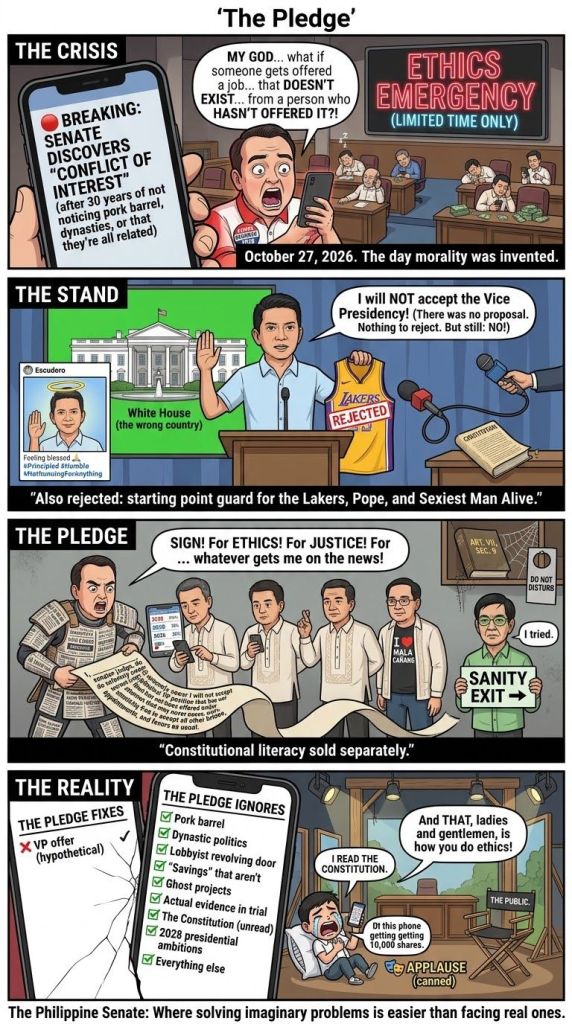
The Anatomy of a Pledge Nobody Asked For
Let us review the facts, such as they are. Senate President Chiz Escudero—a man who has been in politics since the Pleistocene era and who has lost more elections than most politicians have fought—declared that he would refuse any hypothetical offer to become Vice President because of “conflict of interest.” This is a bit like me declaring that I would refuse a hypothetical offer to become the starting point guard for the Lakers. It sounds principled until you remember that nobody was offering, nobody asked, and the Lakers have better options.
Escudero even admitted as much: “There was nothing to reject because there was no proposal.”
Translation: I am taking a bold stand against a thing that is not happening.
But Cayetano, never one to let a non-event go to waste, saw an opportunity. He called on all senator-judges to make the same declaration. All of them. Because nothing says “judicial independence” like forcing your colleagues to publicly commit to refusing a job they haven’t been offered in a scenario that might never occur.
This is the political equivalent of making your entire office sign a pledge promising they won’t accept a promotion from your boss. Sure, it looks noble. But it also implies that (a) the boss might actually make such offers, (b) your colleagues are the kind of people who would accept them, and (c) you think so little of both that you need to preemptively bind them in writing.
Article VII, Section 9: The Constitution Nobody Read
Here’s the thing that Cayetano, Escudero, and the entire Philippine commentariat seem to have missed while they were busy patting themselves on the back: the Constitution explicitly contemplates that a sitting senator can become Vice President.
Article VII, Section 9 is not ambiguous. It does not whisper. It does not hedge. It states, in language that would be clear to a first-year law student who bothered to show up to class:
“Whenever there is a vacancy in the Office of the Vice-President during the term for which he was elected, the President shall nominate a Vice-President from among the Members of the Senate and the House of Representatives who shall assume office upon confirmation by a majority vote of all the Members of both Houses of the Congress, voting separately.”
Read that again. Slowly. Let it sink in.
The Constitution doesn’t say “the President shall nominate a Vice President from among retired politicians” or “from the private sector” or “from a list of people who have never been elected to anything.” It says: Members of the Senate and House.
You know who is a Member of the Senate? Every single senator-judge in that impeachment court. That’s the point. The framers of the Constitution—those brilliant minds who gave us the disaster that is the Philippine political system—deliberately created a mechanism where senators and representatives are eligible for the vice presidency.
And now Cayetano wants everyone to promise they won’t participate in a process the Constitution explicitly authorizes.
This is not ethics. This is constitutional illiteracy dressed up as moral superiority.
The Pledge Problem: When Symbolism Replaces Substance
Let’s play a game. Imagine you’re a senator-judge. You sign Cayetano’s pledge. You promise, in front of cameras and voters and your ever-patient mother, that you will not accept the vice presidency if Sara Duterte is convicted.
Now what?
Does your pledge make you more likely to evaluate the evidence impartially? Or does it make you more likely to convict, because you’ve now staked your entire political reputation on the narrative that conviction is the right outcome? Congratulations: you’ve just created a new incentive to vote for conviction so you can maintain consistency with your public promise.
Does your pledge prevent you from cutting a secret deal with Malacañang where you get something else—a Cabinet post, an ambassadorship, a nice side contract for your spouse? No. It prevents exactly one specific thing while leaving every other avenue of self-dealing wide open.
Does your pledge protect the integrity of the trial? Or does it signal to the public that the Senate, rather than being a deliberative body capable of impartial judgment, is actually a collection of potential office-seekers who need to be publicly handcuffed to prevent them from auctioning their votes to the highest bidder?
The last one is the real question. And the answer is damning.
The “Conflict of Interest” That Isn’t
Escudero and Cayetano both use the phrase “conflict of interest” as though it has a fixed, universally accepted meaning that clearly applies here. It doesn’t.
Republic Act No. 6713, the Code of Conduct and Ethical Standards for Public Officials, defines conflict of interest in Section 3(i) as a situation involving “a member of a board, an officer, or a substantial stockholder of a private corporation or owner or has a substantial interest in a business, and the interest of such corporation or business, or his rights or duties therein, may be opposed to or affected by the faithful performance of official duty.”
Notice what’s missing from that definition? Any mention of future political appointments. Any mention of hypothetical scenarios. Any mention of a job you might get if you vote a certain way on an impeachment case.
The RA 6713 definition is about financial interests in existing businesses. It’s about not voting on a bill that benefits your family corporation. It’s about not awarding a government contract to your brother-in-law’s construction firm.
It is not about a constitutional provision that explicitly authorizes members of Congress to be nominated for vice president. It is not about a process that requires confirmation from both chambers and the President’s nomination. It is not about a hypothetical scenario that has not happened and may never happen.
If we stretch the concept of “conflict of interest” this far, then every senator has a conflict of interest in every vote they cast, because every vote affects their reelection prospects, their political standing, their relationships with colleagues, and their future opportunities. Should they all recuse themselves from everything?
The Real Consequence: Closing a Constitutional Door
Here’s what nobody in the Senate seems to be considering: what happens if Cayetano’s pledge becomes an informal requirement for senator-judges?
The Vice Presidency was designed to be fillable from Congress. Why? Because the framers understood that after a presidential election, the Vice President is often the only nationally elected official who is obviously next in line. When Vice President Gerald Ford became President after Nixon’s resignation—yes, I know, that’s American history, but stay with me—he had been a member of the House of Representatives. The process worked because Congress was considered a legitimate pool for executive succession.
The Philippine Constitution adopted the same model. And now Cayetano wants to close it off because… optics? Because he’s worried that people might think a senator was self-interested if he voted to convict and then became Vice President?
How about this radical idea: judge senators by their votes, their reasoning, their conduct, and their evidence, not by their hypothetical aspirations. If a senator casts a vote that is clearly unsupported by the evidence, and then immediately accepts a VP nomination, you can investigate. You can call for an ethics probe. You can consider it evidence of improper conduct.
But preemptively stripping the Senate of its constitutional role because you don’t trust your colleagues is not ethics. It’s insecurity dressed up as principle.
The Lacson Objection: A Rare Voice of Sanity
Before we proceed, let me give credit where it’s due. Senator Ping Lacson—hardly a man who has never made questionable decisions—at least had the intellectual honesty to point out that eligibility for the vice presidency and impartiality in adjudication are separate issues.
This is correct.
The Constitution says a member of Congress can be nominated for Vice President if there’s a vacancy. It does not say that being so eligible makes you incapable of judging an impeachment. Those are different questions.
You can be impartial in a trial even if you’d be willing to accept a job offer that might arise from the outcome. The relevant question is not whether you’d accept the offer, but whether you’d manipulate your judicial decision-making to get the offer.
If the concern is that some senators might do this—might cast a vote not based on evidence but on personal ambition—then the answer is to demand a thorough, transparent trial; scrutinize the evidence rigorously; and hold senators accountable at the polls if their votes seem politically motivated.
The answer is not to force everyone to sign a public pledge that binds them to a particular course of action regardless of circumstances. That’s not ethics. That’s political theater.
The Absurdity of the “Appearance” Argument
Cayetano’s strongest argument is that the appearance of conflict is as important as an actual conflict. He’s not wrong that public perception matters. But consider what this argument actually accomplishes if taken seriously.
If the appearance of conflict is sufficient to disqualify someone, then we need to go much further than a VP pledge. We need to disqualify every senator who has ever expressed a political opinion about Sara Duterte. Every senator who has political allies in the Duterte camp. Every senator who might benefit from a future Marcos endorsement. Every senator who might want to run for president in 2028 and would benefit from eliminating a rival.
The list would include… everyone.
The appearance standard, carried to its logical conclusion, makes judgment impossible. At some point, you have to trust that elected officials can make decisions based on evidence and the Constitution. If you don’t trust that, then the problem isn’t the pledge. The problem is democracy itself.
The Elephant in the Room: 2028
Let’s talk about what’s actually happening here, because the ethics discussion is cute, but it’s not the real story.
Sara Duterte is the current frontrunner for the 2028 presidential election. If she’s convicted and disqualified from holding public office, the field opens up dramatically. Who benefits? Everyone who might want to run for president.
Alan Peter Cayetano has presidential ambitions. Chiz Escudero has presidential ambitions. Lito Lapid probably has presidential ambitions because why not. Half the Senate probably has presidential ambitions, because it’s the Senate and that’s what happens.
So when Cayetano stands up and demands that all senator-judges promise not to accept the vice presidency—a job that would make them only one heartbeat away from the presidency—he is, in effect, asking his colleagues to remove themselves from the immediate line of succession. Meanwhile, he positions himself as the moral leader of this noble endeavor, which conveniently also positions him as a potential presidential candidate in 2028.
Is this genuine ethics? Or is it strategic positioning dressed as ethics? Or is it maybe both—genuine concern mixed with calculated advantage, which is how almost all politics works?
I can’t read minds. Neither can you. But let’s not pretend that this is a purely philosophical debate. These are politicians. They think about power. That’s not a crime. But it’s also not a rationale for constitutional amendment by press release.
The Senate Rules Nobody Is Enforcing
Here’s another delicious irony. The Senate’s own rules on impeachment—the very rules Escudero is supposed to enforce as presiding officer—have a provision that might be far more relevant than anything about VP pledges.
Article 18 of the Senate Rules on Impeachment prohibits the presiding officer, senators, prosecutors, the impeached official, and witnesses from making public comments about the merits of a pending case. This is a standard gag rule to prevent trial by publicity.
Cayetano’s statements about the ethics of future VP appointments might not technically be about the “merits” of the impeachment case—they’re about the context in which the case is being decided. But they’re close enough to the line that a reasonable person could ask whether the Senate is actually enforcing its own rules or whether those rules are just suggestions that nobody takes seriously.
More importantly, the entire discussion of VP succession is a distraction from what should be the focus: the evidence. The prosecution has withdrawn three of four articles of impeachment. Only one charge remains—alleged unexplained wealth and defective asset declarations. The trial should be about whether that charge is proven. Everything else is noise.
But noise is what generates headlines. And headlines are what politicians crave. And so here we are.
The Path Forward: Ethics Without Gimmicks
If Cayetano genuinely wants to strengthen the ethics of the impeachment process—and I’m not saying he doesn’t, I’m just noting that it’s convenient—there are better ways to do it than a public pledge that everyone knows will be ignored or circumvented.
- Option 1: Disclosure of Actual Communications. If a senator has been approached—formally or informally—about the vice presidency, they should disclose that communication. Not hypothetically. Actually. In writing. Under oath. If Malacañang is floating VP possibilities to sitting senators while they’re judging an impeachment case, that’s a genuine conflict that deserves scrutiny.
- Option 2: Clear Prohibition on Quid Pro Quo. The Senate should clarify that any explicit or implicit agreement to exchange an impeachment vote for a future appointment is not just unethical but potentially illegal. This is already true under existing law, but a formal statement from the Senate—signed by all senators—would send a clear signal.
- Option 3: Rigorous Evidence-Based Trial. The best defense against improper influence is a trial so transparent, so focused on evidence, and so rigorous in its procedures that any attempt to vote on political grounds would be obvious. If a senator votes to convict despite weak evidence, or to acquit despite strong evidence, voters can make their own judgments.
- Option 4: Accept the Constitution We Have. Article VII, Section 9 exists. It’s not going away. If a vacancy occurs, the President can nominate a member of Congress, both chambers vote, and the process works as designed. If we don’t like that system, we can amend the Constitution. But we can’t just pretend it doesn’t exist because some senators are worried about optics.
The Deeper Crisis: Trust in Institutions
At the heart of this entire controversy is a fundamental question: do we trust our institutions to function as designed? Do we trust that senators can evaluate evidence fairly? Do we trust that the President won’t offer the VP job as a bribe? Do we trust that the confirmation process will serve as a check on improper nominations?
If the answer is yes, then Cayetano’s pledge is unnecessary.
If the answer is no, then a pledge won’t help. Because if senators are corrupt enough to trade impeachment votes for appointments, they’re corrupt enough to sign a piece of paper and ignore it. The pledge doesn’t solve the problem; it just makes the problem less visible.
The only real solution is the one we keep avoiding: robust institutions, transparent processes, rigorous accountability, and an informed citizenry that holds leaders accountable. Those are hard. A pledge is easy. So we get a pledge.
Conclusion: A Comedy of Constitutional Errors
Let me summarize the state of play:
- Chiz Escudero announced he won’t accept a hypothetical job offer.
- Alan Peter Cayetano demanded that everyone else make the same meaningless promise.
- Ping Lacson pointed out that this is silly.
- The Constitution remains unread.
- The trial continues.
- And somewhere, a law student who actually read Article VII, Section 9 is screaming into a pillow.
This is the Philippine Senate in 2026: a collection of political survivors who can’t resist an opportunity for moral theater, even when the moral is questionable and the theater is bad.
Are senators capable of judging Sara Duterte’s impeachment fairly? That’s the question. And the answer is: we don’t know. Not because they might become Vice President, but because they’re human beings with ambitions, biases, and political pressures that no pledge can eliminate.
The Constitution provides the structure: impeachment, trial, vote. The rest is up to the people in that room.
If Cayetano wants to improve the process, he should demand a fair trial, rigorous cross-examination, and full disclosure of evidence. He should call out actual instances of misconduct if he sees them. He should be transparent about his own motivations, which are not exactly mysterious.
What he shouldn’t do is propose a pledge that solves nothing, addresses no actual problem, distorts the Constitution, and treats his colleagues like children who can’t be trusted with the keys to the car.
But then, if you’re Alan Peter Cayetano, what else are you going to do? The Senate is out of session, the cameras are rolling, and no one else is talking about ethics.
Except, apparently, when it comes to VP offers that no one has made.
Louis ‘Barok’ C. Biraogo is the author of the Kweba ni Barok blog, where he writes about Philippine politics, law, and the many ways in which both fail to live up to their ideals. He has been wrong before and reserves the right to be wrong again, though he’d prefer it if the Senate stopped giving him so much material.
Key Citations
A. Legal & Official Sources
- The 1987 Constitution of the Republic of the Philippines. Official Gazette of the Republic of the Philippines, 1987, officialgazette.gov.ph/constitutions/1987-constitution/.
- The 1987 Constitution of the Republic of the Philippines, Article VII. Commission on Elections, http://www.comelec.gov.ph/?r=References/RelatedLaws/Constitution/1987Constitution/Article7.
- Republic Act No. 6713. An Act Establishing a Code of Conduct and Ethical Standards for Public Officials and Employees. 1989, lawphil.net/statutes/repacts/ra1989/ra_6713_1989.html.
- Senate of the Philippines. Rules of Procedure on Impeachment. Senate of the Philippines, senate.gov.ph/hq/uploads/temp/16394881-a838-4d3e-90ee-af89cede94b7.pdf.
B. News Reports
- BNC Staff. “Escudero Says He Would Reject VP Post If Sara Duterte Is Removed.” Bilyonaryo News Channel, 25 Oct. 2026, bnc.bilyonaryo.com/escudero-says-he-would-reject-vp-post-if-sara-duterte-is-removed/news/.
- “All Senators Should Reject VP Offer – Alan Peter.” Philstar.com, Philstar Global, 27 Oct. 2026, http://www.philstar.com/headlines/2026/10/27/2565924/all-senators-should-reject-vp-offer-alan-peter/amp/.
- Ager, Maila. “Lacson Says Cayetano’s Call for Senators to Reject VP Post Uncalled For.” INQUIRER.net, 26 Oct. 2026, newsinfo.inquirer.net/2330311/lacson-says-cayetanos-call-for-senator-judges-to-reject-vp-post-is-uncalled-for/amp.
- ₱9 Billion in ‘Savings’? DILG’s Fire Truck Deal Smells Like Smoke

- ₱8B BBM Pork: CCTV for Every Captain’s Kumpare?

- ₱8.9 Billion, 331 Ghost Police Stations: The TIKAS Scandal Explained

- ₱8.4 Billion, 42,000 Barangays, 1 Election: The “Bawat Barangay Makikinabang” Vote-Buying Masterclass

- ₱75 Million Heist: Cops Gone Full Bandit

- ₱63 to the Dollar: The Only Thing Falling Faster Than the Peso Is the Government’s Credibility

- ₱6.77B Ghost Haunts Duterte: RTC Dismisses Mans Carpio’s Desperate Plea

- ₱6.77 Billion and Zero Cash: The Sara Duterte SALN Math That Doesn’t Add Up

- ₱6.7-Trillion Temptation: The Great Pork Zombie Revival and the “Collegial” Vote-Buying Circus

- ₱58.53B, Zero Receipts: The LGSF Pork Barrel Nobody Wants to Name

- ₱53 Million Man Tells ₱695-a-Day Workers to Stop Being ‘Mayabang’: The Audacity of BSP’s Remolona

- ₱4.4 Billion and a Witness Who Can’t Explain It: The Duterte Impeachment’s Most Expensive Non-Answer






Leave a Reply