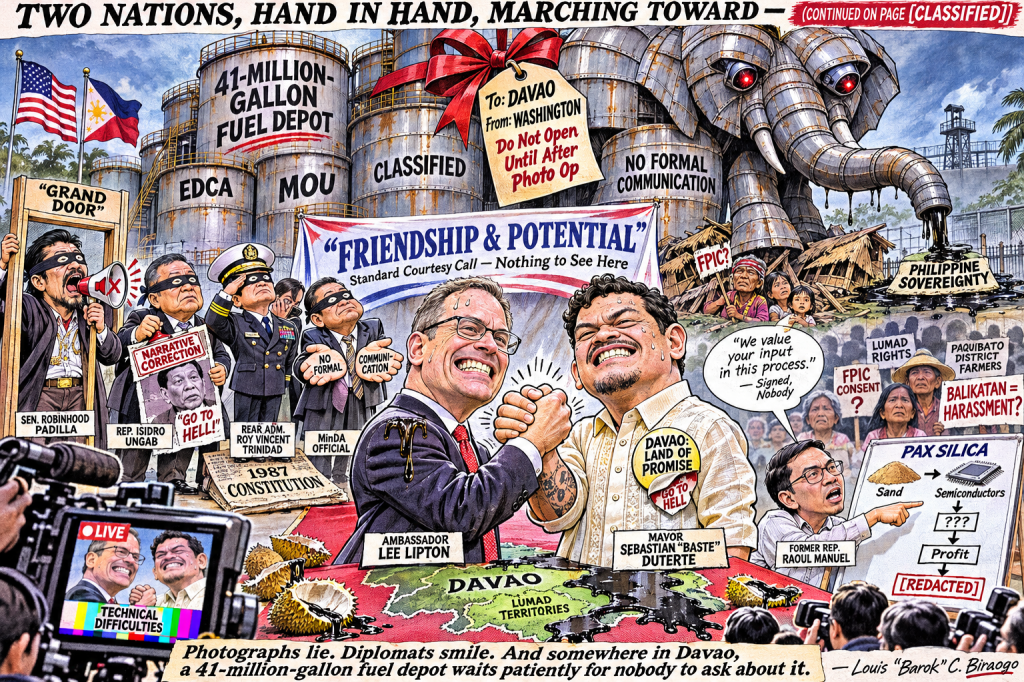
The Duterte dynasty needed friends. Washington needed a parking lot. Davao got both—and nobody asked the Lumad.
By Louis ‘Barok‘ C. Biraogo | October 28, 2026
PHOTOGRAPHS lie. Diplomats smile. And somewhere in Davao, a 41-million-gallon fuel depot waits patiently for nobody to ask about it.
On October 22, 2026, U.S. Ambassador Lee Lipton stood in Davao City, beaming beside Mayor Sebastian “Baste” Duterte, surrounded by Dabawenyos waving American flags. “With people like this,” Lipton declared, “it is easy to see nothing but POTENTIAL for what we can achieve together.” (Davao Today)
It was a lovely moment. Heartwarming, even. Two nations, hand in hand, marching toward a shared future of prosperity and friendship.
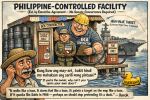
And somewhere in the background—perhaps just outside the frame, perhaps in a filing cabinet in Washington, perhaps in the imagination of paranoid activists—sat a 41-million-gallon fuel depot that nobody in the room wanted to discuss.
Welcome to Philippine foreign policy in 2026: a theater of the absurd where ambassadors play tourists, mayors play host, senators play cheerleaders, and the actual stakes remain buried under layers of diplomatic euphemism and willful ignorance.
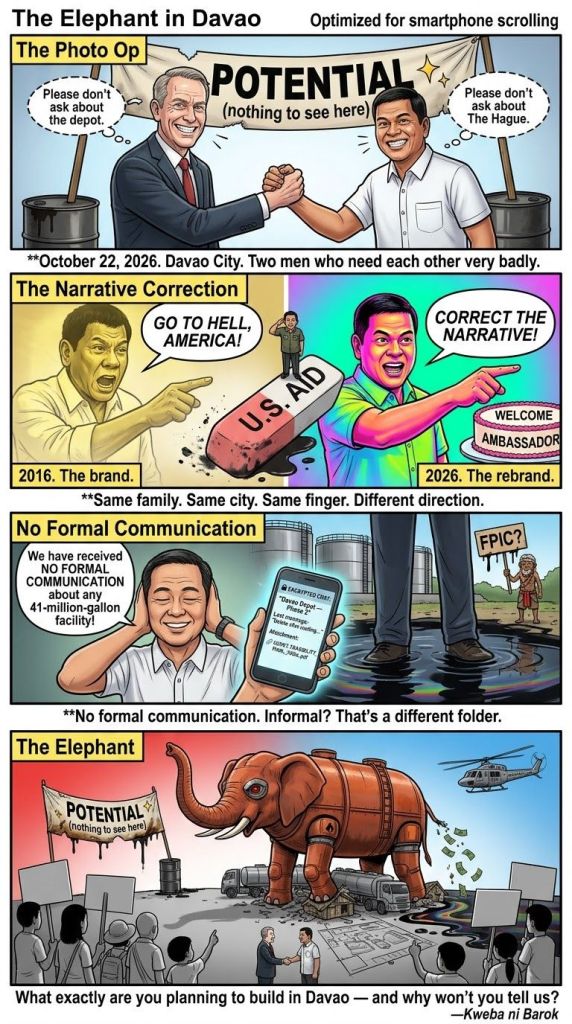
The Choreography of Deniability
Let us first appreciate the exquisite timing. Two days before Lipton’s visit, the Italian Ambassador Davide Gigilo had also visited Davao. This suggests either a coordinated Western charm offensive or an extraordinary coincidence involving two European ambassadors simultaneously discovering the charms of durian and Mount Apo.
I’ll let you decide which is more plausible.
The official narrative is that Lipton’s visit was a standard courtesy call—the kind of diplomatic pleasantry that new ambassadors perform when they need to familiarize themselves with the host country. Nothing to see here, folks. Just a diplomat doing diplomat things.
But then there’s Senator Robinhood Padilla, who helpfully explained that the visit “aims to open the grand door to free and safe business for the progress of the Land of Promise.” And Representative Isidro Ungab, who clarified that the visit would “correct the narrative na anti-US kaming mga Davao”—that is, correct the perception that Davao is anti-American.
Correct the narrative. How delightfully vague. Correct it to what, exactly? That Davao is open for business? That the Duterte dynasty is willing to forgive and forget? That the family that once famously told the United States to “go to hell” is now ready to sit down for coffee and development assistance?
I’m sure the 41-million-gallon fuel depot has nothing to do with any of this. Perish the thought.
The Constitutional Fog Machine
Here is where the story becomes genuinely interesting—and by interesting, I mean legally labyrinthine in the way that only Philippine constitutional law can be.
Article XVIII, Section 25 of the 1987 Constitution is admirably clear: “foreign military bases, troops, or facilities shall not be allowed in the Philippines except under a treaty duly concurred in by the Senate.”
Three requirements. A treaty. Senate concurrence. And, if Congress so demands, a national referendum.
Simple enough, right? Not so fast.
In 2016, the Supreme Court upheld the Enhanced Defense Cooperation Agreement (EDCA) in Saguisag v. Executive Secretary, ruling that it was a valid executive agreement implementing existing treaties rather than a new basing arrangement requiring Senate approval. The vote was 10-4-1. The majority reasoned that EDCA merely operationalized the 1951 Mutual Defense Treaty and the 1998 Visiting Forces Agreement (VFA), which the Court had earlier upheld in Bayan v. Zamora.
Justice Maria Lourdes Sereno, in her dissent, saw things differently. “The more onerous obligations of the Philippines and the far-reaching privileges accorded the United States under the EDCA cannot be justified as nor deemed to be mere implementing arrangements of the VFA,” she wrote.
She lost. But her words echo.
Now we have a proposed fuel depot in Davao—a facility that activists claim would store 41 million gallons of fuel for U.S. military operations. The Armed Forces of the Philippines (AFP)’s Rear Admiral Roy Vincent Trinidad says EDCA provides sufficient legal basis. Activists say it doesn’t.
Who’s right? That depends entirely on what the facility actually is, who controls it, and what agreements—if any—have been signed.
And here’s the beautiful part: nobody will tell us.
The Ministry of Missing Information
When the Davao City government opposed foreign military facilities in April 2026, the Mindanao Development Authority (MinDA) helpfully announced that it had received “no formal communication” about a U.S. military oil depot.
No formal communication. I love this phrase. It suggests that informal communication might well have occurred—perhaps over dinner, perhaps in a text message, perhaps in a whisper during a golf game—but since nothing was formally submitted, MinDA can plausibly deny all knowledge.
This is how bureaucracy works in the Philippines: not through lying, but through the careful management of what counts as a “formal” communication. A verbal agreement? Not formal. A memorandum of understanding? Depends on the wording. A handshake? Definitely not formal. A signed contract? Well, now we’re getting somewhere—but by then, the project is already done.
So we have a situation where:
- Activists claim a U.S. military fuel depot is being planned for Davao
- The city government says it opposes foreign military facilities
- MinDA says no formal proposal has been received
- The AFP says EDCA provides the legal basis
- The U.S. Embassy says nothing at all
- And the ambassador takes a photo with the mayor and everyone smiles
This is not transparency. This is the absence of transparency dressed up in diplomatic protocol.
The Duterte Gambit
Let us now turn to the political dimension, which is where the story becomes genuinely Shakespearean.
The Duterte dynasty is in trouble. Rodrigo Duterte sits in an International Criminal Court (ICC) detention cell in The Hague, awaiting trial for crimes against humanity. Sara Duterte, the Vice President, faces an impeachment trial in the Senate that could bar her from the 2028 presidential race. The family’s political machine, once seemingly invincible, is now fighting for survival.
Enter the United States—the very country Rodrigo once told to “go to hell.”
Why would the Dutertes welcome an American ambassador? The answer, I suspect, is not complicated: desperation.
When your patriarch is in an international prison and your scion faces impeachment, you need friends. You need international legitimacy. You need to demonstrate that you are not, in fact, a pariah family with authoritarian tendencies and a troubling relationship with extrajudicial killings.
You need a photo-op with an American ambassador.
Representative Ungab’s comment about “correcting the narrative” is telling. The Dutertes have spent years cultivating an anti-American image—partly genuine, partly performative, partly a useful political tool. But images can be changed. Narratives can be corrected. And 41 million gallons of fuel storage capacity can be a powerful incentive to correct them.
The question is: what does the United States want in return?
The Pax Silica Mystery
Raoul Manuel, the former Kabataan representative, raised an intriguing possibility: that the Davao fuel depot is connected to “Pax Silica”—a term that sounds like a pharmaceutical brand but apparently refers to U.S. military-industrial investments in strategic minerals.
Silica, for the uninitiated, is the primary component of sand. It’s also essential for semiconductors, solar panels, and a host of other technologies critical to modern economies and militaries. The Philippines has significant silica deposits.
Could a U.S. military fuel depot in Davao be part of a broader strategy to secure access to critical minerals? Could the “Pax Silica” project be a cover for something more extensive?
I don’t know. And that’s precisely the problem.
Manuel’s allegation may be paranoid fantasy. It may be prescient analysis. But without access to the actual documents—the feasibility studies, the financing agreements, the procurement contracts—there is no way to know.
And the government isn’t telling.
The Human Rights Afterthought
Amid all the geopolitical maneuvering and political theater, there is a dimension to this story that deserves more attention than it’s receiving: the actual people of Mindanao.
The League of Filipino Students Davao warns of “heightened militarization, harassment and human rights violations against local farmers and Indigenous Lumad communities.” They point to Balikatan exercises in Paquibato District as a source of abuse.
These are serious allegations. They deserve serious investigation.
But here’s the thing: the activists haven’t provided incident-level documentation. They speak of “harassment” and “violations” in general terms, without specifying dates, locations, perpetrators, or victims. This doesn’t mean the abuses haven’t happened—the Philippines has a long and sordid history of military abuses against civilians—but it does mean that the claims remain unproven.
Similarly, the claim that military exercises are “imposed” on Paquibato District suggests a lack of consultation, if not outright coercion. But what was the actual consultation process? Were community leaders informed? Did they object? Were their objections overruled?
We don’t know. Because nobody is telling.
The Indigenous Peoples Question
Speaking of Lumad communities, the Indigenous Peoples’ Rights Act (IPRA) provides specific protections that are directly relevant to any infrastructure project in ancestral domains.
Section 59 of Republic Act No. 8371, the Indigenous Peoples’ Rights Act of 1997 (IPRA), requires “free and prior informed consent” (FPIC) for any project that affects ancestral lands. This isn’t a suggestion; it’s a legal requirement. And the consent must be obtained “under the community’s customary laws and practices, free from external manipulation, interference, or coercion.”
If a fuel depot is being planned for an area that overlaps with ancestral domains—and in Mindanao, that’s almost inevitable—then FPIC is mandatory. Not a public hearing. Not a consultation. FPIC.
The question is: has FPIC been obtained? Has it even been initiated?
We don’t know. Because nobody is telling.
The Great Filipino Silence
Here is what I find most troubling about this entire affair: the willing suspension of inquiry.
A U.S. ambassador visits Davao. He meets with the mayor. They smile for photos. The mayor’s political allies speak of “correcting narratives” and “opening doors.” And everyone—everyone—pretends that this has nothing to do with the alleged military fuel depot that activists have been warning about for months.
This is not how a sovereign nation should conduct its affairs.
If the fuel depot is a legitimate commercial project, then it should be disclosed, reviewed, and approved through proper legal channels. If it’s a military facility, then it should be subject to the constitutional requirements for foreign military bases. If it doesn’t exist, then officials should say so clearly and put the matter to rest.
Instead, we get ambiguity. We get obfuscation. We get “no formal communication” and “correcting the narrative” and photos of smiling politicians.
This is governance by implication—the art of doing things without admitting that you’re doing them.
The Real Losers
Who loses in this game of diplomatic hide-and-seek?
The Lumad communities whose ancestral lands may be affected by a military facility they were never told about.
The farmers of Paquibato District whose fields may become training grounds for foreign troops.
The ordinary Dabawenyos whose city may become a strategic hub in a geopolitical competition between the United States and China—without their consent, without their knowledge, and without any say in the matter.
And ultimately, all Filipinos, who are asked to accept that their government is acting in their interest without being shown the evidence.
A Modest Proposal
I have a suggestion—radical, I know—for how to resolve this controversy:
Disclose everything.
If there is a proposal for a fuel depot, publish it. The feasibility study. The financing agreements. The environmental impact assessment. The land acquisition documents. The security arrangements. The memoranda of understanding. All of it.
If the proposal involves military access, submit it to the constitutional process required by Article XVIII, Section 25. Get Senate concurrence. Hold a referendum if Congress so demands. Follow the law.
If the proposal affects ancestral domains, conduct genuine FPIC consultations. Not information sessions. Not public hearings. FPIC, as required by IPRA.
If there are human rights concerns, investigate them. Document the abuses. Hold the perpetrators accountable. Protect the victims.
And if there is no proposal—if this is all a misunderstanding, a rumor, a paranoid delusion—then say so. Clearly. Publicly. Definitively. Put the matter to rest.
This is what transparency looks like. This is what accountability requires.
It is not what we are getting.
The Barok Question
Barok often asks: What would a morally serious person do?
In this case, a morally serious person would demand answers. They would not accept “no formal communication” as an answer. They would not be satisfied with “correcting the narrative.” They would not celebrate a diplomatic photo-op while ignoring the 41-million-gallon elephant in the room.
A morally serious person would recognize that sovereignty is not just a word to be invoked at international forums. It is a practice—a daily discipline of demanding transparency, insisting on legal compliance, and protecting the rights of the most vulnerable.
By that standard, the Lipton visit is a failure. Not because diplomacy is wrong, but because this diplomacy was conducted in the shadows, with the public kept in the dark about matters that directly affect their lives.
The Last Word
I will conclude with a prediction: within the next two years, we will learn more about the Davao fuel depot. Documents will surface. Whistleblowers will speak. Investigative journalists will dig. And we will discover—to no one’s surprise—that the truth was more complicated than the official narrative suggested.
Perhaps the depot will be a benign commercial facility. Perhaps it will be a fully disclosed military logistics center operating under a valid EDCA framework. Perhaps the Duterte family’s embrace of the American ambassador was entirely innocent, motivated only by a genuine desire for economic development.
Or perhaps not.
But by the time we know the answer, the deal will be done, the facility will be built, and the communities will be displaced. That’s how it works in the Philippines: by the time the truth comes out, it’s too late to do anything about it.
So here’s my final question, addressed to Ambassador Lipton, to Mayor Duterte, to Senator Padilla, and to everyone else who smiled for the cameras on October 22:
What exactly are you planning to build in Davao—and why won’t you tell us?
The Filipino people deserve an answer. Not a diplomatic deflection. Not a bureaucratic excuse. An answer.
Until we get one, I’ll keep asking. And I suspect I won’t be alone.
Louis ‘Barok’ C. Biraogo is a blogger and writer from Davao City. He writes about politics, human rights, and the things that governments would prefer you didn’t notice.
Key Citations
A. Legal & Official Sources
- Philippines. Constitution of the Republic of the Philippines. 1987. Official Gazette, www.officialgazette.gov.ph/constitutions/1987-constitution/.
- Philippines. Republic Act No. 8371. Indigenous Peoples’ Rights Act of 1997. LawPhil Project, www.lawphil.net/statutes/repacts/ra1997/ra_8371_1997.html.
- Saguisag v. Executive Secretary. G.R. Nos. 212426 and 212444. 12 Jan. 2016. Supreme Court of the Philippines, lawphil.net/judjuris/juri2016/jan2016/gr_212426_2016.html.
- Bayan v. Zamora. G.R. No. 138570. 10 Oct. 2000. Supreme Court of the Philippines, lawphil.net/judjuris/juri2000/oct2000/gr_138570_2000.html.
B. News Articles
- “Activists Warn U.S. Envoy’s Davao Trip Signals Deeper Mindanao Foothold.” Davao Today, 26 Oct. 2026, davaotoday.com/headline/activists-warn-u-s-envoys-davao-trip-signals-deeper-mindanao-foothold/.
- BNC Staff. “US Ambassador Visits Mayor Baste to Discuss Investment, Defense Ties.” Bilyonaryo News Channel, 22 Oct. 2026, bnc.bilyonaryo.com/us-ambassador-visits-mayor-baste-to-discuss-investment-defense-ties/news/.
- “MinDA: No Formal Communication on US Military Oil Depot Plans in Davao Region.” Mindanao Times, 16 Apr. 2026, www.mindanaotimes.com.ph/minda-no-formal-communication-on-us-military-oil-depot-plans-in-davao-region/.
C. Official Websites
- “City Official Backs LGUs Stand on Oil Depot.” Davao City Government, 22 Apr. 2026, davaocity.gov.ph/local-government/city-official-backs-lgus-stand-on-oil-depot/.
- “Ang Hirap Maging Mahirap”: The PAO Scandal That Proves Government Contempt Is Nothing New

- “Far-Off” My Axx: Malacañang’s Claire Castro Drowns in Her Own Legal Gaslighting
- “Forthwith” to Farce: How the Senate is Killing Impeachment—And Why Enrile’s Right (Even If You Can’t Trust Him)
- “HINDI AKO NAG-RESIGN!”

- “I Know Nothing”: Baste Duterte’s Amnesia Defense Meets ₱33M in GenCorp Contracts

- “I’m calling you from my new Globe SIM. Send load!”

- “Mahiya Naman Kayo!” Marcos’ Anti-Corruption Vow Faces a Flood of Doubt

- “Manageable” Debt, Unmanageable Lies: DBM’s ₱21 Trillion Fairy Tale
- “Meow, I’m calling you from my new Globe SIM!”

- “Natrabaho”: One Word, One Ombudsman, and a Judiciary on Trial
- “No Special Jail for Crooks!” Boying Remulla Slams VIP Perks for Flood Scammers
- “Philippine-Controlled” or Yankee Gas Station? The Davao Fuel Depot Farce Exposed




Leave a Reply