Claire Castro Discovers a New Constitutional Test: If the Road Is Paved and the Pocket Is Empty, the Insertion Is Legal
By Louis ‘Barok‘ C. Biraogo | October 29, 2026
STAY with me, because the Palace is counting on you not to.
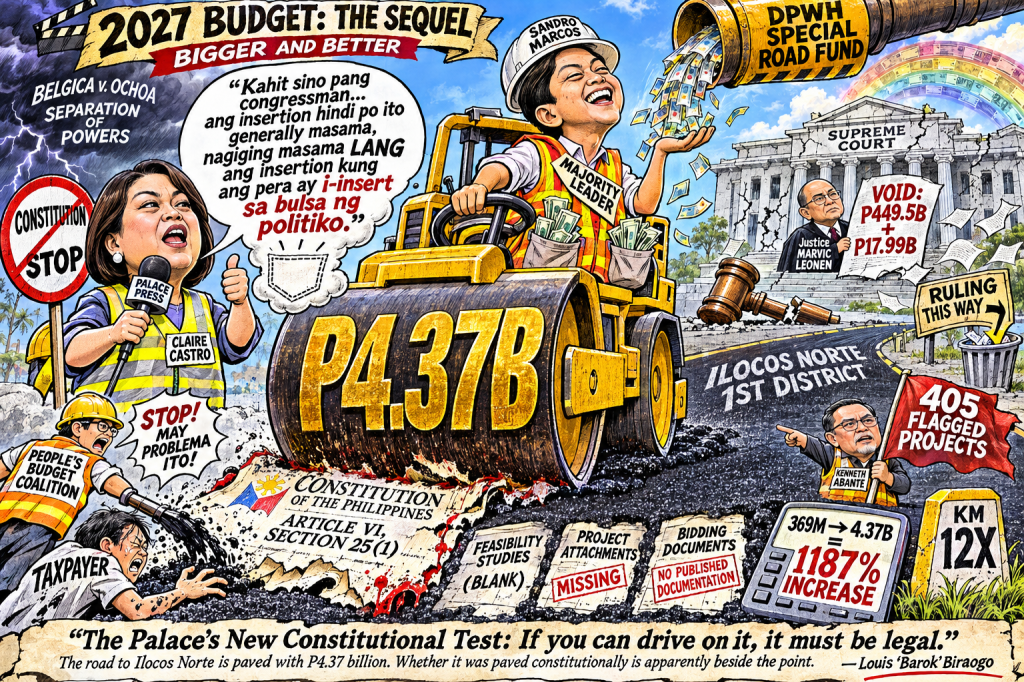
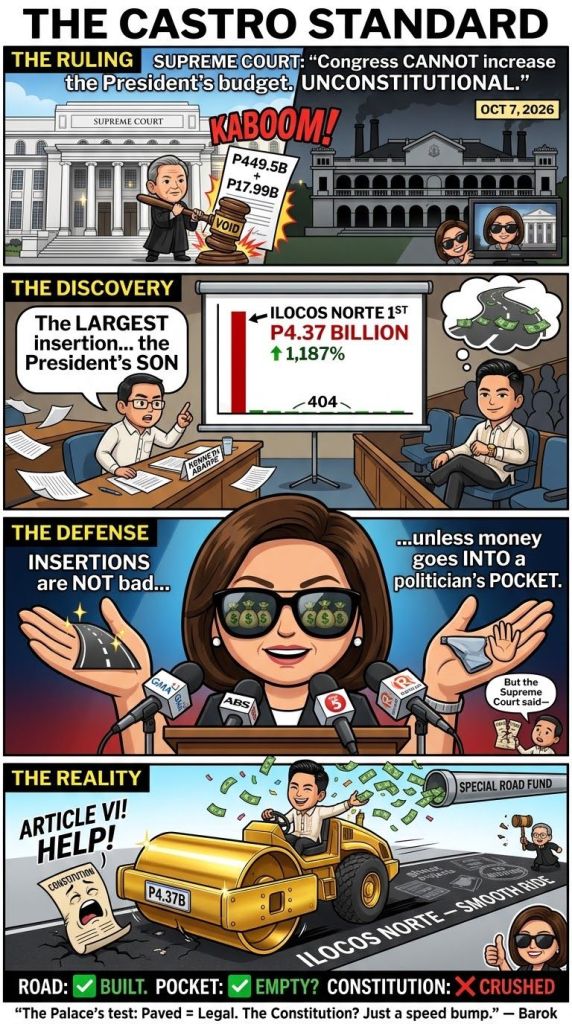
The Supreme Court, in a decision penned by Senior Associate Justice Marvic Leonen and promulgated just three weeks ago, declared that Congress cannot increase the President’s recommended appropriations. The Court voided P449.5 billion in unprogrammed appropriations for 2024 and P17.99 billion in Department of Public Works and Highways (DPWH) Special Road Fund increases for 2025. It called out the SAGIP program as a “covert repository of lump sum allocations for DPWH infrastructure.” It said Congress “severely distorted the budget creating artificial fiscal space.”
Seven days later—seven days—Palace Press Officer Claire Castro stood before reporters in Cagayan de Oro and explained that budget insertions are “not generally bad” because they only become bad “when the money is inserted into a politician’s pocket.”
And the project that prompted this constitutional exegesis? P4.37 billion in DPWH projects for the district of Ilocos Norte Representative Sandro Marcos. The President’s son. The House Majority Leader. The Chairman of the House Committee on Rules.
The largest allocation among 405 projects flagged by the People’s Budget Coalition.
Now, I am not a constitutional scholar. I am a blogger with a laptop and a suspicious mind. But even I can see that Castro’s defense is not a legal argument. It is a rhetorical misdirection so brazen that it deserves its own case study in how to gaslight a nation.
Pocket-Lining Jurisprudence
Here is the problem. Castro’s test—did the money go into a politician’s pocket?—is not the test the Supreme Court applied. It is not the test the 1987 Constitution of the Republic of the Philippines (Constitution) requires. And it is certainly not the test that any serious auditor would use.
The Court’s test, as articulated in Belgica v. Ochoa (G.R. No. 208566) and reinforced in the October ruling, is about process, not outcome. The question is not whether the road was built or whether the money was stolen. The question is whether Congress had the constitutional authority to insert the funds in the first place, and whether the mechanism through which those funds were allocated violated the separation of powers.
Castro says: “Perhaps we should simply look at whether the project is good, regardless of which congressman it is for.”
No. We should look at whether the project was lawfully authorized. Those are different questions. A road can be useful and still unconstitutional. A bridge can be necessary and still the product of a prohibited legislative intervention. A flood control project can be completed and still have been funded through a mechanism that the Supreme Court has already declared void.
This is not a subtle distinction. It is the entire ballgame.
Paved, Therefore Legal?
Let me walk you through what actually happened, because the timeline matters.
- On October 7, the Supreme Court ruled.
- On October 20, the decision was announced. The Court said Congress exceeded its constitutional limits by increasing the President’s recommended appropriations. It invalidated specific provisions in the 2024, 2025, and 2026 budgets. It set conditions for the use of unprogrammed funds going forward.
- On October 21, Malacañang announced it would file a motion for reconsideration. We covered that. “We followed the unconstitutional law, Your Honor” was the gist of it.
- On October 26, Kenneth Abante of the People’s Budget Coalition testified before the Senate Finance Committee that Sandro Marcos’s district had received P4.37 billion in DPWH projects—the single largest allocation among 405 projects under scrutiny.
- On October 27, Castro defended the insertions.
The sequencing is not accidental. The Palace is not responding to a hypothetical. It is responding to a specific finding, about a specific district, represented by a specific person, just days after the Supreme Court said the mechanism that produced such findings is constitutionally suspect.
And Castro’s response? Don’t look at the process. Look at the project. Don’t ask whether the insertion was lawful. Ask whether the road is paved.
This is not defense. This is deflection with a smile.
Translation Services Provided
Let us be precise about what Castro actually said, because the exact phrasing matters.
“Kahit sino pang congressman iyan kung ang pondo na nailaan sa kaniyang distrito ay tama ang paggamit, walang ghost projects, walang substandard na mga materials na ginamit sa mga proyekto ay hindi po ito magkakaroon ng problema dahil ang insertion hindi po ito generally masama, nagiging masama lang ang insertion kung ang pera ay i-insert sa bulsa ng politiko.”
Translation: “Whoever the congressman is, if the funds allocated to his district are used correctly, there are no ghost projects, no substandard materials used in the projects, then there should be no problem because insertions are not generally bad. Insertions only become bad when the money is inserted into a politician’s pocket.”
Notice what this formulation does. It collapses every possible constitutional violation into a single, narrow, almost impossible-to-prove category: personal enrichment through direct cash transfer.
It ignores the possibility that an insertion could be unconstitutional even if every peso is spent on concrete and rebar. It ignores the possibility that a project could be overpriced, or awarded to a favored contractor, or included without the technical justification required by law, or inserted through a mechanism that the Supreme Court has already said violates the separation of powers.
It ignores the entire body of Philippine jurisprudence on budget insertions that has accumulated since Belgica.
The Supreme Court in Belgica did not say that the Priority Development Assistance Fund (PDAF) was bad because legislators pocketed the money. It said PDAF was unconstitutional because it allowed legislators to intervene in post-enactment budget execution—a violation of separation of powers, non-delegability of legislative power, and the President’s veto authority.
The Court in the October ruling did not say that the P449.5 billion increase was void because the money was stolen. It said the increase was void because Congress exceeded its constitutional authority to increase the President’s recommended appropriations.
Castro’s test is not the constitutional test. It is a political test dressed up as a legal one.
The Rulebook and the Referee
And here is the thing about political tests: they are designed to be passed. If you define wrongdoing narrowly enough—as direct personal pocketing—then almost no one is ever guilty. The money flows to the district. The contractor builds the road. The congressman cuts the ribbon. Everyone is happy. The fact that the allocation may have violated the Constitution is treated as a technicality, a lawyer’s quibble, a distraction from the real work of governance.
But the Constitution is not a technicality. It is the rulebook. And the Supreme Court, in case anyone in Malacañang has forgotten, is the referee.
Twelve Times the Fun
Let me be fair to Castro for a moment. She is not wrong that insertions, in some abstract sense, are not inherently evil. Congress has the power of the purse. Legislators can advocate for their districts. The problem is not that Sandro Marcos wanted infrastructure for Ilocos Norte. The problem is the mechanism, the scale, and the timing.
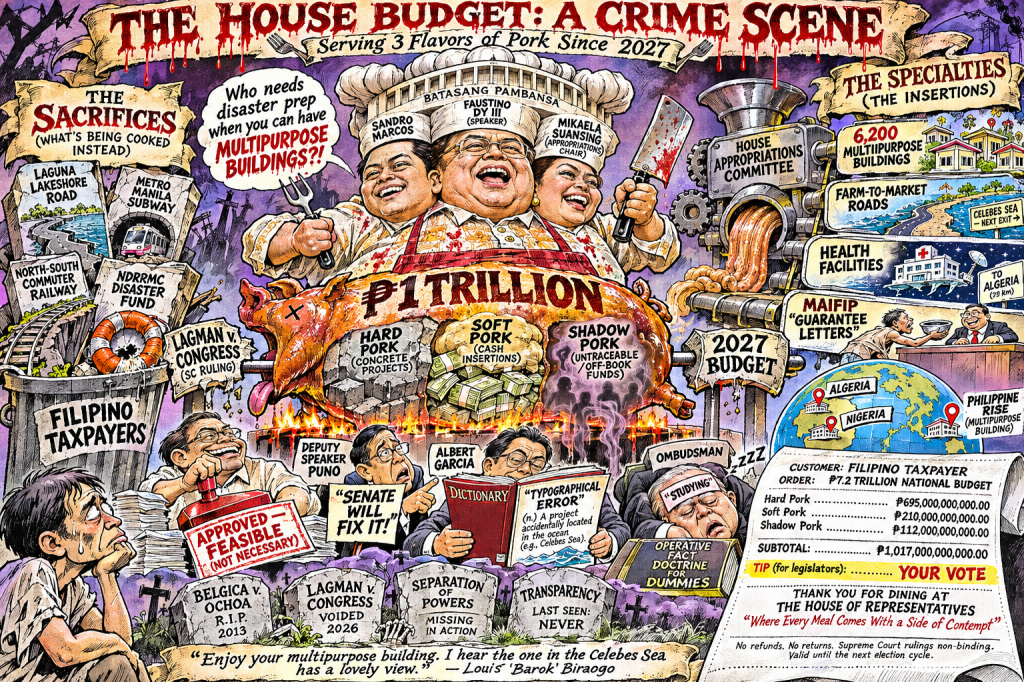
- The mechanism: the House inserted P4.38 billion into the DPWH budget for Ilocos Norte’s 1st District, up from P369 million in the President’s original proposal, as detailed in an earlier piece. That is a twelve-fold increase. It is not a modest adjustment. It is a wholesale rewriting of the executive’s budget priorities for one district.
- The scale: Abante’s coalition flagged over P1 trillion in what it called “budgetary red flags” in the House version of the 2027 budget, including P190 billion in infrastructure projects inserted without published project attachments. The P4.37 billion for Sandro Marcos’s district is the largest single item. It is not an anomaly. It is the flagship of a fleet.
- The timing: all of this happened just days after the Supreme Court invalidated the previous budget’s insertions. The House, in other words, looked at the wreckage of the 2024 and 2025 budgets, watched the Supreme Court strike them down, and then proceeded to do the same thing again—only bigger.
Castro says we should look at whether the projects are good. Fine. Let us look. Where are the project attachments? Where are the technical justifications? Where are the feasibility studies? Abante’s coalition says nearly 7,000 projects worth P190 billion lack published documentation. If the projects are so good, why is the paperwork so missing?
The answer, of course, is that the paperwork is not the point. The projects are the point. The projects are how you build a political network, reward allies, and demonstrate that you can deliver. The paperwork is an inconvenience. The Constitution is an inconvenience. The Supreme Court is an inconvenience.
And Claire Castro, with her helpful distinction between insertions that build roads and insertions that fill pockets, is doing her best to make the inconvenience go away.
The Dare
There is a darker reading here, and I think it deserves to be named.
Sandro Marcos is not just any congressman. He is the President’s son. He is the House Majority Leader. He chairs the Committee on Rules, which controls the flow of legislation in the lower chamber. His district received the largest increase in the House version of the budget. His father’s administration is currently asking the Supreme Court to reconsider the very ruling that declared the previous budget’s insertions unconstitutional.
And the Palace’s response to questions about this arrangement is to say: don’t worry, the money isn’t going into his pocket.
This is not a defense. It is a dare. It is the Palace saying: prove it. Prove that the money is being stolen. Prove that the projects are ghost projects. Prove that the contractors are corrupt. And while you are trying to prove it, we will keep building roads, cutting ribbons, and reminding voters that the opposition has nothing but allegations and press conferences.
The burden of proof, in other words, has been flipped. The Supreme Court says the process was unconstitutional. The Palace says the process does not matter unless you can prove theft. The watchdog says the allocations are anomalous. The Palace says anomalies are not crimes. The journalists ask questions. The Palace answers with talking points.
And the Constitution, the document that is supposed to constrain this entire exercise, is treated as a suggestion.
Negotiating With the Referee
I have written before about the Marcos administration’s relationship with the Supreme Court. It is not a relationship of deference. It is a relationship of negotiation. The Court issues a ruling. The Palace files a motion for reconsideration. The Court clarifies. The Palace complies partially. The cycle repeats.
But this time is different. This time, the Court did not just slap the executive on the wrist. It invalidated the budget. It said the mechanism itself was broken. And the House’s response, in the very next budget cycle, was to do it again.
Castro’s defense is not just a defense of insertions. It is a defense of impunity. It is the argument that the only wrongdoing that matters is the kind you can prove in a criminal court, and that everything else—the constitutional violations, the procedural irregularities, the optics of dynastic privilege—is just noise.
Asphalt Over the Constitution
I do not know whether Sandro Marcos will be the next President. I do not know whether the Supreme Court will hold the line or eventually give in to the pressure to reconsider. I do not know whether the Senate will strip the insertions from the 2027 budget or whether the bicameral conference committee will quietly restore them.
What I know is this: the Palace has told us, in plain language, that it does not believe the Constitution’s budget rules are binding unless someone can prove a crime. It has told us that insertions are fine as long as the roads get built. It has told us that the test is not legality but utility.
And if that is the standard—if the only question is whether the project is good and the money is not stolen—then the Supreme Court’s October ruling is meaningless. The Constitution’s Article VI, Section 25(1) is a dead letter. And every congressman in the country now knows that the way to defend an unconstitutional insertion is to build something visible and dare anyone to call it corrupt.
The road to Ilocos Norte is paved with P4.37 billion. Whether it was paved constitutionally is apparently beside the point.
Louis ‘Barok’ C. Biraogo is the author of Kweba ni Barok, where he writes about Philippine politics, law, and the art of pretending the Constitution is optional. He is still waiting for someone in Malacañang to explain why the Supreme Court’s October ruling does not apply to the President’s son.
Key Citations
A. Legal & Official Sources
- Belgica v. Ochoa. G.R. No. 208566, 19 Nov. 2013. LawPhil Project, lawphil.net/judjuris/juri2013/nov2013/gr_208566_2013.html.
- The 1987 Constitution of the Republic of the Philippines. LawPhil Project, 1987, lawphil.net/consti/cons1987.html.
- Supreme Court of the Philippines. “SC Holds Unprogrammed Appropriations Subject to Guidelines, Voids Congressional Increases in 2024 and 2025 Budgets.” Supreme Court of the Philippines, 20 Oct. 2026, sc.judiciary.gov.ph/sc-holds-unprogrammed-appropriations-subject-to-guidelines-voids-congressional-increases-in-2024-and-2025-budgets/.
B. News Reports
- Biraogo, Louis ‘Barok’ C. “Malacañang Files Motion for Reconsideration: ‘We Followed the Unconstitutional Law, Your Honor.’” Kweba ni Barok, 22 Oct. 2026, kwebanibarok.com/2026/10/22/malacanang-files-motion-for-reconsideration-we-followed-the-unconstitutional-law-your-honor/.
- —. “Marcos Jr.’s Son Got a 1187% Budget Increase and Nobody Can Find the Paperwork.” Kweba ni Barok, 27 Oct. 2026, kwebanibarok.com/2026/10/27/marcos-jr-s-son-got-a-1187-budget-increase-and-nobody-can-find-the-paperwork/.
- —. “Supreme Court to Congress: That’s Not a Contingency Fund, That’s Pork.” Kweba ni Barok, 21 Oct. 2026, kwebanibarok.com/2026/10/21/supreme-court-to-congress-thats-not-a-contingency-fund-thats-pork/.
- “Palace Defends Insertions amid Sandro’s P4.37-B ‘Windfall.’” Daily Tribune, 27 Oct. 2026, tribune.net.ph/2026/10/27/palace-defends-insertions-amid-sandros-p437-b-windfall.

- “Ang Hirap Maging Mahirap”: The PAO Scandal That Proves Government Contempt Is Nothing New

- “Far-Off” My Axx: Malacañang’s Claire Castro Drowns in Her Own Legal Gaslighting
- “Forthwith” to Farce: How the Senate is Killing Impeachment—And Why Enrile’s Right (Even If You Can’t Trust Him)
- “HINDI AKO NAG-RESIGN!”

- “I Know Nothing”: Baste Duterte’s Amnesia Defense Meets ₱33M in GenCorp Contracts

- “I’m calling you from my new Globe SIM. Send load!”

- “Mahiya Naman Kayo!” Marcos’ Anti-Corruption Vow Faces a Flood of Doubt

- “Manageable” Debt, Unmanageable Lies: DBM’s ₱21 Trillion Fairy Tale
- “Meow, I’m calling you from my new Globe SIM!”

- “Natrabaho”: One Word, One Ombudsman, and a Judiciary on Trial

- “No Special Jail for Crooks!” Boying Remulla Slams VIP Perks for Flood Scammers

- “Philippine-Controlled” or Yankee Gas Station? The Davao Fuel Depot Farce Exposed





Leave a Reply