PNOC-EC Signed With Shell Thailand and Interport Indonesia. Here’s What the Fine Print Doesn’t Say.
By Louis ‘Barok’ C. Biraogo — November 17, 2026
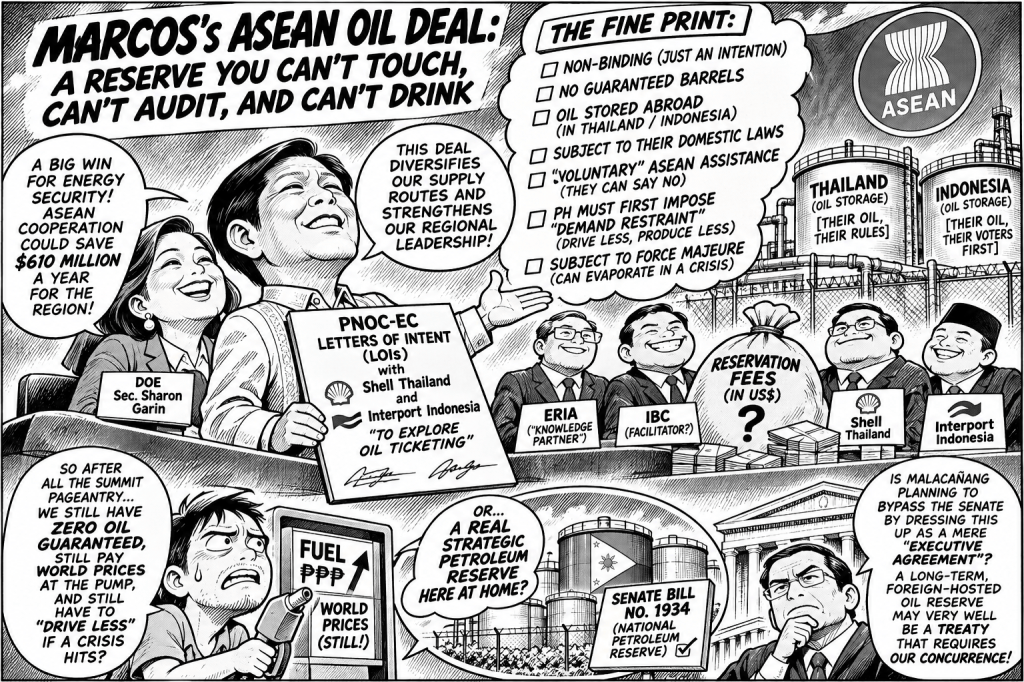
SWEEP aside the summit pageantry and the self-congratulatory press releases from the ASEAN Business and Investment Summit. The Philippine government, through Philippine National Oil Company-Exploration Corporation (PNOC-EC), has signed Letters of Intent with entities in Indonesia and Thailand to “explore” oil ticketing. The headlines scream energy security. Economic Research Institute for ASEAN and East Asia (ERIA)’s slick study promises a $610 million annual saving for the region. President Marcos gets to look like a regional statesman, and Energy Secretary Sharon Garin gets a photo op. Everyone goes home happy, except perhaps the Filipino motorist who still pays world prices at the pump.
Here is the uncomfortable truth that the Department of Energy (DOE) is hoping you won’t scrutinize: The Philippines has not secured a single barrel of oil. What we have is a non-binding agreement to talk about maybe, possibly, storing oil that someone else owns, in someone else’s facility, subject to someone else’s domestic laws, during a crisis where that “someone else” will almost certainly prioritize their own citizens over a Philippine claim.
This isn’t a strategic petroleum reserve. It’s a strategic petroleum vibe. And relying on a vibe during a shooting war in the Strait of Hormuz is a national security malpractice.
The Legal Fiction of the “Letter of Intent”
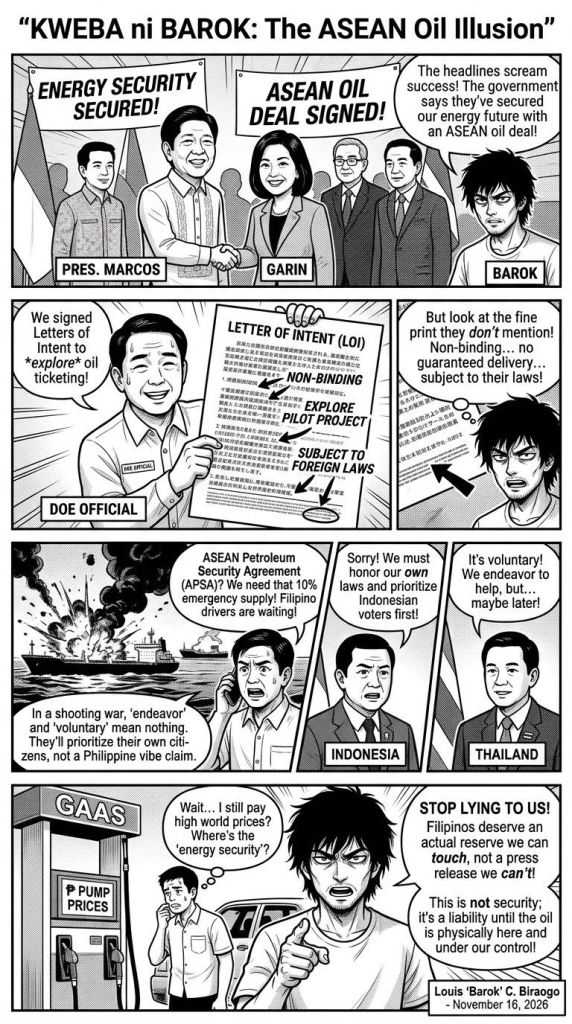
Let’s start with the fundamental legal reality that the DOE and PNOC-EC seem determined to obfuscate. What was signed on November 14, 2026, were Letters of Intent (LOIs). In the hierarchy of legal commitments, an LOI ranks slightly above a handshake and significantly below a binding contract. It expresses an intention to perhaps explore a pilot project. It creates no obligation for PT Interport Mandiri Utama or The Shell Company of Thailand to actually deliver a single drop of diesel to Manila when the proverbial excrement hits the rotary impeller.
The documents are merely “exploring oil ticketing mechanisms.” Under a ticketing arrangement, you pay for the right to access oil. But the critical question—one that the government’s cheerleaders refuse to answer—is: What exactly is the Philippines buying?
Are we buying the oil itself? Are we buying a call option? Or are we merely paying Shell Thailand and Interport a reservation fee for the privilege of competing with Thai and Indonesian domestic consumers for the same barrels when a crisis hits? The LOIs do not say. And until a binding contract specifies the volume, the grade, the physical segregation, the ownership title, and the emergency release protocol, the Filipino people are being sold an illusion.
The ASEAN Paper Tiger and the “Voluntary” Noose
The government’s implicit defense is that this initiative builds on the Association of Southeast Asian Nations (ASEAN) Petroleum Security Agreement (APSA). Let’s examine that safety net, shall we? The 2009 APSA, and its 2025 successor, contains a seemingly generous commitment: member states shall endeavor to supply a distressed neighbor with 10% of its normal requirement.
Read that word carefully: Endeavor.
As the ASEAN Centre for Energy’s own executive director admitted in October 2026, the assistance is strictly “voluntary and commercial,” a fact that “limits the assurance of emergency cargoes.” The APSA even mandates that the distressed country must first impose “demand restraint” measures before it can beg for help. In plain English: before the Philippines can ask Indonesia for oil, the Philippine government must first tell Filipino drivers to drive less and factories to produce less.
If a simultaneous crisis hits the region—exactly the scenario the Iran conflict is currently testing—why would Indonesia, facing its own domestic shortages under Presidential Regulation No. 96/2024, honor a voluntary, non-binding ASEAN pledge over the needs of its own voters? The answer is that it wouldn’t. The ERIA study itself quietly concedes the point by modeling a scenario where cooperation saves money, but it cannot model political will. The $610 million figure is an accounting exercise, not a guarantee of delivery.
The Great Middleman Money Machine
Then there is the question of who benefits from this arrangement. The LOIs were facilitated by ERIA and the Indonesian Business Council (IBC). Why is a Philippine government-owned corporation relying on an Indonesian business lobby to broker its energy security? What is the compensation structure for these “knowledge partners”? The government has refused to disclose the commercial terms of the facilitation, citing confidentiality.
If PNOC-EC is paying reservation fees—in US dollars, no less—to a Shell subsidiary in Thailand for oil that Shell may have sourced from the same Middle Eastern producers that the Philippines could buy from directly, what is the value added? The only value added is the appearance of action. It allows the DOE to claim it has “diversified” supply routes without actually building a single tank or buying a single barrel of physical inventory.
This is the same playbook that gave us the notoriously opaque deals of the past: outsource the risk to a private multinational, pay them in hard currency, and then discover during the actual emergency that the contract’s force majeure clause is thicker than the oil slick.
The Domestic Law Problem: Where is the Senate?
Let’s get constitutional for a moment, because someone needs to. If these LOIs eventually mature into binding government-to-government agreements that create enforceable emergency entitlements, they may very well constitute a treaty under Article VII, Section 21 of the 1987 Constitution. That provision requires the concurrence of at least two-thirds of the Senate.
Is Malacañang planning to bypass the Senate by dressing up a sovereign energy commitment as a mere “executive agreement” or a commercial contract? The Supreme Court has already warned against this in Saguisag v. Ochoa and Bayan Muna v. Romulo: you cannot use an executive agreement to evade the treaty-making process when the subject matter requires it.
If the Philippine government is committing the republic to a long-term, dollar-denominated, foreign-hosted oil reserve scheme, the Senate must ratify it. The Filipino people deserve a debate on whether we are outsourcing our energy sovereignty to Jakarta and Bangkok, or whether we should be building our own Strategic Petroleum Reserve here at home, as Senate Bill No. 1934 proposes. Sotto’s bill may not be perfect, but at least it keeps the oil on Philippine soil and under Philippine control.
The Verdict: Proceed, But Stop Lying to Us
I am not saying the Philippines should reject these pilots outright. In a world where the Strait of Hormuz is a shooting gallery, having some additional option, however tenuous, is better than nothing. The ERIA study has genuine analytical merit regarding the cost savings of regional cooperation.
But the government must stop conflating diplomatic activity with energy security.
The DOE must immediately publish the full text of the LOIs. It must clarify that the Philippines currently has zero legally guaranteed barrels in Indonesia or Thailand. It must stop using the $610 million regional saving figure as if it were a discount on domestic fuel prices. And it must explain to the Filipino public exactly what happens when a Thai fisherman and a Filipino jeepney driver are both waiting for the same Shell tanker during a crisis.
Until the contracts specify physical segregation, independent inventory verification, enforceable delivery deadlines, and sovereign immunity waivers, this initiative is not a lifeline. It is a liability—a potential contingent obligation that could cost the government millions in reservation fees for a service that evaporates the moment it is needed.
The Filipino people deserve a reserve they can touch, not a press release they can’t.
Key Citations
A. Legal & Official Sources
- Association of Southeast Asian Nations. ASEAN Petroleum Security Agreement. 1 Mar. 2009. Centre for International Law, National University of Singapore, https://cil.nus.edu.sg/wp-content/uploads/2019/02/2009-ASEAN-Petroleum-Security-Agreement.pdf.
- Economic Research Institute for ASEAN and East Asia. ASEAN Oil Stockpiling Strategy: Analysis and Recommendations. 12 Nov. 2026, https://www.eria.org/publications/asean-oil-stockpiling-strategy–analysis-and-recommendations.
- Economic Research Institute for ASEAN and East Asia. “ERIA, IBC, and Energy Companies Sign Letters of Intent to Explore Emergency Oil Access for the Philippines.” ERIA, 14 Nov. 2026, https://www.eria.org/news-and-views/eria–ibc–and-energy-companies-sign-letters-of-intent-to-explore-emergency-oil-access-for-the-philippines.
- The 1987 Constitution of the Republic of the Philippines. Official Gazette of the Republic of the Philippines, 1987, https://www.officialgazette.gov.ph/constitutions/the-1987-constitution-of-the-republic-of-the-philippines/the-1987-constitution-of-the-republic-of-the-philippines-article-vii/.
- Saguisag v. Ochoa, G.R. No. 212426, Supreme Court of the Philippines, 12 Jan. 2016, https://www.lawphil.net/judjuris/juri2016/jan2016/gr_212426_2016.html.
- Bayan Muna v. Romulo, G.R. No. 159618, Supreme Court of the Philippines, 1 Feb. 2011, https://lawphil.net/judjuris/juri2011/feb2011/gr_159618_2011.html.
- Senate of the Philippines. Senate Bill No. 1934: Philippine Strategic Petroleum Reserve Act. 20th Congress, 4 Mar. 2026, https://legacy.senate.gov.ph/lis/bill_res.aspx?congress=20&q=SBN-1934.
- Indonesia. Presidential Regulation No. 96 of 2024 on Energy Buffer Reserves. 2 Sept. 2024, https://peraturan.bpk.go.id/Details/297377/perpres-no-96-tahun-2024.
B. News Reports
- Hellenic Shipping News. “ASEAN Targets Full Ratification of Petroleum-Security Pact before Nov Summit: ACE.” Hellenic Shipping News, 30 Oct. 2026, https://www.hellenicshippingnews.com/asean-targets-full-ratification-of-petroleum-security-pact-before-nov-summit-ace/.
- Manila Bulletin. “Philippines Signs Deals to Tap Emergency Oil Reserves in Indonesia, Thailand.” Manila Bulletin, 14 Nov. 2026, https://mb.com.ph/2026/11/14/philippines-signs-deals-to-tap-emergency-oil-reserves-in-indonesia-thailand.
- Talavera, Sheldeen Joy. “Philippines Could Be Granted Access to Indonesian, Thai Oil Storage.” BusinessWorld Online, 15 Nov. 2026, https://bworldonline.com/economy/2026/11/15/794095/philippines-could-be-granted-access-to-indonesian-thai-oil-storage/.
- Nazario, Dhel. “Sotto Bill Seeks Establishment of National Petroleum Reserve for Energy Security.” Manila Bulletin, 5 Mar. 2026, mb.com.ph/2026/03/05/sotto-bill-seeks-establishment-of-national-petroleum-reserve-for-energy-security.
- VietnamPlus. “Oil Stockpiling Cooperation Can Save ASEAN Hundreds of Millions of USD Annually: ERIA.” VietnamPlus, 5 Nov. 2026, https://en.vietnamplus.vn/oil-stockpiling-cooperation-can-save-asean-hundreds-of-millions-of-usd-annually-eria-post354979.vnp.

- ₱9 Billion in ‘Savings’? DILG’s Fire Truck Deal Smells Like Smoke

- ₱8B BBM Pork: CCTV for Every Captain’s Kumpare?
- ₱8.9 Billion, 331 Ghost Police Stations: The TIKAS Scandal Explained

- ₱8.4 Billion, 42,000 Barangays, 1 Election: The “Bawat Barangay Makikinabang” Vote-Buying Masterclass

- ₱75 Million Heist: Cops Gone Full Bandit

- ₱63 to the Dollar: The Only Thing Falling Faster Than the Peso Is the Government’s Credibility
- ₱6.77B Ghost Haunts Duterte: RTC Dismisses Mans Carpio’s Desperate Plea

- ₱6.77 Billion and Zero Cash: The Sara Duterte SALN Math That Doesn’t Add Up

- ₱6.7-Trillion Temptation: The Great Pork Zombie Revival and the “Collegial” Vote-Buying Circus

- ₱58.53B, Zero Receipts: The LGSF Pork Barrel Nobody Wants to Name
- ₱53 Million Man Tells ₱695-a-Day Workers to Stop Being ‘Mayabang’: The Audacity of BSP’s Remolona

- ₱491-M Right-of-Way Scam: DPWH Paid for Ghost Land, Ombudsman Finally Notices




Leave a Reply