When Record Investment Approvals Trigger Fraternity Panic Instead of Applause
By Louis ‘Barok‘ C. Biraogo — November 16, 2026
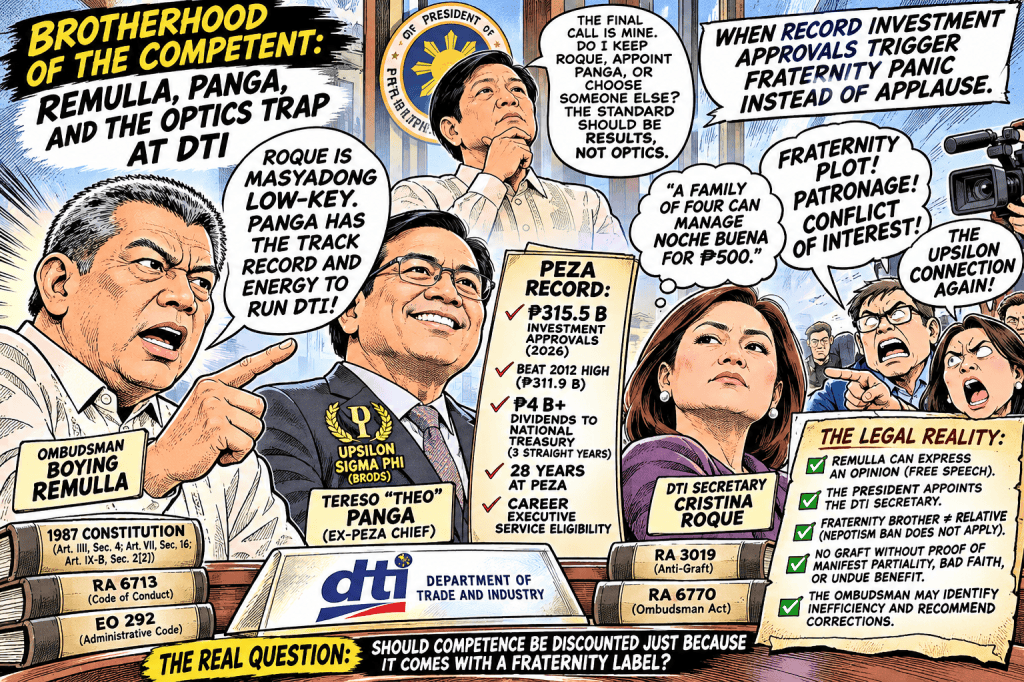
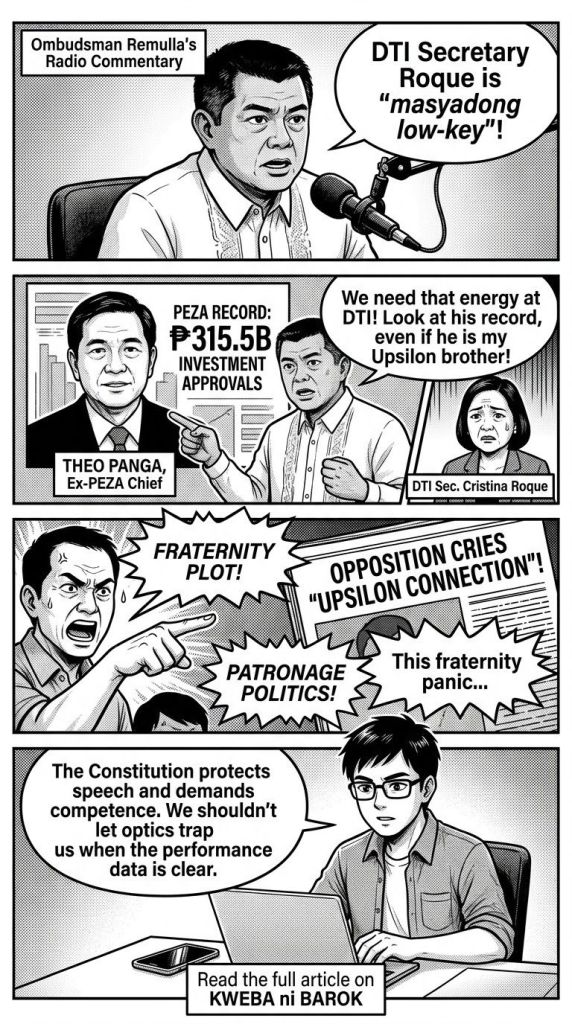
THE pearl-clutching has begun. Ombudsman Jesus Crispin “Boying” Remulla went on his radio program, called Department of Trade and Industry (DTI) Secretary Cristina Aldeguer-Roque “masyadong low-key,” and floated the name of Tereso “Theo” Panga—his Upsilon Sigma Phi brother—as someone who might actually run the place with energy. Within hours the usual suspects treated this as evidence of a dark fraternity plot rather than an adult conversation about competence.
Start with the Record, Not the Nickname
Start with the record, not the nickname. Panga spent roughly twenty-eight years at the Philippine Economic Zone Authority (PEZA). He rose through Policy Planning, zone management, and the Deputy Director General post. He holds Career Executive Service eligibility. Under his watch PEZA recorded investment approvals of ₱315.5 billion as of early November 2026, topping the previous high of ₱311.9 billion set in 2012, and the agency remitted more than ₱4 billion in dividends to the National Treasury over three consecutive years. Those are not cocktail-party credentials. They are measurable outputs from an investment-promotion agency whose core job is to attract capital and jobs.
Roque’s Public Profile Offers a Different Data Point
Roque’s public profile offers a different data point. In late 2025 she told the country that a family of four could manage Noche Buena for ₱500. The remark was widely condemned as detached from the actual cost of living. When an Ombudsman whose statutory mandate includes spotting inefficiency and recommending corrections then says the current secretary is insufficiently assertive, the reaction is not “let us examine the numbers.” It is “he must be lobbying for his brod.”
The Legal Architecture Does Not Support the Outrage
The legal architecture does not support the outrage. Article III, Section 4 of the 1987 Constitution protects speech. The Ombudsman does not forfeit that protection upon taking the oath. Article VII, Section 16 reserves the power to appoint Cabinet secretaries to the President. Remulla’s public preference does not appoint anyone. Article IX-B, Section 2(2) requires merit and fitness “as far as practicable,” yet Cabinet posts are policy-determining political appointments, not rank-and-file competitive examinations. Republic Act No. 6713 (Code of Conduct and Ethical Standards for Public Officials and Employees)’s professionalism clause warns against creating the perception that officials peddle patronage; it does not outlaw the expression of an opinion grounded in a documented track record. Executive Order No. 292 (Administrative Code of 1987)’s nepotism ban covers relatives within the third civil degree. A fraternity brother is not a relative. Republic Act No. 3019 (Anti-Graft and Corrupt Practices Act), Section 3(e) requires proof of manifest partiality, evident bad faith, or gross negligence that produces undue injury or an unwarranted benefit. A radio comment and a shared Greek-letter affiliation fall well short of those elements.
The Transfer Supplies Additional Context
The transfer of Panga from PEZA to the Toll Regulatory Board on 13 November 2026 supplies additional context. Investment facilitation and toll-road regulation are different mandates. Moving an official who has just delivered record approvals into a smaller regulatory shop invites the question whether talent is being optimally deployed. Remulla’s suggestion that the same talent might be better used at DTI is the opposite of concealment; it is an argument made in public, subject to counter-argument and presidential judgment.
Critics Apply a Standard They Do Not Apply to Other Networks
Critics who treat every Upsilonian connection as presumptive corruption are applying a standard they do not apply to other networks. Philippine government has long contained alumni of various fraternities, professional associations, and political clans. The Constitution does not create a disqualification for any of them. What it does require is that appointments rest on qualifications and that public officers remain accountable. Panga’s PEZA biography and the published investment figures meet the first test. Remulla’s decision to say so aloud meets the second; silence would have been the more convenient choice for a man who prefers not to be accused of favoritism.
The Deeper Institutional Risk Runs in the Opposite Direction
The deeper institutional risk runs in the opposite direction from the one usually claimed. If the country’s chief accountability officer is expected to mute every assessment that happens to involve someone he has known for decades, the Office of the Ombudsman becomes a monastery rather than a watchdog. Republic Act No. 6770 (The Ombudsman Act of 1989) already authorizes the Ombudsman to identify inefficiency and recommend its elimination. Identifying a proven investment executive while noting that the current trade secretary has been described, even by her critics, as low-profile is within that perimeter. The remedy for disagreement is better data, not a demand that the Ombudsman pretend he has never met a competent colleague.
Panga’s Strongest Position Is the One He Already Occupies
Panga’s strongest position is the one he already occupies: a career civil servant whose performance numbers are on the public record. He need not apologize for the fraternity that introduced him to people who later noticed those numbers. Remulla’s strongest position is the one the Constitution already grants him: the freedom to describe what he sees, coupled with the absence of any power to impose it. The President remains free to retain Roque, to appoint Panga, or to choose someone else entirely. The only obligation that cannot be outsourced is the obligation to explain the choice in terms of results rather than optics.
The alternative is a politics in which measurable performance is treated as suspect the moment it is noticed by the wrong person, and in which the safest career move is to remain sufficiently low-key that no one ever recommends you. That is not the standard the Code of Conduct or the Constitution was written to protect.
Key Citations
A. Legal & Official Sources
- The 1987 Constitution of the Republic of the Philippines. Official Gazette of the Republic of the Philippines, 1987, http://www.officialgazette.gov.ph/constitutions/1987-constitution/.
- Republic Act No. 6713. An Act Establishing a Code of Conduct and Ethical Standards for Public Officials and Employees. 1989, lawphil.net/statutes/repacts/ra1989/ra_6713_1989.html.
- Executive Order No. 292. The Administrative Code of 1987. Supreme Court E-Library, elibrary.judiciary.gov.ph/thebookshelf/showdocs/5/53270.
- Republic Act No. 3019. Anti-Graft and Corrupt Practices Act. 1960, lawphil.net/statutes/repacts/ra1960/ra_3019_1960.html.
- Republic Act No. 6770. The Ombudsman Act of 1989. Supreme Court E-Library, elibrary.judiciary.gov.ph/thebookshelf//showdocs/2/2100.
- Philippine Economic Zone Authority. “Director General’s Corner.” PEZA, http://www.peza.gov.ph/director-general-corner.
B. News Reports
- Cordero, Ted. “Panga Leaves PEZA with Record P315.5B Investment Yield.” GMA News Online, 13 Nov. 2026, http://www.gmanetwork.com/news/money/economy/1009390/panga-leaves-peza-with-record-p315-5b-investment-yield/story/.
- Mabasa, Roy C. “When Brotherhood Meets Political Power.” Politiko, 15 Nov. 2026, politiko.com.ph/when-brotherhood-meets-political-power/.
- Mabasa, Roy C. “‘Masyadong Low-Key!’ Remulla Hits Cristina Roque, Touts Ex-PEZA Chief as New DTI Chief.” Politiko, 15 Nov. 2026, politiko.com.ph/masyadong-low-key-remulla-hits-cristina-roque-touts-ex-peza-chief-as-new-dti-chief/.
- Clapano, Jose Rodel. “Lawmakers Hit P500 Noche Buena.” The Philippine Star, 29 Nov. 2025, https://www.philstar.com/headlines/2025/11/29/2490611/lawmakers-hit-p500-noche-buena.
- Philstar.com. “Panga Bows Out of PEZA after Record P315 Billion Investment Haul.” The Philippine Star, 14 Nov. 2026, http://www.philstar.com/business/2026/11/14/2569934/panga-bows-out-peza-after-record-p315-billion-investment-haul/amp.
- Serquiña, Mariel Celine. “PEZA Chief Panga Moved to Toll Regulatory Board.” GMA News Online, 13 Nov. 2026, http://www.gmanetwork.com/news/money/economy/1009394/peza-chief-panga-moved-to-toll-regulatory-board/story/.
- “Ang Hirap Maging Mahirap”: The PAO Scandal That Proves Government Contempt Is Nothing New

- “Far-Off” My Axx: Malacañang’s Claire Castro Drowns in Her Own Legal Gaslighting

- “Forthwith” to Farce: How the Senate is Killing Impeachment—And Why Enrile’s Right (Even If You Can’t Trust Him)

- “HINDI AKO NAG-RESIGN!”

- “I Know Nothing”: Baste Duterte’s Amnesia Defense Meets ₱33M in GenCorp Contracts

- “I’m calling you from my new Globe SIM. Send load!”

- “Mahiya Naman Kayo!” Marcos’ Anti-Corruption Vow Faces a Flood of Doubt

- “Manageable” Debt, Unmanageable Corruption: The ₱19.66-Trillion Lie
- “Manageable” Debt, Unmanageable Lies: DBM’s ₱21 Trillion Fairy Tale

- “Meow, I’m calling you from my new Globe SIM!”

- “Natrabaho”: One Word, One Ombudsman, and a Judiciary on Trial

- “No Special Jail for Crooks!” Boying Remulla Slams VIP Perks for Flood Scammers




Leave a Reply