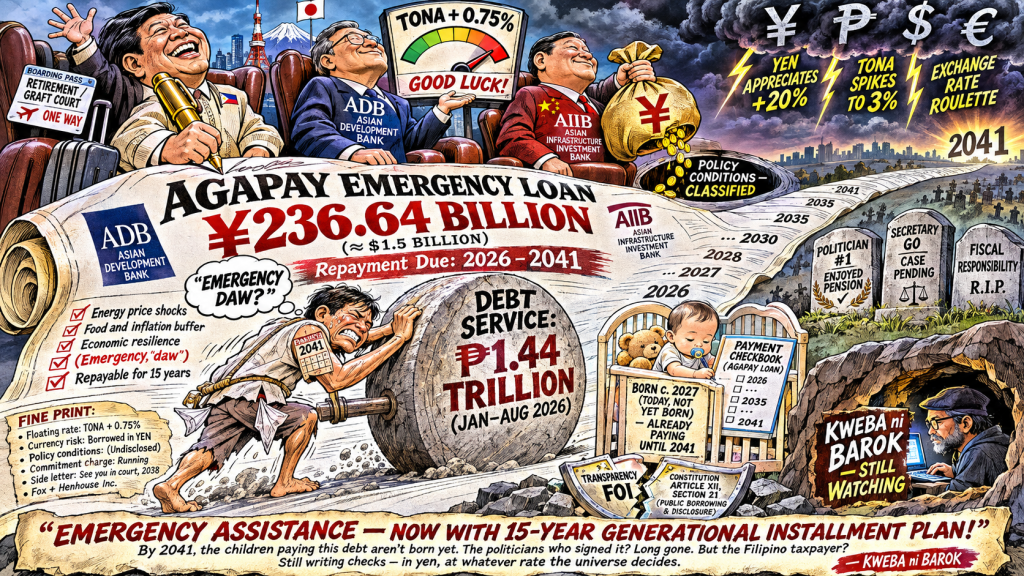
Inside the ₱1.5-Billion AGAPAY Loan: Yen-Denominated Debt, Floating Rates, and a Repayment Schedule That Outlives the Crisis
By Louis ‘Barok‘ C Biraogo — October 29, 2028
MGA ka-kweba, countrymen, and those still naive enough to believe that a loan agreement signed in October is about a war that started years ago—welcome back to the Cave.
Today we are going to dissect the Assistance for Greater Resilience and Alleviation of Poverty Program (AGAPAY) loan. One-point-five billion dollars. Japanese yen. Floating rate. Repayment until 2041.
Let that number sink in. 2041. By then, the children who will be paying off this debt are not yet born. The politicians who signed this deal will be long gone—retired, perhaps enjoying a generous pension, perhaps defending themselves in a graft case or two. But the Filipino taxpayer? The Filipino taxpayer will still be writing checks to the Asian Development Bank (ADB), in yen, at whatever exchange rate the universe decides to bestow upon us in 2038.
And they call this “emergency assistance.”
Let me be clear from the start, mga ka-kweba. I am not against borrowing per se. I am not against helping Overseas Filipino Workers (OFWs), transport workers, or poor households hit by oil price shocks. If the Middle East war has genuinely crippled our economy, then some form of fiscal response is defensible.
But this? This is not a crisis response. This is a generational mortgage on a fire that may or may not still be burning—and the Filipino people are being asked to sign on the dotted line without seeing the full contract.
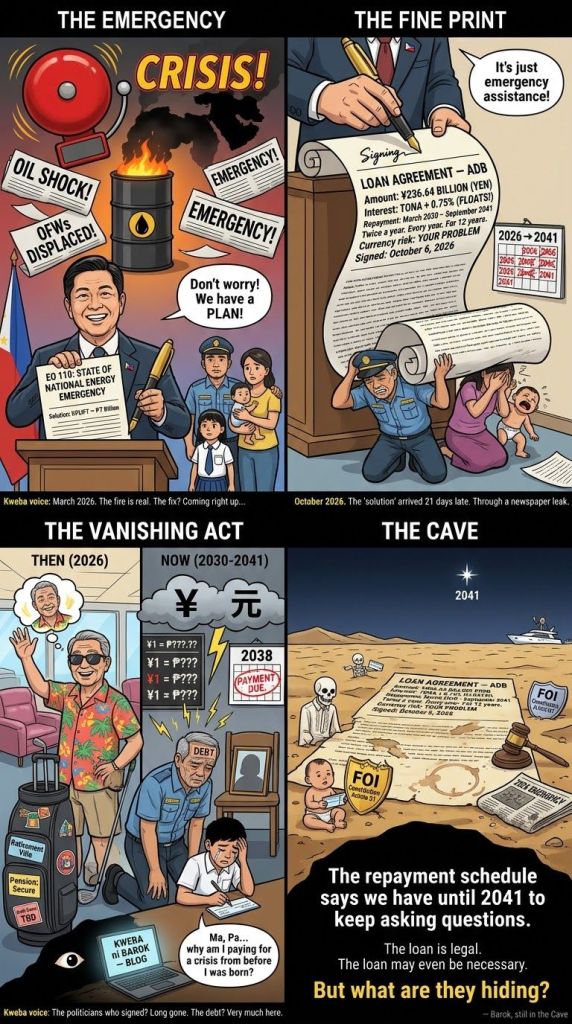
The Timeline That Should Make You Suspicious
Here is the chronology, mga ka-kweba. Follow the breadcrumbs.
- March 24, 2026: President Marcos signs Executive Order No. 110, declaring a State of National Energy Emergency and launching UPLIFT—the Unified Package for Livelihoods, Industry, Food, and Transport. The government estimates UPLIFT will cost seven billion dollars through the end of 2026.
- June 2026: Finance Secretary Frederick Go announces the Philippines will tap the ADB’s Countercyclical Support Facility for up to 1.5 billion dollars.
- September 24, 2026: ADB approves the loan.
- October 6, 2026: Secretary Go signs the agreement. The Manila Bulletin “sees” it on October 27—twenty-one days later.
Twenty-one days. In the age of the internet, in the age of freedom of information executive orders, in the age of constitutional provisions that explicitly say foreign loan information “shall be made available to the public,” the Filipino people learned about the terms of a 1.5-billion-dollar obligation through a newspaper leak three weeks after the ink dried.
The Loan Terms
And what are those terms? Let me read them to you, slowly, so the gravity sinks in.
The loan is denominated in Japanese yen—¥236.64 billion. The interest rate is TONA plus 0.75 percent. TONA is the Tokyo Overnight Average Rate.
It floats. It moves. It is not fixed. The government will also pay a 0.15-percent commitment charge on undrawn balances, beginning sixty days after signing.
Principal repayment begins March 2030 and ends September 2041. Twice a year. Every year. For twelve years.
Now, I am not an economist. I am just a blogger in a cave. But even I can see the obvious question: why does an emergency that requires immediate cash transfers and transport subsidies in 2026 need a repayment schedule that stretches into the 2040s?
The government’s defenders will say: the economic damage from the oil shock can outlast the conflict itself. Businesses accumulate debt, households deplete savings, workers lose jobs. Spreading the cost over time is fiscally responsible.
Fine. I accept that logic—in principle.
But here is what I do not accept: the government has not shown us the comparison. Where is the analysis that says this specific instrument—yen-denominated, floating-rate, twelve-year amortization—is the cheapest, safest, most prudent option available? Where is the document that compares this loan against peso borrowing, dollar borrowing, grant financing, or simply reallocating existing appropriations?
The Transparency Problem
The Constitution does not require the government to make the best possible deal. But the Constitution does require transparency. Article XII, Section 21: “Information on foreign loans obtained or guaranteed by the Government shall be made available to the public.” The Supreme Court, in Colmenares v. Duterte, explicitly rejected the idea that confidentiality clauses could override this constitutional mandate.
So where is the full loan agreement, Secretary Go? Where is the Monetary Board resolution? Where is the debt-sustainability analysis that models what happens if the yen strengthens by 20 percent against the peso, or if TONA spikes to 3 percent?
The Manila Bulletin “saw” the agreement. The Filipino people have not.
The AIIB Dimension: Chinese Money, Japanese Money, and Your Future
If the ADB loan is not enough to make you reach for your blood pressure medication, consider this: the Asian Infrastructure Investment Bank (AIIB)—Beijing-based, if you have forgotten—is extending 1 billion dollars in cofinancing. The AIIB loan will be denominated in Chinese renminbi, at RMB 6.7513 billion.
So let us tally the currency exposure, mga ka-kweba. The Philippines is borrowing in yen and renminbi to fund peso-denominated cash transfers and subsidies. The government’s revenues are in pesos. The debt is in foreign currencies that fluctuate according to monetary policies set in Tokyo and Beijing.
If the yen appreciates against the peso—which it can, at any time, for reasons completely beyond our control—the peso cost of servicing this debt increases. If the renminbi appreciates, same story.
The headline figure of 1.5 billion dollars is not the final bill. The final bill is whatever the exchange rate decides it is on the day each payment is due, for the next fifteen years.
And the AIIB’s own project documents describe the loan as “Policy-Based Cofinancing” under its “Energy, Food Security and Economic Resilience Facility.” Policy-based. That means conditions.
That means the lender has a say in the policy framework. I am not saying the conditions are onerous—I am saying the Filipino people have not been told what they are.
The AIIB’s environmental and social categorization is “Category C,” meaning low risk, because the loan supports “general budget support for time-bound, targeted fiscal measures” with “no physical or infrastructure works.” That sounds reassuring.
But “general budget support” is exactly the kind of financing that is hardest to trace. The money goes into the national treasury. It funds the budget. It is fungible. You cannot follow a specific yen or renminbi note from the ADB’s vault to a jeepney driver’s pocket.
The ADB’s reporting requirements are, to be fair, somewhat robust: quarterly reports on macroeconomic and fiscal conditions, beneficiary data broken down by sex and region, a completion report within six months of closing. But who verifies these reports? The Department of Finance (DOF)—the same agency that signed the loan—is the executing agency.
The fox is not just guarding the henhouse. The fox built the henhouse, signed the mortgage on the henhouse, and is now submitting quarterly progress reports on how well the hens are doing.
The Debt We Already Have
Now let us talk about the elephant in the cave.
As of end-August 2026, the national government’s total outstanding debt stood at ₱19.61 trillion. That is not a typo. Nineteen point six one trillion pesos.
External debt accounted for 32.47 percent of the total, or ₱6.37 trillion.
Debt service for January to August 2026 totaled ₱1.44 trillion. Interest payments alone consumed ₱686.48 billion in that period.
And now we are adding 1.5 billion dollars from the ADB, plus 1 billion dollars from the AIIB, to this pile. The government says the combined 2.5 billion dollars is not all disbursed at once—the ADB project page showed zero disbursements as of October 26. Fair enough.
But the obligation exists. The capacity to draw down exists. And the commitment charge on undrawn balances means the meter is running even before the money leaves the vault.
Here is the question that no one in the economic team wants to answer directly: is AGAPAY additional spending, or is it replacing spending that would have happened anyway?
If the government was always going to spend 7 billion dollars on UPLIFT, and the ADB loan merely finances a portion of that, then the loan is not creating new assistance. It is creating new debt to pay for existing obligations. The fiscal space that AGAPAY supposedly provides is an illusion—the government borrows 1.5 billion dollars, spends it on cash transfers, and then has 1.5 billion dollars less in future fiscal space because it must repay the loan with interest.
The government should publish a financing reconciliation: the original UPLIFT budget, existing appropriations, expected revenues, other financing sources, and the incremental spending that AGAPAY specifically enables. Without that document, the claim that this loan is “necessary” is an assertion, not a demonstration.
The Political Economy of “Emergency”
Let me be blunt, mga ka-kweba. I have been in this cave long enough to know that “emergency” is the most abused word in the Philippine political vocabulary.
- Emergency justifies bypassing procurement.
- Emergency justifies expedited disbursement.
- Emergency justifies concentrating spending authority in the executive.
- Emergency justifies asking questions later, when the money is gone and the officials who spent it have moved on to their next positions.
The 2026 budget process gave us a preview of how this works. The ₱6.793-trillion General Appropriations Act was signed with a dramatic veto of ₱92.5 billion in unprogrammed appropriations—while ₱150.9 billion in “zombie funds” remained untouched, ready to be resurrected when “excess revenue” appeared or new loans were secured.
The pork did not disappear. It changed color and hid in the dark.
AGAPAY is a new loan. A new source of funds. A new opportunity for the same old games.
Consider the UPLIFT components: cash transfers, transport subsidies, emergency loans for Micro, Small, and Medium Enterprises (MSMEs), OFW repatriation and reintegration. Every single one of these is a potential patronage pipeline.
Cash transfers require beneficiary lists. Who controls those lists? Who verifies eligibility? Who handles complaints?
If the lists are built by local politicians, if the verification is cursory, if the complaints mechanism is a hotline that rings in the office of the same official who controls the list—then we have not built a social protection program. We have built a vote-buying machine with a multilateral seal of approval.
Transport subsidies require identifying eligible operators. Who owns the jeepneys? Who holds the franchises?
Who decides which routes get subsidized and which do not? The potential for favoritism is enormous.
MSME emergency loans require lending criteria. Who sets the interest rates? Who bears the default risk?
If the loans are channeled through government financial institutions, are those institutions lending to viable businesses or to connected borrowers?
OFW repatriation and reintegration is the most politically sensitive component. Repatriation is a genuine emergency need. But reintegration support—livelihood assistance, training, job placement—is a long-term development challenge.
Borrowing money in 2026 to fund reintegration programs that will be repaid until 2041 is not emergency response. It is development financing dressed up in crisis clothing.
The ADB’s own documents describe UPLIFT as “timely, targeted, and temporary.” Temporary. Time-bound. So why does the repayment schedule stretch across three presidential administrations?
The Legal Loopholes
The Constitution is clear on foreign borrowing. Article VII, Section 20: the President may contract foreign loans with the prior concurrence of the Monetary Board, subject to limitations provided by law, and the Monetary Board must report to Congress quarterly.
The government will tell you: yes, we complied. The Monetary Board concurred. The President delegated signing authority to the Secretary of Finance, which the Supreme Court upheld in Constantino v. Cuisia. Everything is legal.
And perhaps it is. I am not a Supreme Court justice. I am a blogger who reads the Constitution and gets angry.
But legality is not the same as prudence. And compliance is not the same as transparency.
The Constitution also says, in Article XII, Section 21, that foreign loan information “shall be made available to the public.” The Supreme Court in Colmenares interpreted this as proactive—the government need not wait for a request before making foreign loan information accessible.
So I ask again, Secretary Go: where is the signed agreement? Where are the schedules? Where is the side-letter, if any, on policy conditions? Where is the Monetary Board resolution?
The Manila Bulletin saw the agreement. Why can’t the Filipino people?
What Would Accountability Look Like?
I am not naive, mga ka-kweba. I know that a blog post in the Cave will not force the DOF to publish the loan documents tomorrow. But I also know that the only way to change the incentive structure is to make the cost of secrecy higher than the cost of disclosure.
Here is what a serious accountability agenda would look like:
- First, the DOF should publish the full executed loan agreement, all schedules, and the Monetary Board resolution within thirty days. Not a summary. Not a press release. The document.
- Second, the government should publish a financing reconciliation showing exactly how much of UPLIFT is funded by AGAPAY, how much by existing appropriations, and how much by other sources. If the loan is additional, show the additionality. If it is substitution, admit it.
- Third, the government should publish a debt-sustainability analysis that models the peso cost of the loan under at least three exchange-rate and interest-rate scenarios: a baseline, an adverse scenario, and a severe scenario. If the government has not done this analysis, it should explain why it signed a floating-rate, yen-denominated loan without one.
- Fourth, the implementing agencies—Department of Social Welfare and Development (DSWD), Department of Transportation (DOTr), Department of Trade and Industry (DTI), Department of Migrant Workers (DMW)—should publish beneficiary data at the individual level, anonymized where necessary, in machine-readable format. Not aggregate statistics. Not regional summaries. Individual records that journalists, researchers, and civil society can cross-check for duplicates, ghost beneficiaries, and political clustering.
- Fifth, the Commission on Audit (COA) should conduct a real-time audit of AGAPAY disbursements, not a post-hoc audit three years after the money is gone. COA has the constitutional authority to examine government accounts. It should use it now, while the money is still traceable.
- Sixth, Congress should hold hearings—not to grandstand, not to extract political concessions, but to demand the documents and the analysis. The Senate Finance Committee and the House Appropriations Committee have the power to compel testimony and subpoena records. They should use it.
The Ghost of Borrowings Past
I have seen this movie before, mga ka-kweba. In 2020, the government borrowed billions to respond to Coronavirus Disease 2019 (COVID-19). The Bayanihan laws were passed.
Emergency powers were granted. Cash transfers were distributed—some efficiently, some not. The debt accumulated.
And when the emergency ended, did the structural reforms follow? Did we build a more resilient health system? Did we fix the social protection delivery mechanisms that failed during the pandemic?
Some progress, perhaps. But not enough. The debt remained. The lessons, apparently, did not.
AGAPAY risks repeating the pattern: borrow for an emergency, spend the money through existing channels that are riddled with inefficiencies, and leave future administrations with the bill and the blame.
The difference this time is the timeline. COVID borrowing was largely domestic and short-term. AGAPAY is foreign, floating-rate, and extends to 2041. The risk profile is different. The exposure is different. The intergenerational burden is different.
The Question That Matters
I will end with the question that the government does not want to answer directly, because answering it honestly would require admitting that this loan is not purely about emergency response.
Is AGAPAY a crisis financing instrument, or is it a fiscal space expansion tool dressed up as crisis financing?
The ADB’s Countercyclical Support Facility is designed for shocks. The Middle East war is a shock. The oil price spike is a shock. The OFW displacement is a shock.
But the UPLIFT program is seven billion dollars. AGAPAY finances 2.5 billion of that. The remaining 4.5 billion comes from somewhere—domestic borrowing, existing appropriations, or both.
If the government needed 7 billion dollars to respond to the shock, why is the multilateral component only 2.5 billion? And if 2.5 billion is sufficient, why is the program 7 billion?
These are not rhetorical questions. They are questions that the DOF, the ADB, and the AIIB should be able to answer with documents, not talking points.
Until they do, I will remain in the Cave, suspicious. The loan is legal. The loan may even be necessary. But the loan is not transparent, the loan is not fully explained, and the loan commits the Filipino people to a decade and a half of payments for a crisis whose full costs—human, economic, and political—we are only beginning to understand.
Filipinos should not be left paying through 2041 for an emergency program whose costs, beneficiaries, and results they cannot independently verify.
That is not a radical demand. That is the minimum standard of democratic accountability.
And if the government cannot meet that standard, then the question is not whether AGAPAY is a scandal. The question is what they are hiding.
MGA KA-KWEBA, the Cave will be watching. The repayment schedule says we have until 2041 to keep asking questions. Let us start now.
Key Citations
A. Constitution, Statutes, and Jurisprudence
- Colmenares v. Duterte. G.R. Nos. 245981 and 246594, Supreme Court of the Philippines, 9 Aug. 2022. The LawPhil Project, lawphil.net/judjuris/juri2022/aug2022/gr_245981_2022.html.
- Constantino v. Cuisia. G.R. No. 106064, Supreme Court of the Philippines, 13 Oct. 2005. Supreme Court E-Library, elibrary.judiciary.gov.ph/thebookshelf/showdocs/1/41595.
- Philippines. Office of the President. Executive Order No. 110, s. 2026: Declaring a State of National Energy Emergency and Authorizing the Unified Package for Livelihood, Industry, Food, and Transport. 24 Mar. 2026. The LawPhil Project, www.lawphil.net/executive/execord/eo2026/eo_110_2026.html.
- Philippines. Office of the President. Executive Order No. 2, s. 2016: Operationalizing in the Executive Branch the People’s Constitutional Right to Information and the State Policies to Full Public Disclosure and Transparency in the Public Service. 23 July 2016. Official Gazette of the Republic of the Philippines, www.officialgazette.gov.ph/2016/07/23/executive-order-no-02-s-2016.
- Republic Act No. 11469. Bayanihan to Heal as One Act. 24 Mar. 2020. Supreme Court E-Library, elibrary.judiciary.gov.ph/thebookshelf/showdocs/2/92611.
- Republic of the Philippines. 1987 Constitution of the Republic of the Philippines. The LawPhil Project, lawphil.net/consti/cons1987.html.
B. Official and Multilateral Sources
- Asian Development Bank. “ADB Boosts Philippines’ Crisis Response with $1.5 Billion.” Asian Development Bank, 24 Sept. 2026, www.adb.org/news/adb-boosts-philippines-crisis-response-1-5-billion.
- Asian Development Bank. “AGAPAY Project and Loan Records.” Asian Development Bank, 2026, www.adb.org/projects/60292-001/main.
- Asian Infrastructure Investment Bank. “Energy, Food Security and Economic Resilience Facility.” Asian Infrastructure Investment Bank, 2026, aiib.org/en/what-we-do/emergency-response/energy-food-security-and-economic-resilience-facility/index.html.
- Asian Infrastructure Investment Bank. “Philippines: Economic Resilience and Fiscal Stability Program.” Asian Infrastructure Investment Bank, 30 July 2026, www.aiib.org/en/projects/details/2026/proposed/philippines-economic-resilience-and-fiscal-stability-program.html.
- Bureau of the Treasury. “National Government Debt Records.” Bureau of the Treasury Philippines, 2026, www.treasury.gov.ph/?page_id=12407.
- Commission on Audit. Commission on Audit, Republic of the Philippines. www.coa.gov.ph.
- Department of Finance. “PH Taps USD1.5-Billion ADB Financing to Cushion Middle East Crisis Shock.” Department of Finance, 20 Oct. 2026, www.dof.gov.ph/ph-taps-usd1-5-billion-adb-financing-to-cushion-middle-east-crisis-shock.
- Tradition. “What Is the Tokyo Overnight Average Rate (TONA)?” Tradition Data, www.traditiondata.com/market-education/what-is-the-tokyo-overnight-average-rate-tona.
C. News Articles
- “Govt Eyes $1.5B ADB Funding amid Gulf Crisis.” Daily Tribune, 23 June 2026, tribune.net.ph/2026/06/23/govt-eyes-15b-adb-funding-amid-gulf-crisis.
- “Marcos Signs P6.793 Trillion National Budget for 2026.” The Philippine Star, 6 Jan. 2026, www.philstar.com/headlines/2026/01/06/2499073/marcos-signs-p6793-trillion-national-budget-2026.
- “Marcos Vetoes 7 of 10 Unprogrammed Items.” Philippine Daily Inquirer, Jan. 2026, plus.inquirer.net/?p=361846.
- Manila Bulletin. “Philippines to Repay $1.5-Billion ADB Loan for AGAPAY Program until 2041.” Manila Bulletin, 27 Oct. 2026, mb.com.ph/2026/10/27/philippines-to-repay-15-billion-adb-loan-for-agapay-program-until-2041.

- “Ang Hirap Maging Mahirap”: The PAO Scandal That Proves Government Contempt Is Nothing New

- “Far-Off” My Axx: Malacañang’s Claire Castro Drowns in Her Own Legal Gaslighting
- “Forthwith” to Farce: How the Senate is Killing Impeachment—And Why Enrile’s Right (Even If You Can’t Trust Him)
- “HINDI AKO NAG-RESIGN!”

- “I Know Nothing”: Baste Duterte’s Amnesia Defense Meets ₱33M in GenCorp Contracts
- “I’m calling you from my new Globe SIM. Send load!”

- “Mahiya Naman Kayo!” Marcos’ Anti-Corruption Vow Faces a Flood of Doubt

- “Manageable” Debt, Unmanageable Lies: DBM’s ₱21 Trillion Fairy Tale
- “Meow, I’m calling you from my new Globe SIM!”

- “Natrabaho”: One Word, One Ombudsman, and a Judiciary on Trial
- “No Special Jail for Crooks!” Boying Remulla Slams VIP Perks for Flood Scammers
- “Philippine-Controlled” or Yankee Gas Station? The Davao Fuel Depot Farce Exposed




Leave a Reply