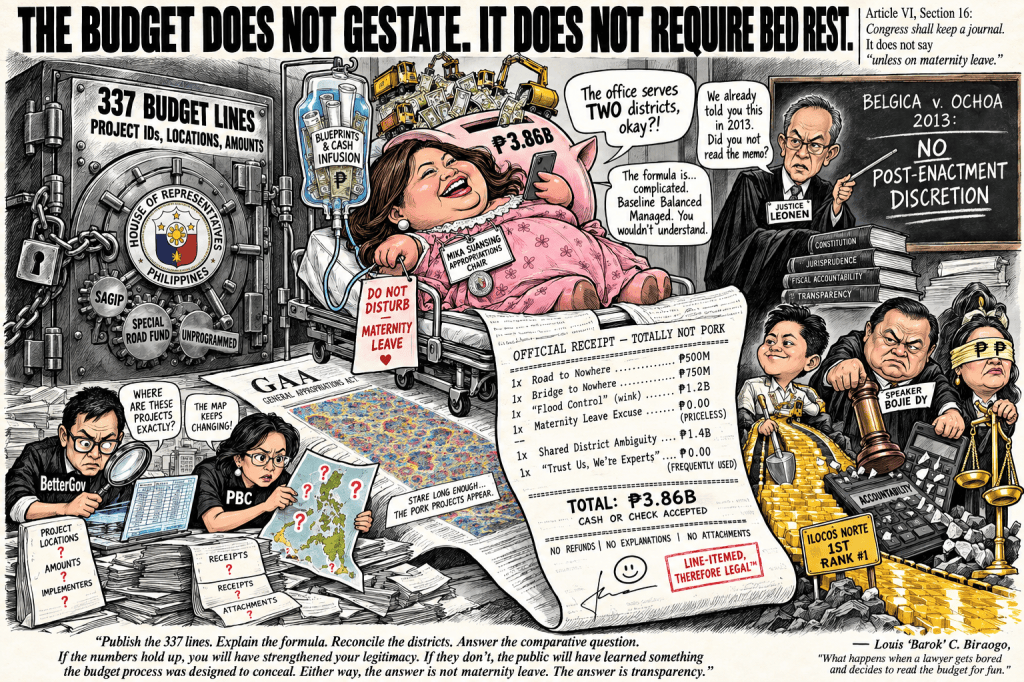
The watchdogs mapped the money. The House offered maternity leave. Here’s what that tells us about how the budget really works.
By Louis ‘Barok‘ C. Biraogo | October 30, 2026
PAUSE the alibi. Let’s replay the tape.
The House Appropriations Chair—the person who literally holds the purse strings for the entire national budget—represents a district whose engineering office just happened to land ₱3.86 billion in the House-approved 2027 budget. Second highest in the entire country. And the best defense we have is: “Well, the engineering office covers two districts, so we don’t actually know whose money it is.”
That’s not a defense. That’s a non-attribution clause with extra steps.
Let me be crystal clear: I am not saying Mika Suansing personally pocketed ₱3.86 billion, forged documents, or signed off on ghost projects. The People’s Budget Coalition (PBC) itself admitted it “did not determine which lawmaker’s district would receive the most projects.” That’s the get-out-of-jail card, and it’s already been played.
But here’s what I am saying: if you are the Chair of the House Committee on Appropriations, and your district’s engineering office ranks second nationwide in infrastructure allocations, and you cannot—or will not—produce a clean, project-level breakdown showing exactly how much went where and why, then you have failed the most basic test of public accountability. Not the criminal test. The basic test. The one that says: explain yourself.
And the explanation so far? Crickets. Or maternity leave. Or “the office serves two districts.” Pick your deflection.
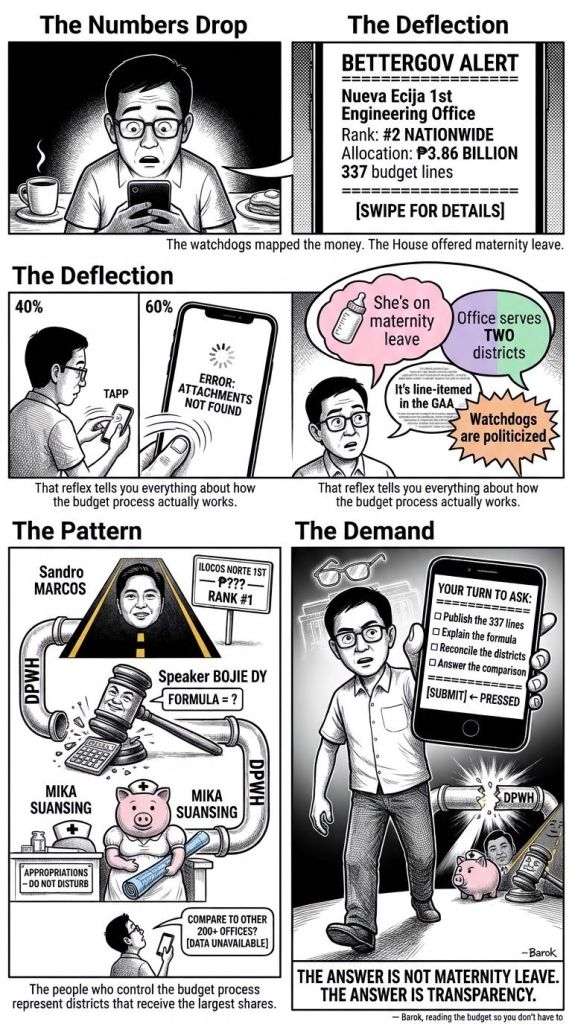
The Watchdogs Brought Receipts. The House Brought Adjectives.
BetterGov and the PBC did something the House never does voluntarily: they mapped the money. Three hundred thirty-seven budget lines. ₱3.86 billion. An engineering office serving two congressional districts, one represented by the Appropriations Chair. The ranking? Second highest in the Philippines.
Then they did something even more remarkable: they admitted the limits of their own data. They couldn’t attribute the projects to a specific district. That’s called intellectual honesty, a commodity rarer than a Department of Public Works and Highways (DPWH) project that comes in on budget.
Compare that to the House response: maternity leave. A legislator’s office reportedly citing her absence from the country as an explanation for why she couldn’t answer questions about a budget she oversaw. Let me check the Constitution of the Republic of the Philippines (1987 Constitution). Article VI, Section 16 requires Congress to keep a journal of its proceedings. It does not require the Appropriations Chair to be physically present to answer whether her district’s ₱3.86 billion is justified. The budget does not gestate. It does not require bed rest.
And here’s the part that should make every taxpayer’s eye twitch: other senior House officials’ districts also ranked high. Ilocos Norte 1st District Engineering Office—Majority Leader Sandro Marcos—ranked first. Speaker Bojie Dy. Lead Prosecutor Gerville Luistro. All associated with top-tier allocations.
So what we have is not an isolated anomaly. We have a pattern: the people who control the budget process represent districts that receive the largest shares of the budget. That is not proof of corruption. It is proof of structural incentive—exactly what the Supreme Court has told Congress to fix since Belgica v. Ochoa (G.R. Nos. 208566, 208493, and 209251) in 2013.
The Supreme Court Has Already Said This Is Illegal. Congress Apparently Didn’t Read the Memo.
The October 2026 Supreme Court ruling is the elephant in the budget room everyone is politely ignoring.
The Court invalidated ₱449.5 billion in congressional increases to unprogrammed appropriations in the 2024 budget. It struck down ₱17.99 billion in additional Special Road Fund allocations in 2025. It declared SAGIP a prohibited lump-sum appropriation—a “covert repository” for DPWH infrastructure. The ruling, penned by Senior Associate Justice Marvic Leonen, was explicit: Congress cannot increase the President’s recommended appropriations. Period. Not through unprogrammed funds. Not through special accounts. Not through bicameral conference committee sleight of hand.
And now, weeks later, we are supposed to believe the 2027 House-approved budget—with ₱3.86 billion flowing to the Appropriations Chair’s engineering office and ₱190 billion in DPWH projects lacking publicly available attachments—is constitutionally pristine?
The Supreme Court didn’t say “Congress, stop inserting.” It said “Congress, you already did this, and it was unconstitutional.” The 2027 budget is not a hypothetical. It is the next iteration of the same system—one the highest court in the land says has operated outside constitutional boundaries for at least three budget cycles.
The “It’s Line-Itemed, So It’s Legal” Defense Is an Insult to Your Intelligence
The House argument goes: These aren’t Priority Development Assistance Fund (PDAF). They’re line-itemed in the General Appropriations Act (GAA). Belgica only struck down lump sums. So we’re fine.
Translation: We made the pork barrel more granular. Therefore it’s not pork.
That’s like saying a bribe is legal as long as you itemize it on a receipt.
Belgica v. Ochoa did not just strike down lump sums. It struck down post-enactment legislative intervention in budget execution—the ability of individual legislators to control project identification, modification, and release after the budget was passed. The Court’s concern was not the form of the appropriation but the power relationship it created: legislators wielding executive functions, directing funds to favored projects and contractors, then overseeing the very implementation they controlled.
Does line-iteming eliminate that power relationship? Or does it simply disguise it? If a legislator can still call up a District Engineering Office and say “prioritize this project,” or “make sure this contractor gets a look,” or “hold that release until after the election,” the constitutional violation persists—whether the project is listed in the GAA or not.
The October ruling warned that post-enactment discretion in the executive branch—the SAGIP mechanism—was unconstitutional because it allowed projects to be identified after Congress approved the budget. But here’s the question nobody in the House wants to answer: if the executive branch can’t have post-enactment discretion, why should individual legislators?
What Would Actual Transparency Look Like? (Hint: Not This)
I’m not just here to throw stones. I’m here to ask the questions the Appropriations Committee should have answered before the budget left the House.
First: Publish the 337 budget lines. All of them. Project IDs, locations, amounts, barangay-level attribution, National Expenditure Program (NEP) comparison, documentation status. If the ₱3.86 billion is legitimate, show us. The public can handle the truth. What it cannot handle is another round of “trust us, we’re the budget experts.”
Second: Explain the allocation formula. Rep. Leandro Legarda Leviste’s release of the “Cabral files” exposed a “Baseline Balanced Managed” parametric formula for computing district allocations—a formula that remains opaque. If an algorithm determines how billions are distributed across engineering offices, the public has a right to see it. Article II, Section 28 mandates full public disclosure of transactions involving public interest. A budget formula is not a state secret. It is a public trust.
Third: Reconcile the two districts. The Nueva Ecija 1st District Engineering Office serves both the 1st and 2nd districts. Fine. Then split the money. Show us how much is physically in Suansing’s district and how much is in Salvador’s. Show us which projects cross district lines and why. Show us whether the distribution correlates with population, road length, flood exposure, or political rank. If it’s need-based, prove it. If it’s not, explain why.
Fourth: Answer the comparative question. If Ilocos Norte 1st ranks first and Nueva Ecija 1st ranks second, what about the other 200+ engineering offices? Is the distribution statistically normal, or does it cluster around districts represented by House leadership? BetterGov has the data. The House has the power to demand the analysis. The public has the right to see it.
The Real Scandal Is Not the Number. It’s the Reflex.
What bothers me most isn’t the ₱3.86 billion. It’s the reflex.
The moment the number was published, the House response was not “let’s review the data.” It was not “we welcome scrutiny.” It was not even “here is the project list, judge for yourselves.” It was deflection: maternity leave, shared districts, line-item compliance, watchdogs are politicized.
That reflex tells you everything about how the budget process actually works. The Appropriations Chair does not expect to be questioned about her district’s allocation. The House does not expect the public to demand project-level transparency. The system does not expect anyone to connect the dots between the Supreme Court’s ruling and the next budget cycle.
Well, I’m connecting the dots.
The Supreme Court said Congress cannot exceed the President’s recommended appropriations. It said lump-sum post-enactment discretion is unconstitutional. It said the budget process must be transparent and accountable. And then, weeks later, the House produced a 2027 budget with ₱190 billion in DPWH projects lacking public attachments and ₱3.86 billion flowing to the Appropriations Chair’s engineering office.
You don’t need a law degree to see the pattern. You just need to be paying attention.
Final Judgment: The Burden Is on the House, Not the Watchdogs
I will say this clearly, because I believe in the presumption of innocence even when I’m mocking the people who rely on it: Mika Suansing has not been proven to have done anything illegal. The evidence does not establish graft, plunder, or even a Belgica violation. The PBC admitted it couldn’t attribute the projects. The report itself includes caveats. The legal analysis is careful and appropriately cautious.
But public accountability is not the same as criminal liability. You do not need to be guilty of a crime to be required to explain yourself. You do not need to be convicted of graft to be expected to produce a project list. You do not need a Sandiganbayan ruling to be asked: why does your district rank second in the entire country?
The House has the power of the purse. With that power comes the burden of proof—not in a courtroom, but in the court of public opinion. And right now, the House is losing that case not because the evidence is damning, but because it refuses to present any evidence at all.
Publish the 337 lines. Explain the formula. Reconcile the districts. Answer the comparative question. If the numbers hold up, you will have strengthened your legitimacy. If they don’t, the public will have learned something the budget process was designed to conceal.
Either way, the answer is not maternity leave. The answer is transparency. And the fact that it has to be demanded—rather than offered—is the real scandal.
Louis ‘Barok’ C Biraogo is the author of Kweba ni Barok, a blog that has been described as “what happens when a lawyer gets bored and decides to read the budget for fun.” He is not a fan of pork barrel, in any of its forms, including the ones that come with line-item receipts.
Key Citations
A. Legal & Official Sources
- Belgica v. Ochoa. G.R. Nos. 208566, 208493, and 209251, Supreme Court of the Philippines, 19 Nov. 2013. LawPhil, lawphil.net/judjuris/juri2013/nov2013/gr_208566_2013.html.
- Republic Act No. 3019. Anti-Graft and Corrupt Practices Act. 1960. LawPhil, lawphil.net/statutes/repacts/ra1960/ra_3019_1960.html.
- Republic Act No. 7080. An Act Defining and Penalizing the Crime of Plunder. 1991. LawPhil, lawphil.net/statutes/repacts/ra1991/ra_7080_1991.html.
- Supreme Court of the Philippines. “SC Holds Unprogrammed Appropriations Subject to Guidelines; Voids Congressional Increases in 2024 and 2025 Budgets.” Supreme Court of the Philippines, 20 Oct. 2026, sc.judiciary.gov.ph/sc-holds-unprogrammed-appropriations-subject-to-guidelines-voids-congressional-increases-in-2024-and-2025-budgets/.
- The 1987 Constitution of the Republic of the Philippines. Official Gazette of the Republic of the Philippines, 1987, http://www.officialgazette.gov.ph/constitutions/1987-constitution/.
B. News Reports
- BetterGov. “Philippine Budget Data API Documentation.” BetterGov, budget.bettergov.ph/docs. Accessed 29 Oct. 2026.
- Bilyonaryo News Channel. “House Appropriations Chair Suansing’s District Linked to P3.86-B DPWH Projects.” Bilyonaryo News Channel, bnc.bilyonaryo.com/house-appropriations-chair-suansings-district-linked-to-p3-86-b-dpwh-projects/news/. Accessed 29 Oct. 2026.
A few flags:
- Belgica duplicate: Your list gives the same E-Library URL for Belgica v. Executive Secretary (G.R. No. 210503, 2019) and Belgica v. Ochoa (2013), and the body cites only the 2013 case. I used the LawPhil link for the 2013 case and left out the 2019 one. Please verify that LawPhil URL.
- Left out: RA 12009, the PNA article, and the 2019 case are not referenced in the body, so they aren’t cited.
- Not verified live: I couldn’t test any URL from here, including the LawPhil ones for RA 3019 and RA 7080.





Leave a Reply