By Louis ‘Barok‘ C. Biraogo — November 19, 2026
A Deal Announced, Nothing Signed
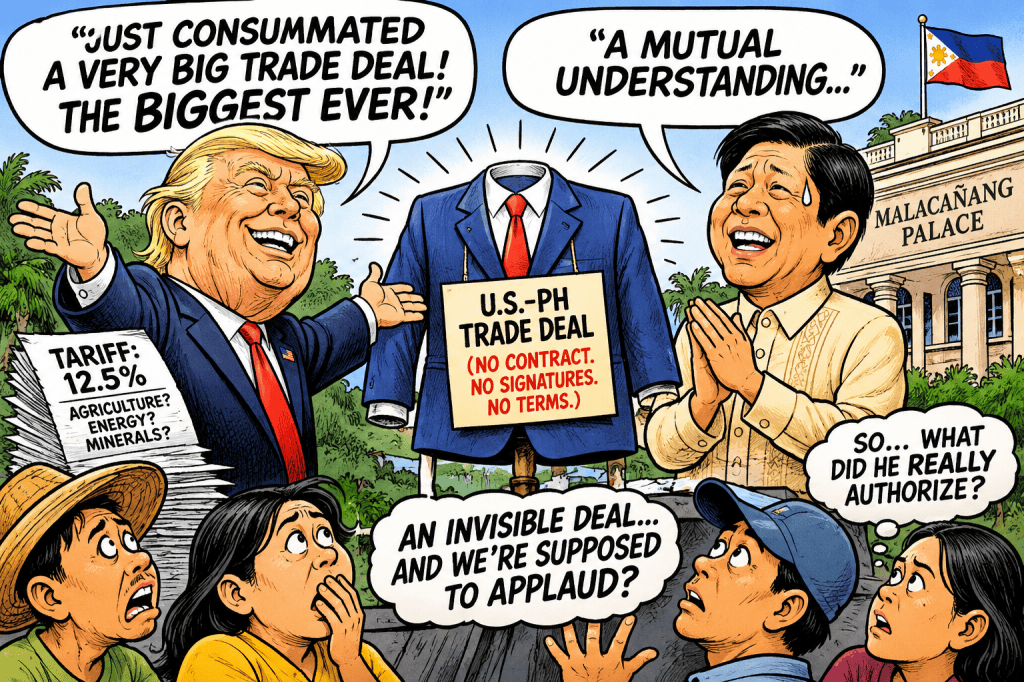
Let me tell you a story about a man who walked into Malacañang Palace and declared, with the straight face of a carnival barker, that he had just sold the Filipino people the biggest trade deal in the history of the United States of America. No contract. No signatures. No terms. Just the word of Donald J. Trump, a man whose relationship with factual precision resembles that of a weatherman in a hurricane.
“Just consummated a very big trade deal,” Trump proclaimed at the state luncheon, as if announcing the birth of a child whose paternity test nobody had bothered to conduct. “The biggest trade deal we’ve ever made by far.” One imagines the silverware pausing mid-air, the waitstaff frozen in place, wondering whether they had missed the memo about the document that apparently existed only in the fevered imagination of the forty-seventh President of the United States.
But here is where our tale takes its deliciously Filipino turn. While Trump was busy constructing his monument to self-congratulation, Philippine Ambassador Jose Manuel Romualdez—a man whose diplomatic precision deserves some recognition in this circus—quietly admitted to Reuters that nothing, absolutely nothing, had been signed. Not a page. Not a paragraph. Not even a cocktail napkin with a scribbled promise.
“None,” Romualdez replied, when asked if anything was signed. It is the kind of answer that should have echoed through the marble halls of Malacañang like a death knell for presidential hyperbole.
Yet echo it did not. Instead, we were treated to the spectacle of two presidents—one apparently living in a reality of his own manufacture, the other perhaps too polite or too politically desperate to correct him—smiling for the cameras while the Philippine people were asked to celebrate an agreement that exists in the same realm as unicorns and honest campaign promises.
The asymmetry is almost poetic in its absurdity. Trump, the master of the art of the non-deal, declares victory with the enthusiasm of a man who has just discovered fire. Marcos, the inheritor of a political dynasty whose relationship with democratic accountability has always been complicated, offers us the word “understanding”—that magnificent diplomatic euphemism for “we talked about stuff and maybe something will happen someday, possibly, if the stars align and nobody checks too carefully.”

What Exactly Did Marcos Authorize?
What exactly did Marcos authorize?
- Did he agree to open our agricultural markets to American corn and soybeans that would bury our small farmers under an avalanche of subsidized imports?
- Did he commit to purchasing liquefied natural gas from a pipeline in Alaska that exists, at present, primarily in the PowerPoint presentations of energy executives?
- Did he nod politely while Trump sketched nuclear reactors on the back of a menu, ignoring the ghost of Bataan Nuclear Power Plant—that 2.3 billion monument to Marcos family ambition and public sector incompetence that never produced a single watt of electricity?
The questions multiply like rabbits in springtime, and the Palace’s silence fertilizes them generously.
The Tariff Trap
Consider the tariff question, that 12.5% sword of Damocles hanging over Philippine exports since July. Trump imposed this penalty through a Section 301 investigation—a mechanism that sounds like a tax code provision but functions more like economic extortion.
The Philippines, Washington declared, had not done enough to stop forced labor imports. Manila responded with a Joint Administrative Order, the bureaucratic equivalent of a student promising to do better next semester. Trade Secretary Cristina Roque, whose optimism in the face of American trade pressure deserves its own psychological study, had hoped to reduce the rate to 10%.
But did Trump grant this concession? The research materials dance around the answer like a politician avoiding a direct question. We are told the tariff is “the immediate bargaining chip,” that “American agricultural and energy exports appear to be the commercial priorities,” that “the Philippine government’s challenge is to obtain measurable benefits without exchanging an immediate tariff concession for long-term economic dependence.” The language of diplomacy, when translated into plain English, reads: the Filipinos may have given away the store while the Americans kept the keys.
The Supreme Court Ruling That Should Have Changed Everything
And what of the Supreme Court ruling that should have changed everything? In February 2026, the United States Supreme Court—in Learning Resources, Inc. v. Trump, a case name that sounds like a textbook title but carries the weight of constitutional thunder—held that Trump could not simply invent tariff powers out of thin air. The International Emergency Economic Powers Act, the Court declared, does not grant the President authority to play tariff God. Congress holds that power under Article I, Section 8 of the U.S. Constitution, those dusty words written by men who actually believed in separation of powers.
This ruling matters because it reveals Trump for what he is: a man who governs by proclamation, whose relationship with legal constraint resembles that of a teenager with a curfew. The 12.5% tariff on Philippine goods rests now on Section 301 of the Trade Act of 1974—a different legal foundation, perhaps, but built on the same swampy terrain of delegated emergency powers. Trump promises to reduce tariffs the way a magician promises to pull a rabbit from a hat: the trick works only if you don’t look too closely at the mechanics.
Who Checks the Executive at Home?
The constitutional comedy extends to our own shores, where the 1987 Constitution—born from the ashes of Marcos family rule, ironically enough—stands as a silent witness to potential executive overreach. Article VII, Section 21 requires Senate concurrence for treaties and international agreements. The Supreme Court, in cases like Pimentel v. Executive Secretary and Bayan Muna v. Romulo, has drawn careful distinctions between executive agreements (which implement existing policy) and treaties (which create new obligations). Marcos cannot simply label a sweeping trade arrangement an “executive agreement” and bypass the Senate the way his father bypassed democratic institutions.
Yet who will enforce this constitutional boundary? The Senate, that collection of political ambition and family dynasties, has shown all the institutional spine of a jellyfish when confronted with executive power. Will they demand to see the terms? Will they hold hearings? Or will they, like good courtiers, applaud the Emperor’s new clothes while the Filipino people shiver in the cold?
Farmers, Energy, and Minerals: Who Pays?
The agricultural dimension reveals the cruel mathematics of this purported deal. Trump explicitly named American farmers as beneficiaries. This is not incidental rhetoric; it is the tell in a poker game, the unconscious revelation of who actually holds the winning hand.
American agricultural exports—corn, soybeans, wheat, dairy—arrive on ships subsidized by the Farm Bill, supported by infrastructure we can only dream of, backed by logistics systems that make our rural roads look like goat paths. Our farmers, those millions of smallholders who constitute the backbone of rural Philippines, would compete against this juggernaut with what exactly? Their carabaos? Their prayers? Their increasingly irrelevant land titles?
The Rice Tariffication Act, Republic Act No. 11203, already taught us this lesson: liberalize imports, watch domestic production collapse, then wonder why food security becomes a geopolitical vulnerability. The 2024 amendments to that law, Republic Act No. 12078, represented a belated recognition that markets do not automatically serve national interest. Yet here we are, potentially repeating the same mistake with American agricultural products, because the President of the United States smiled at our President and called it the biggest deal ever made.
The energy proposals deserve their own chapter in this satire. Alaska natural gas! Nuclear power! The Luzon Economic Corridor! Each announcement sounds magnificent until you examine the details, at which point they evaporate like morning mist.
The Alaska pipeline exists in planning documents, not in steel and concrete. The nuclear reactors are theoretical, their financing unarranged, their waste disposal unaddressed, their seismic risks in our earthquake-prone archipelago unmentioned. The Bataan Nuclear Power Plant—built by the current President’s father, never operated, a mausoleum to nuclear ambition—stands as the monument we should visit before signing anything.
And Pax Silica, that grandly named initiative for critical minerals and semiconductor supply chains? Not signed during Trump’s visit. The framework that was supposed to anchor our strategic future in American-led technology networks remained, like so much else, an aspiration wrapped in a promise inside a press release.
The indigenous Aeta communities in Capas, Tarlac, whose ancestral lands would supposedly host this technological utopia, have already raised alarms about displacement, water demands, and the free, prior, informed consent that Republic Act No. 8371 guarantees but developers routinely ignore. Human Rights Watch documented these concerns. The Palace, apparently, had other priorities.
Geopolitics as Protection Racket
The geopolitical theater completes this picture of transactional absurdity. Trump arrives in Manila, declares a historic trade victory, then departs for China—the country against which this entire strategic realignment is supposedly directed. The Mutual Defense Treaty of 1951, that Cold War relic that Washington invokes when convenient and interprets narrowly when not, provides the security backdrop against which economic concessions are extracted.
The Philippines faces Chinese maritime aggression in the West Philippine Sea, and in response, we are offered… what, exactly? Trump’s personal assurance that “it will be taken care of”? The same Trump who abandoned Kurdish allies in Syria, who questioned the North Atlantic Treaty Organization’s (NATO) Article 5, whose commitment to alliance obligations has the consistency of quicksand?
This is not alliance management. This is protection racket logic dressed in diplomatic language. Pay us in agricultural market access, energy procurement commitments, and strategic mineral supplies, and maybe—no promises, but maybe—we’ll help you when the Chinese coast guard shows up again at Ayungin Shoal.
The Right to Know the Terms
The transparency questions cut to the heart of democratic accountability. Article III, Section 7 of our Constitution guarantees the right to information on matters of public concern. The Supreme Court, in Chavez v. Public Estates Authority and Legaspi v. Civil Service Commission, has affirmed this right with language that should shame any government hiding trade terms from its own people.
Republic Act No. 6713, the Code of Conduct for Public Officials, demands that public interest prevail over personal or political convenience. Yet we are asked to trust, to celebrate, to applaud an agreement whose contents remain as mysterious as the President’s true net worth.
Who Actually Won?
Who actually won this deal? The research materials offer four scenarios, ranging from “genuinely reciprocal agreement” to “largely symbolic announcement.” The evidence points decisively toward the latter end of that spectrum.
Trump has his diplomatic victory to brandish before American voters and Chinese negotiators. Marcos has photographs and handshakes to display during the next election cycle. American farmers and energy companies have the prospect of new markets. And the Filipino people? We have the privilege of paying for whatever was promised, in tariffs not reduced, in markets opened, in dependencies created, in sovereignty quietly bartered away.
The measure of a trade agreement is not the adjectives used at a state luncheon. It is not the number of handshakes exchanged or the warmth of presidential smiles. It is concrete economic results, legally enforceable commitments, demonstrable benefits to ordinary people. Until the agreement is published, the tariff reduced, the reciprocal obligations established, this supposed historic deal remains what it has always been: an announcement in search of a contract, a proclamation in search of substance, a emperor parading through Malacañang in clothes that only he can see.
And we, the Filipino people, are expected to applaud and pay for the privilege of his nakedness.
Key Citations
A. Court Decisions
- Bayan Muna v. Romulo. G.R. No. 159618, 1 Feb. 2011. Jur.ph.
- Chavez v. Public Estates Authority. G.R. No. 133250, 9 July 2002. Supreme Court E-Library.
- Learning Resources, Inc. v. Trump. 607 U.S. _ (2026). Supreme Court of the United States, 20 Feb. 2026.
- Legaspi v. Civil Service Commission. G.R. No. L-72119, 29 May 1987. Lawyerly.
- Pimentel v. Office of the Executive Secretary. G.R. No. 158088, 6 July 2005. Supreme Court E-Library.
B. Constitution and Statutes
- Philippines. The 1987 Constitution of the Republic of the Philippines. Official Gazette of the Republic of the Philippines.
- Philippines. Republic Act No. 6713: Code of Conduct and Ethical Standards for Public Officials and Employees. 20 Feb. 1989. Official Gazette of the Republic of the Philippines.
- Philippines. Republic Act No. 8371: Indigenous Peoples’ Rights Act of 1997. 29 Oct. 1997. Official Gazette of the Republic of the Philippines.
- Philippines. Republic Act No. 11203: Rice Tariffication Act. 2019. The Lawphil Project.
- Philippines. Republic Act No. 12078: An Act Amending Republic Act No. 8178 or the “Agricultural Tariffication Act,” as Amended by Republic Act No. 11203. 6 Dec. 2024. The Lawphil Project.
- Article I, Section 8.” Constitution Annotated, Congress.gov, Library of Congress.
- United States, Congress. Trade Act of 1974. Public Law 93-618, sec. 301, United States Statutes at Large, vol. 88, 3 Jan. 1975, pp. 2041–2043.
- International Emergency Economic Powers Act. 50 U.S.C. §§ 1701–1707. Legal Information Institute, Cornell Law School,
C. News Articles
- “Donald Trump Says PH, US Clinch ‘Big’ Trade Deal.” GMA News Online, 18 Nov. 2026.
- Human Rights Watch. “Philippines: US Tech Hub to Displace Hundreds.” Human Rights Watch, 16 Nov. 2026.
- “Roque Hopeful for Lower Exports Tariff after PH-US Bilateral Talks.” Philippine News Agency, 16 Nov. 2026.
- “Trump Announces ‘Biggest Trade Deal’ between Philippines, US.” Rappler, 18 Nov. 2026.
- “Trump Says US, Philippines Sealed ‘Biggest’ Trade Deal.” Philstar.com, 18 Nov. 2026.
- “Trump Says US Wraps Up ‘Very Big Trade Deal’ with Philippines.” Reuters, 18 Nov. 2026.
D. Official Websites
- United States. The White House. “Actions by the United States in the Investigations Under Section 301 of the Trade Act of 1974 of the Acts, Policies, and Practices of 60 Economies Related to the Failure of Each Economy to Impose and Effectively Enforce a Prohibition on the Importation of Goods Produced with Forced Labor.” July 2026. whitehouse.gov.
- United States. Office of the United States Trade Representative. “Philippines.” United States Trade Representative.
- ₱9 Billion in ‘Savings’? DILG’s Fire Truck Deal Smells Like Smoke
- ₱8B BBM Pork: CCTV for Every Captain’s Kumpare?
- ₱8.9 Billion, 331 Ghost Police Stations: The TIKAS Scandal Explained

- ₱8.4 Billion, 42,000 Barangays, 1 Election: The “Bawat Barangay Makikinabang” Vote-Buying Masterclass
- ₱75 Million Heist: Cops Gone Full Bandit

- ₱63 to the Dollar: The Only Thing Falling Faster Than the Peso Is the Government’s Credibility
- ₱6.77B Ghost Haunts Duterte: RTC Dismisses Mans Carpio’s Desperate Plea
- ₱6.77 Billion and Zero Cash: The Sara Duterte SALN Math That Doesn’t Add Up

- ₱6.7-Trillion Temptation: The Great Pork Zombie Revival and the “Collegial” Vote-Buying Circus

- ₱58.53B, Zero Receipts: The LGSF Pork Barrel Nobody Wants to Name
- ₱53 Million Man Tells ₱695-a-Day Workers to Stop Being ‘Mayabang’: The Audacity of BSP’s Remolona
- ₱491-M Right-of-Way Scam: DPWH Paid for Ghost Land, Ombudsman Finally Notices



Leave a Reply