Inside the GenCorp Shell Game: A ₱46,875 “Loose Investment,” ₱2.14 Million in Returns, and a Sworn SALN That Can’t Decide If It’s an Admission or a Crime
By Louis ‘Barok‘ C. Biraogo | November 18, 2026
BEFORE we applaud the creativity, let us examine the paperwork.
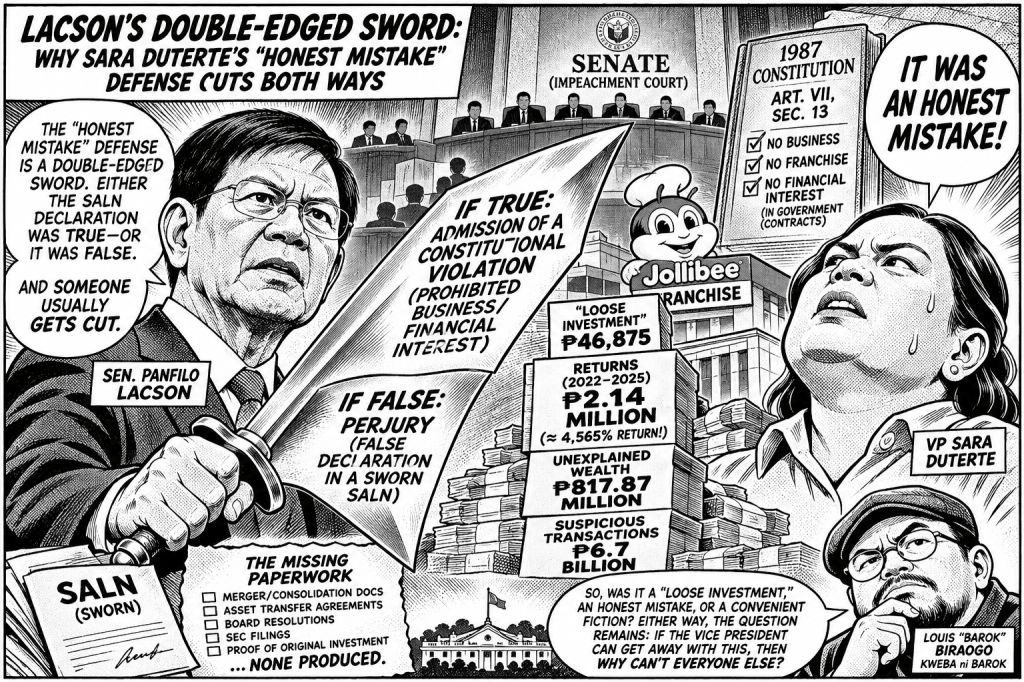
The Vice President of the Republic of the Philippines allegedly declared shares in GenCorp Industries Inc. in her Statement of Assets, Liabilities, and Net Worth (SALN)—a sworn document required under pain of perjury and constitutional mandate. Securities and Exchange Commission (SEC) records, however, do not identify her as a shareholder. Now her defenders want us to believe this was an “honest mistake.”
An honest mistake. In a sworn document. Filed with the Ombudsman. Repeated across multiple years. By the second-highest official of the land. Who happens to be a lawyer.
Forgive me if I don’t reach for the tissue box.
Senator Panfilo Lacson—a man who has spent more time investigating corruption than most Filipinos have spent watching teleseryes—saw through this with the clarity of decades in law enforcement. His observation that the “honest mistake” defense is a “double-edged sword” is an understatement that would make a Zen master blush.
Because here’s the thing about double-edged swords: someone usually gets cut.
The Anatomy of an “Honest Mistake”
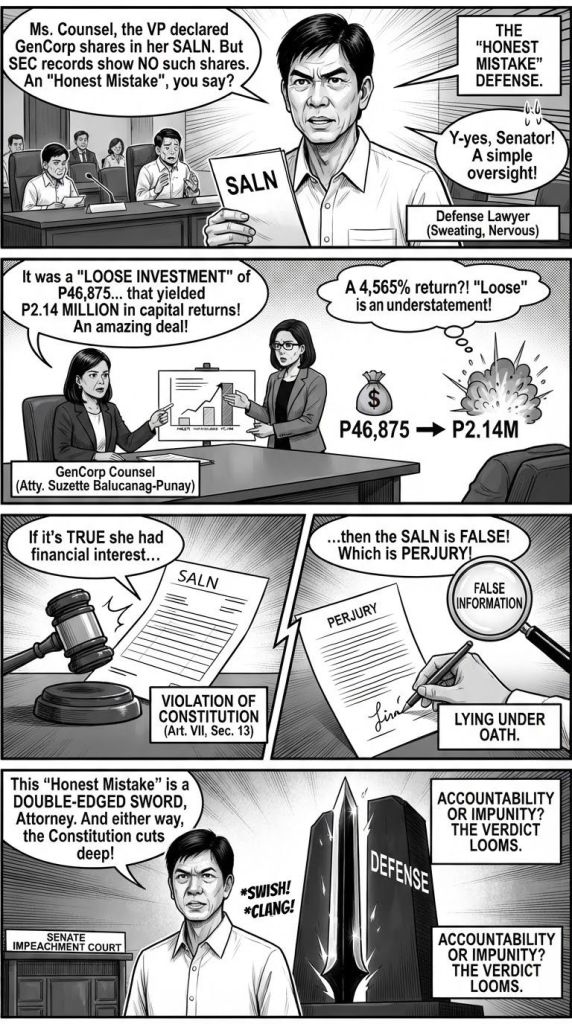
According to testimony from GenCorp’s corporate counsel, Atty. Suzette Balucanag-Punay, Vice President Sara Duterte made an investment of ₱46,875 connected to a Jollibee franchise in Davao City, made through Davao Bounty Times Food Corporation, which was supposed to operate the Jollibee Times Square branch. That branch eventually operated under Great Jolly Times Foods Corporation, which subsequently became GenCorp Industries Inc.
From 2022 to 2025, Duterte reportedly received approximately ₱2.14 million in payments from GenCorp, described as “returns of capital” from a “loose investment.”
A loose investment.
I’ve heard of loose change, loose lips, and loose morals. But “loose investment” is a new one—a term that exists nowhere in the Republic Act No. 11232 (Revised Corporation Code), nowhere in the Republic Act No. 8799 (Securities Regulation Code), and nowhere in any reputable corporate law textbook. It appears to be a legal category invented for this occasion, like a designer label slapped onto a generic product to justify its price tag.
Let’s do the arithmetic the defense hopes you won’t: ₱46,875 invested, ₱2.14 million returned. That’s a return of approximately 4,565 percent. For context, the Philippine Stock Exchange Composite Index has never delivered anything close to that in a three-year period.
But sure. It was a “loose investment.” Nothing to see here. Move along.
The Constitutional Problem Nobody Wants to Discuss
Article VII, Section 13 of the 1987 Constitution of the Republic of the Philippines is remarkably clear:
“The President, Vice-President, the Members of the Cabinet, and their deputies or assistants shall not, unless otherwise provided in this Constitution, hold any other office or employment during their tenure. They shall not, during said tenure, directly or indirectly practice any other profession, participate in any business, or be financially interested in any contract with, or in any franchise, or special privilege granted by the Government or any subdivision, agency, or instrumentality thereof, including government-owned or controlled corporations or their subsidiaries.”
The prohibition is not limited to “owning shares.” It prohibits the Vice President from “directly or indirectly” participating in “any business” or being “financially interested” in any government contract, franchise, or special privilege.
A Jollibee franchise is, by definition, a franchise. And if GenCorp had contracts with the Davao City government—as reports suggest—then the constitutional prohibition on financial interest in government contracts becomes directly relevant.
The defense’s argument appears to be: “She wasn’t technically a shareholder, so she wasn’t technically participating in business.”
To which any first-year law student should respond: “Since when does the Constitution care about technicalities?”
The Constitution prohibits “indirect” participation precisely because wealthy and powerful individuals often hide their business interests behind corporate structures, nominee arrangements, and layers of intermediaries. The whole point of the prohibition is to prevent exactly the kind of arrangement the defense is now describing.
If the Vice President received ₱2.14 million from a corporation over the course of her term, and that corporation was doing business with government entities, then she was—at minimum—financially interested in that business. Whether her name appears on a stock certificate is legally irrelevant to the constitutional question.
The “Honest Mistake” Defense: A Legal Unicorn
Salvador Panelo—former Chief Presidential Legal Counsel—has staked his reputation on the proposition that Duterte’s SALN declaration was an “honest mistake.”
For the mistake to be honest, Duterte would have to believe, in good faith, that she owned shares in GenCorp when she did not. This belief would have to persist across multiple SALN filings, survive the scrutiny of whoever prepared her SALN, and be consistent with her receiving ₱2.14 million from a corporation in which she allegedly had no ownership interest.
Alternatively, for the mistake to be honest, Duterte would have to believe she owned shares because she actually did—but through some undocumented, informal, “loose” arrangement that corporate records don’t reflect.
But here’s the problem: if she actually had a financial interest in GenCorp—whether through shares, a “loose investment,” or some other arrangement—then the SALN declaration was not a mistake at all. It was an admission.
And if she had no financial interest whatsoever, then why was GenCorp paying her ₱2.14 million?
This is what Senator Lacson means by a double-edged sword. Either the declaration was true—in which case it’s evidence of a constitutional violation—or it was false—in which case it’s perjury.
There is no third edge to this sword. The defense is trying to have it both ways: claiming no ownership to avoid the constitutional problem, while claiming good faith to avoid the perjury problem. But you can’t have it both ways. That’s not how law works. That’s not how logic works. And that’s certainly not how the Constitution works.
The Corporate Succession Shell Game
The defense’s explanation involves a chain of corporate entities: Davao Bounty Times Food Corporation, Great Jolly Times Foods Corporation, GenCorp Industries Inc. Each entity allegedly assumed the obligations of the previous one, carrying forward Duterte’s “loose investment” like a relay race baton.
But here’s what’s missing: the legal documents that would establish this succession.
Under the Revised Corporation Code, mergers and consolidations require board resolutions, stockholder approval, and SEC filing. Asset transfers require bills of sale, assignment agreements, and clear documentation of what was transferred and assumed.
Where are these documents?
The defense witness reportedly could not produce written records establishing the precise original investment amount. She could not produce the agreements that transferred obligations from one corporation to another. She could not produce the corporate resolutions authorizing payments to Duterte.
What she could produce, apparently, was a convenient narrative: trust us, there was an investment, it moved through these corporations, and now we’re paying the Vice President millions of pesos because reasons.
This is not how corporate law works. This is how Ponzi schemes work—except even Ponzi schemes usually have better paperwork.
The ₱817 Million Question
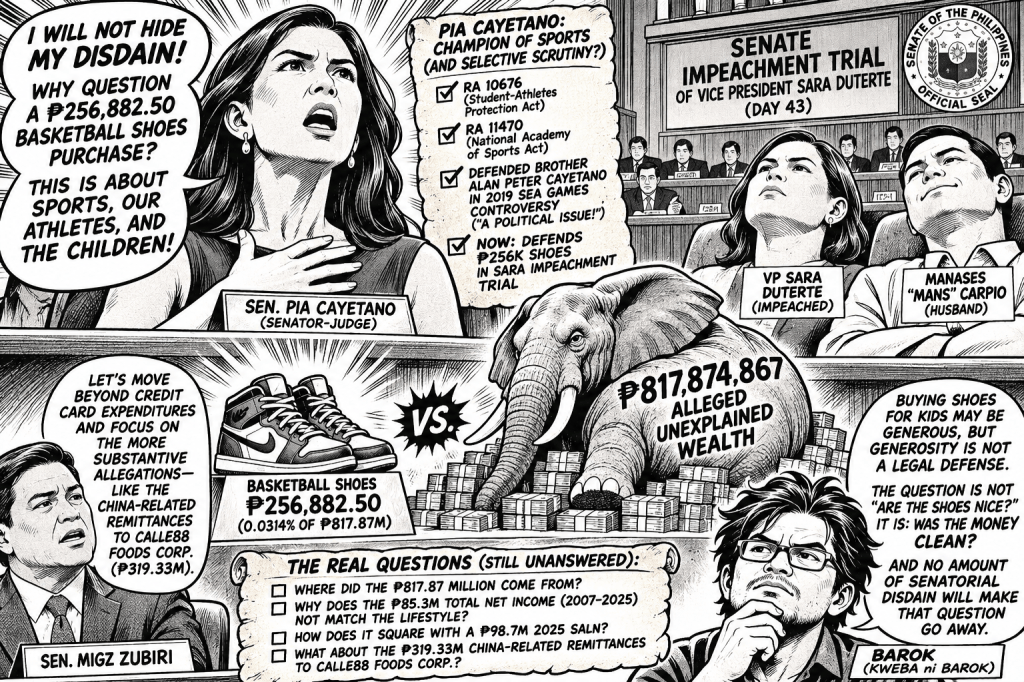
Forensic accounting expert Alexander Cabrera has reportedly testified that Duterte and her husband accumulated ₱817.87 million in unexplained wealth from 2022 to 2025. The defense has not directly rebutted this computation, instead focusing on peripheral matters like a ₱205,007 Tokyo dinner and ₱256,882.50 in Nike shoes.
The defense also abruptly dropped 16 bank executives from eight financial institutions who had been subpoenaed to testify. Prosecutors had intended to question them about dollar accounts and large transactions.
Earlier hearings revealed ₱6.7 billion in covered and suspicious transactions flagged by the Anti-Money Laundering Council.
And now we have the GenCorp payments: ₱2.14 million flowing to the Vice President from a corporation in which she claims no ownership, connected to a Jollibee franchise, allegedly originating from a ₱46,875 investment made nearly two decades ago.
At what point does the accumulation of these anomalies stop being a series of “honest mistakes” and start being a pattern?
The Senate’s Dilemma: Justice or Politics?
The Senate sits as an impeachment court. The Constitution requires a two-thirds vote for conviction—16 of 24 senators, though the Senate has reportedly lowered the threshold to 14 of 20 participating senators.
This is not a criminal trial. The standard is not proof beyond reasonable doubt. Impeachment is a political proceeding with constitutional consequences, and the senators are not bound by the technical rules of evidence applicable in ordinary courts.
But the senators are bound by their oaths, their consciences, and the judgment of history.
If they convict Duterte on weak evidence, they risk appearing politically motivated. If they acquit her despite substantial evidence of constitutional violations, they risk appearing complicit in corruption.
Senator Lacson’s statement puts him in a difficult position. As a senator-judge, he is expected to maintain political neutrality. But as a public figure with a reputation for anti-corruption advocacy, he is also expected to speak truth to power.
His statement is careful. It does not declare Duterte guilty. It merely observes that the defense’s explanation creates logical problems the defense must resolve. That is not prejudgment. That is analysis. And if the Senate cannot tolerate analysis, then it has no business calling itself a court.
The Bigger Picture: Accountability in an Age of Impunity
The GenCorp controversy is not just about one Vice President and one questionable investment. It is about whether the Philippines can hold its highest officials accountable for constitutional violations, or whether power insulates the powerful from scrutiny.
The Constitution’s prohibition on business interests is not a technicality. It is a fundamental safeguard against corruption, conflict of interest, and the abuse of public office for private gain. If the Vice President can maintain financial interests through “loose investments” and “honest mistakes,” then the prohibition is meaningless.
The SALN requirement is not a paperwork exercise. It is a transparency mechanism designed to allow the public to monitor the financial affairs of its officials. If the Vice President can file inaccurate SALNs without consequence, then the requirement is a sham.
And the impeachment process is not a political game. It is a constitutional mechanism for removing officials who have betrayed the public trust. If the Senate treats it as a partisan exercise, then the Constitution is dead.
The Verdict Before the Verdict
I don’t know how the Senate will vote. I don’t know whether Duterte will be convicted or acquitted. I don’t know whether the GenCorp payments were legitimate returns on a real investment or evidence of concealed wealth.
But I do know this: the “honest mistake” defense is not honest, and it is not a mistake. It is a legal strategy designed to avoid accountability by exploiting ambiguities in corporate law and constitutional interpretation.
It is a strategy that assumes the public is too ignorant to understand the difference between legal ownership and beneficial interest, between a stock certificate and a financial arrangement, between an honest error and a convenient fiction.
It is a strategy that assumes the Senate is too cowardly to apply the Constitution without fear or favor.
It is a strategy that assumes the Philippines has not changed—that impunity still reigns, that power still protects its own, that the law is merely a suggestion for those who can afford better lawyers.
Maybe those assumptions are correct. Maybe Duterte will be acquitted. Maybe the “honest mistake” defense will carry the day. Maybe the ₱2.14 million will be explained away as a legitimate return on a legitimate investment, and the ₱817 million in unexplained wealth will remain unexplained, and the ₱6.7 billion in suspicious transactions will remain suspicious, and the bank executives will remain unsubpoenaed, and the Constitution will remain unenforced.
But if that happens, the Senate will have sent a message: that the Constitution is optional for the powerful, that SALNs are suggestions, that impeachment is a game, and that accountability is a fiction.
And that message will echo through every corruption case, every unexplained wealth proceeding, every SALN filing, every constitutional challenge for generations to come.
Because if the Vice President can get away with it, why can’t everyone else?
Louis ‘Barok’ C. Biraogo is the proprietor of Kweba ni Barok, a legal blog that has been described as “what happens when a self-taught legal enthusiast watches too much political news and decides to write about it.” He holds no brief for any political faction, which is precisely why everyone hates him.
Key Citations
A. Legal & Official Sources
- The 1987 Constitution of the Republic of the Philippines. Official Gazette of the Republic of the Philippines, 1987, http://www.officialgazette.gov.ph/constitutions/1987-constitution/.
- Republic Act No. 11232. An Act Providing for the Revised Corporation Code of the Philippines. 20 Feb. 2019, http://www.officialgazette.gov.ph/2019/02/20/republic-act-no-11232/.
- Republic Act No. 8799. The Securities Regulation Code. 19 July 2000, http://www.lawphil.net/statutes/repacts/ra2000/ra_8799_2000.html.
- Republic Act No. 6713. An Act Establishing a Code of Conduct and Ethical Standards for Public Officials and Employees. 20 Feb. 1989, http://www.officialgazette.gov.ph/1989/02/20/republic-act-no-06713/.
- Republic Act No. 9160: Anti-Money Laundering Act of 2001. The Lawphil Project, Arellano Law Foundation, 29 Sept. 2001, lawphil.net/statutes/repacts/ra2001/ra_9160_2001.html.
- Anti-Money Laundering Council. http://www.amlc.gov.ph/. Accessed 18 Nov. 2026.
B. News Reports
- Panti, Llanesca T. “Sara Duterte Had ‘Loose Investment’ in GenCorp, Received P2.14M — Witness.” GMA News Online, GMA Network, 11 Nov. 2026, http://www.gmanetwork.com/news/topstories/nation/1009095/sara-duterte-had-loose-investment-in-gencorp-received-p2-14m-witness/story/.
- Rappler. “Financial Analyst: Sara Duterte Has ‘Undisclosed Wealth’ Ahead of Impeachment Trial.” Rappler, 9 Oct. 2026, https://www.rappler.com/philippines/financial-analyst-sara-duterte-undisclosed-wealth-impeachment-trial/. Accessed 18 Nov. 2026.
- “Evidence Supports Betrayal of Public Trust–Prosecution.” BusinessMirror, 3 Nov. 2026, businessmirror.com.ph/2026/11/03/evidence-supports-betrayal-of-public-trust-prosecution/.
- “Duterte Impeachment Trial: Lacson Warns ‘Honest Mistake’ a Double-Edged Sword.” Manila Bulletin, 17 Nov. 2026, mb.com.ph/2026/11/17/duterte-impeachment-trial-lacson-warns-honest-mistake-a-double-edged-sword.
- Galvez, Daphne. “Lacson Questions VP Camp’s ‘Honest Mistake’ Claim.” Philstar.com, 18 Nov. 2026, philstar.com/headlines/2026/11/18/2570890/lacson-questions-vp-camps-honest-mistake-claim.
- “GenCorp Counsel Links Sara to P2.14M Jollibee Capital Returns During VP Term.” Daily Tribune, 11 Nov. 2026, tribune.net.ph/2026/11/11/gencorp-counsel-links-sara-to-p2-14m-jollibee-capital-returns-during-vp-term.
- “Defense Witness Denies Sara Duterte Owns Shares in GenCorp.” SunStar, 11 Nov. 2026, sunstar.com.ph/davao/defense-witness-denies-sara-duterte-owns-shares-in-gencorp.
- “Sara Duterte Had No GenCorp Stake but Received P2.1 Million in Capital Returns—Witness.” ABS-CBN News, 12 Nov. 2026, news.abs-cbn.com/news/2026/11/12/sara-duterte-had-no-gencorp-stake-but-received-p2-1-million-in-capital-returns-witness/.
- “Ang Hirap Maging Mahirap”: The PAO Scandal That Proves Government Contempt Is Nothing New

- “Far-Off” My Axx: Malacañang’s Claire Castro Drowns in Her Own Legal Gaslighting
- “Forthwith” to Farce: How the Senate is Killing Impeachment—And Why Enrile’s Right (Even If You Can’t Trust Him)
- “HINDI AKO NAG-RESIGN!”

- “I Know Nothing”: Baste Duterte’s Amnesia Defense Meets ₱33M in GenCorp Contracts

- “I’m calling you from my new Globe SIM. Send load!”

- “Mahiya Naman Kayo!” Marcos’ Anti-Corruption Vow Faces a Flood of Doubt

- “Manageable” Debt, Unmanageable Corruption: The ₱19.66-Trillion Lie

- “Manageable” Debt, Unmanageable Lies: DBM’s ₱21 Trillion Fairy Tale
- “Meow, I’m calling you from my new Globe SIM!”

- “Natrabaho”: One Word, One Ombudsman, and a Judiciary on Trial

- “No Special Jail for Crooks!” Boying Remulla Slams VIP Perks for Flood Scammers





Leave a Reply