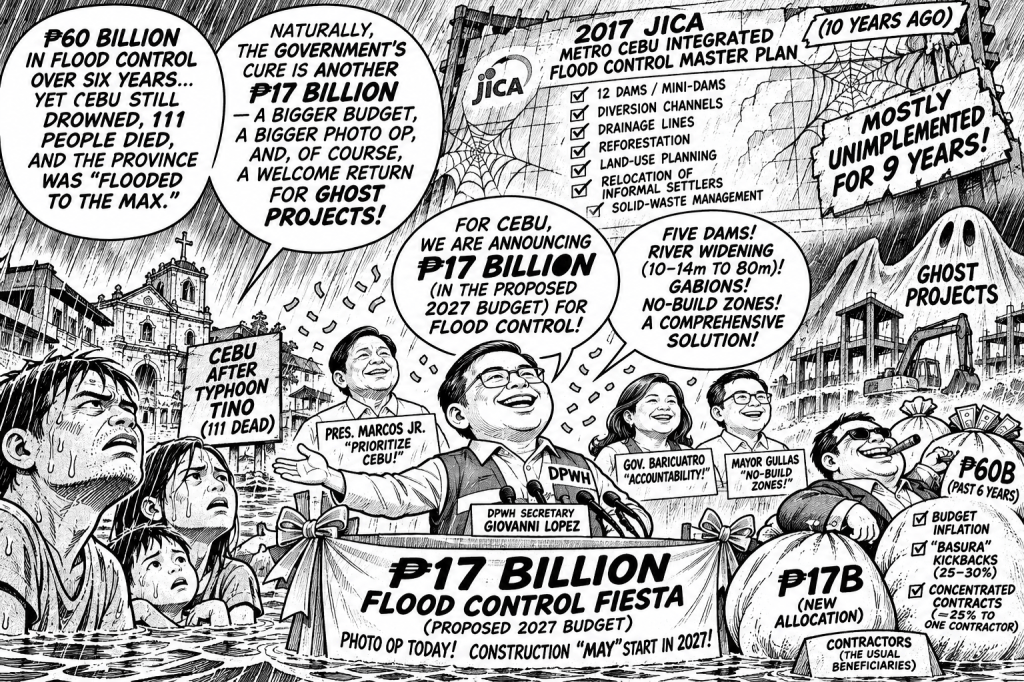
Cebu drowned on ₱60 billion. Naturally, the government’s cure is another ₱17 billion and a photo op.
By Louis “Barok” C. Biraogo — November 18, 2026
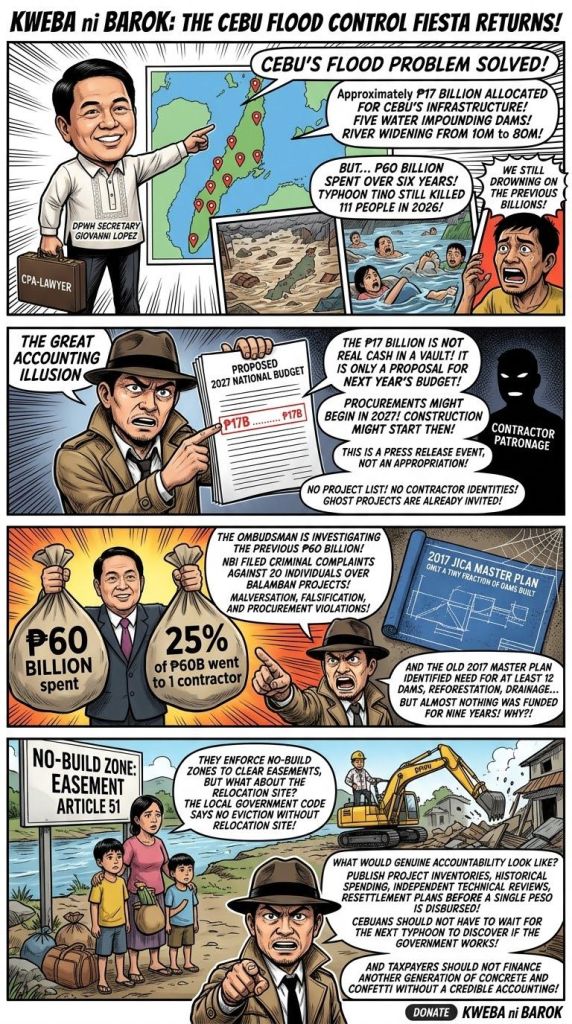
THE Department of Public Works and Highways (DPWH) has done it again. On November 14, 2026, Secretary Giovanni Lopez—the CPA-lawyer-cum-agency-savior appointed to cleanse an institution that has made corruption as routine as a barangay fiesta—announced approximately ₱17 billion for Cebu’s flood control and infrastructure projects. Five water impounding structures! River widening from 10–14 meters to 80 meters! Gabions! No-build zones! A veritable buffet of concrete, engineering jargon, and political photo opportunities.
Forgive me if I don’t break out the confetti. Cebu has been down this river before—literally. According to the Ombudsman’s preliminary figures, the province received approximately ₱60 billion in flood-control spending over the preceding six years, and yet Typhoon Tino still killed 111 people and left Governor Pamela Baricuatro lamenting that Cebu was “flooded to the max” (SunStar Cebu). The new ₱17 billion is being pitched as the answer to a problem that ₱60 billion was supposed to solve. This is not flood mitigation; this is Groundhog Day with a bigger budget.
The Great Accounting Illusion
Here is the first inconvenient truth that the Manila Times buried beneath its triumphant headline: as the Daily Tribune clarified on November 16, the ₱17 billion is not money in a vault. It is part of the proposed 2027 national budget. Procurement could begin in 2027. Construction may start within that year. In other words, what Secretary Lopez announced with great fanfare is not an appropriation, not an allotment, not an obligation, and certainly not a disbursement. It is a line item in a budget proposal that Congress has not yet enacted. The distinction matters, because the Manila Times report used the word “allocated” as though the cash had already been delivered in duffel bags to the DPWH regional office.
What we have, then, is a press release dressed up as a fiscal event. The ₱15.9 billion balance—the portion not earmarked for the five dams—remains a mystery wrapped in an arithmetic calculation. No project list. No contractor identities. No breakdown by district, municipality, or river basin. The DPWH has promised transparency under Republic Act No. 12009 (New Government Procurement Act), which Secretary Lopez’s own agency has had since July 2024 to implement. Yet here we are, two years into the law’s effectivity, and the public cannot determine whether the ₱17 billion will finance flood control or another round of congressional pet bridges.
The Master Plan Nobody Implemented
Perhaps the most damning revelation in the entire controversy is not that the money might be wasted. It is that the government already knew what to do—and did not do it. The 2017 Metro Cebu Integrated Flood Control and Drainage System Master Plan, prepared with assistance from the Japan International Cooperation Agency (JICA), identified the need for at least 12 dams and mini-dams, diversion channels, drainage lines, reforestation of upland areas, land-use planning, relocation of informal settlers, and solid-waste management (Central Visayas Regional Development Plan 2017–2022). It was an integrated watershed-management blueprint, not merely a concrete-pouring schedule.
Nearly a decade later, SunStar Cebu‘s November 2026 investigation found that only five sabo and weir dams worth approximately ₱193.6 million had been constructed. The major proposed structures—including the Mananga and Buhisan dams—remained unfunded. Upstream watershed rehabilitation and detention basins were “limited.” Approximately 9,800 structures still occupy river easements across Metro Cebu.
So let us be clear about what the ₱17 billion represents. It is not a bold new vision. It is a down payment on a nearly ten-year-old plan that was never implemented because the political class found concrete structures more photogenic than reforestation, and because kickbacks flow more smoothly through construction contracts than through watershed management. The five proposed dams—two on the Cotcot River, one on the Mananga, one on the Butuanon, one on the Bulacao—are not new ideas born of Typhoon Tino’s tragedy. They are legacy projects from 2017, finally funded because a disaster made them politically unavoidable.
Why were they unfunded for nine years? That is the question the Senate and the House should be asking. Not whether Cebu needs flood control—of course it does—but why the DPWH sat on a JICA-assisted master plan while rivers overflowed and residents drowned. The ₱17 billion is not an answer to that question. It is an admission that the government has been asleep at the wheel.
The Ombudsman’s Arithmetic and the Contractor Concentration
The second inconvenient truth involves the Ombudsman’s investigation into the ₱60 billion in Cebu flood-control spending from the previous six years. According to publicly reported preliminary figures, approximately 25% of that amount went to Cebu’s Seventh Congressional District and approximately 25% went to a single contractor (GMA News Online, Philstar.com). These are preliminary figures, not findings of liability. But they raise a question that cannot be dismissed with a press conference: Why is flood-control spending so geographically concentrated? Why is it so concentrated in one company? Is this the invisible hand of competitive bidding, or the visible hand of a procurement system designed to favor the well-connected?
The National Bureau of Investigation (NBI) has already filed criminal complaints against 20 individuals—including DPWH personnel and private individuals—over two flood-control projects in Barangay Singsing, Balamban, Cebu. The alleged offenses include malversation, technical malversation, falsification of public documents, perjury, violations of the Anti-Graft and Corrupt Practices Act, and violations of procurement law (Philippine News Agency, 4 Aug. 2026). The Department of Justice (DOJ) has emphasized that these are complaints undergoing preliminary investigation, and the respondents are entitled to due process. Fair enough. But the existence of these complaints, combined with the Ombudsman’s concentration figures, establishes something the DPWH cannot wish away: the agency has a credibility problem so profound that any new allocation must be accompanied by extraordinary safeguards.
Instead, what do we get? A new ₱17 billion announcement, a photo opportunity at the Mananga River, and Secretary Lopez crediting Talisay City Mayor Samsam Gullas for establishing no-build zones—as though enforcing existing easement laws under Presidential Decree No. 1067 (Water Code of the Philippines) is a novel act of political courage rather than a basic legal obligation.
The Mananga River and the Engineering of Wishful Thinking
Let us examine the flagship intervention: widening the Mananga River from 10–14 meters to approximately 80 meters. Secretary Lopez explained that a river channel should have a width comparable to the span of the bridge crossing it. This is not an engineering justification; it is an analogy. The Manning equation for open-channel flow depends on cross-sectional area, hydraulic radius, channel slope, and roughness coefficient—not on whether the bridge is long. A river widened to 80 meters in one section but constrained downstream by bridges, culverts, and encroachments may simply transfer floodwater from one community to another. The DPWH has not published the hydraulic modeling, the design discharge calculations, the sediment transport analysis, or the climate projections that would justify an 80-meter target. It has published a press release.
This is not to say river widening is inherently wrong. Removing artificial constrictions, restoring floodways, and increasing conveyance capacity are legitimate engineering objectives. But the DPWH’s own track record suggests that “river widening” can easily become “river dredging with a contractor kickback,” or “gabion construction with substandard materials,” or “channelization that destroys riparian habitats and increases downstream erosion.” The burden of proof is on the government, and the government has not met it. Where is the Environmental Compliance Certificate under Presidential Decree No. 1586? Where is the water permit from the National Water Resources Board under Presidential Decree No. 1067? Where is the geotechnical investigation? The DPWH has had since 2017 to prepare these documents. If they exist, publish them. If they do not, explain why.
The No-Build Zones and the Displacement Question
Secretary Lopez and Mayor Gullas deserve credit for enforcing no-build zones along the Mananga River. Article 51 of the Water Code establishes public-use easements of 3 meters in urban areas, 20 meters in agricultural areas, and 40 meters in forest areas. Structures within these easements are illegal. Clearing them is necessary for flood control. But the enforcement of no-build zones raises a question that the government has not answered: What happens to the families who live there?
The 2017 master plan explicitly included “relocation of informal settlers occupying riverbanks” as a nonstructural intervention. Section 27 of the Local Government Code requires that occupants not be evicted unless appropriate relocation sites have been provided. The 1987 Constitution protects property rights and due process. If the government plans to clear 9,800 structures from river easements across Metro Cebu, it needs a resettlement plan, a compensation framework, and a consultation process. What it has, instead, is a press release celebrating “no-build zones” without a word about where the evicted families will go. This is not flood control; it is disaster capitalism with a green ribbon.
The Legal Skeleton of a Scandal
The legal framework governing the ₱17 billion allocation is robust on paper. Article VI, Section 29(1) of the Constitution requires appropriations by law. Article II, Section 28 mandates full public disclosure of transactions involving public interest. Republic Act No. 12009 requires competitive bidding, PhilGEPS posting, and value-for-money evaluations. Republic Act No. 3019 (Anti-Graft and Corrupt Practices Act) criminalizes graft, including causing undue injury to the government and giving unwarranted benefits to private parties. Republic Act No. 6713 (Code of Conduct and Ethical Standards for Public Officials and Employees) requires public officials to uphold public interest over personal interest. Belgica v. Ochoa (2013) and Araullo v. Aquino III (2014) constrain legislative and executive discretion over budget execution. Oposa v. Factoran (1993) recognizes intergenerational environmental responsibility. Chavez v. Public Estates Authority (2002) affirms the right to information on matters of public concern.
All of this exists. None of it prevented ₱60 billion from being spent in Cebu with results so disappointing that the Ombudsman is now investigating. The laws are not the problem. The problem is the political will to enforce them—or, more precisely, the political economy that makes enforcement unprofitable for those in power.
The Political Economy of Flood Control
Let us name the elephant in the room. The DPWH budget has replaced the outlawed Priority Development Assistance Fund as the primary vehicle for congressional patronage. Weena Gera of the UP Center for Integrative and Development Studies has described how flood control—technically complex, disaster-urgent, and rhetorically shielded by climate change—has become a “mechanism for corruption” (“Flood-Control Fiasco“). The pattern is well-documented: budget inflation, “basura” kickback systems extracting 25–30% commissions, fixed deductions of 3.5% at the central office and 2.5% at the regional level, and ghost projects that exist only on paper. The Ombudsman has filed 79 flood-control-related cases involving 67 persons, including a senator, four congressmen, a former DPWH secretary, and 39 DPWH personnel (GMA News Online, 6 Nov. 2026).
The ₱17 billion for Cebu must be understood in this context. It is not merely a response to Typhoon Tino. It is an opportunity—for the Marcos administration to demonstrate action after a scandal, for Cebu politicians to claim credit, for contractors to secure new revenue streams, and for the DPWH to rehabilitate its image under new leadership. Every actor has a legitimate institutional interest and a potential conflict of interest. The public interest is not automatically served by any of them.
President Marcos Jr. personally directed that Cebu be prioritized after Typhoon Tino. Secretary Lopez, appointed to institutionalize reforms, now faces the test of whether he can deliver them. Governor Baricuatro has demanded accountability for the previous ₱60 billion. Mayor Gullas has enforced no-build zones. These are not villains. But they are politicians operating within a system that rewards announcements over accomplishments, ribbon-cuttings over measurable outcomes, and press releases over procurement documents.
What Would Genuine Accountability Look Like?
If the government were serious about ensuring that the ₱17 billion actually reduces flood risk, it would do the following before a single peso is disbursed:
- First, publish the complete project inventory—every structure, every river section, every drainage line, every peso—with locations, costs, and technical justifications. The DPWH cannot claim transparency under RA 12009 while withholding the basic details of what it plans to build.
- Second, release the 2017 master plan implementation record. Explain why only five of at least 12 recommended dams were built. Explain why the Mananga and Buhisan dams remained unfunded for nine years. Explain what happened to the reforestation, detention basins, and land-use regulations that the JICA-assisted plan recommended.
- Third, reconcile the historical spending. The DPWH should produce a consolidated database of all flood-control projects in Cebu from 2016 to 2026, with unique project IDs, geographic coordinates, contractors, completion status, audit findings, and actual physical accomplishment. This would allow auditors and the public to determine whether the new projects are genuinely new or simply repetitions of old failures.
- Fourth, submit the five dam projects to independent technical review. Hydrologists, geotechnical engineers, environmental scientists, and disaster-risk specialists should evaluate the feasibility studies, design flood assumptions, storage capacities, cost estimates, and environmental impacts. The DPWH cannot be the sole judge of its own engineering.
- Fifth, establish a resettlement and compensation plan for affected communities. No-build zones are legally necessary, but they cannot become an excuse for evicting poor families without due process, just compensation, and adequate relocation. The Local Government Code and the Constitution require no less.
- Sixth, invite independent monitoring. Civil society organizations, academic institutions, and the Commission on Audit (COA) should have real-time access to procurement documents, construction progress, and disbursement records. The days of self-certification by DPWH regional offices must end.
The Choice
The ₱17 billion for Cebu is neither inherently corrupt nor inherently virtuous. It is a fiscal instrument whose character will be determined by how it is implemented. The legal framework exists to ensure transparency, competition, and accountability. The question is whether the political will exists to enforce it.
Secretary Lopez has an opportunity to prove that the DPWH can reform. President Marcos Jr. has an opportunity to demonstrate that his administration’s anti-corruption rhetoric is more than a post-scandal public relations campaign. Governor Baricuatro has an opportunity to translate her demand for accountability into concrete oversight. Mayor Gullas has an opportunity to show that no-build zones can be enforced without trampling on the rights of the poor.
But opportunities are not accomplishments. Announcements are not appropriations. Press releases are not procurement documents. And ₱17 billion is not flood control until the water actually recedes and the communities are actually safer.
Cebu’s residents should not have to wait for the next typhoon to discover whether the government’s latest flood-control program works. And taxpayers should not have to finance another generation of concrete and confetti without first receiving a credible accounting of what happened to the billions already spent.
The ghost projects of Balamban are watching. The 111 dead of Typhoon Tino are watching. The families living in river easements are watching. The question is whether anyone in Malacañang, the DPWH, or Congress is watching back.
Key Citations
A. Legal & Official Sources
- The 1987 Constitution of the Republic of the Philippines. Official Gazette of the Republic of the Philippines, 1987, http://www.officialgazette.gov.ph/constitutions/1987-constitution/.
- Republic Act No. 12009. An Act Revising Republic Act No. 9184, Otherwise Known as the “Government Procurement Reform Act,” and for Other Purposes (New Government Procurement Act). 2024, http://www.officialgazette.gov.ph/2024/07/20/republic-act-no-12009/.
- Presidential Decree No. 1067. A Decree Instituting a Water Code, Thereby Revising and Consolidating the Laws Governing the Ownership, Appropriation, Utilization, Exploitation, Development, Conservation and Protection of Water Resources (Water Code of the Philippines). 1976, lawphil.net/statutes/presdecs/pd1976/pd_1067_1976.html.
- Republic Act No. 7160. An Act Providing for a Local Government Code of 1991. 1991, http://www.officialgazette.gov.ph/1991/10/10/republic-act-no-7160/.
- Republic Act No. 3019. Anti-Graft and Corrupt Practices Act. 1960, http://www.officialgazette.gov.ph/1960/08/17/republic-act-no-3019/.
- Republic Act No. 6713. An Act Establishing a Code of Conduct and Ethical Standards for Public Officials and Employees. 1989, http://www.officialgazette.gov.ph/1989/02/20/republic-act-no-06713/.
- Belgica v. Ochoa. G.R. Nos. 208566, 208493, and 209251, Supreme Court of the Philippines, 19 Nov. 2013. lawphil.net/judjuris/juri2013/nov2013/gr_208566_2013.html.
- Araullo v. Aquino III. G.R. No. 209287, Supreme Court of the Philippines, 1 July 2014. lawphil.net/judjuris/juri2014/jul2014/gr_209287_2014.html.
- Oposa v. Factoran. G.R. No. 101083, Supreme Court of the Philippines, 30 July 1993. lawphil.net/judjuris/juri1993/jul1993/gr_101083_1993.html.
- Chavez v. Public Estates Authority. G.R. No. 133250, Supreme Court of the Philippines, 9 July 2002. lawphil.net/judjuris/juri2002/jul2002/gr_133250_2002.html.
- Department of Economy, Planning, and Development, Region VII. Central Visayas Regional Development Plan 2017–2022: Midterm Update. dro7.depdev.gov.ph/wp-content/uploads/2022/04/2017-2022_RDP_Region-7_MediumTerm.pdf.
B. News Reports
- Ombudsman Investigates P60-Billion Cebu Flood Control Projects after Severe Flooding.” SunStar Cebu, 10 Aug. 2026, http://www.sunstar.com.ph/amp/story/cebu/ombud-begins-flood-probe.
- “DPWH Allots P17B for Cebu Projects.” The Manila Times, 14 Nov. 2026, http://www.manilatimes.net/2026/11/14/regions/dpwh-allots-p17b-for-cebu-projects/2469559/amp.
- “DPWH Allots ₱17 Billion for Cebu Infrastructure, Including 5 Water Impounding Projects.” Daily Tribune, 16 Nov. 2026, tribune.net.ph/amp/story/2026/11/16/dpwh-allots-p17-billion-for-cebu-infrastructure-including-5-water-impounding-projects.
- “Ombudsman Looking into Cebu’s ₱60 Billion Worth of Flood Control Projects.” GMA News Online, 10 Aug. 2026, http://www.gmanetwork.com/news/topstories/regions/998011/ombudsman-looking-into-cebu-s-60-billion-worth-of-flood-control-projects/story/.
- “P60-Billion Cebu Flood Projects Face Ombudsman Probe.” Philstar.com, 11 Aug. 2026, qa.philstar.com/headlines/2026/08/11/2548357/p60-billion-cebu-flood-projects-face-ombudsman-probe.
- “20 DPWH-Cebu Employees Face Charges for Flood Control Projects.” Philippine News Agency, 4 Aug. 2026, http://www.pna.gov.ph/articles/1281077.
- Gera, Weena. “Flood-Control Fiasco: A Policy Reckoning for Accountability in the Philippines’ Climate Risk Governance.” UP Center for Integrative and Development Studies, 2 Oct. 2025, up.edu.ph/flood-control-fiasco-policy-reckoning/.
- “Ombudsman: 79 Flood Control-Related Cases Filed in Courts.” GMA Network, 6 Nov. 2026, http://www.gmanetwork.com/news/topstories/nation/2026/11/06/ombudsman-79-flood-control-related-cases-filed-in-courts/.
- “SunStar Cebu. ‘Cebu Flood Control: P43B Spent, Yet Critical Plans Ignored.’” SunStar, 2026, http://www.sunstar.com.ph/amp/story/cebu/notable-waterways-focus-areas.

- ₱9 Billion in ‘Savings’? DILG’s Fire Truck Deal Smells Like Smoke

- ₱8B BBM Pork: CCTV for Every Captain’s Kumpare?

- ₱8.9 Billion, 331 Ghost Police Stations: The TIKAS Scandal Explained

- ₱8.4 Billion, 42,000 Barangays, 1 Election: The “Bawat Barangay Makikinabang” Vote-Buying Masterclass

- ₱75 Million Heist: Cops Gone Full Bandit

- ₱63 to the Dollar: The Only Thing Falling Faster Than the Peso Is the Government’s Credibility

- ₱6.77B Ghost Haunts Duterte: RTC Dismisses Mans Carpio’s Desperate Plea

- ₱6.77 Billion and Zero Cash: The Sara Duterte SALN Math That Doesn’t Add Up

- ₱6.7-Trillion Temptation: The Great Pork Zombie Revival and the “Collegial” Vote-Buying Circus

- ₱58.53B, Zero Receipts: The LGSF Pork Barrel Nobody Wants to Name
- ₱53 Million Man Tells ₱695-a-Day Workers to Stop Being ‘Mayabang’: The Audacity of BSP’s Remolona

- ₱491-M Right-of-Way Scam: DPWH Paid for Ghost Land, Ombudsman Finally Notices






Leave a Reply