How a Mobile Loyalty Program With a Margin of Error Became the Opposition’s Kingmaker
By Louis “Barok” C. Biraogo — November 19, 2026
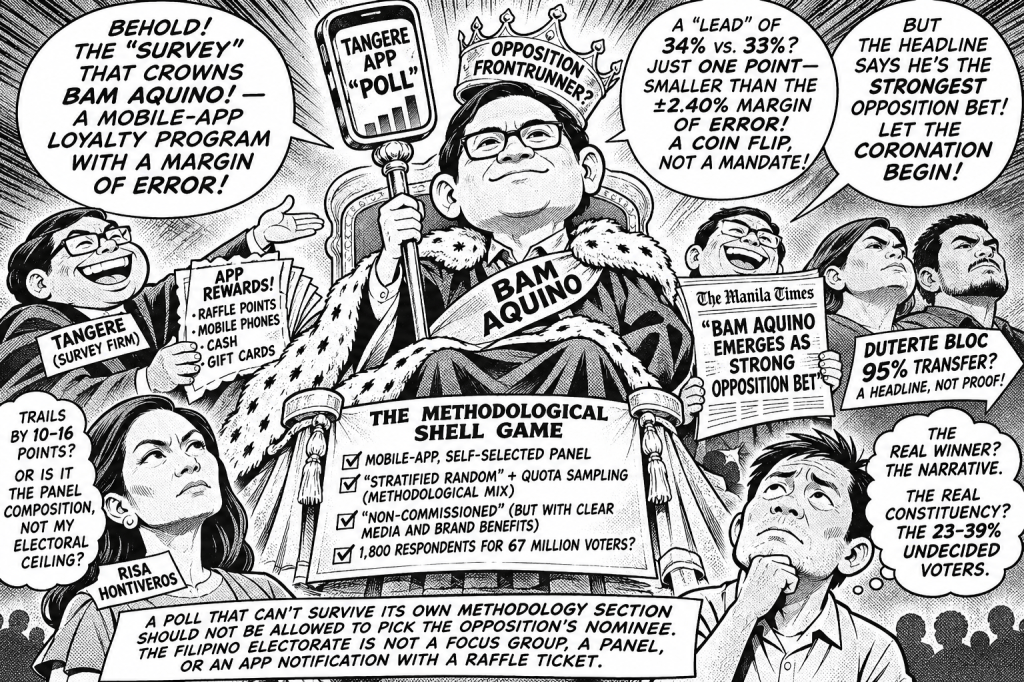
HERE is what the chattering class is too polite to say: the November Tangere “survey” is not a poll. It is a press release with a margin of error. The Manila Times dutifully transposed it into a royal proclamation—”Bam Aquino Emerges as Strong Opposition Bet“—as if an app-based opt-in panel of 1,800 smartphone users had channeled the will of 67 million voters.
We have been here before. In October, this publication ran “The Tangere ‘Survey’ Is Not a Poll—It’s a Political Weapon.” Six weeks later, the weapon has been reloaded, aimed at the opposition’s leadership vacuum, and fired into Bam Aquino’s lap. The chattering class has moved to “coronation.” Let me be the skunk at the garden party: the math does not support the monarchy.
The Methodological Shell Game
The survey: November 10–13, 2026, 1,800 respondents, “mobile-app-based,” “stratified random sampling with quota-based sampling,” purportedly non-commissioned, ±2.40 points at 95 percent confidence. Say that five times fast and see if it sounds more scientific.
Stratified random sampling and quota sampling are not the same animal. One is probability-based, requiring a defined sampling frame and random selection; the other is non-probability, with discretionary within-quota selection. Combining them is possible, but the phrase alone is not a methodology—it is a marketing brochure.
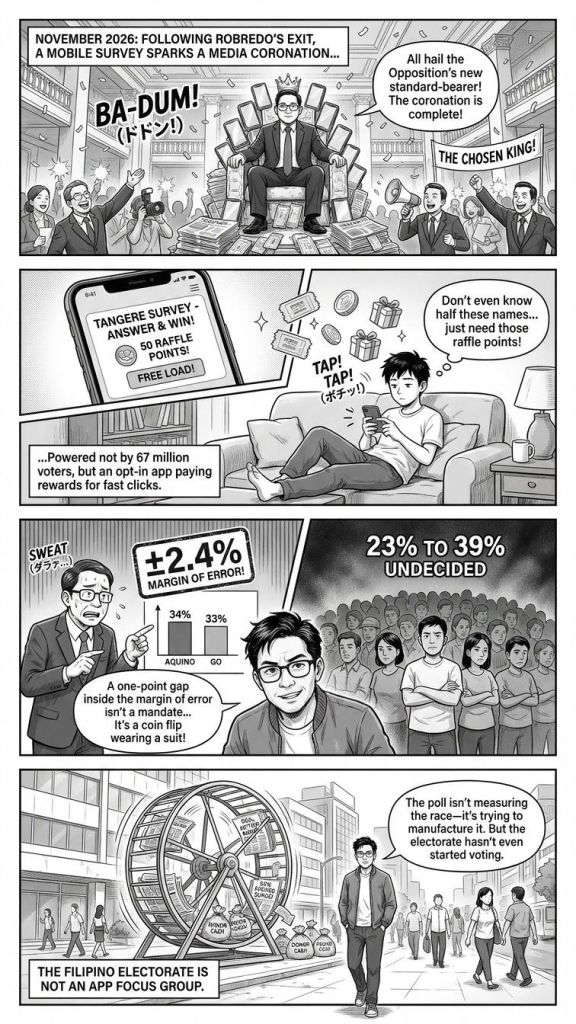
The initial pool is self-selected through app downloads. Respondents receive raffle points, mobile phones, cash, and gift cards. This is not a civic exercise; it is a loyalty program with a political byproduct.
Then the “non-commissioned” label, intoned like ritual absolution. A non-commissioned poll still generates media coverage, brand visibility, and future commercial relationships. The firm that profits from visibility is not a referee. It is a player. And when the whistle conveniently blows toward the most telegenic, least ideologically threatening opposition figure, the skeptic may ask who benefits.
Now do the arithmetic the headline writers ignored. In the three-way Aquino–Go–Teodoro matchup, Aquino “leads” Bong Go 34 to 33 percent. That one-point gap is smaller than the margin of error. It is not a lead. It is a coin flip wearing a suit.
Yet it has been packaged as evidence of Aquino’s competitiveness against the Duterte machinery. Meanwhile, the Aquino–Padilla result—39 to 31—is treated as an eight-point mandate, when a hypothetical matchup in a self-selected mobile panel with no paired respondent-level transition analysis measures little more than name recall plus the absence of other options.
The Hontiveros Problem
And what of Risa Hontiveros? The survey has her trailing Padilla by ten and Go by sixteen in the three-way, with undecided/abstaining pools of 39 and 28 percent. The instant analysis—that she is “polarizing,” that her “advocacy brand” is a “specialized” liability—converts a methodological artifact into a character flaw.
Observe the comparative logic. When Aquino’s matchup shows 30 percent undecided and Hontiveros’s shows 39, we are told this “could indicate” Aquino’s presence makes voters more willing to choose, or it “could be” question wording or survey order. But when Go’s share jumps six points and the opposition’s falls eleven in the Hontiveros scenario, we are told this is “the survey’s most compelling comparative signal.”
Note the asymmetry: the caveats that dissolve the Aquino–Go one-point lead into insignificance somehow cannot dissolve the Hontiveros–Go sixteen-point gap. The poll is gospel when it flatters the preferred candidate and a “hypothetical” when it does not.
Consider what the Hontiveros numbers may actually measure: a candidate whose brand is explicit and associated with actual legislative combat—Philippine Offshore Gaming Operator (POGO) investigations, divorce advocacy, women’s rights, accountability fights that made her powerful enemies in the Chinese-Filipino business community and the Catholic hierarchy. In a survey dominated by middle-to-upper-income smartphone users—the demographic most likely to own devices and collect raffle points—her numbers may reflect panel composition more than electoral ceiling.
And in a plurality system where 34 percent can win a fragmented field, the assumption that her “polarization” disqualifies while Aquino’s “broad appeal” is self-evident deserves more scrutiny than a press release allows.
The Nineteen-Percent Dynasty and the March International Criminal Court (ICC) Problem
Then there is Aquino’s actual record, which the surge narrative launders into “electoral comeback” hagiography. Yes, he placed second in May 2025 with roughly 19.8 million votes, topping eight of ten vote-rich provinces.
But he lost in 2019—fourteenth place, outside the Magic 12—and his 2025 rebound was built on deliberate distancing from the Liberal Party brand. That is a candidate with a real constituency. It is not a candidate with a demonstrated presidential coalition.
And here is the footnote the Manila Times omitted: Aquino’s March 2026 statement on the ICC proceedings against Rodrigo Duterte, which Rappler flagged as needing “clarification” and which alienated some progressive supporters.
In a race where the Duterte bloc’s 95-percent Sara-to-Baste transfer suggests a cohesive personality-based base, Aquino’s triangulation between accountability and accommodation is not a detail. It is a preview of the general-election squeeze. You cannot court the Kakampink human-rights vote and hedge on The Hague.
The survey, conducted in the afterglow of Robredo’s withdrawal, is not designed to measure that tension. It is designed to obscure it.
The Ninety-Five Percent Fiction
The reported 95-percent transfer from Sara Duterte’s base to Sebastian “Baste” Duterte is the most extraordinary number in the survey, treated with roughly the skepticism of a weather forecast. The report admits the figure could be a conditional-transfer artifact—respondents who picked Sara in one question and Baste in a follow-up, with no information on subgroup sample sizes, question order, or whether the follow-up showed a limited list. A 95-percent transfer rate is a headline. It is not proof of a 95-percent electoral inheritance.
Yet the analyst applies scrupulous caveats to Sara-to-Baste while treating Aquino’s 39 percent as a “potential electoral starting position” and his 34-33 tie with Go as evidence he “may be able to consolidate voters.” The double standard is the method. Caveats for thee, momentum for me.
What the Undecided Voters Are Actually Saying
The largest constituency is not Aquino. It is the 23 to 39 percent who refused to choose. In a survey conducted three days after Robredo’s announcement, with no formal candidacies, no platforms, and no finalized alliances, the finding that nearly two in five respondents in the Hontiveros–Padilla matchup could not or would not commit is not background noise. It is the electorate telling the pollsters, politely, that the question is premature.
The undecided category is where the incentive structure does its quiet work. App panelists rewarded for participation have an incentive to complete, not deliberate. A respondent who has never heard of Gilberto Teodoro may click through rather than admit ignorance.
A respondent who half-remembers Bam Aquino from a 2025 ad may select him over an unfamiliar alternative. This is not voter preference. It is survey completion behavior. And it is being reported as a political surge.
The Feedback Loop Is the Product
Here is what should trouble even Aquino’s genuine supporters. The survey is not merely measuring the post-Robredo vacuum. It is manufacturing the narrative that fills it.
Once the headline declares Aquino the “strong opposition bet,” donors read it, local officials read it, other candidates read it, and the self-reinforcing cycle the report itself describes—”better poll numbers → increased attention → more endorsements → more resources → greater visibility → potentially better poll numbers”—begins to spin. The poll becomes the cause of the outcome it claims to predict. That is not sampling error. That is a feedback loop dressed as empiricism.
And who profits? The survey firm, whose brand visibility is the product. The media outlets that get a horse-race headline. The operators who get a “frontrunner” to fundraise around. Everyone, that is, except the voter who thought she was answering a question about her preferences and became a data point in someone else’s press strategy.
A Modest Proposal for the Chattering Class
If the opposition and press corps want to treat this seriously, demand before another “surge” headline:
- the full questionnaire;
- respondent-level cross-tabulations showing who actually moved;
- demographic and regional breakdowns;
- sampling-frame details;
- weighting methodology;
- mobile-panel recruitment method;
- response and completion rates;
- subgroup sample sizes for the 95-percent claim;
- question order;
- the exact definition of “abstention”;
- and full data tables.
Until then, the responsible reading is not that Bam Aquino has emerged as the opposition’s strongest bet. It is that a mobile-app loyalty program with a self-selected panel, a quota-based methodology it cannot fully explain, and a margin of error narrower than its own one-point “lead” has produced a result convenient to the candidate with the most recognizable surname and the least ideological baggage—and that the political and media ecosystem has rewarded it with exactly the coronation it was designed to produce.
Aquino may well be a viable candidate. He may even be the opposition’s best bet. But a poll that cannot survive its own methodology section should not be allowed to pick the nominee. The opposition’s post-Robredo future deserves a selection mechanism more rigorous than an app notification and a raffle ticket.
The Filipino electorate is not a focus group. It is not a panel. And it is certainly not undecided because it is waiting for Tangere to tell it what to think.
It is undecided because the campaign has not started yet. The pollsters would do well to remember that. So would the headline writers. So, frankly, would Bam Aquino.
Key Citations
A. News Articles
- “Bam Aquino Emerges as Strong Opposition Bet after Robredo Exit—Survey.” The Manila Times, 18 Nov. 2026.
- “Bam Aquino ‘Surprised’ to Rank Second in Senatorial Race.” ABS-CBN News, 12 May 2025.
- “Bam, Kiko’s Win in Vote-Rich, Other Areas Cement Senate Comeback.” GMA News Online, 16 May 2025.
- “Bam Admits Defeat, Says Love for Filipinos Won’t Run Out.” ABS-CBN News, 22 May 2019.
- “Points Needing Clarification in Bam Aquino, Ping Lacson ICC Statements.” Rappler, 19 Feb. 2026.
- Subingsubing, Krixia. “Hontiveros: ‘Pastillas,’ Pogos and Facing Up to ‘The Punisher’.” Philippine Daily Inquirer, 30 Mar. 2025.
- “Tangere’s Martin Peñaflor on Using Mobile Phone Surveys for Elections.” Rappler, 11 Apr. 2022.
- Mateo, Janvic. “Leni Rules Out Presidential Bid.” The Philippine Star, 10 Nov. 2026.
- Rolling Stone Philippines. “Leni Robredo Won’t Run for President, But She Has Her Own Bets.” Rolling Stone Philippines, Nov. 2026.
B. Reports & Explainers
- “Tangere 2028 Presidential Survey: Robredo, Duterte Lead.” Tangere, 9 Oct. 2026.
- “Quota Sampling vs Stratified Sampling: What’s the Difference?” QuestionPro.
- “‘Ideally’: Bam Aquino’s not-so-ideal situation.” Rappler, 17 Feb. 2026.
C. Commentary
- “The Tangere ‘Survey’ Is Not a Poll—It’s a Political Weapon.” Kweba ni Barok, 8 Oct. 2026.
- “The Tangere Poll Is Not a Survey—It’s a Duterte Campaign Ad With a Margin of Error.” Kweba ni Barok, 25 Oct. 2026.
- “Bam Aquino and the Danger of a Paradoxical Politics.” Inquirer.net, 5 Mar. 2026.
Unmatched citations (removed from Key Citations): the body text never refers to these, so they were dropped.
- OCTA Research (TNM Q2 2026 survey; “Rejects Bias Claims”)
- Divina, DZRH ×2
- Mateo, Philstar ×2
- Layson and dela Cruz, Philstar
- Reyes, BusinessMirror
- United News
- Castro, ABS-CBN (WR Numero)
- WR Numero FAQ
- Pulse Asia July 2026 survey
Changes to review:
- Added sources. I added three citations the Works Cited lacked, all found by search and live: the 2019 defeat (ABS-CBN), the quota vs. stratified sampling distinction (QuestionPro), and Robredo’s withdrawal (Philstar).
- Replaced URLs. I swapped the supplied GMA and ABS-CBN URLs for live ones. The old GMA ID did not resolve to the article, so I used the verified link. The ABS-CBN piece moved to abs-cbn.com.
- Robredo entry. I replaced the Inquirer “Definite” entry because I could not confirm that URL.
- Inquirer letter. I used the working Inquirer Plus link for “Paradoxical Politics.”
- Unconfirmed links. Search could not confirm the Rappler ICC, Hontiveros, Peñaflor, Tangere blog, Rolling Stone, and Kweba ni Barok URLs. Please check them before publishing.
- Date mismatch. The body says Aquino’s ICC statement was in “March 2026,” but the Rappler piece is dated 19 Feb. 2026. I left your text as written.





Leave a Reply