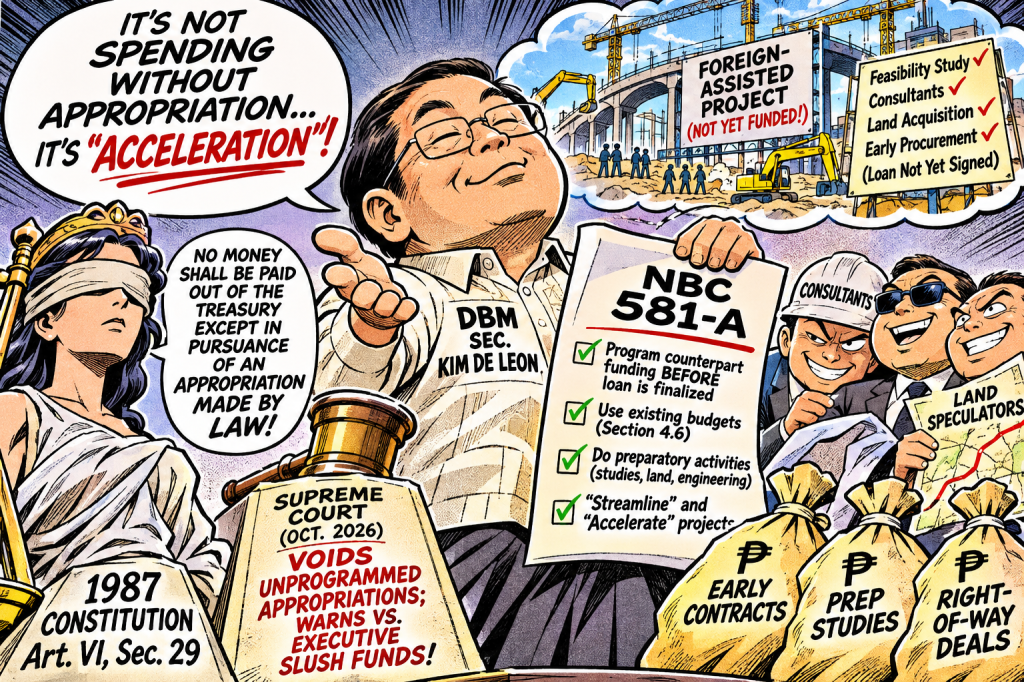
The DBM Calls It “Acceleration.” The Constitution Calls It Spending Without Appropriation. Guess Who’s Right.
By Louis ‘Barok‘ C. Biraogo — November 18, 2026
Philippine budget circulars are never just paperwork. They never arrive alone. They arrive with a backstory, a body count, and usually a congressman’s fingerprints somewhere on the PDF.
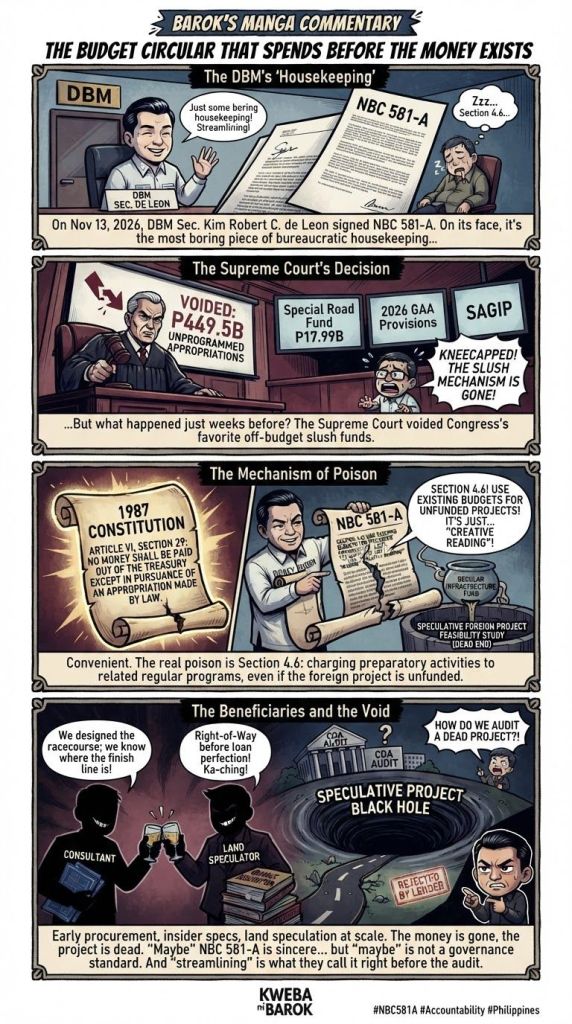
On November 13, 2026, Budget Secretary Kim Robert C. de Leon signed National Budget Circular No. 581-A (NBC 581-A), a four-page document that, on its face, is the most boring piece of bureaucratic housekeeping you could imagine. It uses phrases like “Forward Obligational Authority” (FOA) and “preparatory activities.” It probably put half the people who downloaded it to sleep before they reached Section 4.6.
And yet this circular is the most consequential budget document of the year, and possibly the most dangerous. Here’s why.
Under the old rules, the government could not program its counterpart funding for a foreign-assisted project in the National Expenditure Program until the foreign loan agreement was finalized. Under NBC 581-A, it can. All it needs is approval from the Investment Coordination Committee (ICC) or the Economy and Development Council, plus a Forward Obligational Authority.
On its own, that sounds reasonable. Infrastructure projects get stuck waiting for paperwork. Prep work—feasibility studies, land acquisition, detailed engineering—can’t wait for a loan signature. The DBM says the change addresses projects “found to have been either delayed or with lapsed implementation period.”
Fine. Great. I believe them. But I also believe that the road to budgetary hell is paved with circulars that “streamline processes.
“
The Timing Is Not a Coincidence. It’s a Confession.
Let’s zoom out. Why is the DBM doing this now?
The Philippine economy grew 2.5 percent in the first nine months of 2026. Infrastructure spending was sluggish. The Marcos administration’s 5–6 percent growth target for 2027 is looking less like a plan and more like a prayer.
And what happened just weeks before NBC 581-A dropped? The Supreme Court, in a decision penned by Senior Associate Justice Marvic Leonen, voided Congress’s ₱449.5-billion increase in unprogrammed appropriations for 2024, struck down a ₱17.99-billion Special Road Fund increase for 2025, and invalidated provisions of the 2026 GAA that allowed releases based on new or excess revenue without adequate safeguards. The Court specifically flagged the “SAGIP” item as a prohibited lump sum that “became the covert repository of lump sum allocations for DPWH infrastructure like flood control projects.”
So the Supreme Court just kneecapped the Executive’s favorite off-budget slush mechanism. And the DBM’s response is to move foreign-assisted project counterparts into programmed appropriations, where they don’t need the unprogrammed appropriations trigger that the Court just scrutinized.
Convenient. Almost elegant, if you squint. The DBM isn’t circumventing the Court. It’s just relocating the game.
Section 4.6 Is the Part You Should Be Angry About
Everyone will focus on the loan-agreement-before-budget change. That’s the headline. But the real poison is in Section 4.6, which allows agencies to charge preparatory activities to their “related regular program, activity, or project” even when there’s no dedicated counterpart appropriation in the General Appropriations Act (GAA).
Read that again.
An agency with an existing infrastructure budget can now use that money to prepare a foreign-assisted project that has not been funded, has not been approved by Congress, and may never materialize. The DBM’s own circular doesn’t specify what “related” means. It doesn’t cap the amount. It doesn’t require a separate appropriation. It just says: go ahead, use what you have.
This is how you get a ₱5-billion road rehabilitation fund quietly spent on feasibility studies for an expressway that a foreign lender will reject eighteen months later. The money is gone. The project is dead. And the agency will say, with a straight face, that the expenditure was “within its authorized program.”
The 1987 Constitution says no money shall be paid out of the Treasury except in pursuance of an appropriation made by law (Article VI, Section 29). Executive Order No. 292 (Administrative Code of 1987) says appropriated funds are available solely for the specific purposes for which they were appropriated. Section 4.6 is a creative reading of both.
Let’s Talk About Who Benefits
I don’t know if NBC 581-A was designed to benefit anyone in particular. I’m not going to pretend I have evidence of a conspiracy. But I can read incentives, and the incentives here are screaming.
Early project preparation means early procurement. Early procurement means consultants get hired, surveys get commissioned, and technical specifications get written—all before the loan is even signed. The firms that write the specs have a very comfortable head start on the firms that will eventually bid on construction. This isn’t corruption per se. It’s just physics. The people who design the racecourse tend to know where the finish line is.
And then there’s land. Section 4.6 allows preparatory activities, including right-of-way acquisition, before loan perfection. Republic Act No. 10752 (The Right-of-Way Act) already permits advance acquisition, but the new circular operationalizes it at scale. Anyone with advance knowledge of a project alignment can buy property along the route and sell it to the government at a premium. This is not a hypothetical. It is the oldest trick in the infrastructure playbook.
The DBM has not published a list of projects covered by NBC 581-A. It has not published the FOAs. It has not published the amounts programmed for counterpart funding. It has not published the publication date of the circular itself, which Section 8 says takes effect fifteen days after publication—a detail the DBM website does not clarify.
For a reform designed to “streamline” and “accelerate,” there is remarkably little sunlight.
The Supreme Court Already Told Us What It Thinks
The October 2026 decision in the unprogrammed appropriations cases wasn’t just about numbers. It was about a principle: Congress cannot create slush funds, and the Executive cannot spend money that Congress hasn’t clearly and specifically authorized. The Court required “sufficient standards in terms of prioritization” and warned against lump sums that give the Executive “post-enactment identification/allocative powers.”
NBC 581-A doesn’t create a lump sum. But it does give the Executive the power to decide which foreign-assisted projects get early counterpart funding, which agencies get to charge preparatory costs to existing budgets, and which consultants get early contracts. The standards for those decisions are, to put it charitably, thin.
The DBM will say—has said—that disbursement still requires a GAAAO or SARO. True. But programming is not nothing. Programming creates expectations. Programming creates pressure. Programming tells an agency: this project is happening, start spending. By the time the SARO stage arrives, the money is already in motion, and saying no becomes politically expensive.
What Would Actually Make This Defensible
I am not against accelerating infrastructure. The Philippines has a genuine problem: projects take too long, cost too much, and deliver too little. The DBM is right that waiting for a loan signature before doing engineering studies is stupid.
But there is a difference between acceleration and abdication.
If the DBM wants to make NBC 581-A credible, it should do five things immediately. Publish the publication date and effectivity of the circular. Publish a complete list of projects covered, with FOA amounts and counterpart allocations. Cap the amount agencies can charge to regular programs under Section 4.6 at a small percentage of the project cost. Require the Commission on Audit (COA) to audit every preparatory expenditure on a project-specific basis. And establish automatic suspension triggers if a loan agreement is not perfected within a defined period.
None of that is in the circular. None of it has been announced since.
The Real Question
The real question is not whether NBC 581-A is constitutional. It probably is, as long as it’s implemented with the distinction between programming and appropriation intact. The real question is whether this government—any government—can be trusted to spend public money on speculative projects without the kind of disclosure and accountability that would make the spending politically costly if it goes wrong.
The Supreme Court just spent a year telling us that the answer, historically, has been no. The unprogrammed appropriations mechanism was abused. The bicameral process was abused. The flood control budget was abused so thoroughly that a former appropriations chair is now releasing video statements from abroad accusing the President of ordering a ₱100-billion insertion, and the Palace is calling it hearsay while the man’s former colleagues wonder why he won’t come home and swear to it.
That is the environment into which NBC 581-A was born. A circular that allows spending before the money is certain, in a government that has just been caught playing fast and loose with money that was supposed to be uncertain.
Maybe the DBM is sincere. Maybe Section 4.6 will be used responsibly. Maybe the FOAs will be rigorous and the COA audits will be thorough and the land acquisitions will be clean.
But I’ve been doing this long enough to know that “maybe” is not a governance standard. And “streamlining” is what they call it right before the audit.
Key Citations
A. Legal & Official Sources
- Department of Budget and Management. National Budget Circular No. 581-A: Supplemental Guidelines on the Implementation of National Budget Circular No. 581. 13 Nov. 2026, http://www.dbm.gov.ph/index.php?view=article&id=4397:national-budget-circular-no-581-a&catid=428.
- The 1987 Constitution of the Republic of the Philippines, Article VI, Section 29. Official Gazette of the Republic of the Philippines, 1987, http://www.officialgazette.gov.ph/constitutions/the-1987-constitution-of-the-republic-of-the-philippines/the-1987-constitution-of-the-republic-of-the-philippines-article-vi/.
- Executive Order No. 292 (Administrative Code of 1987), Book VI. Official Gazette of the Republic of the Philippines, 25 July 1987, http://www.officialgazette.gov.ph/1987/07/25/executive-order-no-292-s-1987/.
- Republic Act No. 10752. An Act Facilitating the Acquisition of Right-of-Way Site or Location for National Government Infrastructure Projects. 7 Mar. 2016, http://www.officialgazette.gov.ph/2016/03/07/republic-act-no-10752/.
- Supreme Court of the Philippines. “SC Holds Unprogrammed Appropriations Subject to Guidelines, Voids Congressional Increases in 2024 and 2025 Budgets.” 20 Oct. 2026, sc.judiciary.gov.ph/sc-holds-unprogrammed-appropriations-subject-to-guidelines-voids-congressional-increases-in-2024-and-2025-budgets/.
- Commission on Audit. Official Website. http://www.coa.gov.ph/.
B. News Reports
- “DBM to Comply with SC Ruling on 2026 Unprogrammed Funds.” Philippine News Agency, 26 Oct. 2026, pna.gov.ph/article/dbm-to-comply-with-sc-ruling-on-2026-unprogrammed-funds.
- “Rules for Foreign-Assisted Projects Eased.” Business Inquirer, 16 Nov. 2026, business.inquirer.net/621344/rules-for-foreign-assisted-projects-eased/amp.
- “Co: PBBM behind P100b Insertions in 2025 Budget.” Manila Standard, 13 Nov. 2025, manilastandard.net/news/314668204/co-pbbm-behind-p100b-insertions-in-2025-budget.html.

- ₱9 Billion in ‘Savings’? DILG’s Fire Truck Deal Smells Like Smoke

- ₱8B BBM Pork: CCTV for Every Captain’s Kumpare?

- ₱8.9 Billion, 331 Ghost Police Stations: The TIKAS Scandal Explained

- ₱8.4 Billion, 42,000 Barangays, 1 Election: The “Bawat Barangay Makikinabang” Vote-Buying Masterclass

- ₱75 Million Heist: Cops Gone Full Bandit

- ₱63 to the Dollar: The Only Thing Falling Faster Than the Peso Is the Government’s Credibility

- ₱6.77B Ghost Haunts Duterte: RTC Dismisses Mans Carpio’s Desperate Plea

- ₱6.77 Billion and Zero Cash: The Sara Duterte SALN Math That Doesn’t Add Up

- ₱6.7-Trillion Temptation: The Great Pork Zombie Revival and the “Collegial” Vote-Buying Circus

- ₱58.53B, Zero Receipts: The LGSF Pork Barrel Nobody Wants to Name

- ₱53 Million Man Tells ₱695-a-Day Workers to Stop Being ‘Mayabang’: The Audacity of BSP’s Remolona

- ₱491-M Right-of-Way Scam: DPWH Paid for Ghost Land, Ombudsman Finally Notices







Leave a Reply