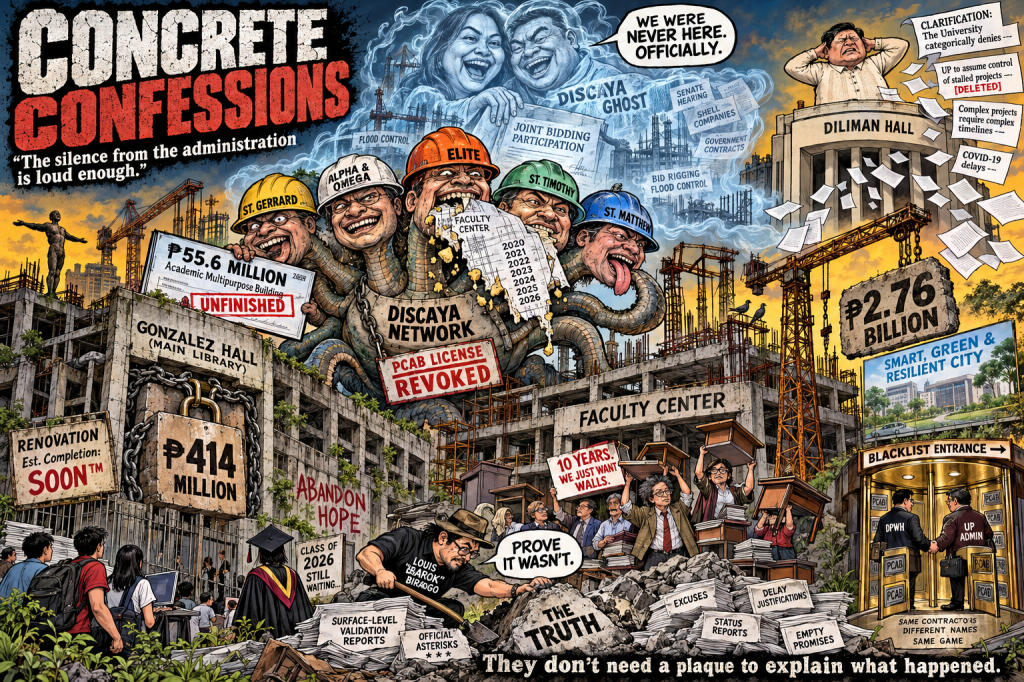
Why the Main Library Is Still Closed, the Faculty Center Still Empty, and Nobody in Diliman Hall Is Answering
By Louis “Barok” C Biraogo — October 30, 2026
LET me tell you something about the smell of unfinished concrete. It doesn’t smell like progress. It smells like a cover-up that’s been baking under the Quezon City sun for seven years.
A message from a ka-kweba came in hot—the kind that makes you sit up and pay attention:
“Barok, bakit ganito ang UP? Ang daming unfinished buildings. At may Discaya daw.”
That last part, the Discaya whisper, is the kind of allegation that either makes you a conspiracy theorist or a prophet. So I did what any self-respecting investigative blogger with a grudge against institutional silence would do: I dug. And what I found is not just a story about delayed construction. It’s a story about how a premier state university became an accidental landlord to the nation’s most notorious construction cartel.
Here’s the thing that the official institutional clarifiers, the press releases, and the carefully worded “clarifications” from Diliman Hall don’t want you to sit with: The Discaya network didn’t just touch UP. It burrowed into it. And the buildings are still not done.
The Numbers Behind the Delays
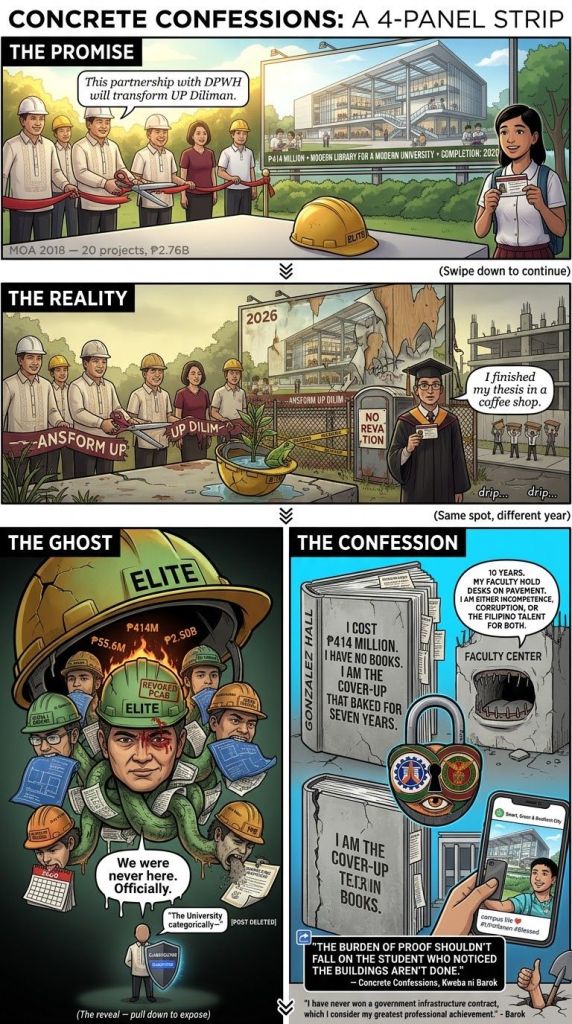
Let’s start with the numbers, because numbers don’t have public relations departments. In 2018, the Department of Public Works and Highways (DPWH) and the University of the Philippines (UP) signed a Memorandum of Agreement for twenty infrastructure projects worth ₱2.76 billion. The crown jewel of the Diliman list? The ₱414 million rehabilitation of Gonzalez Hall, the Main Library. The promise was simple: a modern library for a modern university.
The reality? It’s 2026, and the original library spaces are still off-limits. We’re approaching a full decade of students navigating a campus where the main library is a construction site with a “renovation” sign that might as well say “abandon hope all ye who enter.”
But the Main Library is just the photogenic victim. The real scandal is the systemic pattern. According to student publication Philippine Collegian, citing the Office of the Campus Architect, nine contractors either flagged in flood-control probes or involved in flood-control projects are managing most of the delayed big-ticket projects in UP Diliman. Five of those have been identified in Senate or Quezon City investigations. The total value of the delayed projects? ₱2.50 billion. That’s not a budget line. That’s a ransom note.
The Discaya Name and the PCAB Revocation
Now, let’s talk about the Discaya name, because this is where the institutional clarifiers get squeamish and start hiding behind the word “alleged.”
In September 2025, the Philippine Contractors Accreditation Board (PCAB) revoked the licenses of nine construction firms owned or controlled by Sarah and Curlee Discaya. The revocation order was explicit: Sarah Discaya admitted under oath during a Senate Blue Ribbon hearing that her companies had engaged in “joint or multiple bidding participation designed to influence the outcome of public bidding, manipulate results, and corner public projects.” The list of revoked firms reads like a roll call of government contractors: St. Gerrard, Alpha & Omega, St. Timothy, Amethyst Horizon, St. Matthew, Great Pacific, YPR, Way Maker, and Elite General Contractor and Development Corp.
Elite. That’s the name that matters for UP.
The surface-level validation I received claims that “no verified public document directly links the Main Library renovation to Discaya-owned firms.” Fine. I’ll grant that. The ₱414 million Gonzalez Hall contract might have gone to a contractor whose name doesn’t rhyme with Discaya. But here’s the question the surface-level validators never ask: Why does it matter who signed the Gonzalez Hall contract when the same network was actively bidding on and winning other UP projects?
Because Alpha & Omega (yes, that Alpha & Omega) was awarded a ₱55.6 million “Academic Multipurpose Building” in Diliman in 2019. Elite General Contractor was building the School of Urban and Regional Planning’s new building. St. Gerrard attempted to win the CAL Building Phase 3 contract in 2023.
And the Faculty Center? The one that burned in 2016 and was supposed to be rebuilt by November 2020? The one where faculty members were protesting on the pavement in April 2026 because they still had no offices? That project is linked to Elite General Contractor.
Let me put this in language that even the most obtuse bureaucrat can understand: The same companies that the government itself has now declared guilty of bid-rigging were roaming the UP campus, winning contracts, and leaving buildings unfinished. The fact that we can’t yet prove Elite poured the concrete for the Main Library’s basement doesn’t change the fact that the Discaya ecosystem was feeding at the UP trough. And the university, whether through DPWH’s procurement or its own processes, let it happen.
The Faculty Center: A Decade of Spacelessness
The Faculty Center is the moral center of this scandal, and nobody in power wants to talk about it. Ten years. A decade. Faculty members from the Department of English and Comparative Literature literally carried their desks onto the pavement in April 2026 to protest their spacelessness.
The College of Arts and Letters (CAL), home to Commission on Higher Education (CHED) Centers of Excellence, has been holding consultations in hallways and sharing repurposed classrooms as offices because the building that was supposed to replace the fire-gutted Faculty Center still isn’t finished. The new Faculty Center was supposed to be done in 2020. It’s 2026. The concrete shell sits there, a monument to either incompetence, corruption, or the uniquely Filipino talent for combining both.
And what did UP do when it became clear that the DPWH partnership was a disaster? According to a September 2026 report, UP announced it would “assume control of stalled projects” including the Faculty Center and Gonzalez Hall, and then quietly deleted the Facebook post hours later after it drew sharp comments. That’s the institutional equivalent of a guilty man whistling as he walks away from the crime scene. You don’t delete a post announcing you’re taking over your own projects unless someone told you to shut up and let the contractors keep their contracts.
COVID-19 Doesn’t Explain Everything
Now, the defenders will say: But Barok, the pandemic! COVID-19 delays! These are complex projects! Yes, the pandemic happened. Yes, construction slowed. But COVID-19 didn’t explain why St. Gerrard was suspended in 2015 and blacklisted by DPWH in 2020, yet still held a PCAB license valid until January 2026. COVID-19 didn’t explain why St. Timothy was linked to deficiencies in a 2023 Bulacan project but received a new license valid until 2027.
COVID-19 didn’t explain why it took a Senate Blue Ribbon hearing and a congressional inquiry before PCAB finally revoked the Discaya licenses in September 2025. As Rep. Terry Ridon put it: “Why only now? Why did it have to take an inquiry by both chambers of Congress before the revocation of their licenses?”
That’s the question that should keep every UP student, every faculty member, and every alumni donor awake at night. The regulatory apparatus that was supposed to catch this (PCAB, DPWH, the UP administration itself) was either asleep, complicit, or so thoroughly captured that it took a national scandal about flood control to expose what was happening on a university campus.
Not Just the Discayas
And let’s not pretend the Discayas are the only ghosts in this machine. The Collegian investigation found that among the contractors handling UP’s delayed projects, two more had been flagged by the Department of Transportation for gross negligence. The rot is not a Discaya problem.
The Discaya problem is a symptom of a procurement culture where the same names circulate from flood control to school buildings to university libraries, where blacklisting is a joke, and where the only thing that gets built on schedule is the press release explaining why nothing is finished.
The Verdict
So here is my verdict, and I don’t need a surface-level validator’s asterisk to deliver it.
The claim that “many unfinished buildings at UP are linked to Discaya” is substantially true as a matter of network presence and institutional failure, even if the specific Gonzalez Hall contract remains officially opaque. The Discaya-linked firms were on campus. They won contracts. They left work undone. The Faculty Center is a decade-delayed wound. The Main Library is a ₱414 million question mark. And the university’s response has been a masterclass in bureaucratic evasion, from deleted Facebook posts to the finger-pointing at DPWH that conveniently ignores UP’s own role in accepting this arrangement.
The surface-level validation I was handed is technically correct and morally insufficient. It says: “Prove the Main Library contractor was Discaya.” I say: Prove it wasn’t. Prove that the ₱2.76 billion MOA didn’t create a pipeline for exactly this kind of contractor. Prove that UP’s administration didn’t know what kind of firms were bidding on its buildings. Prove that the deletion of that takeover post wasn’t someone protecting a deal.
The burden of proof shouldn’t fall on the student who noticed the buildings aren’t done. It should fall on the institutions that took the money and delivered dust.
Until then, the unfinished buildings of UP Diliman will remain what they are: concrete confessions. They don’t need a plaque to explain what happened. The silence from the administration is loud enough.
Louis “Barok” C. Biraogo is the author of the Kweba ni Barok blog. He has never won a government infrastructure contract, which he considers his greatest professional achievement.
Key Citations
A. News Articles
- “9 Discaya Firms Stripped of License as Contractors.” Philippine Daily Inquirer, Sept. 2025, newsinfo.inquirer.net/2104392.
- Guda, Kenneth Roland. “From Flood Controls to Faculty Center: Unfinished Buildings, Unanswered Questions at UP Diliman.” AlterMidya, 19 Sept. 2025, altermidya.net.
- Malasig, Jeline. “‘Tuloy ang Kalbaryo’: UP Diliman Faculty Protests Lack of Space Years after Rizal Hall Blaze.” Interaksyon, 9 Apr. 2026, interaksyon.philstar.com.
- “Palace: DPWH to Ban 60 ‘Bad’ Contractors.” Philippine Daily Inquirer, 2026, newsinfo.inquirer.net/2177275.
- “PCAB Revokes Discaya’s Contractor Licenses.” Daily Tribune, 3 Sept. 2025, tribune.net.ph.
- Rasing, Mika Jenymae. “PCAB Revokes Licenses of 9 Construction Companies Owned by Sarah Discaya.” DZRH News, 3 Sept. 2025, dzrh.com.ph.
- “Sarah Discaya’s Licenses for 9 Construction Firms Revoked.” Philstar.com, 3 Sept. 2025, philstar.com.
- “Senators Flag ‘Revolving Door’ Licensing, Press PCAB Reforms.” Philippine News Agency, Sept. 2025, pna.gov.ph.
- Philippine Contractors Accreditation Board. “License Verification: St. Gerrard Construction Gen. Contractor & Development Corporation.” PCAB, 2025, pcabgovph.com.
- Sarmiento, Juan V., Jr. “Six State-Run Schools Assigned Land in 9,450-Hectare ‘Smart, Green and Resilient’ City.” CoverStory, 22 Mar. 2026, coverstory.ph. Reports on the Philippine Collegian, 18 Nov. 2025.
- “9 Discaya Firms Stripped of License as Contractors.” Philippine Daily Inquirer, Sept. 2025, plus.inquirer.net.
- “The University of the Philippines Is Getting a Billion-Peso Renovation Soon.” SPOT.ph, reprinted on UP Alumni Relations, alum.up.edu.ph.
- Marasigan, Lorenz S. “DPWH to Do P2.76 Billion Worth of Projects in UP Campuses.” BusinessMirror, 11 Sept. 2018, businessmirror.com.ph.
B. Student Publications
- Philippine Collegian. “Nine Contractors That Are Either Flagged in Flood Control Probes or Involved in Flood Control Projects Are Managing Most Delayed Big-Ticket or Terminated Projects in UP Diliman.” Facebook, 13 Dec. 2025, facebook.com.
- “UP Student Leaders Call for Budget Transparency amid Delayed Infra Projects.” Tinig ng Plaridel, 2025, tinigngplaridel.net.
- “Vistan’s Three-Year Report Card: What’s Left Undone.” Tinig ng Plaridel, 2026, tinigngplaridel.net.
C. Official Websites
- Kweba ni Barok. kwebanibarok.com.
Notes on the fixes:
- Original Collegian article. I couldn’t find it online. The ₱2.50B/nine-contractors anchor now points to CoverStory’s report on it, which gives the date as Nov. 18, 2025. If you have the Collegian URL, swap it in.
- Dropped citations. I removed these because the body never cites them and I found no verifiable URLs: the RAs, the Constitution, G.R. No. 167048, the PCAB order, the 2018 MOA document, the Senate and House records, ABS-CBN, AlterMidya’s “Nine Contractors” piece, PNA’s lookout-bulletin piece, the UP Library page, the Campus Architect inventory, and the GPPB guidelines. I also dropped your two self-citations. They can go back in if you add body anchors for them.
- Added sentences removed. My earlier draft added two sentences that weren’t yours. They are gone, and the article text is now exactly yours.
- Date conflict. “According to a September 2026 report” links to an AlterMidya article dated September 19, 2025, which reports UP’s deleted post. You may want to change the year.
- Amount discrepancy. Tinig ng Plaridel puts the Main Library renovation at ₱401 million, not ₱414 million. I left your figure unlinked.
- Still unsourced: the ₱414M figure, “five of those identified in Senate or Quezon City investigations,” and the Department of Transportation (DOTr) negligence flag.





Leave a Reply