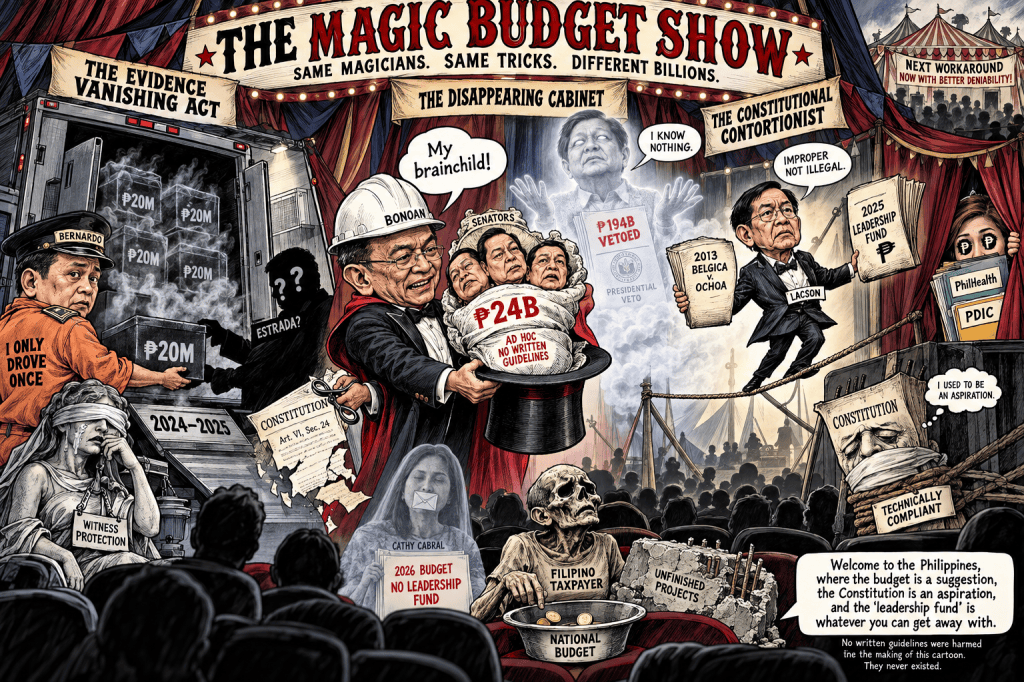
The DBM Secretary Was ‘Aware,’ the President ‘Didn’t Know,’ and the Public Pays for All of It
By Louis ‘Barok‘ C. Biraogo | October 30, 2026
WELCOME to the Philippines, where the Department of Public Works and Highways (DPWH) apparently operates a slush fund so informal it makes your office petty cash drawer look like a Swiss vault. The “Senate Leadership Fund“—a phrase that sounds like a fraternity scholarship but actually describes what may be the most creative constitutional violation since someone decided “not technically illegal” was a valid defense.
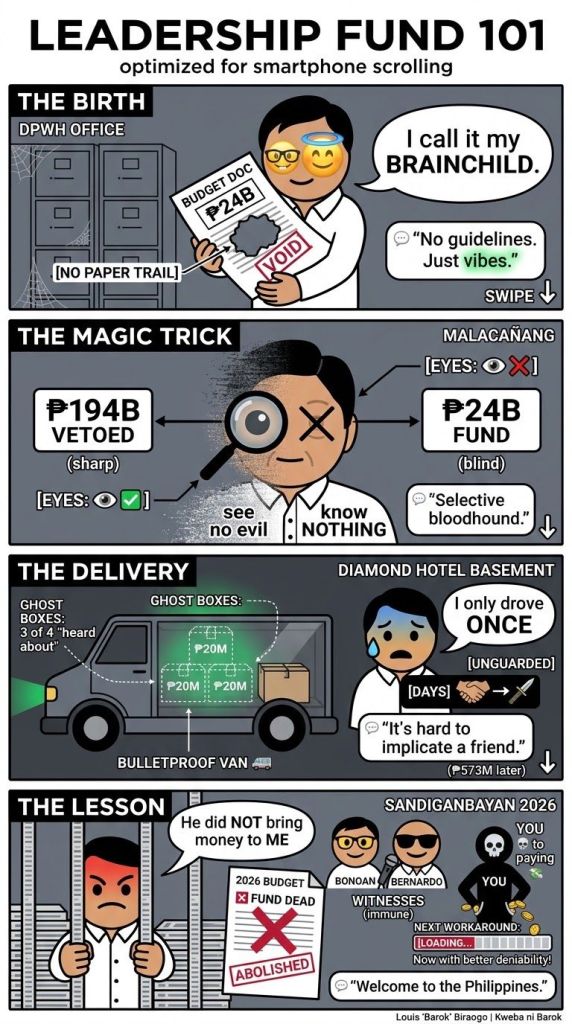
The Man Who Invented a Fund and Forgot to Tell Anyone
Former DPWH Secretary Manuel Bonoan admitted to creating a ₱24 billion allocation scheme for senators—but called it his “brainchild.” Nothing says “I’m definitely not guilty” quite like using the term parents use for precious offspring to describe a fund operating on verbal instructions with no written guidelines.
“I reported it to the President,” Bonoan testified, adding Marcos was “alarmed” by budget cuts. Alarmed, apparently, but not alarmed enough to ask, “Wait, we’re doing what now with how many billions?” This is the governmental equivalent of your accountant saying, “I moved some money around to protect your interests, but I didn’t write anything down because vibes.”
The Disappearing President: A Magic Trick in Plain Sight
The most remarkable aspect of Bonoan’s testimony is what he carefully positioned the President to not know. Marcos was allegedly unaware of the fund—requiring us to believe the Chief Executive, who has constitutional control over all executive departments, somehow missed a ₱24 billion mechanism under his nose.
This is the same President who vetoed ₱194 billion from the 2025 budget, demonstrating impressive capacity to scrutinize fiscal details. But a parallel fund for senators? Never heard of it. The President is like a selective bloodhound—sniffing out objectionable line items from kilometers away but utterly blind to a parallel budgetary universe in his own infrastructure department.
Sure, Bonoan said he “did not inform” the President. That’s different from the President not knowing through other channels—like the economic team that allegedly discussed the fund, or the Department of Budget and Management (DBM) Secretary supposedly aware, or the fact that this was common enough knowledge that multiple state witnesses can describe its operations in detail. But sure. The President knew nothing.
The Bernardo Problem: How to Make Friends and Implicate Them Later
Roberto Bernardo, former Undersecretary for Operations, is the star witness against Senator Jinggoy Estrada. He alleges ₱573 million in kickbacks, personally delivered cash in sealed boxes, and details that would make a crime novelist proud—if crime novels were based on affidavits that changed over time.
Bernardo didn’t initially name Estrada in his September 2025 affidavit. He added these allegations later, explaining: “It is difficult to implicate a friend. I could not bring myself to do that.” Ah yes—the “I initially forgot to mention the ₱573 million because we’re bros” defense. The same logic that prevents people from telling friends they have spinach in their teeth—except here, the “spinach” is allegedly hundreds of millions in cash.
Bernardo personally accompanied only ONE of four alleged deliveries. For the other three, he relies on fellow state witness Gerard Opulencia. So “Bernardo testifies to ₱573 million in kickbacks” should come with a footnote: “*Actual knowledge of most alleged transactions is based on hearsay from a co-witness with every incentive to cooperate.”
The defense pounced: no wiretaps, no videos, no photographs, no bank records, no CCTV. Just the testimony of a man who initially didn’t implicate his friend, admits emotional difficulty doing so, and has witness protection status that presumably depends on delivering prosecutable testimony.
State witnesses are simultaneously the most useful and least reliable prosecutorial tools. They explain complex schemes from inside. They also have powerful incentives to say what prosecutors want. The Supreme Court requires “substantial corroboration” and careful assessment. Here, corroboration comes from witnesses with similarly complicated credibility profiles.
The “Leadership Fund” vs. the Constitution
Remember Belgica v. Ochoa? The 2013 Supreme Court decision declaring the Priority Development Assistance Fund (PDAF) unconstitutional—saying legislators couldn’t control post-enactment project identification and fund allocation? Apparently nobody told DPWH they could just do it differently.
The “leadership fund” allegedly operated during budget preparation—an “ad hoc, verbally instructed allocation” with “minimum P500 million per senator” and “P1 billion for Senate president and major committee chairpersons.” If that sounds like pork barrel with fresh paint, it probably is.
Senator Panfilo Lacson called it “improper, although not illegal.” The kind of legal analysis that warms your heart—technically permissible if you squint hard enough and ignore Belgica’s constitutional principles. The key issues: separation of powers (legislators performing executive functions), specificity in appropriations (lump-sum allocations without clear guidelines), and checks and balances (legislators controlling allocation AND execution). Belgica was explicit: pork barrel violates these principles. The “leadership fund” appears to be a workaround maintaining the practical effect while relocating the mechanism to budget preparation.
It’s like banning cigarettes and selling “nicotine delivery systems” that look, function, and probably taste exactly like cigarettes. The form changed; the substance didn’t.
The Pangandaman Question: “Aware” Is Doing a Lot of Work
Bonoan testified former DBM Secretary Amenah Pangandaman was “aware” of the fund. But aware of what? The general concept? Specific allocations? Alleged kickbacks? Constitutional problems? The qualified statement—”I believe she was aware”—doesn’t clarify.
Pangandaman already faces separate complaints for alleged fund diversion from the Philippine Health Insurance Corporation (PhilHealth) and the Philippine Deposit Insurance Corporation (PDIC). If the pattern holds, “aware” might be the most damning thing you can be in Philippine budget circles—not quite “participated” but definitely not “innocent bystander.” But mere awareness of a budget discussion isn’t a crime. Prosecutors need to establish she acted or failed to act in ways satisfying specific offense elements.
The Estrada Problem: Third Time’s the Charm?
Jinggoy Estrada has been here before. Acquitted in the jueteng plunder case. Acquitted in the PDAF plunder case (though convicted of direct bribery). Now a third plunder charge involving ₱573 million in alleged “commitment fees.”
His defense is predictable: attack witness credibility, emphasize evidence gaps, hope for a repeat of the “main plunderer” doctrine that saved him before. In the PDAF case, the court found Estrada wasn’t the “main plunderer” even though he received kickbacks—Janet Napoles got that title, and Estrada walked.
Could history repeat? If Estrada was merely a beneficiary of a system created by others, he might argue he wasn’t the main plunderer. The P573 million, his lawyers could say, was “commitment fees” in a gray-area fundraising system, not ill-gotten wealth from criminal acts. Legally dubious but historically effective. The man has two plunder acquittals. Even a broken clock is right twice a day.
The State Witness Shuffle: Immunity for Architects, Prosecution for Beneficiaries
There’s something deeply unsettling about the state witness arrangement. Bonoan, who created the fund, gets discharged. Bernardo, who allegedly facilitated deliveries, gets witness protection. But Estrada, who allegedly received benefits, faces detention.
The people who designed and operated the system now help prosecute the people who benefited. Like a bank robbery where the getaway driver and safecracker get immunity for testifying against the person who spent the money.
Rule 119 of the Revised Rules Of Criminal Procedure requires the discharged accused “does not appear to be the most guilty.” Bonoan, who called the fund his “brainchild,” apparently doesn’t qualify as “most guilty” because he says he was responding to congressional pressure and presidential directives? The man created the mechanism, but Estrada is the target because he allegedly received money.
This inverted accountability reveals practical realities: prosecutors need insiders to explain complex schemes. Insiders get immunity. Beneficiaries face the music. Justice, if it comes, arrives through compromised instruments.
The Evidence: Where Is It?
Let’s play “What Evidence Would Actually Convict Someone?”
- Documentary: No written guidelines exist (by design). What records might show how ₱573 million was calculated? What financial records might trace alleged deliveries?
- Physical: “Sealed boxes containing amounts in multiples of ₱20 million.” Very cinematic. Where are these boxes? Who else witnessed deliveries?
- Digital: No wiretaps, texts, or emails. The conspirators communicated through verbal instructions, personal meetings, and sealed boxes—either brilliant criminal design or convenient excuse for lack of evidence.
- Corroborating witnesses: Opulencia and Alcantara allegedly confirm aspects. But they’re also state witnesses with incentives to cooperate.
- The “driver”: Bernardo says his driver accompanied the June 2025 delivery. Has the driver testified?
The prosecution’s case rests heavily on testimony that evolved over time, from witnesses with complex incentives, about transactions leaving no documentary trace. Not airtight—more “trust us, we have witnesses.”
The Institutional Learning That Wasn’t
Lacson confirmed the “leadership fund” was abolished in the 2026 budget. Institutional learning! Reform! But it was abolished not because anyone was convicted, but because it became politically toxic after hearings. The same officials who operated it are now witnesses. The same institutional structures remain. The same budget process continues.
Abolishing a problematic practice because it became embarrassing isn’t holding anyone responsible. It’s the difference between fixing a leak because you understand the problem and putting a bucket under it because you don’t want the floor wet. The conditions that produced the fund—executive-legislative collusion, lack of transparency, discretionary allocations, career officials willing to implement questionable directives—remain intact. The next workaround is probably being designed now, with better documentation and deniability.
The Death of Cathy Cabral: The Case That Could Have Been
DPWH Undersecretary for Planning Cathy Cabral died in December 2024. She was a key figure in the budget process. What did she know about the fund? What documents might she have had? What testimony might she have provided?
Her death—possibly unrelated—removes a potentially crucial witness. It raises questions that will never be answered: Was the fund as described? Who directed project allocations? What internal objections were raised? In corruption cases, missing witnesses often become more important in death than in life. Whatever she knew died with her—convenient for anyone she might have implicated.
The Broader Pattern: How Many “Leadership Funds” Are There?
The fund was described as an “innovative way” to “curb congressional insertions”—the official euphemism. The real function: provide senators project allocations they could claim credit for, maintaining plausible deniability about direct control.
But if this fund existed for 2024 and 2025 budgets, what other informal mechanisms exist in other departments? How many “innovative” practices operate outside public scrutiny? How many verbal instructions never appear in any document?
The “leadership fund” was exposed because of hearings, witnesses, and political dynamics. But for every exposed fund, ten probably remain hidden. For every cooperating witness, dozens of officials never speak. For every scandal, a network of systematic practices continues operating.
The Final Analysis: Guilty Until Proven… Whatever
What we know:
- A “Senate Leadership Fund” existed in the DPWH budget for 2024 and 2025, allocations potentially reaching ₱24 billion.
- It operated through verbal instructions, without written guidelines or public disclosure.
- Senators allegedly received allocations based on position, minimums of ₱500 million.
- Estrada allegedly sought an additional ₱1 billion and allegedly received ₱573 million in kickbacks.
- The witnesses are former officials with immunity or witness protection.
- Their testimony evolved over time, contains hearsay, and lacks direct documentary or physical corroboration.
- The President supposedly knew nothing—either true or convenient.
- The DBM Secretary was “aware”—meaning everything or nothing.
- The fund was abolished for 2026—solving the future, not the past.
What we don’t know:
- Whether kickbacks happened.
- Whether the fund was illegal or just improper.
- Whether Estrada is guilty or just close to questionable transfers.
- Whether Bernardo is truthful or telling partial truths serving his interests.
- Whether the prosecution can prove anything beyond reasonable doubt.
What this reveals:
- The budget process remains vulnerable to workarounds complying with the law’s letter while violating its spirit.
- State witness arrangements are necessary tools creating necessary reliability problems.
- The line between “improper” and “criminal” is remarkably elastic.
- Accountability comes through compromised mechanisms and selective enforcement.
- The people who design corrupt systems often escape consequences while beneficiaries face prosecution.
The Last Word
The “leadership fund” controversy is a legal, political, and constitutional mess wrapped in procedural complexity and served with witness credibility issues. The prosecution may succeed or fail on evidentiary shoals that swallowed other plunder cases. The fund may be abolished, but conditions creating it remain.
What’s clear: The Philippine government operates in a gray zone where technically compliant mechanisms function as de facto constitutional violations, verbal instructions allocate billions, and the distinction between proper process and clever workaround depends on who’s explaining.
The “leadership fund” wasn’t an accident. It was a system—designed, operated, and defended by people who understood exactly what they were doing and why. Whether criminal or merely improper depends on evidentiary standards that may never be met and legal interpretations that remain contested.
Meanwhile, the projects that funded senators’ priorities and allegedly funded campaigns continue to be built (or not), the officials who created the system walk free, and the public funds it all.
Welcome to the Philippines, where the budget is a suggestion, the Constitution is an aspiration, and the “leadership fund” is whatever you can get away with.
Louis ‘Barok’ C. Biraogo is the author of Kweba ni Barok, a blog described as “unnecessarily aggressive” and “surprisingly accurate.” He has never been a state witness, but has watched enough legal dramas to know the one who talks first usually has the most to hide.
Key Citations
A. Legal & Official Sources
- Arroyo v. People. G.R. No. 220598, Supreme Court of the Philippines, 2017.
- Belgica v. Ochoa. G.R. Nos. 208566, 208493, and 209251, Supreme Court of the Philippines, 19 Nov. 2013, lawphil.net/judjuris/juri2013/nov2013/gr_208566_2013.html.
- Enrile v. Sandiganbayan. G.R. No. 213847, Supreme Court of the Philippines, 2015.
- Estrada v. Sandiganbayan. G.R. No. 148560, Supreme Court of the Philippines, 19 Nov. 2001.
- Napoles v. Sandiganbayan. G.R. No. 224162, Supreme Court of the Philippines, 2017.
- People v. Verceles. G.R. No. L-31084, Supreme Court of the Philippines, 29 May 1981, lawphil.net/judjuris/juri1981/may1981/gr_l-31084_1981.html.
- Republic Act No. 3019. Anti-Graft and Corrupt Practices Act. LawPhil Project, lawphil.net/statutes/repacts/ra1960/ra_3019_1960.html.
- Republic Act No. 6713. Code of Conduct and Ethical Standards for Public Officials and Employees. LawPhil Project, lawphil.net/statutes/repacts/ra1989/ra_6713_1989.html.
- Republic Act No. 7080. An Act Defining and Penalizing the Crime of Plunder, as amended by Republic Act No. 7659. LawPhil Project, lawphil.net/statutes/repacts/ra1991/ra_7080_1991.html.
- Republic Act No. 9184. Government Procurement Reform Act. LawPhil Project, lawphil.net/statutes/repacts/ra2003/ra_9184_2003.html.
- Republic Act No. 12009. New Government Procurement Act. LawPhil Project, lawphil.net/statutes/repacts/ra2024/ra_12009_2024.html.
- Republic of the Philippines. 1987 Constitution of the Republic of the Philippines. LawPhil Project, lawphil.net/consti/cons1987.html.
- Revised Penal Code of the Philippines. Arts. 210, 212, 217, and 220. LawPhil Project, https://lawphil.net/statutes/acts/act1930/act_3815_1930.html.
- Rules of Court. Rules 114, 119, and 110–127. LawPhil Project, lawphil.net/courts/rules/rc_110-127_crim.html.
- Serana v. Sandiganbayan. G.R. No. 161131, Supreme Court of the Philippines, 2008.
- Tetangco v. Ombudsman. G.R. No. 156427, Supreme Court of the Philippines, 2006.
B. News Reports
- Morong, Joseph, and Sherylin Untalan. “EXPLAINER: What Was ‘Leadership Fund’ in the National Budget?” GMA News Online, 12 Aug. 2026, http://www.gmanetwork.com/news/topstories/nation/998462/explainer-what-is-leadership-fund-in-the-national-budget/story/.
- Mendoza, John Eric. “Bonoan: Ex-DBM Chief Was Aware of ‘Leadership Fund,’ Marcos Was Not.” INQUIRER.net, 27 Oct. 2026, newsinfo.inquirer.net/2330867/bonoan-ex-dbm-chief-was-aware-of-leadership-fund-marcos-was-not.
- “Bernardo on Saying Jinggoy Got P573 Million in Kickbacks: ‘It’s Hard to Implicate a Friend.’” GMA News Online, GMA Network, 28 Oct. 2026, http://www.gmanetwork.com/news/topstories/nation/1007481/bernardo-on-saying-jinggoy-got-p573-million-in-kickbacks-it-s-hard-to-implicate-a-friend/story/.
- “Estrada Sought P1B in Projects, Citing People to Help in Polls — Bernardo.” NewsWatch Plus, 28 Oct. 2026, http://www.newswatchplus.ph/2026/10/28/estrada-sought-1b-in-projects-citing-people-to-help-in-polls-bernardo/.
- ” Amenah Tagged ‘Co-Conspirator’ in Ralph’s Fund Switcheroo.” Daily Tribune, 27 May 2026, tribune.net.ph/2026/05/28/amenah-tagged-co-conspirator-in-ralphs-fund-switcheroo.





Leave a Reply