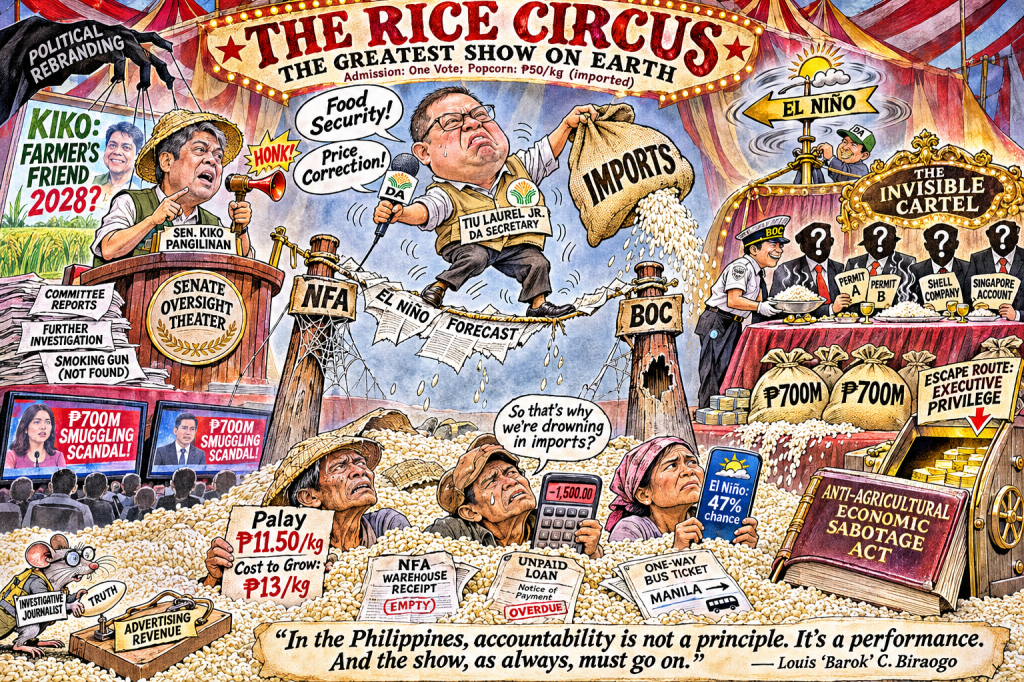
How Imported Rice Arrives Just in Time to Break Filipino Farmers—and No One Goes to Jai
By Louis ‘Barok‘ C. Biraogo | October 29, 2026
CUE the dramatic music.
Senator Kiko Pangilinan—yes, that Kiko, the man who lost the vice presidency so badly he had to reinvent himself as the Senate’s designated farmer-whisperer—has discovered that rice imports might be arriving during harvest season. Stop the presses. Alert the Vatican. Somewhere, a thousand agricultural economists are clutching their pearls while simultaneously wondering why anyone needed a Senate hearing to figure out that importing rice when farmers are harvesting rice might, just possibly, depress the price of rice.
This is the level of insight we’re working with, folks.
But wait—there’s more. According to Pangilinan, this isn’t just bad timing. It’s a modus operandi. A conspiracy, even. A cartel, perhaps. And the evidence? Two vessels carrying 20,000 metric tons of rice worth ₱700 million were intercepted in September with “questionable documentation.” The Department of Agriculture (DA)‘s own 60-day rule allegedly prohibits releasing imports during harvest. And somehow, despite the Anti-Agricultural Economic Sabotage Act—a law with a name so grandiose it practically demands a marching band—nobody’s been jailed.
Let me pause here to express my profound shock. A Philippine law passed with great fanfare and promises of accountability has failed to produce visible results? Color me absolutely stunned. Next you’ll tell me the traffic in Metro Manila is bad.
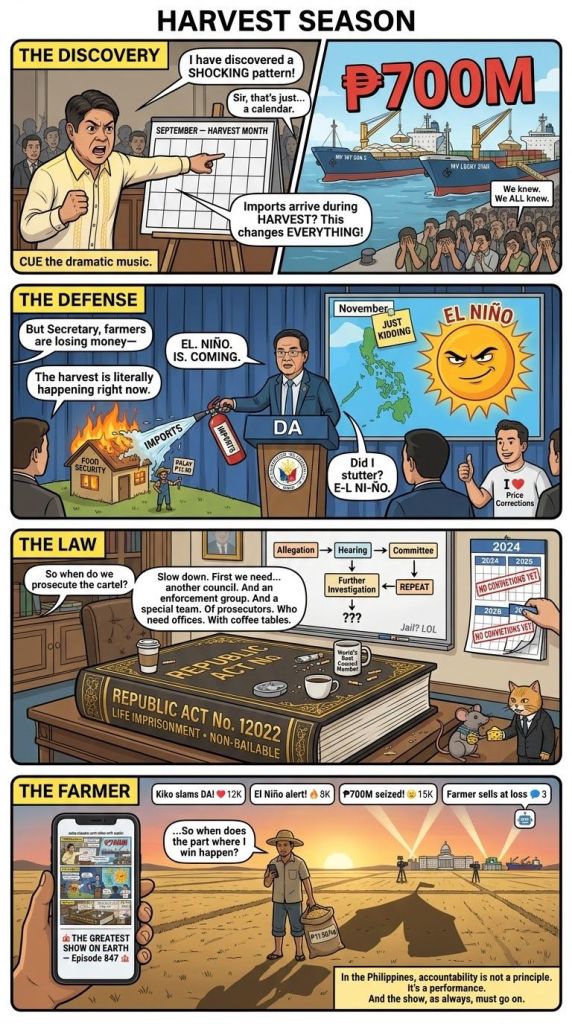
The Law: A Beautiful Thing That Doesn’t Work
Let’s examine this legal masterpiece, Republic Act No. 12022, the Anti-Agricultural Economic Sabotage Act. It defines agricultural smuggling as “economic sabotage.” It sets a threshold of ₱10 million. It threatens life imprisonment. It’s non-bailable. It creates a council, an enforcement group, and a special team of prosecutors—because nothing says “we’re serious” like multiplying the number of committees.
And yet, as of this writing, the “big fish” remain comfortably un-incarcerated. The law’s proponents will tell you that prosecution takes time. Evidence gathering is complex. Due process must be observed.
All true. Also all irrelevant to the optics. Because while the legal system grinds its wheels, Filipino farmers are selling palay at ₱11.50 a kilo—below the ₱12 to ₱13 it costs them to grow it. The DA calls this a “price correction.” Farmers call it something less polite. And the traders? They’re buying low, storing, and selling high—a business model so ancient it predates the invention of money.
Here’s the uncomfortable question nobody wants to ask: If the law is so tough, why hasn’t anyone been perp-walked in front of cameras? Either the evidence isn’t there, the enforcers aren’t trying, or the fix is in. Pick your poison.
The DA’s Defense: We’re Not Incompetent, We’re Just Preemptive
Agriculture Secretary Francisco Tiu Laurel Jr.—a man whose facial expressions suggest he’s perpetually smelling something unpleasant—has a counterargument. It goes something like this: El Niño is coming, so we need imports—unless you want Filipinos to starve.
It’s a compelling narrative. It’s also remarkably convenient. Because “El Niño is coming” can justify almost anything—imports during harvest, imports after harvest, imports during the dry season, imports during the wet season. It’s the agricultural equivalent of “national security,” a phrase that has launched a thousand abuses of power.
The DA’s position, as articulated by Undersecretary Asis Perez, is that current prices represent a “price correction” from unsustainably low levels. Translation: “We’re not hurting farmers; we’re just restoring the natural order of things where farmers get less money.”
I wish I were making this up.
The logic is that prices were artificially low last year, so now they’re returning to “proper” levels. For whom, exactly? Because from where I sit, “proper” looks an awful lot like “whatever the traders want to pay.”
The Numbers Game: ₱700 Million and Other Magic Tricks
Let’s talk about the ₱700 million figure being tossed around like a frisbee at a dog park. It represents the estimated value of the intercepted rice cargoes—12,500 metric tons on the MV Tay Son 2 and 7,500 metric tons on the MV Lucky Star.
Sounds impressive. But here’s what the breathless headlines won’t tell you: a seizure is not a conviction. An interception is not proof of conspiracy. And ₱700 million in estimated cargo value is not the same as ₱700 million in government losses, criminal profits, or recoverable assets.
The Bureau of Customs—an agency whose historical relationship with smuggling is, shall we say, complicated—has confirmed the seizures. The DA has cancelled permits. Officials are making concerned faces. And yet, somehow, no one can answer the simplest questions: Who owns the rice? Who financed the shipments? Who approved the permits? And why did these particular vessels get stopped when thousands of others presumably sail through?
I’ll tell you why: because asking those questions would require following the money. And following the money would lead to uncomfortable places—places where names are spoken in whispers and favors are traded over golf games.
Pangilinan: The Reluctant Crusader
Now let’s talk about Kiko Pangilinan himself. Here’s a man who, fresh off a devastating 2022 electoral loss, has somehow positioned himself as the Senate’s leading voice on agricultural accountability. It’s a remarkable reinvention, almost as impressive as his transformation from former Aquino administration loyalist to born-again majority coalition member.
Pangilinan’s strength as an investigator lies in his committee chairmanship and his genuine connections to farmer groups. His weakness? He’s a politician with a history of losing national elections and an obvious incentive to stay in the public eye. Every hearing he conducts is both an oversight exercise and a campaign commercial.
This doesn’t make him wrong. It just makes him suspicious.
The senator’s core allegation—that imports are deliberately timed to depress farm-gate prices—is economically plausible. It’s also the kind of allegation that’s nearly impossible to prove without a smoking gun. Traders can always claim they were responding to market signals. The DA can always claim it was balancing consumer and producer interests. And the officials who actually approved the permits? They can claim they were just following orders.
Meanwhile, the farmers lose either way—both when imports arrive during harvest and when prices spike because of shortages. It’s almost as if the entire system is designed to transfer wealth from people who grow food to people who trade it.
The El Niño Excuse: Weather as Weapon
Let me address the El Niño argument directly. Yes, the DA has forecast a strong El Niño for 2026. Yes, palay production could decline by 750,000 metric tons. Yes, this creates legitimate supply concerns.
But here’s what the DA won’t say: El Niño forecasts have been used before to justify excessive imports. The 2023-2024 El Niño was supposed to devastate rice production; it didn’t. The buffer stocks were mismanaged; they are. The National Food Authority (NFA)’s inventory levels have fallen below mandated minimums; they have.
So forgive me if I’m skeptical when the DA announces that El Niño requires opening the import floodgates during harvest season. The weather is not a permit to bypass your own rules. Forecasts are not a license to manipulate markets. And “food security” is not a blank check to enrich connected traders at farmers’ expense.
The DA’s defense would be stronger if it published its supply assumptions, explained its import timing, and demonstrated consistent treatment of importers. It has done none of these things. Instead, it has relied on generalized warnings and vague reassurances, all while the actual permit records remain conveniently opaque.
The Cartel Question: Where There’s Smoke, There’s Usually Arson
Pangilinan claims a cartel exists—and that cartels cannot exist without government collusion. He’s half right. Private cartels can and do exist without official participation. But in the Philippines, agricultural cartels almost always require government complicity. The permitting system is too complex, the customs process too discretionary, and the enforcement apparatus too easily captured for large-scale smuggling to occur without official facilitation.
The question isn’t whether some officials are corrupt. The question is how many, at what level, and whether anyone with actual power will ever be held accountable.
History suggests the answer to the last question is “no.” The 2013 “David Tan” cartel allegations produced hearings, headlines, and ultimately nothing. The 2019 rice tariffication fiasco enriched importers while impoverishing farmers. The 2024 Anti-Agricultural Economic Sabotage Act was supposed to change everything. It has changed nothing.
So why would this time be different? Because Kiko Pangilinan is asking hard questions? Because the Bureau of Customs seized two vessels? Because President Marcos Jr. has acknowledged that “government officials themselves are smuggling”?
With all due respect to the President’s newfound honesty, acknowledgment is not accountability. The seizure of cargo is not the prosecution of criminals. And a Senate investigation is not a conviction.
The Imperial Senate’s Oversight Theater
Let’s not pretend the Senate inquiry is a neutral fact-finding exercise. Pangilinan’s committee hearings will be carefully choreographed productions designed to generate headlines, embarrass the DA, and position the senator as the champion of Filipino farmers.
The DA will send its lawyers to invoke executive privilege. The Bureau of Customs will present charts showing increased enforcement. The traders will send lawyers who will invoke their clients’ right to silence. And at the end of it all, a committee report will be released recommending “further investigation”—the traditional euphemism for “we couldn’t prove anything but we want to keep looking busy.”
This is not to say the hearings are worthless. They may uncover evidence. They may expose inconsistencies. They may pressure agencies into action. But anyone expecting a dramatic resolution—handcuffs, resignations, structural reform—is living in a fantasy world.
The Philippine political system does not produce accountability. It produces performance art.
The Farmers: Convenient Props Since Time Immemorial
Throughout this controversy, Filipino farmers have been invoked so frequently that they’ve become a rhetorical device rather than a constituency. Pangilinan speaks for them. The DA claims to protect them. The President expresses concern for them. The traders buy their crops at prices that would make a loan shark blush.
But where are the farmers in this debate? Where are their representatives? Where are their demands?
They are in the provinces, wondering why the price of palay fell again. They are borrowing money for the next planting season, knowing they’ll struggle to repay it. They are watching their children leave the farm, knowing the land won’t sustain another generation.
The farmers are not in the Senate hearing room. They’re not at the Bureau of Customs. They’re not in the boardrooms of the traders who profit from their labor. They’re the background noise to a conversation conducted entirely without them.
The Unasked Questions
Here are the questions nobody in the Senate seems interested in asking:
- Who actually owns the rice? The importer of record is usually a shell company. The beneficial owners are hidden behind layers of corporate structure. And the real money flows through accounts in Singapore or Hong Kong.
- Who approved the permits? Every import requires multiple signatures. Were all of them legitimate? Were any of them falsified? Were any of them obtained through bribery?
- Why these vessels? The MV Tay Son 2 and MV Lucky Star were intercepted. How many other vessels with identical cargoes sailed through without inspection? And what made these two special?
- Where did the rice go? The cargoes were seized, but where were they headed? Who planned to sell them? And at what price?
- Who benefits from the status quo? The answer is not farmers. It’s not consumers. It’s the intermediaries—the traders, the brokers, the warehouses, the logistics companies—who capture value between the farm and the table.
These are the questions that would break the scandal open. But they’re also the questions that would implicate powerful people. And in the Philippines, powerful people have a remarkable ability to avoid inconvenient scrutiny.
The Media: Amplifier of Outrage, Not Agent of Change
The Philippine media has covered this controversy with characteristic sensationalism. Headlines blare “₱700-M RICE SMUGGLING!” without noting that smuggling hasn’t been proven. Reporters quote Pangilinan’s allegations without investigating their basis. Editorial boards demand accountability without specifying what accountability would look like.
This is not journalism. It’s outrage production.
The tragedy is that genuine investigative reporting could make a difference. Someone could track the flow of permits. Someone could follow the money. Someone could interview the farmers who actually know what’s happening. But that would require resources, time, and institutional support—things Philippine media increasingly lack.
Instead, we get the same cycle: allegation, hearing, report, nothing. Rinse and repeat.
What Would Actual Reform Look Like?
If I believed anyone in power cared about solving this problem, I would propose the following:
- Publish every import permit. In real time. With the names of the beneficial owners. Let sunlight disinfect the system.
- Mandate automatic forfeiture. If a shipment violates customs regulations, the entire cargo is seized and sold at auction. No negotiations. No settlements. No “considerations.”
- Prosecute the beneficiaries. Not the vessel operators, not the customs brokers, but the people who put up the money and expected to collect the profits.
- Create a genuine farmer support program. Direct payments to palay growers when prices fall below cost. Crop insurance that actually pays out. Storage facilities that let farmers wait for better prices.
- Break up the trading oligopoly. If a handful of families control rice distribution, no amount of import regulation will protect farmers. Antitrust enforcement is not just for tech companies.
- Fire incompetent officials. Not investigate them. Not transfer them. Fire them. And prohibit them from ever working in agriculture again.
These reforms would threaten powerful interests. They would face ferocious opposition. They would require sustained political will—something in short supply.
Which is why they won’t happen.
The Cynic’s Conclusion
The rice importation scandal is not a scandal. It is a feature of the Philippine political economy. Farmers have always been exploited. Traders have always profited. Officials have always been corrupt. And the laws that are supposed to protect the vulnerable have always been inadequate or unenforced.
Pangilinan’s allegations are probably true in their general outline. Imports probably are timed to depress prices. Officials probably are colluding with traders. And the Anti-Agricultural Economic Sabotage Act will probably result in no meaningful convictions.
But here’s the uncomfortable truth: proving all of this changes nothing. Because the same people who would be implicated in a scandal are the ones responsible for investigating it. The DA is the defendant; the DA is also the enforcement agency. The Senate is the overseer; the Senate is also a collection of politicians with their own agendas. The Bureau of Customs is the gatekeeper; the Bureau of Customs is also, historically, a gateway for smuggling.
This is not a system that can be reformed from within. It can only be challenged from without—by organized farmers, by vigilant media, by independent civil society. And those forces are weak, fragmented, and under-resourced.
So enjoy the hearings. Appreciate Pangilinan’s rhetorical flourishes. Marvel at the DA’s evasions. But don’t expect anything to change. Because in the Philippines, accountability is not a principle. It’s a performance.
And the show, as always, must go on.
Louis ‘Barok‘ C. Biraogo is the founding editor of Kweba ni Barok. After twenty years covering Philippine politics, he has learned that hope is not a strategy—but it does make for excellent satire.
Key Citations
A. Laws & Court Decisions
- Philippines. Republic Act No. 11203. An Act Liberalizing the Importation, Exportation, and Trading of Rice, Lifting for the Purpose the Quantitative Import Restriction on Rice, and for Other Purposes. 2019. LawPhil Project, lawphil.net/statutes/repacts/ra2019/ra_11203_2019.html.
- Philippines. Republic Act No. 12022. An Act Declaring Agricultural Smuggling as Economic Sabotage, Prescribing Penalties Therefor, and for Other Purposes. 2024. LawPhil Project, lawphil.net/statutes/repacts/ra2024/ra_12022_2024.html.
- Philippines. Republic Act No. 10667. Philippine Competition Act. 2015. LawPhil Project, lawphil.net/statutes/repacts/ra2015/ra_10667_2015.html.
- Neri v. Senate Committee on Accountability of Public Officers and Investigations. G.R. No. 180643, 25 Mar. 2008. LawPhil Project, lawphil.net/judjuris/juri2008/mar2008/gr_180643_2008.html.
B. Official Websites & Documents
- “BOC, DA, at Navy, Kinilala ni Sen. Kiko Dahil sa Matagumpay na Paghuli ng ₱700M na Bigas!” Bureau of Customs, 13 Oct. 2026, customs.gov.ph/boc-da-at-navy-kinilala-ni-sen-kiko-dahil-sa-matagumpay-na-paghuli-ng-%E2%82%B1700m-na-bigas/.
- Philippines. Department of Agriculture. “DA Keeps Rice Imports Open as El Niño Risks Mount.” Department of Agriculture, 4 Aug. 2026, https://www.da.gov.ph/da-keeps-rice-imports-open-as-el-nino-risks-mount/.
- Pangilinan, Francis “Kiko.” “Senator Kiko Pangilinan’s Manifestation on Smuggling.” Senate of the Philippines, 8 Oct. 2026, kikopangilinan.com/senator-kiko-pangilinans-manifestation-on-smuggling/.
C. News Articles
- “P700M Rice Shipment from Vietnam Seized.” PortCalls Asia, 13 Oct. 2026, portcalls.com/p700m-rice-shipment-from-vietnam-seized/.
- Bacon, Pexcel John. “NFA Fell Short of Rice Buffer Stock Target in 2025 — CoA.” BusinessWorld Online, 24 Sept. 2026, bworldonline.com/the-nation/2026/09/24/781345/nfa-fell-short-of-rice-buffer-stock-target-in-2025-coa/.
- GMA News. “Marcos Warns vs Agri Smuggling.” GMA News Online, 29 June 2022, www.gmanetwork.com/news/topstories/nation/836535/marcos-warns-vs-agri-smuggling/story/.
- ₱9 Billion in ‘Savings’? DILG’s Fire Truck Deal Smells Like Smoke
- ₱8B BBM Pork: CCTV for Every Captain’s Kumpare?
- ₱8.9 Billion, 331 Ghost Police Stations: The TIKAS Scandal Explained

- ₱8.4 Billion, 42,000 Barangays, 1 Election: The “Bawat Barangay Makikinabang” Vote-Buying Masterclass
- ₱75 Million Heist: Cops Gone Full Bandit

- ₱63 to the Dollar: The Only Thing Falling Faster Than the Peso Is the Government’s Credibility
- ₱6.77B Ghost Haunts Duterte: RTC Dismisses Mans Carpio’s Desperate Plea
- ₱6.77 Billion and Zero Cash: The Sara Duterte SALN Math That Doesn’t Add Up

- ₱6.7-Trillion Temptation: The Great Pork Zombie Revival and the “Collegial” Vote-Buying Circus

- ₱58.53B, Zero Receipts: The LGSF Pork Barrel Nobody Wants to Name
- ₱53 Million Man Tells ₱695-a-Day Workers to Stop Being ‘Mayabang’: The Audacity of BSP’s Remolona
- ₱4.4 Billion and a Witness Who Can’t Explain It: The Duterte Impeachment’s Most Expensive Non-Answer



Leave a Reply