₱22.28 Million in Disallowed Funds, ₱22.7 Million Without Vouchers—and Two Officials Who Thought ‘Nag-aayos Pa Kami’ Was a Legal Defense
By Louis “Barok” C. Biraogo — October 31, 2026
GATHER ’round, children, and let me tell you about the Philippine barangay—the government unit where your tax pesos vanish into thin air, preferably without a receipt. It is the smallest unit of government, the one closest to the people, the one where your tax pesos are supposed to turn into drainage canals, health centers, and basketball courts. It is also, conveniently, the level of government where accountability goes to die—buried under missing disbursement vouchers, “lost” receipts, and the time-honored excuse: “Nag-aayos pa po kami ng dokumento.”
Except this time, the Ombudsman decided to stop laughing.
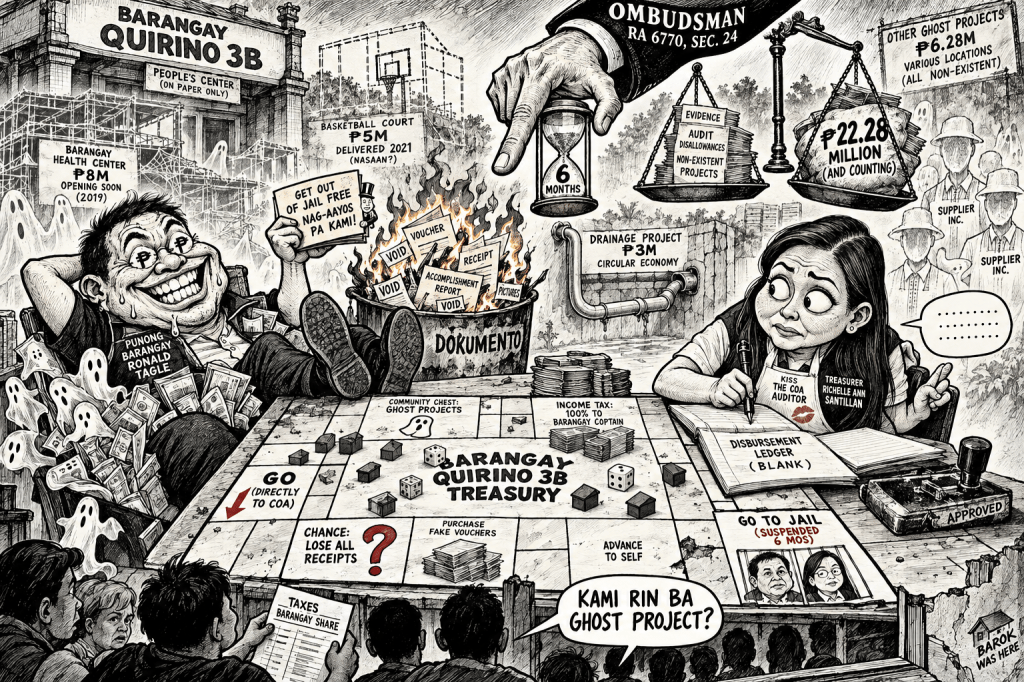
On October 30, 2026, the Office of the Ombudsman dropped a six-month preventive suspension ordertí on Punong Barangay Ronald Tagle and Barangay Treasurer Richelle Ann Santillan of Barangay Quirino 3B (Claro), Quezon City. The charge? Grave misconduct and gross neglect of duty over ₱22.28 million in disallowed funds and another ₱22.7 million allegedly released without the basic courtesy of a disbursement voucher. In a barangay. Not a department. Not a GOCC. A barangay. Twenty-two million pesos in a village treasury. I’ve seen smaller heists in heist movies.
And what did the respondents say? That they are “continuously addressing the Commission on Audit (COA) findings.” Ah. The official motto of every Filipino official caught with their hand in the cookie jar: We are addressing it. Translation: “We were hoping you wouldn’t notice.”
GHOST BARANGAY: The ₱22M Swipe
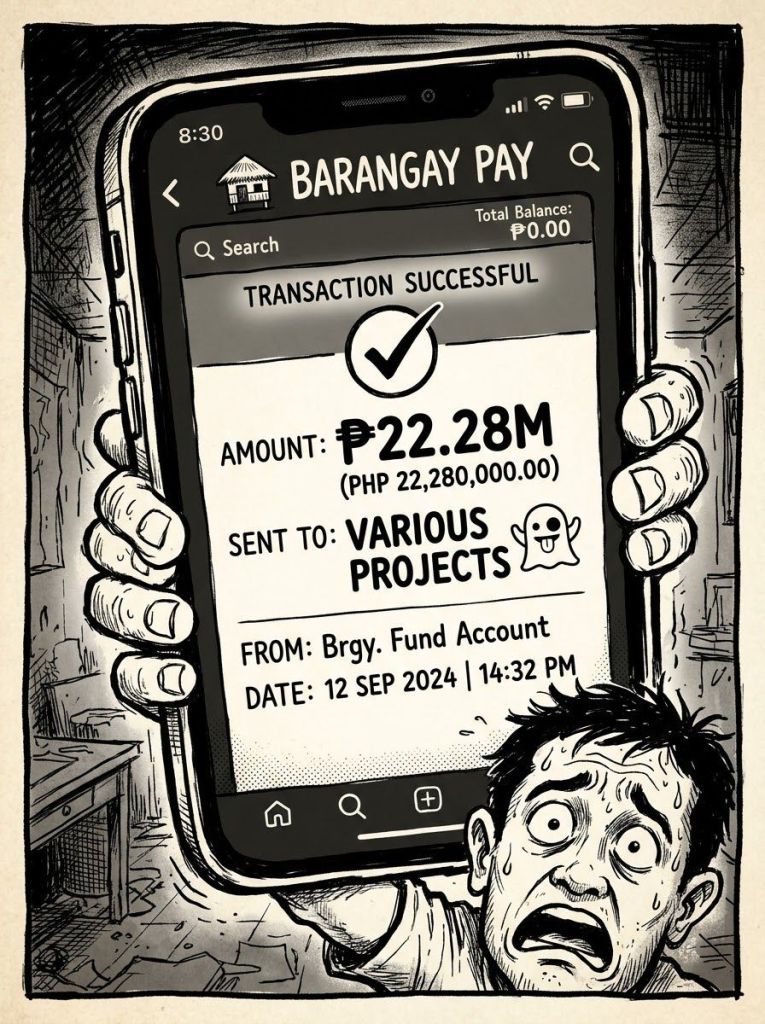
“Every swipe sends ₱22M to the ghost dimension. Terms: lol.”
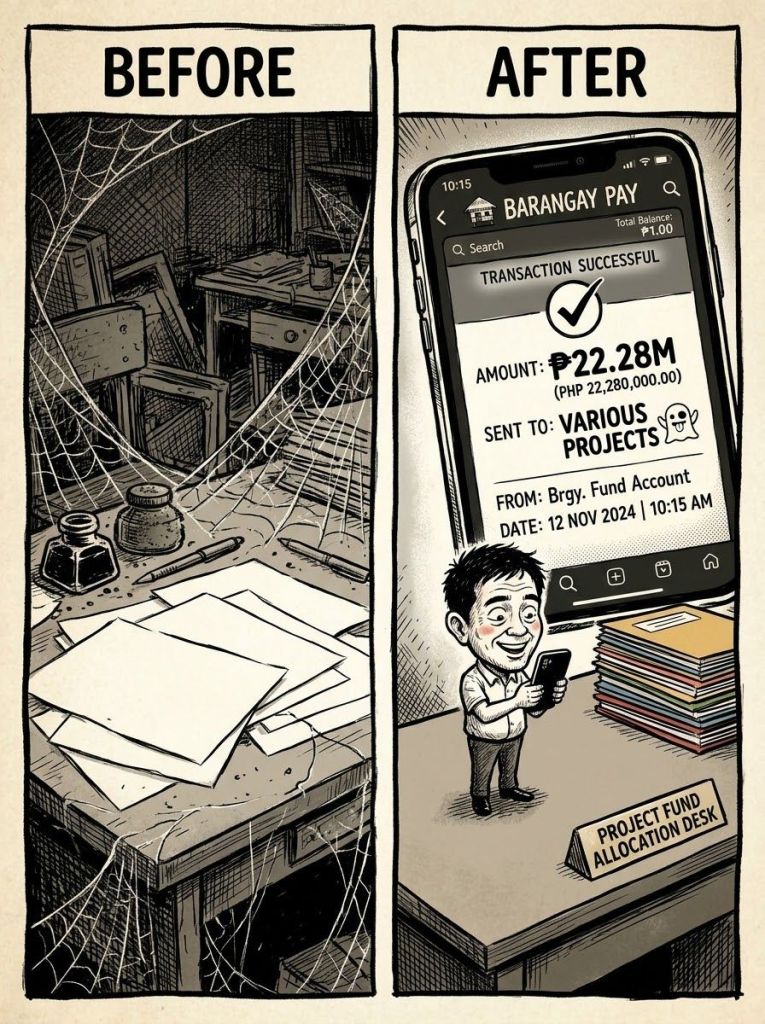
“The ‘Nag-aayos’ update: now with 100% more cobwebs.”
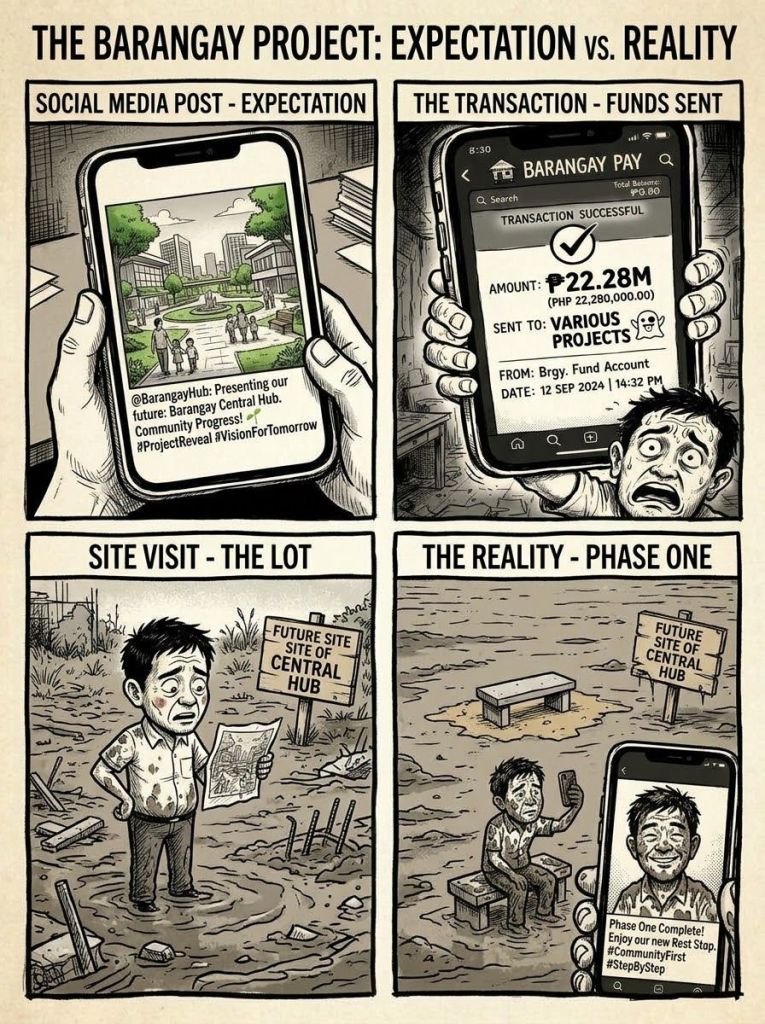
★☆☆☆☆ “Projects arrived damaged. Also invisible.” — Verified Taxpayer
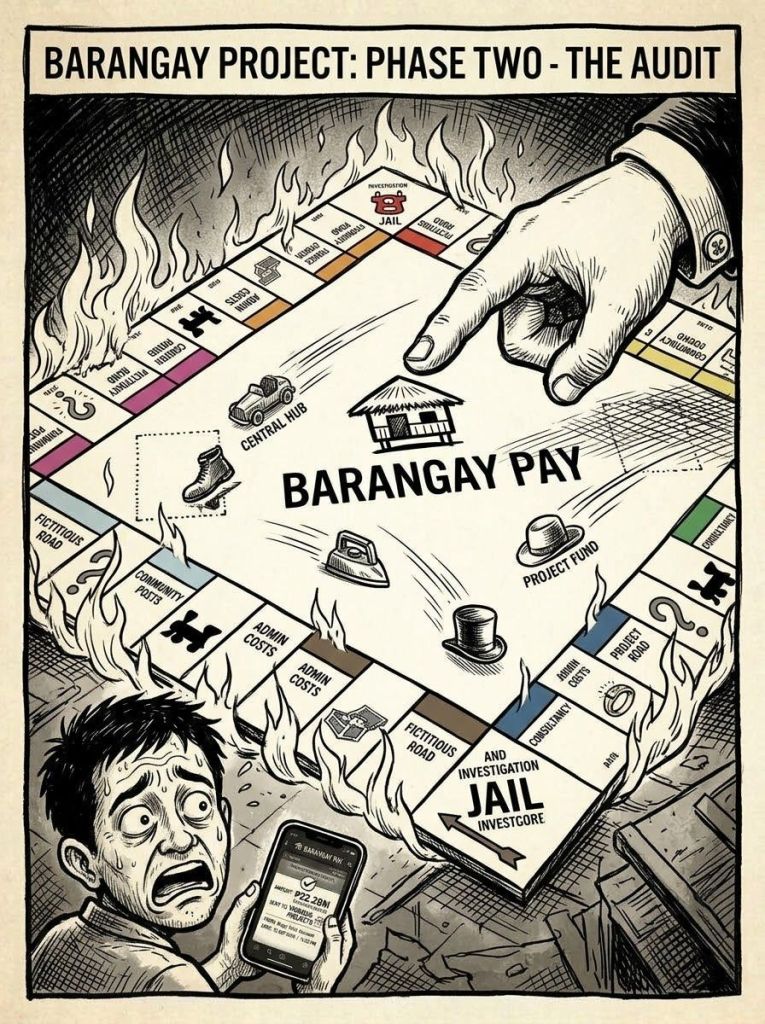
: “But the ombudsman has uno reverse card”
The Ombudsman: Finally, A Government Office With A Spine
I know the knee-jerk reaction of the terminally cynical: the Ombudsman is a toothless tiger, the office where complaints go to nap. I’ve said it myself. But on this one, the Ombudsman deserves a standing ovation—or at least a golf clap, which in this country is practically canonization.
Under Section 24 of Republic Act No. 6770 (Ombudsman Act of 1989), the Ombudsman can preventively suspend an official if the evidence of guilt is strong and the charge involves dishonesty, oppression, grave misconduct, or neglect of duty, or if the charge warrants removal, or if the official’s continued stay may prejudice the case. The Ombudsman found all of it. The evidence is not circumstantial pillow talk—it’s a COA audit trail documenting years of missing vouchers, non-existent projects, and disbursements that materialized out of thin air. The Ombudsman did not convene a beauty pageant. It did not wait for the barangay council to form a committee to study the possibility of forming a task force. It acted.
Compare that to the usual Quezon City response to a barangay scandal: express “concern,” form an “investigative body,” and quietly forget about it until the next election cycle. The Ombudsman, bless its bureaucratic heart, did the unthinkable: it treated ₱22 million of public money as if it actually belonged to the public.
The “Ghost Project” Excuse And Other Fairy Tales
The respondents’ defense is already shaping up to be a masterpiece of administrative fiction: the projects existed, the money was used legitimately, and the missing documents are simply “administrative deficiencies.” Translation: The ghost didn’t steal the money; the ghost just forgot to file the paperwork.
Here’s the problem. When you release ₱22.7 million without disbursement vouchers—the single most basic accountability document in government finance—you are not suffering from “administrative deficiency.” You are suffering from a spectacular, years-long failure of nerve, competence, or honesty. A disbursement voucher is not a suggestion. It is the legal proof that public money left the treasury for a legitimate purpose.
And the amount? The Ombudsman’s figures show ₱15.9 million in 2020, ₱23.9 million in 2021, ₱17.64 million in 2022, and ₱17.88 million in 2023 in undocumented disbursements. That is not an isolated clerical error. That is a policy. If you lose a receipt once, you’re careless. If you lose the receipts for tens of millions over four consecutive years, you’re either running a slush fund or auditioning for a heist film.
The Supreme Court, in Office of the Ombudsman v. Evangelista, has already ruled that no prior hearing is required for preventive suspension—it is a protective measure, not a punishment. And in Lee v. Sales, the Court reminded everyone that filing a motion for reconsideration does not stay execution. So the respondents’ October 30 motion is, legally speaking, the administrative equivalent of throwing a crumpled receipt at a speeding train.
The Mayor And The Politics Of “Implementation”
Mayor Joy Belmonte has been directed to implement the suspension and report compliance within three days. This is where the fun begins, because nothing in Philippine politics is simpler than a mayor’s obligation and nothing is more complicated than actually doing it.
She faces a classic dilemma: implement promptly and risk alienating barangay officials allied with local power brokers, or delay and risk the Ombudsman’s wrath. Non-compliance without just cause is ground for disciplinary action—but since when has legality been a deterrent in this country? The Ombudsman should send a thank-you card in advance, with a gentle reminder that “the Ombudsman is watching” is not just a slogan on a coffee mug.
And here’s the uncomfortable question nobody in the Quezon City government wants to ask: if Quirino 3B was bleeding ₱22 million for years, how many other barangays are doing the exact same thing with the exact same missing paperwork? The Ombudsman should conduct a citywide audit. The results would probably require a separate suspension order for every barangay hall in Metro Manila.
The Treasurer’s Defense And The Limits Of “I Was Just Following Orders”
Treasurer Santillan will likely argue she was merely following the punong barangay’s instructions—the standard defense of every subordinate caught in a corruption scandal. But Section 395 of Republic Act No. 7160 (Local Government Code of 1991) imposes an independent fiduciary duty on the barangay treasurer. She is legally required to keep custody of funds, disburse them per established procedures, and render a written accounting. “I was just following orders” is not a defense when the orders require violating the Presidential Decree No. 1445 (Government Auditing Code of the Philippines).
On the other hand, the Ombudsman must be careful. Preventive suspension is one thing; establishing guilt is another. The Madera v. Commission on Audit doctrine protects officials who acted in good faith with the diligence of a good father of a family. If Santillan can prove she was excluded from project selection or acted on apparently valid certifications, her case may deserve a closer look. But the word “may” is doing a lot of heavy lifting there. If she signed off on millions without vouchers, good faith is going to need a very good lawyer and an even better alibi.
The Investigative Question Nobody Wants To Ask: Where Did The Money Go?
The suspension order is a start, not a conclusion. The public deserves a transaction-by-transaction accounting—the amounts, dates, approving officials, purported projects, suppliers, bank accounts, and ultimate beneficiaries. If the projects were ghosts, someone built those ghosts. Someone signed off on the existence of something that did not exist. Someone collected the money for something never delivered.
The most disturbing possibility is that this is not an accounting error but a coordinated scheme—a network of officials, suppliers, and possibly political patrons using the barangay treasury as a private piggy bank. If so, the suspension of two officials is the opening act, not the finale. Investigators should trace the money through bank records, supplier registrations, and procurement records. The ghost projects may be invisible, but the money is not. It went somewhere.
The Deeper Sickness: Barangay Governance As A Corruption Free-for-all
Quirino 3B is not just about two officials. It is a symptom of a larger disease: the Philippines treats barangay governance as a minor-league operation unworthy of serious scrutiny. Barangays are run by officials with no formal training in financial management. Accounting systems are primitive. Internal controls are weak. Audit observations accumulate for years before anyone acts. By the time COA and the Ombudsman catch up, the money is long gone and the officials have moved on.
This is why the Ombudsman’s decision to impose the maximum six-month suspension matters. It sends a message that barangay officials are not exempt from accountability just because they operate at the grassroots level. The principle is bigger than the money: public office is a public trust, and public trust means public accounting.
Article XI, Section 1 of the 1987 Constitution declares that public office is a public trust. The Ombudsman is constitutionally mandated to investigate and prosecute. The COA is constitutionally mandated to audit. When these two institutions work together, as they apparently did here, the machinery of accountability functions as designed. The problem is that it rarely functions this efficiently. The Quirino 3B case should be a model, not an anomaly.
A Warning To The Respondents And A Challenge To The System
To Tagle and Santillan: your motion for reconsideration is not a magic wand. It does not stay the suspension. It does not erase the COA findings. It does not make the missing vouchers reappear. If you have evidence the projects existed, present it. If you have receipts, produce them. But do not insult the public’s intelligence with assurances that you are “continuously addressing” the findings. Address them now. In public. With documents.
To the Ombudsman: do not stop here. Follow the money. Identify every supplier, contractor, and beneficiary. Establish individual liability based on actual participation, not mere position. And if the evidence supports it, file criminal charges under the Republic Act No. 3019 (Anti-Graft and Corrupt Practices Act) and the Revised Penal Code (Act No. 3815). The public deserves more than a six-month suspension; it deserves a reckoning.
To Mayor Belmonte: implement the suspension promptly, designate acting officials, secure the financial records, and initiate a citywide review of barangay financial management. Do not treat this as an isolated incident. Treat it as a warning.
And to the Filipino public: pay attention. Quirino 3B is not just a story about two barangay officials and a pile of missing receipts. It is a story about whether accountability in this country is real or merely theatrical. The Ombudsman has done its part. The COA has done its part. Now it is up to the rest of us to demand that the process continue—that the money be traced, that the responsible parties be held accountable, and that the ghosts of Quirino 3B finally be exorcised from the barangay treasury.
Because if we don’t, the next ghost project will be built right on top of our collective apathy. And it will cost us another ₱22 million.
Key Citations
A. Legal & Official Sources
- The 1987 Constitution of the Republic of the Philippines. Official Gazette of the Republic of the Philippines, 1987, https://www.officialgazette.gov.ph/constitutions/the-1987-constitution-of-the-republic-of-the-philippines/.
- Republic Act No. 6770. An Act Providing for the Functional and Structural Organization of the Office of the Ombudsman, and for Other Purposes (Ombudsman Act of 1989). 1989, https://lawphil.net/statutes/repacts/ra1989/ra_6770_1989.html.
- Republic Act No. 7160. An Act Providing for a Local Government Code of 1991. 1991, https://www.officialgazette.gov.ph/1991/10/10/republic-act-no-7160/.
- Presidential Decree No. 1445. Ordaining and Instituting a Government Auditing Code of the Philippines. 1978, https://www.lawphil.net/statutes/presdecs/pd1978/pd_1445_1978.html.
- Republic Act No. 3019. Anti-Graft and Corrupt Practices Act. 1960, https://lawphil.net/statutes/repacts/ra1960/ra_3019_1960.html.
- Act No. 3815. An Act Revising the Penal Code and Other Penal Laws (Revised Penal Code). 1930, https://lawphil.net/statutes/acts/act_3815_1930/act_3815_1930.html.
- Office of the Ombudsman v. Evangelista. G.R. No. 177211, Supreme Court of the Philippines, 13 Mar. 2009, https://www.lawphil.net/judjuris/juri2009/mar2009/gr_177211_2009.html.
- Lee v. Sales. G.R. No. 205294, Supreme Court of the Philippines, 4 July 2018, https://lawphil.net/judjuris/juri2018/jul2018/gr_205294_2018.html.
- Madera v. Commission on Audit. G.R. No. 244128, Supreme Court of the Philippines, 8 Sept. 2020, https://lawphil.net/judjuris/juri2020/sep2020/gr_244128_2020.html.
B. News Reports
- Panti, Llanesca T. “Ombudsman Suspends 2 QC Brgy. Execs over P22.28M Unsettled Disallowances, Ghost Projects.” GMA News Online, GMA Network, 30 Oct. 2026, https://www.gmanetwork.com/news/topstories/nation/1007733/ombudsman-suspends-2-qc-brgy-execs-over-p22-28m-unsettled-disallowances-ghost-projects/story/.
- Orcullo, Jerod. “QC Barangay Officials Suspended over ₱22M in Unresolved Audit Findings.” Daily Tribune, 30 Oct. 2026, https://tribune.net.ph/2026/10/30/qc-barangay-officials-suspended-over-22m-in-unresolved-audit-findings.
- ₱9 Billion in ‘Savings’? DILG’s Fire Truck Deal Smells Like Smoke

- ₱8B BBM Pork: CCTV for Every Captain’s Kumpare?
- ₱8.9 Billion, 331 Ghost Police Stations: The TIKAS Scandal Explained

- ₱8.4 Billion, 42,000 Barangays, 1 Election: The “Bawat Barangay Makikinabang” Vote-Buying Masterclass

- ₱75 Million Heist: Cops Gone Full Bandit

- ₱63 to the Dollar: The Only Thing Falling Faster Than the Peso Is the Government’s Credibility

- ₱6.77B Ghost Haunts Duterte: RTC Dismisses Mans Carpio’s Desperate Plea
- ₱6.77 Billion and Zero Cash: The Sara Duterte SALN Math That Doesn’t Add Up

- ₱6.7-Trillion Temptation: The Great Pork Zombie Revival and the “Collegial” Vote-Buying Circus

- ₱58.53B, Zero Receipts: The LGSF Pork Barrel Nobody Wants to Name
- ₱53 Million Man Tells ₱695-a-Day Workers to Stop Being ‘Mayabang’: The Audacity of BSP’s Remolona
- ₱4.4 Billion and a Witness Who Can’t Explain It: The Duterte Impeachment’s Most Expensive Non-Answer





Leave a Reply