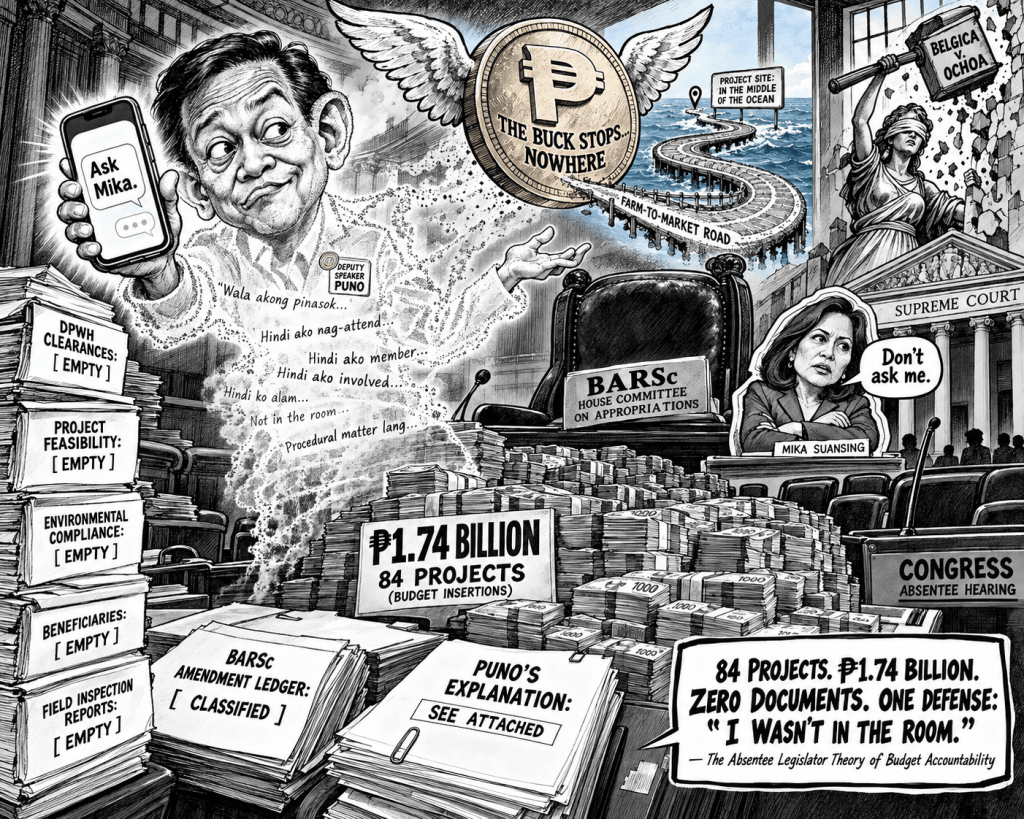
84 projects. ₱1.74 billion. Zero documents. One text message: ‘Ask Mika.’ A masterclass in budget accountability—or the absence of it.
By Louis ‘Barok‘ C. Biraogo | October 31, 2026
ALLOW me to summarize the Deputy Speaker’s legal brilliance.
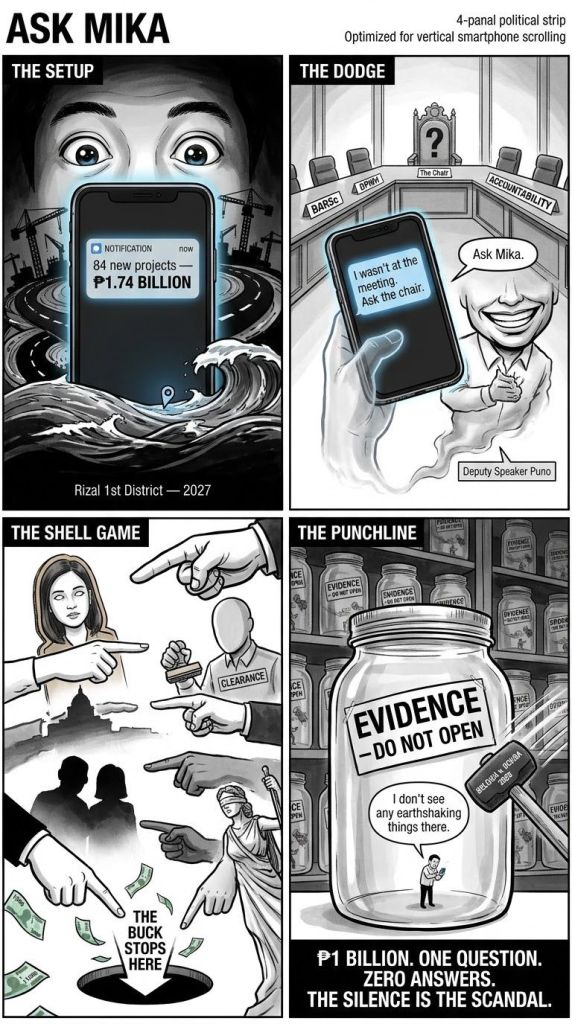
A congressman’s district engineering office is sitting on ₱1.74 billion in proposed 2027 infrastructure projects. A budget watchdog says 84 of those projects, worth over ₱1 billion, are linked to his constituency. The congressman’s response, delivered by text message to a news channel, is essentially: “I wasn’t at the meeting. Ask the chair.”
That’s it. That’s the defense. Not “the projects are technically sound.” Not “here are the documents proving they originated from the Department of Public Works and Highways (DPWH).” Not even “the watchdogs got the geography wrong.” Just: Wala akong pinasok. Hindi ako nag-attend ng hearings. Hindi ako member ng Budget Amendments and Review Sub-Committee (BARSc). Si Mika ang tanungin nila.
Ronnie Puno, Deputy Speaker of the House and chairman of the National Unity Party, has just invented a new constitutional doctrine: the Absentee Legislator Theory of Budget Accountability. Under this theory, if you didn’t physically sit in the room where the money was allocated, you bear zero responsibility for explaining why your district’s engineering office received a billion pesos in projects. The buck doesn’t stop anywhere. It just floats, like a farm-to-market road with coordinates in the middle of the ocean.
Let’s be clear about what Puno is not saying. He is not saying the 84 projects don’t exist. He is not saying the ₱1.74 billion figure is wrong. He is not saying the Rizal 1st District Engineering Office doesn’t cover his district. He is saying that his procedural absence from specific committee venues absolves him of the obligation to explain the substantive outcome that benefits his constituents.
This is not a legal defense. It is a jurisdictional shrug.
And it’s not even a good one.
The Engineering Office Is Not a Magical Black Box
Puno’s defenders will point out, correctly and technically, that the Rizal 1st District Engineering Office serves three legislative districts: Puno’s, Philip Acop’s, and Rebecca Ynares’. Therefore, attributing all ₱1.74 billion to Puno is methodologically imprecise. Fine. The People’s Budget Coalition (PBC) attribution may indeed require project-level verification. BetterGov itself has cautioned that engineering office coverage does not establish legislative authorship.
But here is what Puno’s procedural dodge cannot explain: if the projects are not his, whose are they? And why is the congressman who represents the largest portion of that engineering office’s coverage (the Deputy Speaker, no less, the chairman of a major political party) unable or unwilling to say anything about how a billion pesos in infrastructure appeared in the House budget for his area?
The answer, of course, is that Puno can say something. He simply chooses not to. Because every specific answer creates a documentary trail. Every “yes, I requested those projects” invites scrutiny of the requests. Every “no, I didn’t” invites the obvious follow-up: then who did, and why are you not demanding to know?
The Lump-Sum Defense Is an Admission, Not an Exculpation
Puno’s more substantive argument, deployed in a separate press conference days earlier, is that the House had to “fill in the blanks” because the executive submitted lump-sum allocations for public works. The Supreme Court, he says, prohibited lump sums. Therefore, detailing them was compliance, not insertion.
This is clever. It is also circular.
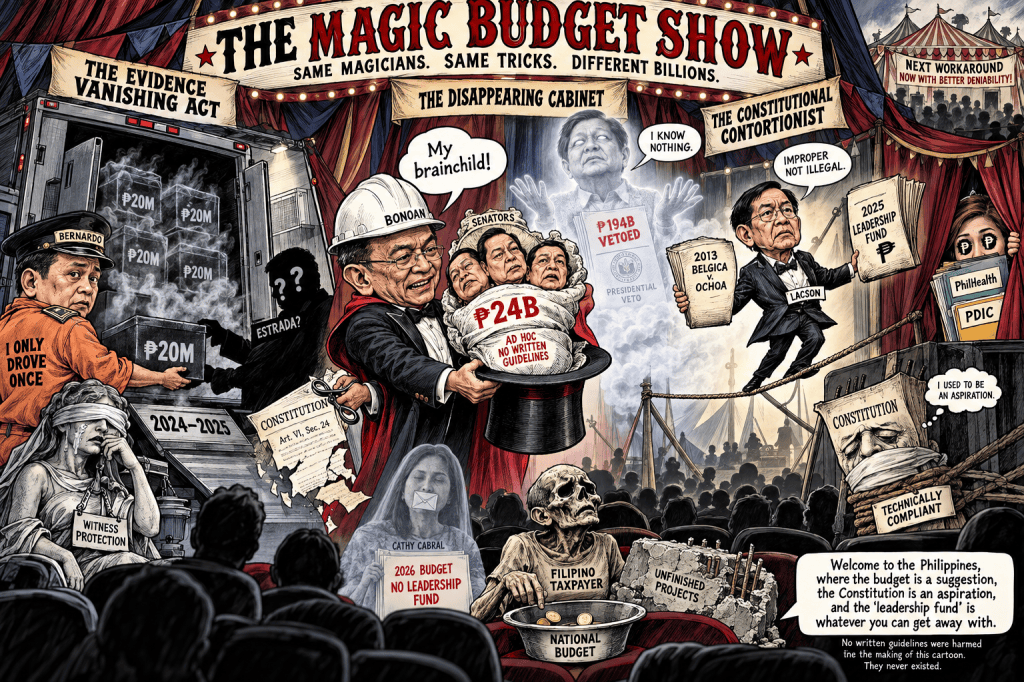
Yes, Belgica v. Ochoa and its progeny prohibit lump-sum appropriations that give legislators post-enactment discretion over project identification and execution. Yes, the executive’s National Expenditure Program (NEP) apparently contained insufficient project-level detail. But the constitutional remedy for a lump-sum executive budget is not for individual legislators to substitute their own project lists. It is for Congress to demand that the executive provide the necessary detail, or to exercise its oversight and amendment powers transparently, with a documented record of who proposed what and why.
What Puno describes as “filling in the blanks” is, in institutional terms, the House Appropriations Committee and its BARSc subcommittee deciding which projects go where. If those decisions were driven by agency recommendations, the documentation should reflect that. If they were driven by legislator requests, the documentation should reflect that. The problem is not that the blanks were filled. The problem is that we still don’t know who held the pen.
Puno says the amendments “cannot be made without the clearance of the agency.” Excellent. Then produce the clearances. Publish the agency endorsements. Show the paper trail. If DPWH requested these 84 projects for Rizal’s 1st District, say so, and let DPWH defend them. If the requests came from somewhere else, say that.
The fact that the response is instead “ask Mika Suansing” tells you everything about the documentary vacuum at the center of this controversy.
Suansing Is Not Puno’s Human Shield
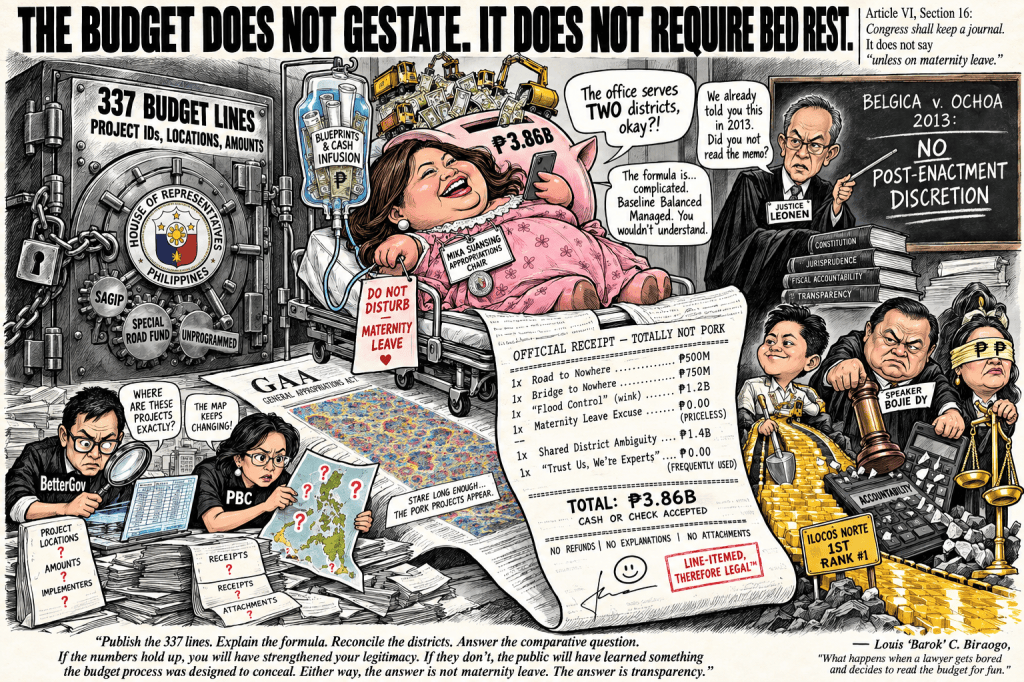
Puno’s deflection to the Appropriations Chair is politically convenient and institutionally absurd. Mika Suansing chairs the committee, and as I have written, she has her own questions to answer. She does not represent Antipolo. She did not campaign in Rizal’s 1st District. She is not responsible for explaining why a specific congressman’s constituency received a specific set of projects, unless, of course, the committee’s own records show that Puno did request them, in which case the deflection is not just absurd but actively misleading.
The House Appropriations Committee’s published mandate for BARSc reportedly requires the subcommittee to prepare a detailed report of agency realignments and modifications “with sufficient details identifying the proponent-legislator.” This is the committee’s own standard. If the BARSc report identifies Puno as the proponent of any of the 84 projects, his “I wasn’t in the room” defense collapses. If it identifies someone else, Puno should be demanding its publication to clear his name.
He isn’t demanding anything. He’s pointing fingers and walking away.
The Watchdogs Aren’t Perfect Either, and That Matters
Here is where I depart from the more breathless commentary on this scandal. The PBC and BetterGov have done invaluable work mapping the budget. But their own documentation acknowledges limitations: fuzzy matches, shared engineering offices, unattributable residual amounts. The 84-project, ₱1-billion attribution to Puno may be directionally correct and still be methodologically incomplete. Geographic association is not legislative authorship. A project in Antipolo is not automatically Puno’s project.
The PBC should publish the full project-level schedule supporting its attribution. It should show, for each of the 84 projects, the NEP baseline, the House amendment, the documented origin, and the evidentiary basis for linking it to Puno. If the linkage is circumstantial (the projects are in his district, therefore they are “his”), then the PBC should say so explicitly and let the public judge the strength of the inference.
But here’s the thing: Puno’s response has made the PBC’s work easier, not harder. By refusing to provide any substantive explanation, he has ceded the narrative. The watchdogs don’t need to prove he inserted the projects. They only need to prove that he cannot or will not explain them. And on that front, he is doing their job for them.
The Supreme Court Already Told You This Was Illegal
The October 2026 Supreme Court ruling on unprogrammed appropriations was not subtle. The Court invalidated ₱449.5 billion in congressional increases to the 2024 budget and ₱17.99 billion in additional Special Road Fund allocations for 2025. It declared the SAGIP mechanism a prohibited lump-sum repository. It said, in effect, that Congress has been playing fast and loose with the constitutional prohibition on increasing the President’s recommended appropriations.
Puno’s response to this jurisprudence? “I don’t see any earthshaking things there.”
That is a remarkable statement from a Deputy Speaker of the House. The Supreme Court has just told Congress that its budget practices violated the Constitution. A senior House leader’s assessment is that the ruling is “mostly in terms of procedures” and can be fixed in the Senate or bicam. No urgency. No acknowledgment that the House’s own product might be constitutionally compromised. Just: the Senate can clean it up.
This is the institutional reflex that should concern every taxpayer. The House approves a budget with ₱190 billion in projects lacking public documentation. The Supreme Court says the process has constitutional defects. The response is not “let us review our work.” The response is “let the Senate fix it” and “ask the chair.”
What Puno Should Do, and Won’t
If Ronnie Puno is innocent of any improper insertion, and I have no evidence that he is guilty of a crime, then he has a straightforward path to vindication. He should:
- Publish his office’s communications with DPWH regarding Rizal 1st District projects for 2027. Every letter. Every email. Every meeting note.
- State under oath whether he or his staff submitted any project requests to the Appropriations Committee, BARSc, or the DPWH district office.
- Demand that Suansing release the BARSc amendment ledger identifying the proponent of each of the 84 projects. If his name appears, he should explain why. If it doesn’t, he should say so loudly and demand correction from the PBC.
- Ask DPWH to publish the technical documentation for all 84 projects (feasibility studies, cost estimates, project readiness certifications) and explain why they were included in the NEP as lump sums rather than as individual line items.
He will do none of these things. Because the entire point of the “ask the chair” strategy is to avoid creating a record that can be audited, cross-referenced, or contradicted.
The Real Scandal Is the Reflex
The ₱1 billion figure is alarming. The ₱190 billion national figure is more alarming. But the most alarming thing about this controversy is how predictable it is.
A watchdog publishes data. A legislator denies personal involvement. The denial is procedural rather than substantive. Responsibility is deflected to a committee chair, who deflects to institutional process, which deflects to agency validation, which deflects to the Senate, which will eventually deflect to the bicameral conference committee, which will produce a final budget that no single actor claims authorship of.
This is not accountability. It is a shell game played with public money.
Ronnie Puno may be telling the truth. He may have had nothing to do with those 84 projects. The Rizal 1st District Engineering Office may have generated them entirely independently, and the ₱1.74 billion may be a coincidence of geography. Stranger things have happened, though not many.
But if he is telling the truth, the truth is provable. Documents exist. Records can be released. The Appropriations Committee can identify proponents. DPWH can produce project files. The House can publish the amendment ledger.
The fact that none of this has happened, that the response to a billion-peso question is a text message saying “ask someone else,” is the scandal. Not the number. The silence.
Louis ‘Barok’ C. Biraogo is the author of Kweba ni Barok. He has read the Belgica decision more times than he has read his own tax returns, which is admittedly a low bar.
Key Citations & Further Reading
A. Primary Legal Authorities
- Belgica v. Ochoa. G.R. Nos. 208566, 208493, and 209251, Supreme Court of the Philippines, 19 Nov. 2013. LawPhil, lawphil.net/judjuris/juri2013/nov2013/gr_208566_2013.html.
- Araullo v. Aquino. G.R. Nos. 209287, 209135, 209136, 209155, and 209164, Supreme Court of the Philippines, 1 July 2014. LawPhil, lawphil.net/judjuris/juri2014/jul2014/gr_209287_2014.html.
- Philippine Constitution Association v. Enriquez. G.R. No. 113105, Supreme Court of the Philippines, 19 Aug. 1994. LawPhil, lawphil.net/judjuris/juri1994/aug1994/gr_113105_1994.html.
- Pimentel III v. House of Representatives. G.R. Nos. 274778, 275405, and 276233, Supreme Court of the Philippines, 3 Dec. 2025. LawPhil, lawphil.net/judjuris/juri2025/dec2025/gr_274778_2025.html.
- Francisco v. House of Representatives. G.R. No. 160261, Supreme Court of the Philippines, 10 Nov. 2003. LawPhil, lawphil.net/judjuris/juri2003/nov2003/gr_160261_2003.html.
- Supreme Court of the Philippines. “SC Holds Unprogrammed Appropriations Subject to Guidelines; Voids Congressional Increases in 2024 and 2025 Budgets.” Supreme Court of the Philippines, 20 Oct. 2026, sc.judiciary.gov.ph/sc-holds-unprogrammed-appropriations-subject-to-guidelines-voids-congressional-increases-in-2024-and-2025-budgets/.
B. Constitutional and Statutory Authorities
- The 1987 Constitution of the Republic of the Philippines. Official Gazette of the Republic of the Philippines, 1987, officialgazette.gov.ph/constitutions/1987-constitution/.
- Republic Act No. 3019. Anti-Graft and Corrupt Practices Act. 1960. LawPhil, lawphil.net/statutes/repacts/ra1960/ra_3019_1960.html.
- Republic Act No. 7080. An Act Defining and Penalizing the Crime of Plunder. 1991. LawPhil, lawphil.net/statutes/repacts/ra1991/ra_7080_1991.html.
- Republic Act No. 6713. Code of Conduct and Ethical Standards for Public Officials and Employees. 1989. LawPhil, lawphil.net/statutes/repacts/ra1989/ra_6713_1989.html.
- Republic Act No. 9184. Government Procurement Reform Act. 2003. LawPhil, lawphil.net/statutes/repacts/ra2003/ra_9184_2003.html.
- Republic Act No. 12009. New Government Procurement Act. 2024. Supreme Court E-Library, elibrary.judiciary.gov.ph/thebookshelf/showdocs/2/97750.
- Republic Act No. 7160. Local Government Code of 1991. Supreme Court E-Library, elibrary.judiciary.gov.ph/thebookshelf/showdocs/4/4815.
- Presidential Decree No. 1445. Government Auditing Code of the Philippines. 1978. LawPhil, lawphil.net/statutes/presdecs/pd1978/pd_1445_1978.html.
- Executive Order No. 2, s. 2016. Operationalizing in the Executive Branch the People’s Constitutional Right to Information and the State Policies to Full Public Disclosure and Transparency in the Public Service. Official Gazette, 24 July 2016, officialgazette.gov.ph/2016/07/24/executive-order-no-02-s-2016/.
C. News Reports and Data Sources
- BetterGov. “Philippine Budget Data API Documentation.” BetterGov, budget.bettergov.ph/docs. Accessed 29 Oct. 2026.
- Bilyonaryo News Channel. “House Appropriations Chair Suansing’s District Linked to P3.86-B DPWH Projects.” Bilyonaryo News Channel, bnc.bilyonaryo.com/house-appropriations-chair-suansings-district-linked-to-p3-86-b-dpwh-projects/news/. Accessed 29 Oct. 2026.
- Bilyonaryo News Channel. “Puno Points to Suansing over Budget Insertions in Rizal Districts.” Bilyonaryo News Channel, bnc.bilyonaryo.com/puno-points-to-suansing-over-budget-insertions-in-rizal-districts/news/. Accessed 30 Oct. 2026.
- GMA News Online. “House Approves ₱7.2-Trillion 2027 Budget on Final Reading.” GMA News Online, 12 Oct. 2026, www.gmanetwork.com/news/topstories/nation/1005658/house-approves-p7-2-trillion-2027-budget-on-final-reading/story/.
D. Official House of Representatives Sources
- House of Representatives of the Philippines. “Committee on Appropriations – Official Mandate and BARSc Responsibilities.” Congress of the Philippines, www.congress.gov.ph/committees/committee/view/0504. Accessed 29 Oct. 2026.
- House of Representatives of the Philippines. “BARSc Reviews Proposed Amendments to the 2027 Budget.” Congress of the Philippines, 2 Oct. 2026, congress.gov.ph/media/press-releases/10277.
- House of Representatives of the Philippines. “CSO Portal – Budget Materials and Hearing Resources.” Congress of the Philippines, www.congress.gov.ph/cso/. Accessed 30 Oct. 2026.
E. Secondary Sources and Commentary
- CenPEG (Center for People Empowerment in Governance). “Congress May Only Disallow But Not Add: The Rationale of the Control Function.” CenPEG, www.cenpeg.org. Accessed 29 Oct. 2026.
- Greenpeace Philippines. “P1 Trillion Potentially Lost to Graft, 2023–2025.” Greenpeace Philippines, www.greenpeace.org/philippines/. Accessed 29 Oct. 2026.
- Lacson, Panfilo. Senate Investigation on Flood Control Projects. Senate of the Philippines, 2025–2026, senate.gov.ph. Accessed 29 Oct. 2026.
F. Author’s Previous Work
- Biraogo, Louis ‘Barok’ C. “Suansing’s ₱3.86 Billion Question: Why the Appropriations Chair Won’t Show the Receipts.” Kweba ni Barok, 31 Oct. 2026, https://kwebanibarok.com/2026/10/30/suansings-%e2%82%b13-86-billion-question-why-the-appropriations-chair-wont-show-the-receipts/.
- Biraogo, Louis ‘Barok’ C. “The ₱1-Trillion Pork Roast: The House Budget Is a Crime Scene, Not a Spending Plan.” Kweba ni Barok, 28 Oct. 2026, kwebanibarok.com/2026/10/28/the-%e2%82%b11-trillion-pork-roast-the-house-budget-is-a-crime-scene-not-a-spending-plan/.
- “Ang Hirap Maging Mahirap”: The PAO Scandal That Proves Government Contempt Is Nothing New
- “Far-Off” My Axx: Malacañang’s Claire Castro Drowns in Her Own Legal Gaslighting
- “Forthwith” to Farce: How the Senate is Killing Impeachment—And Why Enrile’s Right (Even If You Can’t Trust Him)
- “HINDI AKO NAG-RESIGN!”

- “I Know Nothing”: Baste Duterte’s Amnesia Defense Meets ₱33M in GenCorp Contracts
- “I’m calling you from my new Globe SIM. Send load!”

- “Mahiya Naman Kayo!” Marcos’ Anti-Corruption Vow Faces a Flood of Doubt

- “Manageable” Debt, Unmanageable Lies: DBM’s ₱21 Trillion Fairy Tale
- “Meow, I’m calling you from my new Globe SIM!”

- “Natrabaho”: One Word, One Ombudsman, and a Judiciary on Trial
- “No Special Jail for Crooks!” Boying Remulla Slams VIP Perks for Flood Scammers
- “Philippine-Controlled” or Yankee Gas Station? The Davao Fuel Depot Farce Exposed




Leave a Reply