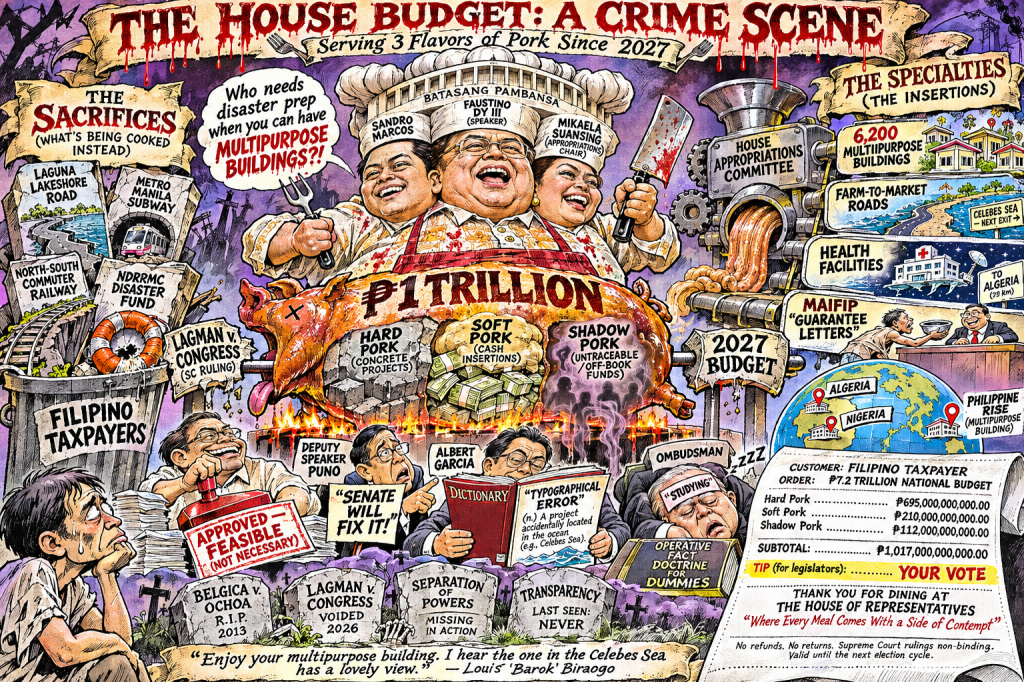
Inside the ₱695-Billion ‘Hard Pork,’ ₱210-Billion ‘Soft Pork,’ and ₱112-Billion ‘Shadow Pork’ Categories the House Hopes You Won’t Google
By Louis ‘Barok‘ C. Biraogo — October 28, 2026
CORRECT me if I’m wrong — and the Supreme Court says I’m not. The House of Representatives—that august chamber of democratic deliberation, that temple of constituent service—has just approved a 2027 national budget that a budget watchdog says contains over ₱1 trillion in “red flag” insertions. Not billion. Trillion. With a T. That’s roughly 14% of the entire ₱7.2-trillion budget floating in a murky category that the People’s Budget Coalition (PBC) has helpfully labeled “pork” in three convenient flavors: hard, soft, and—my personal favorite—”shadow.”
Shadow pork. As if regular pork wasn’t already elusive enough.
The PBC, co-convened by Kenneth Isaiah Abante and AJ Montesa, went before the Senate Finance Committee this week and laid out a spreadsheet of horrors so brazen it would make a pre-2013 Priority Development Assistance Fund (PDAF)-era legislator blush. ₱695 billion in “hard pork” for infrastructure. ₱210 billion in “soft pork” for patronage-driven ayuda. And ₱112 billion in “shadow pork” tucked neatly into unprogrammed appropriations—the budget equivalent of a offshore account, waiting for the right fiscal conditions to materialize.
And what, pray tell, was sacrificed on the altar of these insertions? The Laguna Lakeshore Road (₱27 billion cut). The Metro Manila Subway (₱20 billion cut). The North-South Commuter Railway (₱15 billion cut). And—brace yourself—₱7.75 billion cut from the National Disaster Risk Reduction and Management Council (NDRRMC) disaster fund. Because nothing says “pro-people budget” like defunding disaster preparedness while building 6,200 multipurpose buildings of dubious provenance.
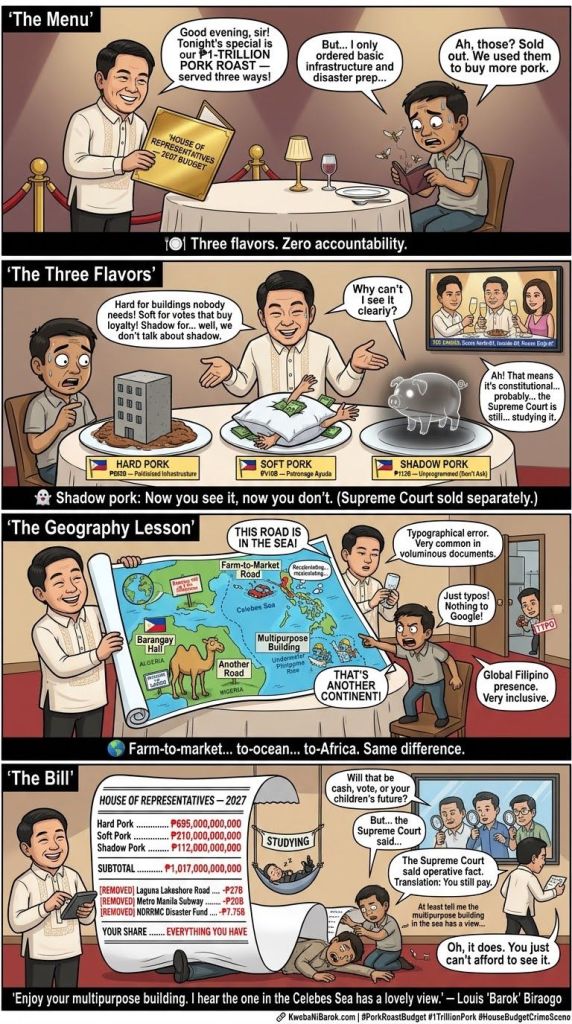
The Geography of Pork
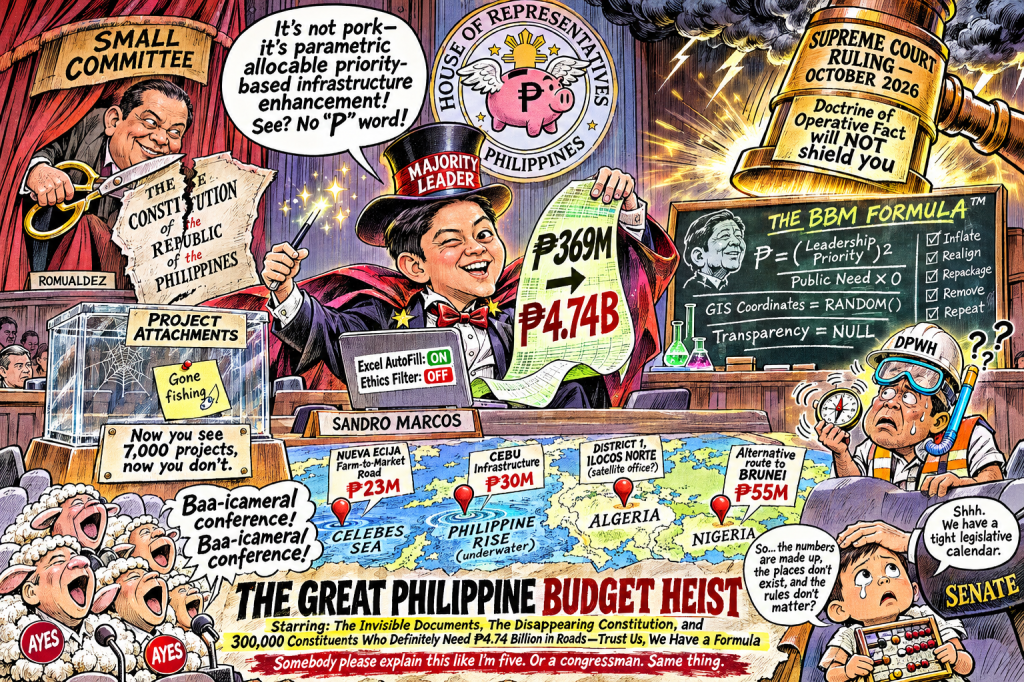
Here’s where the story gets deliciously absurd. The PBC flagged farm-to-market roads whose coordinates allegedly point to the Celebes Sea and the Philippine Rise—both bodies of water, last I checked. Some buildings apparently plotted to Algeria and Nigeria. I’m sure the good people of Algiers are thrilled about their new multipurpose building funded by Filipino taxpayers.
The House’s defense? “Typographical error.” According to House appropriations panel Senior Vice Chair Albert Garcia, the voluminous documents might have introduced a few typos. A typo that puts a road in the middle of the Pacific Ocean. A typo that teleports a barangay hall to West Africa. If these are typos, I’d hate to see what the House considers a deliberate error.
Deputy Speaker Ronnie Puno added that the amendments were “validated” by agencies and that the House merely “filled up the blanks” left by lump-sum allocations in the Department of Public Works and Highways (DPWH) proposal. So the House took a lump sum and broke it into 6,200 individual projects—most of them multipurpose buildings—and somehow this is better? That’s like taking a single unmarked envelope of cash and distributing it into 6,200 smaller unmarked envelopes. The transparency has been multiplied, apparently.
The Sandro Marcos Exception (Which Proves the Rule)
The PBC’s district-level breakdown is a masterpiece of political sensitivity training. House Majority Leader Sandro Marcos—the President’s son, in case anyone forgot—topped the list with 405 projects worth ₱4.37 billion for Ilocos Norte’s 1st District. Speaker Faustino Dy III’s Isabela 6th District came in fourth with 147 projects worth ₱1.68 billion. Appropriations chair Mikaela Suansing’s Nueva Ecija 1st District ranked seventh with 107 projects worth ₱1.35 billion.
The PBC was careful to clarify that these figures represent allocations to DPWH district engineering offices, not funds handed directly to legislators, and are not per se evidence of wrongdoing. Fair enough. But let’s be adults here: when the son of the sitting President, the Speaker of the House, and the chair of the Appropriations Committee all happen to represent districts that rank in the top ten for infrastructure “insertions,” the word “coincidence” starts sweating profusely.
The Legal Fiction of the “Constitutional” Insertion
Now, let’s talk about the constitutional elephant in the room. In October 2026—just weeks before this budget circus—the Supreme Court issued a ruling that should have made every House appropriations staffer reach for their antacid. The Court voided ₱449.5 billion in unprogrammed appropriations from the 2024 budget, declared the SAGIP program a prohibited lump sum, and laid out four conditions for constitutional unprogrammed appropriations: no lump sums, clear distinctions between programmed and unprogrammed spending conditions, sufficient prioritization standards, and consistency with the national fiscal program.
The Court’s language was surgical. It noted that the Bicameral Conference Committee’s proceedings had no records, that its report did not explain increases and decreases, and that it violated the rules of both chambers. It described how Congress had “severely distorted the budget creating artificial fiscal space” by moving projects from programmed to unprogrammed, enabling increases in DPWH infrastructure, Department of Health (DOH) medical assistance, Department of Social Welfare and Development (DSWD)’s Ayuda para sa Kapos ang Kita Program (AKAP), and Department of Labor and Employment (DOLE)’s Tulong Panghanapbuhay sa Ating Disadvantaged/Displaced Workers (TUPAD), as set out in Lagman v. Congress of the Philippines.
Sound familiar? It should. Because the 2027 budget appears to be running the exact same playbook—just with different line items and a fresh coat of “agency validation” paint.
The PBC’s “shadow pork” classification directly implicates this ruling. ₱112 billion in unprogrammed appropriations is being flagged precisely because the Supreme Court has already said that this mechanism, when abused, violates the separation of powers and the constitutional spending ceiling. The House’s response? Essentially: “We’ll let the Senate fix it.” Deputy Speaker Puno literally said the Senate can correct mistakes. This is the legislative equivalent of submitting a draft with footnotes saying “please correct my math” and expecting a passing grade.
The MAIFIP Shell Game
Perhaps the most ethically nauseating revelation is the Medical Assistance for Indigent and Financially-Incapacitated Patients (MAIFIP) maneuver. The executive proposed cutting the Philippine Health Insurance Corporation (PhilHealth)’s subsidy from ₱129.8 billion in 2026 to ₱74.4 billion in 2027. The House could have restored PhilHealth funding. Instead, it doubled MAIFIP to ₱49.2 billion—a program that, according to the PBC, requires patients to seek guarantee letters from politicians to access medical assistance.
Montesa’s quote is worth printing and framing: “The House wants us to get sick so we can beg them to pay for our hospital bills. Are we building a system that guarantees people their rights, or one that leaves them dependent on political favors?”
This is the Belgica doctrine’s nightmare scenario resurrected in health care form. The Supreme Court struck down PDAF precisely because it allowed legislators to exercise post-enactment discretion over fund release. MAIFIP, as structured, does exactly that—just with hospital bills instead of basketball courts. The patient doesn’t know if they’ll get help until a politician’s office says yes. That’s not social protection. That’s patronage with a stethoscope.
The Unprogrammed Appropriations Time Bomb
The ₱112 billion “shadow pork” deserves special scrutiny because it’s the most legally vulnerable category. The Supreme Court’s October 2026 ruling didn’t ban unprogrammed appropriations outright—it said they must be “narrow contingent appropriation[s]” consistent with the national fiscal program, with clear standards and no lump sums. The Court specifically targeted the practice of moving programmed projects into unprogrammed funds to create “artificial fiscal space” for insertions elsewhere.
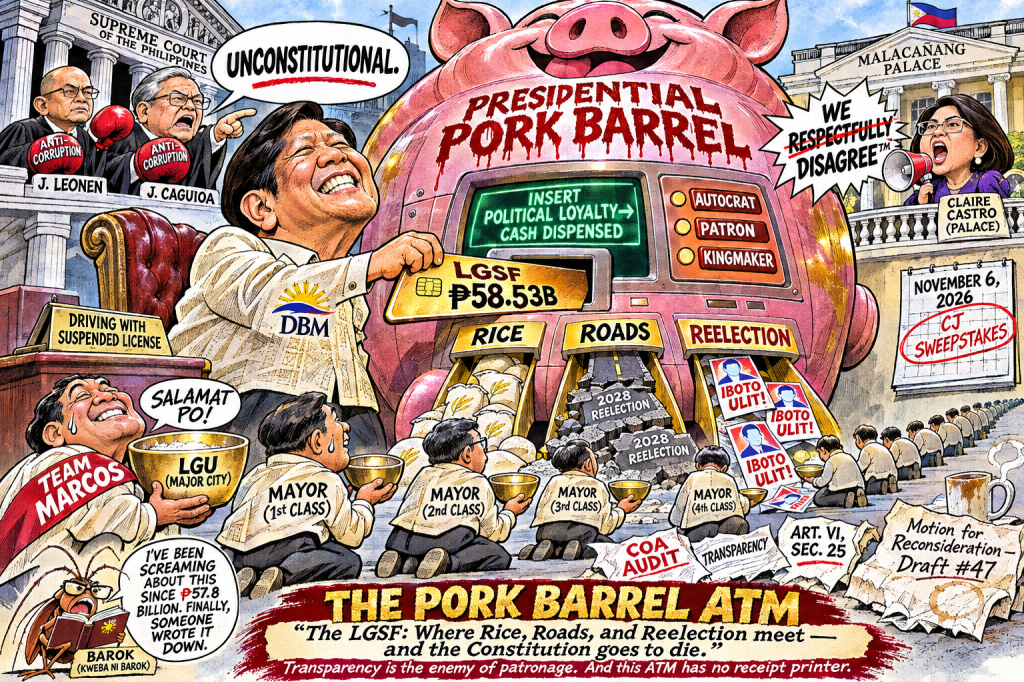
If the 2027 House version replicates this pattern—and the PBC’s classification suggests it might—then the entire budget could face a post-enactment constitutional challenge. Representative Edgar Erice has already threatened to bring the Local Government Support Fund (₱58.53 billion, which he calls the President’s “pork barrel”) before the Supreme Court. The LGSF’s broad guidelines allegedly give the President discretion over project identification, amounts, and release timing. The Palace’s defense—that the process is transparent and cites Leni Robredo’s Naga coliseum as an example—is not exactly reassuring. One person’s successful project does not a constitutional safeguard make.
The “We Validated It” Defense
The House’s fallback position is that the projects were “validated” by implementing agencies. Garcia claims you cannot make amendments without Department of Agriculture (DA), DPWH, or other agency validation. Puno adds that safeguards include accurate coordinates, Regional Development Council (RDC) approval, and Local Government Unit (LGU) consent.
But here’s the thing about validation: it tells you whether a project is feasible, not whether it’s necessary. A multipurpose building in a barangay that already has three multipurpose buildings is perfectly feasible. An irrigation project in an area with no farms is technically constructible. The question isn’t whether the concrete can be poured—it’s whether the pouring was demanded by public need or by political convenience.
And when the same agency that “validates” the project is also the agency whose budget gets augmented by the legislator making the request, the word “validation” starts to look less like quality control and more like a rubber stamp with a procurement contract attached.
The Senate as the Last Adult in the Room
The Senate Finance Committee, to its credit, seems to be taking this seriously. Senators JV Ejercito, Sherwin Gatchalian, and Panfilo Lacson reportedly welcomed the PBC’s findings and said they would guide the Senate’s review. Senate President Gatchalian began the practice of hearing civil society groups on the budget in 2025, and it’s now paying dividends in the form of documented, specific allegations rather than vague reformist platitudes.
But the Senate’s power is limited. It can amend the House version, but the bicameral conference committee—the very body the Supreme Court excoriated for its lack of records and transparency—will ultimately reconcile the two versions. Unless the Senate holds firm and the President wields a line-item veto with surgical precision, the pork will find a way to survive. It always does.
The Accountability Vacuum
Here’s the darkest part of this whole sordid affair: no one is going to jail for this. The Supreme Court’s October 2026 ruling applied the doctrine of operative fact to the 2024 and 2025 budgets, meaning the unconstitutional provisions remain effective for completed transactions. The Court explicitly said the doctrine “does not shield authors, proponents, or implementors from criminal, civil, or administrative liability”—but only if the proper tribunals find they acted in bad faith. The Ombudsman is reportedly “studying” the ruling. Studying. Like a student cramming for an exam they know they’ll fail but hope for a curve.
Meanwhile, the budget grows. The insertions multiply. The multipurpose buildings rise from the sea, from the Algerian desert, from the fertile imagination of a spreadsheet macro gone rogue. And the Filipino taxpayer—the one whose labor funded this ₱7.2-trillion monument to legislative creativity—gets to watch the Senate hearings on livestream and wonder if anyone, anyone, will ever be held responsible for turning the national budget into a political slush fund with line-item branding.
The PBC has done the country a service by putting numbers and districts and sea coordinates to what many suspected but couldn’t prove. But a watchdog can only bark. Someone with actual authority—the Senate, the President, the Ombudsman, the voting public—needs to bite.
Until then, enjoy your multipurpose building. I hear the one in the Celebes Sea has a lovely view.
Key Citations
A. Legal & Official Sources
- Belgica v. Ochoa. G.R. No. 208566, Supreme Court of the Philippines, 19 Nov. 2013. Supreme Court E-Library, elibrary.judiciary.gov.ph/thebookshelf/showdocs/22/66038.
- Lagman v. Congress of the Philippines. G.R. No. 271059, Supreme Court of the Philippines, Oct. 2026. Supreme Court of the Philippines, sc.judiciary.gov.ph/271059-271347-e-02472-e-04036-representative-edcel-c-lagman-et-al-vs-the-congress-of-the-philippines-consisting-of-the-senate-of-the-philippines-represented-by-senate-president-juan-miguel-f-zub/.
- “Supreme Court Holds Unprogrammed Appropriations Subject to Guidelines, Voids Congressional Increases in 2024 and 2025 Budgets.” Supreme Court of the Philippines, Oct. 2026, sc.judiciary.gov.ph/sc-holds-unprogrammed-appropriations-subject-to-guidelines-voids-congressional-increases-in-2024-and-2025-budgets/.
B. News Reports
- Chi, Cristina. “Watchdogs Urge Senate to Strip House ‘Insertions’ in Pork-Riddled 2027 Budget.” Philstar.com, 26 Oct. 2026, http://www.philstar.com/headlines/2026/10/26/2565843/watchdogs-urge-senate-strip-house-insertions-pork-riddled-2027-budget.
- “House Budget Insertions Reached P1 Trillion – Watchdog.” Philstar.com, 27 Oct. 2026, http://www.philstar.com/headlines/2026/10/27/2565946/house-budget-insertions-reached-p1-trillion-watchdog/amp/.
- “House Leaders Defend 2027 Budget Amendments amid Questions over Project Details.” GMA News Online, GMA Network, 26 Oct. 2026, http://www.gmanetwork.com/news/topstories/nation/1007201/house-leaders-defend-2027-budget-amendments-amid-questions-over-project-details/story/.
- Biraogo, Louis ‘Barok’ C. “Marcos Jr.’s Son Got a 1,187% Budget Increase—And Nobody Can Find the Paperwork.” Kweba ni Barok, 27 Oct. 2026, kwebanibarok.com/2026/10/27/marcos-jr-s-son-got-a-1187-budget-increase-and-nobody-can-find-the-paperwork/.

- ₱9 Billion in ‘Savings’? DILG’s Fire Truck Deal Smells Like Smoke

- ₱8B BBM Pork: CCTV for Every Captain’s Kumpare?
- ₱8.9 Billion, 331 Ghost Police Stations: The TIKAS Scandal Explained

- ₱8.4 Billion, 42,000 Barangays, 1 Election: The “Bawat Barangay Makikinabang” Vote-Buying Masterclass
- ₱75 Million Heist: Cops Gone Full Bandit

- ₱63 to the Dollar: The Only Thing Falling Faster Than the Peso Is the Government’s Credibility

- ₱6.77B Ghost Haunts Duterte: RTC Dismisses Mans Carpio’s Desperate Plea
- ₱6.77 Billion and Zero Cash: The Sara Duterte SALN Math That Doesn’t Add Up

- ₱6.7-Trillion Temptation: The Great Pork Zombie Revival and the “Collegial” Vote-Buying Circus

- ₱58.53B, Zero Receipts: The LGSF Pork Barrel Nobody Wants to Name
- ₱53 Million Man Tells ₱695-a-Day Workers to Stop Being ‘Mayabang’: The Audacity of BSP’s Remolona
- ₱4.4 Billion and a Witness Who Can’t Explain It: The Duterte Impeachment’s Most Expensive Non-Answer





Leave a Reply