Mrs. Patron, Diamond Hotel, and a Convenient Case of Conscience: The Weird, Wired World of Bernardo’s Testimony
By Louis ‘Barok‘ C. Biraogo — November 1, 2026
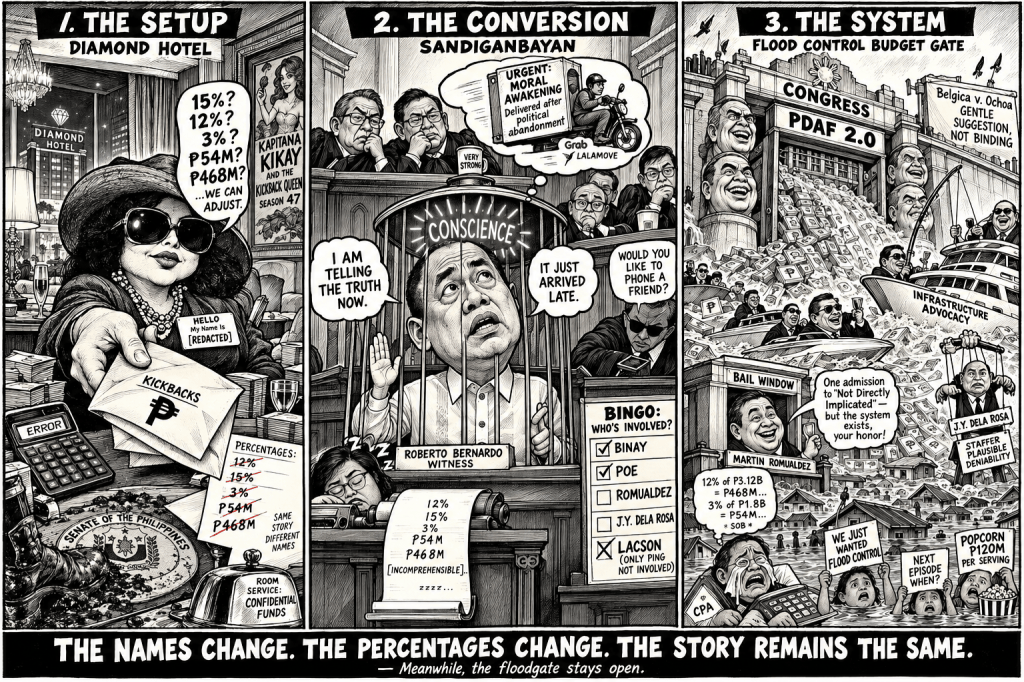
SETTLE down, students. Today’s lesson is brought to you by the letter ₱. Today we’re watching Philippine politics turn a national infrastructure crisis into a never-ending telenovela—complete with dramatic courtroom confessions, convenient memory lapses, and enough mathematical gymnastics to make a Certified Public Accountant (CPA) weep.
This week’s episode? Former Department of Public Works and Highways (DPWH) Undersecretary Roberto Bernardo, a man who apparently discovered both his conscience and a good script editor simultaneously, has dropped a bombshell that has the Sandiganbayan buzzing and the political class reaching for their lawyers’ speed dials.
The flood control kickback scandal has officially expanded to include former Senators Nancy Binay and Grace Poe—two names you definitely didn’t have on your Bingo card unless you’ve been paying attention to earlier chapters.
But wait, there’s more. Because nothing says “credible state witness” quite like admitting in open court that you initially expected the very senators you were implicating to help you after your Senate testimony—and then, when that assistance mysteriously failed to materialize, you suddenly experienced an acute case of conscience, one that arrived in perfect synchronization with your cooperation agreement with the government.
I’m not saying Bernardo’s testimony is a masterclass in transactional memory, but I’ve seen less convenient timing in a bank robbery where the getaway driver suddenly remembers the license plate only after being offered immunity.

The Numbers Game: 12%, 15%, 3%, and Other Fractions That Don’t Add Up
Now, the mathematics, because this is where things get truly entertaining. Bernardo’s judicial affidavit allegedly attributes to Binay a 12-15% “commitment” on certain DPWH infrastructure projects. But then we also get a 3% kickback on ₱1.8 billion in project costs, which equals ₱54 million.
The arithmetic is technically correct: ₱1.8 billion multiplied by 3% does, indeed, equal ₱54 million. Gold star for multiplication. But here’s the question that should have the Sandiganbayan’s Justices reaching for reading glasses and a very strong cup of coffee: Were the 12-15% and 3% figures describing the same arrangement, different arrangements, different project batches, or different layers of an alleged scheme existing in a quantum superposition of corruption?
Because if the prosecution cannot explain this discrepancy, defense counsel is going to have a field day. Imagine the cross-examination: “Mr. Bernardo, would you say the percentage was 12%, 15%, or 3%? Or would you like to phone a friend?”
And then there’s the ₱3.12 billion figure from the November 2025 Senate testimony, which, if you apply the alleged 15% commitment, yields ₱468 million. That’s quite the spread: ₱54 million here, ₱468 million there. It’s like a corruption buffet where you choose your own percentage depending on how hungry the investigating court happens to be.
The prosecution needs to reconcile these numbers, or the defense will argue that Bernardo’s testimony is less “insider revelation” and more “choose-your-own-adventure accounting.” I’ve seen lottery ticket odds that felt more reliable.
The Poe Allegations: When “Mrs. Patron” and “J.Y. Dela Rosa” Walk Into a Budget Hearing
For Grace Poe, Bernardo allegedly attributed a 20% commitment on a ₱500-million project package. Do the math: ₱100 million. But here’s the legal catch that would make any defense attorney’s heart go pitter-patter: A demand is not a payment. An agreement is not a receipt. A project allocation is not automatically ill-gotten wealth.
Bernardo also allegedly identified Poe’s staff member “J.Y. Dela Rosa” as among those who approached him for assistance, and a contractor identified as “Mrs. Patron” who allegedly collected the commitment at the Diamond Hotel through an aide.
Now, if I’m a prosecutor, the phrase “collected at the Diamond Hotel through an aide” had better come with a paper trail, CCTV footage, hotel registration records, bank deposits, and perhaps a signed receipt in triplicate. Because “Mrs. Patron” sounds less like a verified participant and more like a character from a telenovela spin-off: Kapitana Kikay and the Kickback Queen.
The fundamental legal principle remains: A legislator is not automatically criminally responsible for every act of a staff member. The prosecution must establish the legislator’s own participation, authorization, conspiracy, or legally sufficient connection to the offense. Forwarding a legitimate project request is not the same as knowingly negotiating commissions, collecting kickbacks, and delivering proceeds.
The Belgica Doctrine: Or, How I Learned to Stop Worrying and Love the Unconstitutional PDAF
Let’s remember the late, lamented Priority Development Assistance Fund (PDAF), struck down in Belgica v. Ochoa (2013) because it allowed legislators to intervene in post-enactment budget execution—essentially exercising executive functions outside legitimate congressional oversight.
One would think that after such a resounding constitutional rebuke, legislators would have retreated from the post-enactment project identification game. Yet here we are in 2026, with allegations that senators were allegedly negotiating percentages on specific DPWH projects, influencing which contractors got what, and allegedly collecting commissions through intermediaries.
It’s almost as if the Belgica ruling was treated as a gentle suggestion rather than binding constitutional precedent. “We promise not to do post-enactment intervention,” say our legislators, while allegedly doing exactly that, just with more layers of intermediaries and plausible deniability.
The constitutional line is clear: identifying flood-prone communities and advocating for infrastructure projects is legitimate legislative advocacy. Dictating which contractor gets the work, controlling project modifications, influencing fund releases, or receiving money in exchange for these interventions crosses into unconstitutional and potentially criminal territory.
If the allegations are true, the line has been blurred into oblivion by a system that treats infrastructure appropriations as a personal spending account—with VIP access for those who know the right percentages.
Bernardo’s Credibility: The State Witness Who Cried “Conscience”
Now, the elephant in the courtroom: Bernardo’s credibility.
He admitted receiving ₱120 million in installments from alleged co-conspirators. He acknowledged participating in the alleged arrangements. He initially expected the senators he implicated to help him. He decided to cooperate when that help did not come. And he claims his conscience troubled him after learning about ghost projects.
That’s quite the sequence. It’s almost as if a seasoned insider, facing potential criminal liability, calculated that cooperation with the government was more beneficial than waiting for political allies who turned out to be less than reliable.
The Supreme Court has consistently held that accomplice testimony must be carefully evaluated and substantially corroborated. Under Republic Act No. 6981 (Witness Protection, Security and Benefit Act), a state witness must meet several requirements: absolute necessity for the testimony, no other direct evidence available, substantial corroboration on material points, and the witness must not appear to be the most guilty.
Bernardo’s admission that he allegedly facilitated kickbacks and received substantial financial benefits raises the question: Is he actually the “most guilty” actor? Or just the one who got caught first and decided to sing like a canary to preserve his freedom?
The prosecution’s challenge is to demonstrate that his testimony is supported by evidence independent of his personal credibility. Because if the case rests solely on a witness who admits his initial cooperation was based on disappointment rather than moral awakening, the defense will have a field day.
The Romualdez Connection: A Bail Hearing Becomes a Political Broadcast
The timing of Bernardo’s testimony is particularly interesting. It emerged during the bail proceedings of former House Speaker Martin Romualdez, who faces plunder charges. Romualdez’s defense counsel was questioning Bernardo’s credibility and the prosecution’s evidence.
Bernardo reportedly testified that he had no direct dealings with Romualdez regarding kickbacks, and that Romualdez did not request project lists from him. But he implicated other politicians and described an alleged system of project commitments.
This creates a deliciously ironic courtroom dynamic: Romualdez’s defense can potentially use Bernardo’s testimony to argue that the witness’s allegations are unreliable, while simultaneously benefiting from the fact that Bernardo did not directly implicate Romualdez in kickback dealings.
But here’s the thing: The existence of a corrupt system does not automatically establish that every powerful politician participated in it. And the absence of direct cash transactions between Bernardo and Romualdez does not automatically exclude Romualdez from an alleged conspiracy if other evidence establishes his participation.
Watching a bail hearing turn into a political broadcast that expands the scope of a corruption investigation is peak Philippine political theater. I’m surprised they didn’t serve popcorn.
The Prosecution’s Dilemma: All the Names, None of the Proof?
So far, we have allegations against Binay, Poe, Romualdez (through the bail case), and a supporting cast of intermediaries, contractors, and DPWH officials. The list is growing like a social media gossip thread. But the government must resist the temptation to equate a growing list of names with a growing list of proven criminals.
The strongest prosecution is not the one that names the most politicians. It is the one that can establish, through documents, money trails, credible witnesses, and independent corroboration, exactly who did what, when, how, and for whose benefit.
Right now, the prosecution’s case seems to rest heavily on a state witness whose credibility is under fire, whose numbers don’t quite add up, and whose motivation for cooperating is, at best, complicated. That’s not a slam-dunk case; it’s a Hail Mary pass wrapped in a sworn affidavit.
If the government cannot corroborate Bernardo’s allegations with documentary evidence, financial records, and independent witness accounts, the cases could collapse before they even reach the plunder stage. And that would be a devastating blow not just to the specific prosecutions, but to public confidence in the entire anti-corruption effort.
The Institutional Reforms We’ll Probably Forget
And now for the part where I remind everyone that individual prosecutions, while necessary, are insufficient without structural reforms. This is where you can roll your eyes because you know, and I know, that these reforms will be discussed, promised, and then quietly forgotten until the next major scandal.
But let’s run through them anyway, for form’s sake: a publicly accessible DPWH project database with full disclosure of project proponents and endorsements; publication of project cost estimates and awarded contracts; geographic mapping of infrastructure appropriations; independent engineering inspections; digital tracking of project accomplishments; contractor beneficial-ownership disclosure; stronger conflict-of-interest rules; transparent publication of bicameral budget amendments.
The objective should be to make the alleged kickback system structurally difficult to reproduce. But that requires sustained political will, which is notoriously in short supply when the people in power benefit from the status quo.
Final Verdict: The Scandal is the System, Not Just the Individuals
Here’s the uncomfortable truth that Bernardo’s testimony reveals, regardless of whether his specific allegations against Binay and Poe are proven: The Philippines’ budget and procurement systems remain vulnerable to political capture.
Even if every politician named by Bernardo were eventually acquitted, the government would still have to answer a fundamental question: How could a national infrastructure system allegedly become so vulnerable to political commissions, questionable project allocations, contractor manipulation, and ghost projects?
The answer cannot simply be that a few officials were dishonest. The answer must include an examination of the institutional weaknesses that allowed the alleged transactions to occur.
Because if the system remains unchanged, then even after this scandal subsides, the next one is already being written—perhaps with new names, new percentages, and new intermediaries, but with the same fundamental dynamics of corruption.
And that, dear readers, is the real scandal. The flood control kickbacks are not just about stolen money. They’re about a system that, allegedly, treats public infrastructure as a negotiable political asset—where percentages are allegedly assigned, commissions are allegedly collected, and flood control projects are allegedly treated as opportunities for private enrichment rather than as lifelines for communities facing existential threats from climate change and natural disasters.
A flood-control budget is supposed to protect communities from floods. It must never become a floodgate for political enrichment.
But if the system remains unchanged, it will continue to be exactly that: a floodgate that enriches the few while leaving the many exposed to the consequences—both literal and figurative—of corruption.
Stay tuned for the next episode. The Sandiganbayan will reconvene, the lawyers will argue, and the public will watch with a mixture of fascination, disgust, and a weary familiarity that comes from having seen this show before.
The names change. The percentages change. The story remains the same.
And that’s the most damning indictment of all.
Key Citations
A. Legal & Official Sources
- Belgica v. Ochoa. G.R. No. 208566, Supreme Court of the Philippines, 19 Nov. 2013, lawphil.net/judjuris/juri2013/nov2013/gr_208566_2013.html.
- Republic Act No. 6981. An Act Providing for a Witness Protection, Security and Benefit Program and for Other Purposes. 1991, lawphil.net/statutes/repacts/ra1991/ra_6981_1991.html.
B. News Reports
- Mendoza, John Eric. “Bernardo tells Sandiganbayan: Binay, Poe also received alleged kickbacks.” Philippine Daily Inquirer, 29 Oct. 2026, newsinfo.inquirer.net/2332346/bernardo-tells-sandiganbayan-binay-poe-also-received-alleged-kickbacks.
- “Bernardo Cites Conscience, Lack of Help as Reasons for Exposing Ghost Projects.” Daily Tribune, 29 Oct. 2026, tribune.net.ph/2026/10/29/bernardo-cites-conscience-lack-of-help-as-reasons-for-exposing-ghost-projects.
- “Bernardo: Only Ping Not Involved in Infra Kickbacks.” The Philippine Star, 30 Oct. 2026, http://www.philstar.com/headlines/2026/10/30/2566659/bernardo-only-ping-not-involved-infra-kickbacks.
- “Kickbacks Rose to 25% under Romualdez.” Daily Tribune, 20 Oct. 2026, tribune.net.ph/2026/10/20/kickbacks-rose-to-25-under-romualdez.
- Ong, Ghio. “P120 Million ‘Balato’ from Co 1% of Flood Kickbacks – Bernardo.” The Philippine Star, 8 Oct. 2026, http://www.philstar.com/headlines/2026/10/08/2561681/p120-million-balato-co-1-flood-kickbacks-bernardo.
- “Romualdez Camp Argues ‘No Proof Evident’ in Plunder Case.” Daily Tribune, 28 Sept. 2026, tribune.net.ph/2026/09/28/romualdez-camp-argues-no-proof-evident-in-plunder-case.
- ₱9 Billion in ‘Savings’? DILG’s Fire Truck Deal Smells Like Smoke

- ₱8B BBM Pork: CCTV for Every Captain’s Kumpare?

- ₱8.9 Billion, 331 Ghost Police Stations: The TIKAS Scandal Explained

- ₱8.4 Billion, 42,000 Barangays, 1 Election: The “Bawat Barangay Makikinabang” Vote-Buying Masterclass

- ₱75 Million Heist: Cops Gone Full Bandit

- ₱63 to the Dollar: The Only Thing Falling Faster Than the Peso Is the Government’s Credibility

- ₱6.77B Ghost Haunts Duterte: RTC Dismisses Mans Carpio’s Desperate Plea
- ₱6.77 Billion and Zero Cash: The Sara Duterte SALN Math That Doesn’t Add Up

- ₱6.7-Trillion Temptation: The Great Pork Zombie Revival and the “Collegial” Vote-Buying Circus

- ₱58.53B, Zero Receipts: The LGSF Pork Barrel Nobody Wants to Name
- ₱53 Million Man Tells ₱695-a-Day Workers to Stop Being ‘Mayabang’: The Audacity of BSP’s Remolona
- ₱4.4 Billion and a Witness Who Can’t Explain It: The Duterte Impeachment’s Most Expensive Non-Answer




Leave a Reply