
Will November 3 Produce Documents—or Just Another Press Release?
By Louis “Barok” C. Biraogo | November 1, 2026
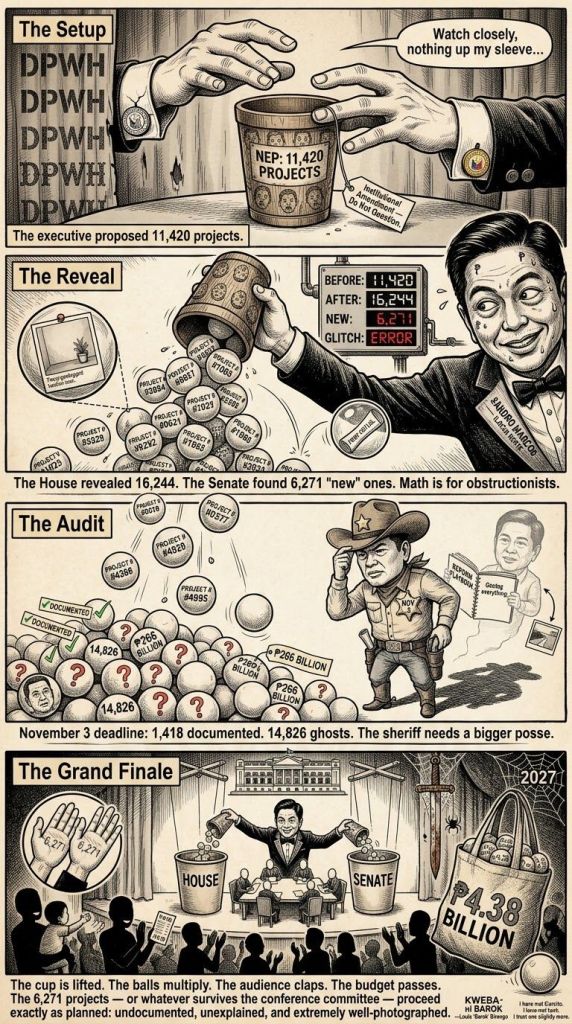
ALLOW me to describe a vanishing act—not of a coin, but of 6,271 projects that apparently never left the room.
A magician places eleven thousand rubber balls under a cup, then lifts the cup to reveal sixteen thousand. When you ask where the extra five thousand came from, he tells you that eleven thousand of them were always sixteen thousand. When you press further, he calls you an obstructionist who does not understand the elementary arithmetic of governance. And then—this is the best part—he asks you to approve the whole thing by budget day, or the government shuts down.
That, dear readers, is the plot of the Philippine 2027 budget season. Only the balls are infrastructure projects, the cup is the House of Representatives, and the magician is every single person who has ever defended an “institutional amendment” with a straight face.
The Numbers That Do Not Add Up (And Nobody Is Doing the Math)
The executive’s National Expenditure Program (NEP) contained 11,420 projects of the Department of Public Works and Highways (DPWH). The House-transmitted General Appropriations Bill (GAB) contains 16,244—a net increase of 4,824. But the Senate’s comparison identifies 6,271 newly introduced projects.
Run that again. The newly introduced projects exceed the net increase by 1,447 projects. Either 1,447 old projects vanished—consolidated, renamed, or quietly vaporized—or somebody in the budget process cannot count.
Now multiply. Six thousand two hundred seventy-one projects at a reported ₱172.1 billion means an average of ₱27.4 million per project—small enough to be invisible in the aggregate, large enough to be lucrative, and unnamed enough to be deniable. This is not an infrastructure program. This is a portfolio of plot points.
“Institutional Amendments”: The Magic Words of Philippine Budgeting
The House defense is that the NEP arrived with lump sums, and Congress merely “filled in the blanks”—with prior agency approval, no less. This is precisely as convincing as a child claiming the cookie jar arrived empty.
Review the choreography. The DPWH reportedly sought ₱20 billion in “institutional amendments” to its ₱643.95-billion proposal. The House’s own September 25 announcement celebrated stricter safeguards: Programs of Works (POWs), Certificates of Implementability (COIs), geotagged photographs. Then the House transmitted a budget containing 6,271 projects not in the NEP—and by the Senate’s October 26 accounting, only 1,418 of the 16,244 projects had supporting documents reach the Senate committee, leaving 14,826 undocumented. ₱266 billion worth are flagged for scrutiny.
So the story is: a department invented the world’s most rigorous project-vetting system, and the chamber that endorsed it waved 6,271 undocumented projects through like guests who forgot their invitations but remembered their plus-ones.
“Institutional” is the budget equivalent of “decorative”: attach it to anything and the thing becomes respectable. An “institutional amendment” is not a pork barrel; it is a departmental correction. It is not a legislator’s fantasy; it is a technical adjustment. Repeat until the news cycle rolls over.
The Supreme Court Already Said This Is Illegal, But Sure, Let Us Pretend It Is Novel
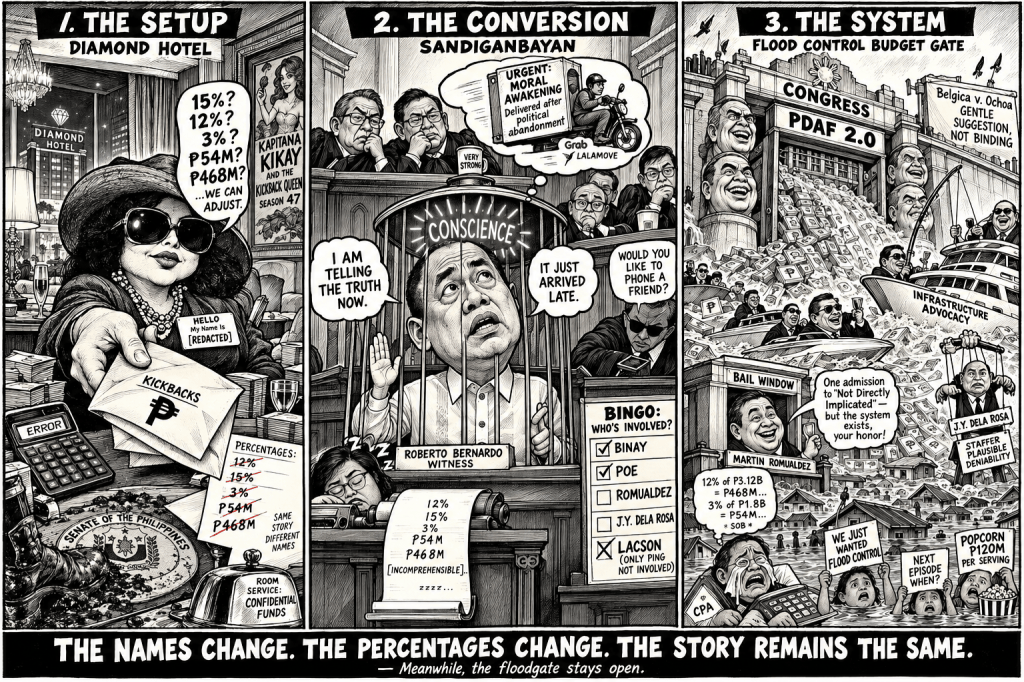
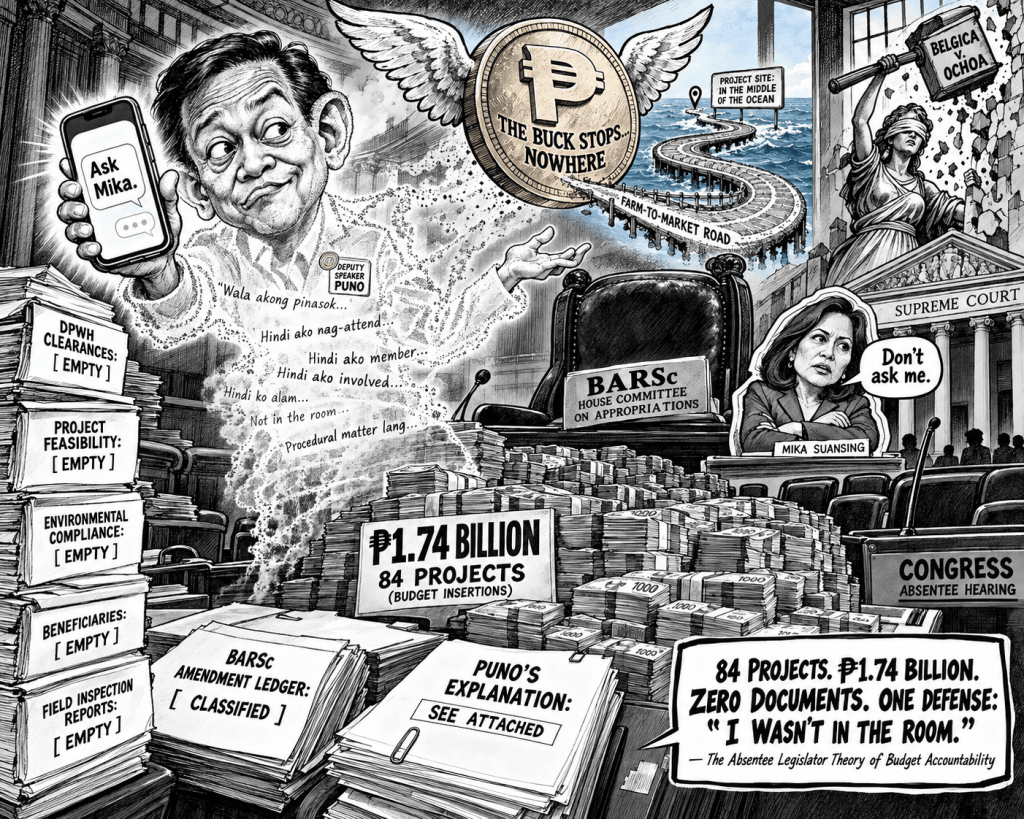
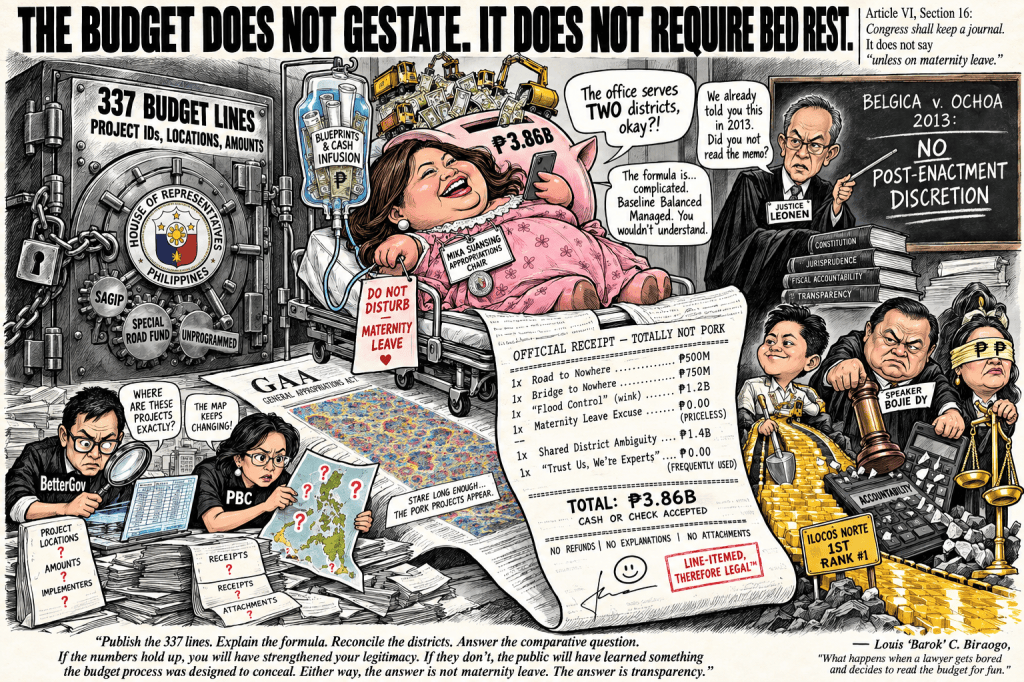
Everyone forgot that the Supreme Court has already decided this movie’s third act. Belgica v. Ochoa (2013) did not strike down the Priority Development Assistance Fund because the paperwork was sloppy. It struck it down because legislators were participating in post-enactment project identification—precisely the function the House claims it is merely performing constitutionally. If a legislator’s district allocation becomes a named, funded, location-specific project, the constitutional problem is not the document attached to it. The problem is who chose it, for whom, and with what implied future leverage.
Then came Araullo v. Aquino (2014) on the Disbursement Acceleration Program (DAP), and the October 2026 ruling striking down the 2024 and 2025 budget provisions—₱449.5 billion in unprogrammed appropriations, ₱17.99 billion in the DPWH Special Road Fund, ₱12.7 billion in Special Accounts. The Court has now said three times that Congress cannot conjure money the President did not propose. And yet here we are, asked to believe that 6,271 projects materialized from thin air while the peso totals somehow stayed neutral.
Please, someone, show the class the peso-by-peso reconciliation. Show the deletions. Show the 1,447 missing projects. “It came from savings” is not an accounting. It is a bedtime story for budget hearings.
Vince Dizon’s Reform Legacy and the Convenient Amnesia of Personnel Changes
Now consider the man who designed the safeguards currently being ignored, and who is employed three buildings away. Vince Dizon, formerly of the DPWH, now of the Department of Transportation (DOTr), and Giovanni Lopez, formerly of the DOTr, now of the DPWH—a job swap so perfectly balanced it resembles not a reshuffle but a hostage exchange.
Dizon removed 80-plus personnel, referred 110-plus to the Ombudsman, and built a documentary regime requiring geotagged photographs to prove that a road is not merely a state of mind. Lopez, a CPA and lawyer, is now expected to uphold it. Yet 6,271 undocumented projects still appeared—either the reforms were theater, or they were circumvented at a level where the theater has reserved seating.
The Ombudsman already has 39 cases in court and 209 under investigation on flood-control corruption. Ejercito flagged 155 flood-control projects worth ₱8.2 billion in September. If the reform machinery can be bypassed this easily, the “reform” was never a system. It was a personal brand.
The Sandro Marcos Problem, Which Malacañang Would Prefer You Forget
And now the detail that makes this opera delicious: Ilocos Norte’s First District, represented by House Majority Leader Sandro Marcos, received ₱4.38 billion in DPWH insertions—the single largest district allocation according to the watchdog that actually did the arithmetic.
Malacañang defended the insertions as “valid projects.” Malacañang would. The President, who promised a “squeaky clean” budget, now faces a domestic political problem with a shared surname.
The People’s Budget Coalition counted the money: ₱172.1 billion in DPWH insertions across roughly 6,200 projects. Watchdogs have done the work the chambers of Congress apparently could not. The scandal is not that these insertions were discovered. The scandal is that everyone knew, and the budget passed anyway, repeatedly, under different acronyms with identical mechanics.
Ejercito’s Deadline: Genuine Reform or an Audition for 2028?
Fairness in this column is costly, so savor it. Senator JV Ejercito is asking the right questions—demanding documentation, invoking Dizon’s reforms, pushing the Masterplan for Infrastructure and National Development (MIND Act, Senate Bill No. 2, as an institutional fix. Reformers deserve credit even when their motives are mixed.
But keep your eyes open. Ejercito reportedly faces tough odds in the 2028 Senate race. The DPWH scandal offers a high-profile, cameras-on platform. The November 3 deadline is a beautiful political instrument: if DPWH complies, he is the sheriff; if DPWH fails, he is the sheriff whose warning was ignored. Either way, the headline includes his name.
The worst-case scenario is not the projects that get removed. It is the projects that get “removed” from the newspaper while remaining in the General Appropriations Act (GAA). Nothing prevents a classic Philippine ending: a loud deadline, a document dump of indeterminate completeness, a compliance announcement, and a conference committee where the 6,271 quietly become 3,000, then 2,000, then “a matter between the two chambers.” The Palace, meanwhile, holds the item veto like a sword nobody has ever drawn, because the budget is never about fiscal integrity—it is about keeping everyone inside the coalition happy.
The Questions Nobody Wants to Answer
- Who proposed each of the 6,271 projects? By name. By district. By endorsement letter. If the projects are “valid,” proponents should be proud to sign their names, as they are proud to sign project tarpaulins before elections.
- Where are the POWs, the COIs, and the geotagged photographs? Not the promise of them. The documents.
- Why does the House claim prior agency approval while the Senate committee says only 1,418 of 16,244 projects had documents submitted? Somebody is lying, or “approval” has acquired a new legal meaning this fiscal year.
- What happened to the 1,447 missing projects—consolidated, renamed, replaced? Or are we to accept that appropriation bills operate on quantum superposition?
- Who are the contractors positioned to benefit? Any company sharing a boardroom, a warehouse, or a beneficial owner with a previous Ombudsman referral? Any project packaging tailored to a single bidder?
- Will the Senate apply the same scrutiny to its own insertions? If Ejercito audits only the lower chamber’s additions, he has not built a reform. He has built a lever.
Verdict: A Performance of Reforms, in Three Acts
The 2027 budget is being performed in three acts. Act One: The Senate discovers mystery projects. Act Two: The DPWH promises documentation. Act Three: The conference committee produces a budget nobody can fully explain but everybody can defend.
If the Philippines has learned anything from Belgica, Araullo, and the October 2026 ruling, it is this: the Supreme Court can declare a scheme unconstitutional, but it cannot make a legislature forget how to run it under a new name. Pork does not die. It reincarnates—as “institutional amendments,” as “local development initiatives,” as “geotagged projects” with photographs of a riverbank that may or may not be the riverbank.
The Filipino taxpayer does not need 6,271 more announcements. The taxpayer needs 6,271 verifiable documents—or fewer projects if fewer are warranted. And the Senate needs to remember that its watchdog role is not just a MIND Act talking point.
Until then, the magic act continues: the cup is lifted, the balls multiply, and the audience is told to clap. As usual, we will clap. The budget must pass. The children must be fed. And the 6,271 projects, or whatever is left of them after the November 3 theatrical run, will proceed exactly as planned—undocumented, unexplained, and extremely well-photographed.
A disclosure, for transparency: I have met Ejercito. I have met pork. I trust one of them slightly more than the other, and I will not tell you which.
Key Citations
A. Legal & Official Sources
- Araullo v. Aquino III. G.R. Nos. 209287 et al., 1 July 2014. Supreme Court E-Library, elibrary.judiciary.gov.ph/assets/pdf/philrep/2014/G.R.%20No.%20209287.pdf.
- Belgica v. Ochoa, Jr. G.R. Nos. 208566 et al., 19 Nov. 2013. Supreme Court E-Library, elibrary.judiciary.gov.ph/assets/pdf/philrep_ebooks/Volume_721.pdf.
- House of Representatives of the Philippines. “DPWH Budget Clears House Debates with Stricter Project Safeguards.” Congress.gov.ph, congress.gov.ph/index.php/media/press-releases/10256.
- The 1987 Constitution of the Republic of the Philippines. Art. VI, sec. 27. Official Gazette of the Republic of the Philippines, http://www.officialgazette.gov.ph/constitutions/the-1987-constitution-of-the-republic-of-the-philippines/the-1987-constitution-of-the-republic-of-the-philippines-article-vi/.
B. News Reports
- Bilyonaryo News Channel. “Ejercito: Up to 6,271 DPWH Projects May Be Scrapped from 2027 Budget over Missing Documents.” Bilyonaryo, bnc.bilyonaryo.com/ejercito-up-to-6271-dpwh-projects-may-be-scrapped-from-2027-budget-over-missing-documents/news/.
- “DPWH Seeks ₱20B ‘Institutional Amendments’ within Proposed 2027 Budget.” GMA News Online, GMA Network, http://www.gmanetwork.com/news/topstories/nation/1003634/dpwh-seeks-p20b-institutional-amendments-within-proposed-2027-budget/story/.
- “JV Draws Line on HGAB.” Daily Tribune, 30 Oct. 2026, tribune.net.ph/2026/10/30/jv-draws-line-on-hgab.
- Philippine News Agency. “Senate Flags ₱266-B DPWH Projects for Further Scrutiny.” PNA, http://www.pna.gov.ph/article/senate-flags-p266-b-dpwh-projects-for-further-scrutiny.
- “SC Strikes Down 2024, 2025 Budgets; Sets Limits for Unprogrammed Appropriations.” GMA News Online, GMA Network, http://www.gmanetwork.com/news/topstories/nation/1006575/sc-strikes-down-2024-2025-budgets-sets-limits-for-unprogrammed-appropriations/story/.
- “Ejercito renews push for long-term infra master plan.” Inquirer.net, 25 Aug. 2026, newsinfo.inquirer.net/2293067/ejercito-renews-push-for-long-term-infra-master-plan.

- ₱9 Billion in ‘Savings’? DILG’s Fire Truck Deal Smells Like Smoke

- ₱8B BBM Pork: CCTV for Every Captain’s Kumpare?

- ₱8.9 Billion, 331 Ghost Police Stations: The TIKAS Scandal Explained

- ₱8.4 Billion, 42,000 Barangays, 1 Election: The “Bawat Barangay Makikinabang” Vote-Buying Masterclass

- ₱75 Million Heist: Cops Gone Full Bandit

- ₱63 to the Dollar: The Only Thing Falling Faster Than the Peso Is the Government’s Credibility

- ₱6.77B Ghost Haunts Duterte: RTC Dismisses Mans Carpio’s Desperate Plea

- ₱6.77 Billion and Zero Cash: The Sara Duterte SALN Math That Doesn’t Add Up

- ₱6.7-Trillion Temptation: The Great Pork Zombie Revival and the “Collegial” Vote-Buying Circus

- ₱58.53B, Zero Receipts: The LGSF Pork Barrel Nobody Wants to Name
- ₱53 Million Man Tells ₱695-a-Day Workers to Stop Being ‘Mayabang’: The Audacity of BSP’s Remolona
- ₱4.4 Billion and a Witness Who Can’t Explain It: The Duterte Impeachment’s Most Expensive Non-Answer




Leave a Reply