
The Senate’s budget watchdog just called out the President’s son—and the Palace’s defense is basically “trust us, it’s not final yet”
By Louis ‘Barok’ C Biraogo — November 1, 2026
HERE’S a number that ought to make the long-suffering Filipino taxpayer choke on their kapeng barako—and not because it’s strong: 405.
That is not the number of times a congressman said “budget insertions are normal” this week. It is the number of Department of Public Works and Highways (DPWH) projects that the People’s Budget Coalition (PBC) found attributed to the First District of Ilocos Norte, represented by House Majority Leader Sandro Marcos. The price tag? ₱4.37 billion.
Four hundred and five projects. In one district. For one congressman. Who happens to be the President’s son.
Now, before the Palace’s lawyers and spin doctors arrive with their defamation threats and “insertions are not inherently illegal” PowerPoint, let me be clear: I am not accusing anyone of corruption. I am accusing them of something far more embarrassing—arithmetic that smells like favoritism.
Senator Ping Lacson, a man who has spent more time reading budget documents than most senators have spent reading anything, said this week that Sandro Marcos’ district would not be exempt from Senate scrutiny. His exact words: “Yes, absolutely”. The Senate’s attitude, he said, is “gung-ho. Kung masagasaan, masagasaan”.
Translation for the Palace: the free ride is over.
But here is where the story gets deliciously absurd. Malacañang’s response was essentially: “Relax, the budget isn’t final yet.” Presidential Communications Office (PCO) Undersecretary Claire Castro explained that just because ₱4.37 billion in projects have been proposed doesn’t mean they’ll be released. Which is a bit like saying just because someone wrote your name on a check doesn’t mean they’ve signed it. Technically true. Also technically missing the point.
The point is not whether the money has been spent. The point is why 405 projects landed in one district in the first place.
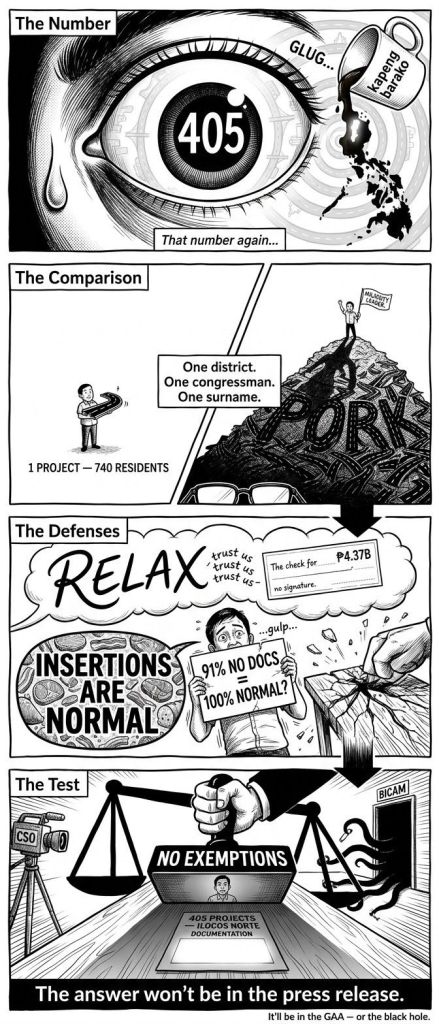
Let me put this in perspective. The Senate Finance Committee discovered that of the 16,244 projects in the DPWH’s proposed 2027 budget, only 1,418 came with supporting documents. That means 91.27 percent of the projects had no paperwork submitted to the committee. If you tried to submit a expense report at any decent corporation with that documentation rate, you would be escorted out by security. In Congress, apparently, it qualifies you for a budget hearing.
And the Ilocos Norte First District—population roughly 300,000, give or take a few barangay captains—somehow ended up with 405 of these undocumented projects. That is one project for every 740 residents. If infrastructure were allocated by population density, Metro Manila would get a skyscraper on every corner and Ilocos Norte would get a basketball court. Instead, the President’s son gets a portfolio that looks like a DPWH district office’s entire five-year plan.
The Palace’s defense is that “insertions are not inherently improper”. Fine. Neither is a congressman’s right to advocate for his constituents. But there is a difference between advocacy and avalanche. When one district gets the largest single allocation in the watchdog’s district-level findings—while 91 percent of the entire DPWH budget lacks documentation—the burden of proof shifts. And right now, the only thing shifting faster is the Palace’s talking points.
Lacson, to his credit, is not just waving a moral finger. He has proposed something genuinely radical: letting civil society organizations (CSOs) observe the bicameral conference committee proceedings, the shadowy “Third Chamber” where budget insertions often get resurrected after the Senate has already deleted them. Senate Finance Chair JV Ejercito has apparently agreed, promising to livestream the bicam and invite CSOs to watch.
This is a remarkable concession. For years, the bicam has operated like a casino VIP room: no windows, no cameras, and the house always wins. If Ejercito actually follows through, it will be the first time ordinary Filipinos can watch their representatives negotiate away their future in real time. Of course, “livestreaming” a meeting where senators discuss project descriptions that nobody has seen is a bit like televising a magic show and calling it transparency. The trick is still hidden.
But here is the deeper problem, and it has nothing to do with the surname Marcos.
The Supreme Court has already ruled that Congress cannot simply add unprogrammed appropriations willy-nilly. In October 2026, the Court struck down ₱449.5 billion in unprogrammed appropriations from the 2024 budget and invalidated increases in the 2025 and 2026 budgets. The Department of Budget and Management (DBM) has said it will comply while “considering appropriate judicial remedies,” which is bureaucratic for “we’ll do it but we won’t like it”.
So Congress is now preparing a 2027 budget in the shadow of a constitutional smackdown. And what does the House do? It adds ₱1.017 trillion in what the PBC calls “hard pork,” “soft pork,” and “shadow pork”. That is not a budget. That is a patronage piñata.
The Palace says the President will review the projects and reject those lacking “clear details or public benefit”. This is reassuring in the same way that a restaurant saying “the chef will personally taste every dish” is reassuring—right up until you remember the chef’s son owns the kitchen.
Because here is the uncomfortable question that Lacson’s “no exceptions” stance forces everyone to confront: Would Sandro Marcos’ 405 projects survive scrutiny if his last name were Santos and his father were a tricycle driver in Tondo?
If the answer is yes, then the projects should be approved and the documentation should be published for everyone to see. If the answer is no, then the Senate has its work cut out for it.
Lacson has also suggested something that makes the Palace’s spin doctors reach for their blood pressure medication: shaming. “We may have to resort to shaming because there are those who are shameless in making insertions,” he said. This is not elegant. It is not constitutional law. But it is honest. When the formal mechanisms of accountability—audits, investigations, plenary debates—are routinely neutered by political convenience, public humiliation becomes the last available disinfectant.
The risk, of course, is that shaming becomes theater. A senator reads a list of names. A congressman issues a press release denying everything. The news cycle moves on. The projects remain. The contractors get paid. The potholes get filled—or don’t.
The real test is not whether Lacson can make Sandro Marcos squirm. It is whether the Senate can establish a principle that survives this budget cycle: that every district, regardless of who represents it, must justify its allocations with the same documents, the same technical studies, and the same public scrutiny.
Ejercito has already flagged ₱266 billion in DPWH projects for further review due to documentation gaps. That is a good start. But the Senate needs to publish a district-by-district comparison. It needs to show Filipinos whether Ilocos Norte’s 405 projects are an outlier or the norm. It needs to force the House to explain, on the record, how those projects were selected, who requested them, and why they were not in the original executive budget.
And it needs to do all of this before the 2027 election season turns the budget into a campaign brochure.
The Palace’s position—that the ₱4.37 billion is “not yet final”—is technically correct and politically irrelevant. The money may not be spent. The projects may be deleted. The President may veto. But the signal has already been sent: if you want infrastructure for your district, it helps to be the Majority Leader. It helps even more to be the President’s son.
Lacson’s declaration that there will be no exceptions is a test of whether the Senate is a co-equal branch of government or a rubber stamp with a livestream. The answer will not be found in press statements. It will be found in the final General Appropriations Act (GAA)—and in whether the 405 projects survive with their documentation intact or disappear quietly into the bicam’s black hole.
Until then, the rest of the country can console themselves with a simple truth: at least the potholes in their districts are equally distributed.
Key Citations
A. Legal & Official Sources
- The 1987 Constitution of the Republic of the Philippines. Official Gazette of the Republic of the Philippines, 1987, http://www.officialgazette.gov.ph/constitutions/1987-constitution/.
- Lagman et al. v. Executive Secretary et al. G.R. No. 271059 et al., 7 Oct. 2026. Supreme Court of the Philippines, sc.judiciary.gov.ph/sc-holds-unprogrammed-appropriations-subject-to-guidelines-voids-congressional-increases-in-2024-and-2025-budgets/.
- Republic Act No. 11975. General Appropriations Act of 2024. 2023. (Struck down in relevant part by the above decision.)
- Republic Act No. 12116. General Appropriations Act of 2025. 2024. (Struck down in relevant part by the above decision.)
B. News Reports
- “House Budget Insertions Reached ₱1 Trillion — Watchdog.” Philstar, 27 Oct. 2026, http://www.philstar.com/headlines/2026/10/27/2565946/house-budget-insertions-reached-p1-trillion-watchdog/.
- “Lacson Says Sandro Marcos’ District Not Exempt from Senate Budget Scrutiny.” BNC | Bilyonaryo News Channel, 2026, bnc.bilyonaryo.com/lacson-says-sandro-marcos-district-not-exempt-from-senate-budget-scrutiny/news/.
- “Palace Defends Budget Insertions for Sandro.” Philstar, 28 Oct. 2026, http://www.philstar.com/headlines/2026/10/28/2566234/palace-defends-budget-insertions-sandro/.
- “JV Open to Inviting Budget Watchdogs to Bicam Hearings.” Philstar, 28 Oct. 2026, http://www.philstar.com/headlines/2026/10/28/2566261/jv-open-inviting-budget-watchdogs-bicam-hearings/amp/.
- “SC Strikes Down 2024, 2025 Budgets; Sets Limits for Unprogrammed Appropriations.” GMA News Online, 2026, http://www.gmanetwork.com/news/topstories/nation/1006575/sc-strikes-down-2024-2025-budgets-sets-limits-for-unprogrammed-appropriations/story/.
- “Senate Flags P266-B DPWH Projects for Further Scrutiny.” Philippine News Agency, 26 Oct. 2026, pna.gov.ph/article/senate-flags-p266-b-dpwh-projects-for-further-scrutiny.
- “Palace: Sandro Marcos’ Proposed District Projects Still Subject to Review.” Philippine News Agency, 2026, pna.gov.ph/article/palace-sandro-marcos-proposed-district-projects-still-subject-to-review.

- “Ang Hirap Maging Mahirap”: The PAO Scandal That Proves Government Contempt Is Nothing New
- “Far-Off” My Axx: Malacañang’s Claire Castro Drowns in Her Own Legal Gaslighting
- “Forthwith” to Farce: How the Senate is Killing Impeachment—And Why Enrile’s Right (Even If You Can’t Trust Him)
- “HINDI AKO NAG-RESIGN!”

- “I Know Nothing”: Baste Duterte’s Amnesia Defense Meets ₱33M in GenCorp Contracts

- “I’m calling you from my new Globe SIM. Send load!”

- “Mahiya Naman Kayo!” Marcos’ Anti-Corruption Vow Faces a Flood of Doubt

- “Manageable” Debt, Unmanageable Lies: DBM’s ₱21 Trillion Fairy Tale
- “Meow, I’m calling you from my new Globe SIM!”

- “Natrabaho”: One Word, One Ombudsman, and a Judiciary on Trial

- “No Special Jail for Crooks!” Boying Remulla Slams VIP Perks for Flood Scammers

- “Philippine-Controlled” or Yankee Gas Station? The Davao Fuel Depot Farce Exposed






Leave a Reply