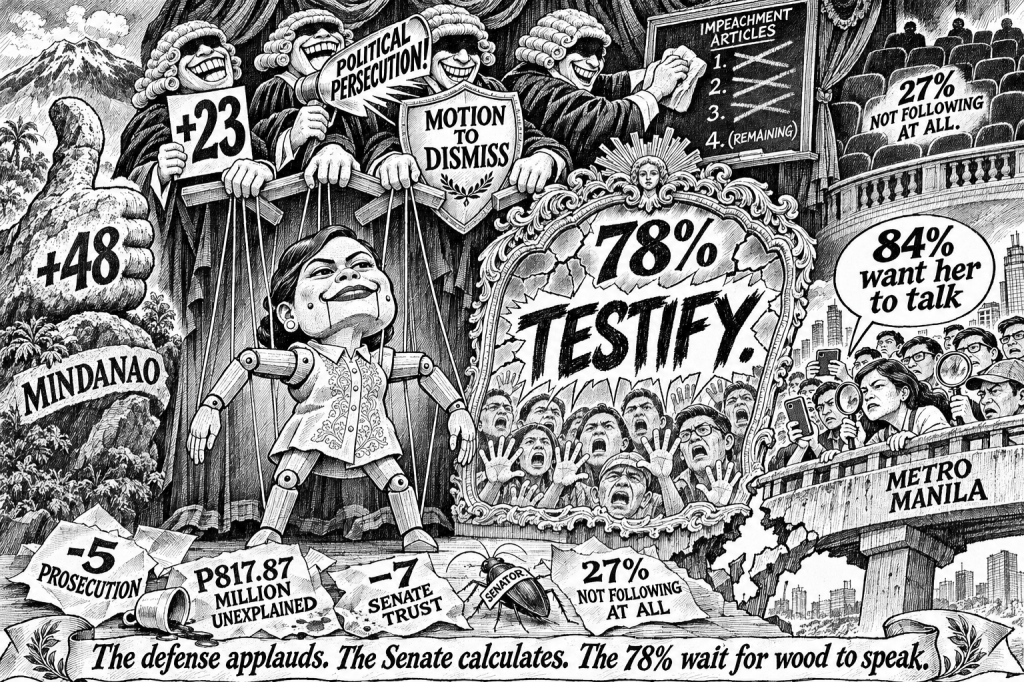
A deep dive into the numbers behind the noise—and why the 78% figure may be the most dangerous data point in Sara Duterte’s political career
By Louis ‘Barok‘ C. Biraogo — November 1, 2026
A Masterclass in Statistical Illusion
The Philippines has just been treated to a masterclass in the art of statistical illusion. The Social Weather Stations (SWS) has released a survey on Vice President Sara Duterte’s impeachment trial, and the headlines have practically written themselves: the defense is winning, the prosecution is floundering, and the public has rendered its verdict on the whole sordid affair.
Except, of course, that the public has done nothing of the kind. What the survey actually reveals is a nation that wants answers, distrusts everyone asking the questions, and has largely stopped paying attention altogether.
The +23 and −5 Ratings: Timing Is Everything
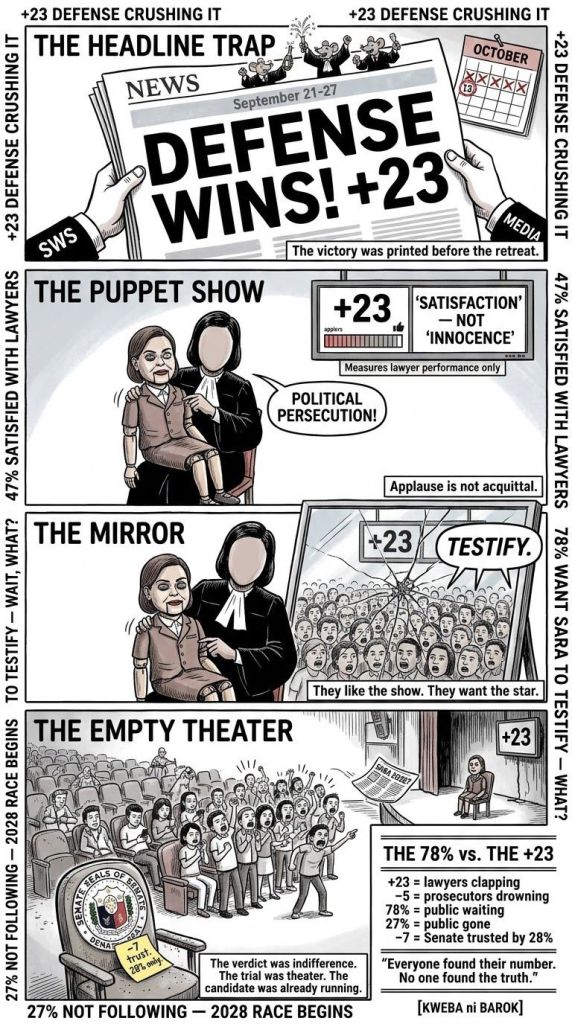
Let us begin with the number that has the commentariat in a swoon: the defense team’s net satisfaction rating of +23, compared with the prosecution’s dismal −5. A twenty-eight-point gap.
The defense is crushing it. The prosecution is toast. Sara Duterte has won the war for public opinion.
Except—and this is the kind of detail that tends to get buried beneath the triumphant press releases—the survey was conducted from September 21 to 27. The prosecution did not withdraw three of its four impeachment articles until October 13.
The public was not reacting to a prosecution that had abandoned most of its case. It was reacting to a prosecution that still had four charges on the table.
The chronology here is not a minor methodological footnote. It is the entire ballgame. To claim that these numbers reflect public judgment on the prosecution’s strategic retreat is to commit an act of temporal fraud so brazen that one almost admires the audacity.
What Net Satisfaction Actually Measures
But the timing is merely the first layer of the onion. Consider what the survey actually measures. The +23 defense rating does not mean that 47 percent of Filipinos believe Sara Duterte is innocent.
It means that 47 percent are satisfied with how her lawyers have performed. These are not remotely the same thing. One can believe a client is guilty as sin and still admire the cut of her advocate’s jib.
The survey question measures applause, not acquittal. And yet the defense camp and its amen corner in the commentariat have conflated the two with a zeal that would make a Madison Avenue flack blush.
The Real Story: 78 Percent Want Her to Testify
Now let us turn to the finding that ought to be the real story, the one that has been politely elbowed aside in the rush to crown the defense team: seventy-eight percent of Filipinos believe Sara Duterte should personally testify. Fifty-nine percent consider it “definitely important.”
This is not a narrow preference. It is a thundering demand. And it cuts directly against the narrative that the public has already decided the vice president is the victim of a political witch hunt.
Think about this for a moment. The same survey that shows the defense lawyers basking in public approval also shows that nearly four in five Filipinos want their client to stop hiding behind those lawyers and answer the charges herself.
The public is saying, in effect: Your mouthpieces are doing a fine job, but we want to hear it from you. This is not the language of a populace that has concluded the accusations are baseless. It is the language of a populace that suspects the opposite, or at least suspects that something is being concealed.
Who Is Actually Following the Trial?
And here is where the survey’s most inconvenient finding for the defense emerges: only 42 percent of Filipinos are following the trial closely or somewhat closely. Twenty-seven percent are not following it at all. Twenty-one percent are following it “just a little.”
The 78 percent who want Duterte to testify are not, by and large, a jury of highly informed citizens who have pored over the forensic accounting testimony and the Anti-Money Laundering Council (AMLC) reports. They are people who have caught headlines, seen snippets on television, scrolled past social media posts, and formed an impression.
That impression—that the vice president should explain herself—is a demand for transparency, not a verdict on guilt. But it is no less politically potent for being underinformed.
Mindanao vs. Metro Manila: A Regional Divide
The regional breakdown offers its own instructive comedy. Mindanao, the Duterte family’s ancestral fiefdom, delivers a defense net satisfaction of +48. Metro Manila, the cynical, sophisticated, perpetually disappointed capital, gives the defense a mere +6 and wants Duterte to testify at a rate of 84 percent.
One might be tempted to see in this a tale of regional loyalty versus urban skepticism. But there is a more parsimonious explanation: in Mindanao, the Duterte name is still worth something.
In Manila, it is worth considerably less. This is not political analysis. It is brand recognition.
Why the Prosecution Struggled to Communicate
The prosecution’s −5 rating has been treated as a damning indictment of its competence. Perhaps it is. But consider the prosecution’s assignment.
It had to explain, to a public with limited attention and even less patience for forensic accounting, a case involving allegedly undeclared bank balances of roughly P207.7 million, undeclared income of P111.85 million, and a total alleged unexplained wealth figure of P817.87 million. It had to do this against a defense team that could simply say “political persecution” and watch the applause roll in.
The prosecution’s failure to communicate is real, but it is not mysterious. Technical complexity is a political liability, and the prosecution drowned in its own spreadsheets.
The October 13 Withdrawal
Then there is the prosecution’s own strategic self-immolation. On October 13, it withdrew three of four articles—confidential funds, bribery, and grave threats—leaving only unexplained wealth. The prosecution’s explanation was that the remaining charge was sufficient.
The political explanation is that the others were becoming liabilities. Either way, the withdrawal handed the defense a gift: the argument that the prosecution itself did not believe its own case.
The survey, conducted weeks before this retreat, cannot tell us how the public reacted to it. But the retreat’s timing—after the survey, before the trial’s resumption—suggests a prosecution that is either strategically disciplined or politically terrified. The survey cannot adjudicate between these possibilities.
The Senate Trust Deficit
Perhaps the most quietly devastating finding in the entire survey is buried in the SWS report on institutional trust. Net trust in the Senate to make a fair decision is −7. Twenty-eight percent express much trust.
Thirty-five percent express little trust. Thirty-two percent are undecided. The body that will decide Sara Duterte’s political fate is held in lower esteem than the prosecution it will judge.
This is the survey’s true bombshell, and it has nothing to do with Sara Duterte. It is that the institution constitutionally tasked with rendering an impartial verdict is itself viewed with suspicion by a plurality of the public.
The 51 percent who say they would accept the Senate’s verdict are not expressing confidence in the Senate. They are expressing resignation to it. There is a difference between legitimacy and inevitability, and the survey suggests the Senate is banking on the latter while pretending to possess the former.
Caveats and the Weaponization of Numbers
The survey’s authors, to their credit, have been scrupulous about caveats. The margin of error is ±3 percentage points nationally, higher regionally. The survey is non-commissioned, which strengthens its independence.
The questions measure perceptions, not facts. But scrupulousness has never stopped political actors from weaponizing numbers, and it will not stop them now.
The defense will cite the +23 and ignore the 78 percent. The prosecution will cite the 78 percent and ignore the −5. The Senate will cite the 51 percent acceptance figure and ignore the −7 trust rating.
Everyone will find the number that suits them, and the Philippine public will be left exactly where it started: waiting for answers that no one seems willing to provide.
The 2028 Calculus: Testify or Stay Silent
And what of Sara Duterte herself? She has already announced her intention to run for president in 2028.
The impeachment trial is not merely a legal proceeding. It is the opening act of a presidential campaign. Her defense team’s public relations advantage is an asset.
But the 78 percent who want her to testify is a warning. If she refuses, she hands the prosecution a narrative of evasion that will follow her into the campaign. If she testifies, she risks contradictions, admissions, and the kind of unscripted moments that no amount of legal preparation can anticipate.
The survey has given her a choice: transparency or defiance. The public has already indicated which it prefers. Whether she listens is another matter entirely.
A Mirror Held Up to Philippine Politics
In the end, the SWS survey is less a snapshot of public opinion than a mirror held up to a political system that has learned to function without public trust. The defense is winning the public relations battle because the prosecution is losing it. The prosecution is losing it because the case is complicated and the public is distracted.
The public is distracted because the trial is slow, the institutions are suspect, and the outcome feels predetermined by political arithmetic rather than evidence. And the Senate, which will ultimately decide, is trusted by barely more than a quarter of the people it is supposed to serve.
This is not a story about Sara Duterte’s guilt or innocence. It is a story about a country that has grown so accustomed to political theater that it can no longer distinguish between performance and accountability.
The survey’s most honest finding is not the +23 or the −5 or even the 78 percent. It is the 27 percent who are not following the trial at all. They have already rendered their verdict, and it is indifference.
The rest of us are still waiting for someone to testify.
Key Citations
A. Reports & Studies
- Social Weather Stations. “Net Satisfaction with the Prosecution of the Impeachment Case at −5, with the Defense of Vice President Sara Duterte at +23.” SWS Social Weather Report, sws.org.ph/social-weather-report-net-satisfaction-with-the-prosecution-of-the-impeachment-case-at-5-with-the-defense-of-vice-president-sara-duterte-at-23/.
- Social Weather Stations. “42% of Adult Filipinos Follow Closely the Senate Impeachment Trial of Vice President Sara Duterte.” SWS Social Weather Report, sws.org.ph/social-weather-report-42-of-adult-filipinos-follow-closely-the-senate-impeachment-trial-of-vice-president-sara-duterte/.
B. News Articles
- “SWS: Sara Duterte’s Defense Gets Higher Net Satisfaction than Prosecution.” GMA News Online, gmanetwork.com/news/topstories/nation/1007545/sws-sara-duterte-s-defense-gets-higher-net-satisfaction-than-prosecution/story/.
- “SWS: 78% Want Sara to Testify; Defense Rates Higher than Prosecution.” Daily Tribune, 29 Oct. 2026, tribune.net.ph/2026/10/29/sws-78-want-sara-to-testify-defense-rates-higher-than-prosecution.
- Magadia, Carl. “Testify, Sara Told by 8 of 10 Pinoys.” Daily Tribune, 29 Oct. 2026, tribune.net.ph/2026/10/29/testify-sara-told-by-8-of-10-pinoys.
- Mateo, Janvic. “Poll: Only 28% See Fair Ruling in VP Impeachment.” The Philippine Star, 24 Oct. 2026, philstar.com/headlines/2026/10/24/2565341/poll-only-28-see-fair-ruling-vp-impeachment.
- “Impeach Court Grants Prosecution Bid to Drop 3 of 4 Charges vs VP Sara.” The Philippine Star, 13 Oct. 2026, https://www.philstar.com/headlines/2026/10/13/2562940/impeach-court-grants-prosecution-bid-drop-3-4-charges-vs-vp-sara.
- Villanueva, Brooke. “Prosecution Withdraws 3 Impeachment Articles vs Sara Duterte.” Philstar Life, 13 Oct. 2026, philstarlife.com/amp/article/782399-prosecution-withdraws-articles-impeachment-trial-duterte.
- “Sara Duterte Trial Recap, Oct. 9: Unexplained Wealth Pegged at P818 Million.” The Philippine Star, 10 Oct. 2026, philstar.com/headlines/2026/10/10/2562247/sara-duterte-trial-recap-oct-9-unexplained-wealth-pegged-p818-million.
- “VP Sara Unexplained Wealth at P817M—Witness.” Daily Tribune, 9 Oct. 2026, tribune.net.ph/2026/10/09/vp-sara-unexplained-wealth-at-p817m-witness.
- Valderama, Tita C. “Week 14, Impeachment Trial: Sara Duterte’s Alleged P818M Undeclared Assets and Unexplained Wealth.” VERA Files, 11 Oct. 2026, verafiles.org/articles/week-14-impeachment-trial-sara-dutertes-alleged-p818m-undeclared-assets-and-unexplained-wealth.
- “Philippine VP Sara Duterte Announces Run for President in 2028.” Al Jazeera, 18 Feb. 2026, aljazeera.com/news/2026/2/18/philippine-vp-sara-duterte-announces-run-for-president-in-2028.
C. Official Websites
- The 1987 Constitution of the Republic of the Philippines. The LawPhil Project, lawphil.net/consti/cons1987.html.
- Anti-Money Laundering Council. Republic of the Philippines, amlc.gov.ph.
- Social Weather Stations. sws.org.ph.
- ₱9 Billion in ‘Savings’? DILG’s Fire Truck Deal Smells Like Smoke

- ₱8B BBM Pork: CCTV for Every Captain’s Kumpare?

- ₱8.9 Billion, 331 Ghost Police Stations: The TIKAS Scandal Explained

- ₱8.4 Billion, 42,000 Barangays, 1 Election: The “Bawat Barangay Makikinabang” Vote-Buying Masterclass

- ₱75 Million Heist: Cops Gone Full Bandit

- ₱63 to the Dollar: The Only Thing Falling Faster Than the Peso Is the Government’s Credibility

- ₱6.77B Ghost Haunts Duterte: RTC Dismisses Mans Carpio’s Desperate Plea
- ₱6.77 Billion and Zero Cash: The Sara Duterte SALN Math That Doesn’t Add Up

- ₱6.7-Trillion Temptation: The Great Pork Zombie Revival and the “Collegial” Vote-Buying Circus

- ₱58.53B, Zero Receipts: The LGSF Pork Barrel Nobody Wants to Name
- ₱53 Million Man Tells ₱695-a-Day Workers to Stop Being ‘Mayabang’: The Audacity of BSP’s Remolona
- ₱4.4 Billion and a Witness Who Can’t Explain It: The Duterte Impeachment’s Most Expensive Non-Answer




Leave a Reply