Padilla and Go Asked for Sixteen. The Senate Said Fourteen. The Court Said: Prove It
By Louis “Barok” C. Biraogo — November 2, 2026
SOMEWHERE in the 1987 Constitution, a sentence is weeping quietly into its footnotes.
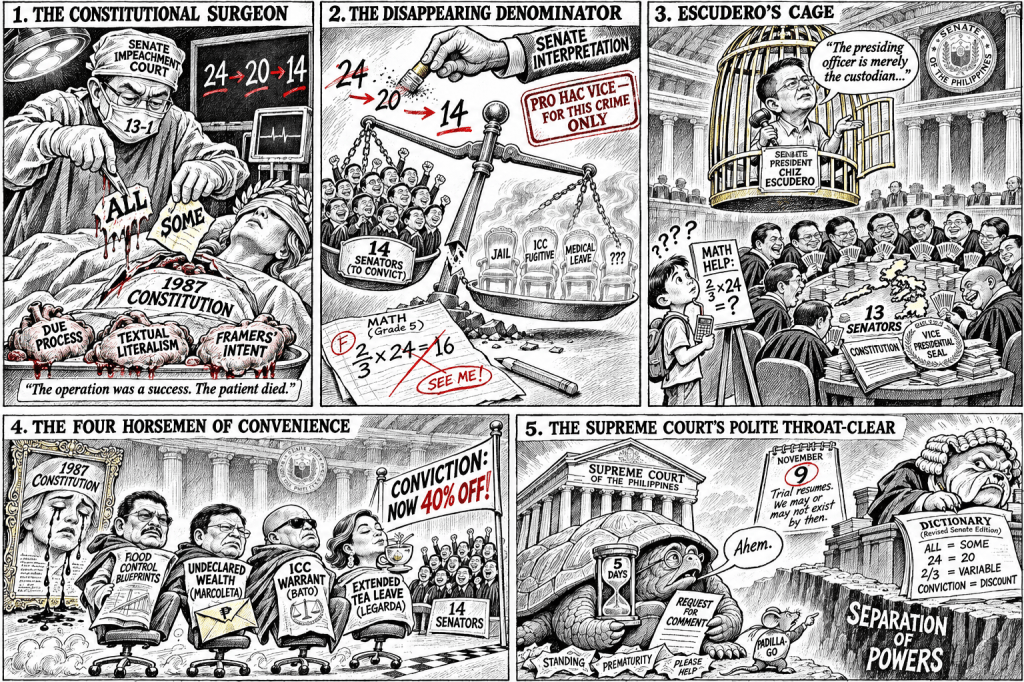
The 1987 Constitution says—and I’m quoting here, because apparently this is now a controversial act of textual literalism—that “no person shall be convicted without the concurrence of two-thirds of all the Members of the Senate”. Twenty-four senators. Two-thirds of twenty-four. That’s sixteen.
This is not advanced calculus. This is the kind of math that a reasonably motivated fifth-grader could handle with a calculator and a juice box.
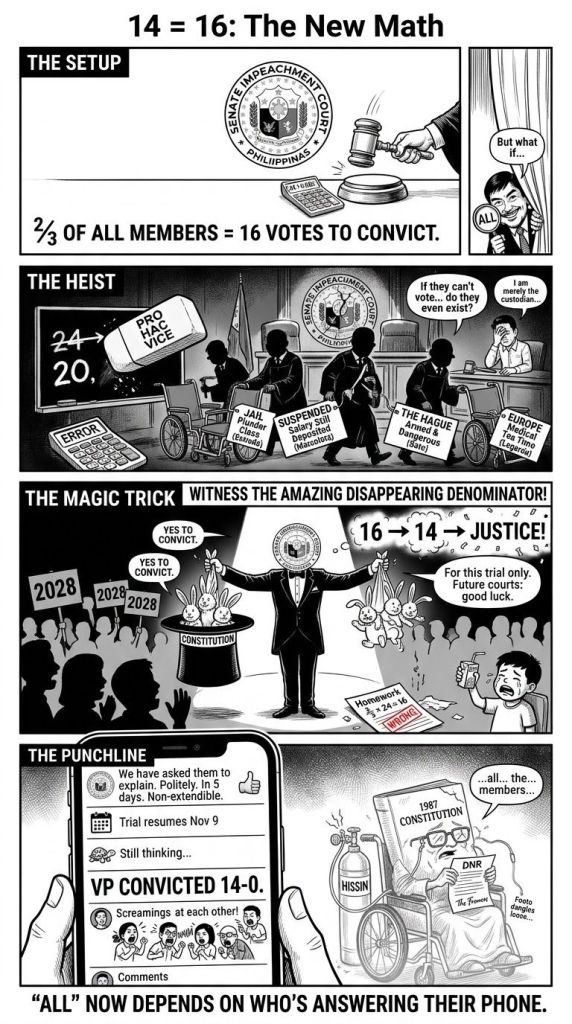
And yet, on September 23, 2026, the Senate impeachment court looked at that sentence and decided that “all the Members” actually means “some of the Members, specifically the ones we can find, minus the ones who are hiding, detained, or apparently in France”. By a 13–1 vote, with six senators conspicuously abstaining, the court conjured a new denominator: twenty. Two-thirds of twenty is 13.33, which they generously rounded up to fourteen because apparently fractions are also now subject to senatorial discretion.
Fourteen votes to convict a Vice President. Fourteen votes to overturn the will of 32 million voters. Fourteen votes, because four senators are otherwise occupied—two in jail on plunder charges, one hiding from the International Criminal Court (ICC), and one who has been “medically incapacitated” in Europe for so long that even the Ombudsman is raising an eyebrow.
This is not constitutional interpretation. This is a heist movie with a legal degree.
The Math Is Not the Problem. The Timing Is Everything.
Let’s be clear about what actually happened here. The Senate didn’t discover some profound jurisprudential insight about the functional versus formal meaning of “membership.” They did the math, counted the votes, and realized that sixteen was going to be a problem. So they changed the math.
The timeline is instructive. On July 6, Presiding Officer Chiz Escudero ruled that sixteen votes were required. This was the boring, literal, textbook interpretation. For two months, the trial proceeded under that assumption.
Then, on September 8, Senator Erwin Tulfo—for reasons that remain shrouded in the kind of mystery that usually requires a subpoena—challenged the interpretation. Two weeks later, the court flipped. Thirteen to one.
Escudero, to his credit, voted against the change. He then delivered a statement so laden with institutional resignation that it practically came with a resignation letter: “The presiding officer, after all, is not the court. He is merely the custodian of the process, not the proprietor of its outcome”. Translation: I know this is wrong, but I’m not going to stop it.
The court also made sure to limit the ruling pro hac vice—for this occasion only. They explicitly said it would not bind future impeachment courts. If you have to announce that your constitutional interpretation only applies to one specific trial involving one specific person, you are not interpreting the Constitution. You are writing a fan fiction and hoping nobody notices.
The Four Horsemen of the Denominator
Let’s meet the senators whose absence conveniently lowered the bar for conviction.
- Jinggoy Estrada is detained on plunder charges involving ₱573 million in flood control kickbacks. His father was impeached. He himself was convicted then acquitted on reconsideration. The Estrada family’s relationship with the criminal justice system is less a legal saga than a recurring subscription service.
- Rodante Marcoleta is detained on plunder charges over ₱75 million in undeclared campaign donations. He was suspended for ninety days. He is also, per Senate practice, apparently still collecting staff salaries while in jail.
- Bato dela Rosa is a fugitive from the ICC, hiding from a crimes-against-humanity warrant related to the drug war, with a ₱50 million bounty on his head. He is described by the Interior Secretary as “armed and dangerous”. He is also, constitutionally speaking, still a senator.
- Loren Legarda is on “extended medical leave” abroad. The Ombudsman called the repeated extensions “quite suspicious.” She rejected the characterization, insisting she followed Senate rules. I’m sure the timing is purely coincidental and has nothing to do with the fact that her absence mathematically benefits the prosecution.
Three of these four senators face serious criminal charges. The fourth has been conveniently unavailable for months. The Senate’s new rule doesn’t ask why they’re absent. It just counts the empty chairs and moves on.
The Supreme Court Enters the Chat (Cautiously)
On October 14, the Supreme Court ordered the Senate and House to comment on a petition filed by Senators Robin Padilla and Bong Go challenging the new threshold. This is the judicial equivalent of a polite throat-clearing. The Court did not grant due course. It did not issue a Temporary Restraining Order (TRO). It did not stop the trial. It simply asked the respondents to explain themselves.
This is either judicial prudence or judicial cowardice, depending on your tolerance for institutional self-preservation. The Court has already dismissed three earlier petitions on standing and prematurity grounds. It knows that intervening in an impeachment trial is a political minefield. It also knows that not intervening when the Senate appears to have rewritten a constitutional requirement is an abdication of its own mandate.
The Padilla-Go petition has a stronger standing argument because they are sitting senators whose institutional powers are directly affected. But the Court’s five-day, non-extendible deadline is not a ruling. It’s a request for the Senate to incriminate itself in writing.
What the Constitution Actually Says (For Those Keeping Score)
Article XI, Section 3(6) does not say “two-thirds of senators present.” It does not say “two-thirds of senators participating.” It does not say “two-thirds of senators we can locate.” It says “two-thirds of all the Members of the Senate.”
The framers knew how to write quorum requirements. Article VI, Section 16 explicitly refers to a majority of each House. They chose different language for impeachment conviction. That choice was deliberate.
The Senate’s defense—that the Constitution’s “purpose” requires counting only functional members—is not an interpretation. It is an amendment. And Article XVII tells us how amendments happen: three-fourths vote of Congress or a constitutional convention. Not a 13–1 vote of an impeachment court at 9 PM on a Wednesday.
Former Chief Justice Adolfo Azcuna, who actually helped write the 1987 Constitution, reportedly testified that sixteen votes are required. The Senate chose to listen to three other retired justices who said otherwise. I’m sure that was a purely intellectual exercise and not at all related to the fact that their interpretation produced a more convenient number.
The Real Stakes: 2028
Let’s not pretend this is about constitutional text. This is about the 2028 presidential election.
Sara Duterte is the most popular opposition figure in the country. A conviction—even under a lowered threshold—would disqualify her from public office. An acquittal would make her a martyr and probably boost her numbers. The Marcos administration has every incentive to see her removed. The Duterte camp has every incentive to see the trial collapse.
The prosecution has already withdrawn three of the four impeachment articles, leaving only the unexplained wealth charge. The defense begins presenting evidence on November 9. The trial may run through December. The Supreme Court may or may not rule before then.
If the Court rules after a conviction under the fourteen-vote rule, we have a constitutional crisis. If the Court rules after an acquittal, the issue becomes moot and the Senate’s interpretation stands unchallenged. If the Court rules before the final vote, everyone has to pretend they were going to follow the law all along.
The smart money says the Court will find a procedural off-ramp. It always does.
The Bottom Line
The Senate impeachment court did not “interpret” the Constitution on September 23. It performed surgery on it, removed the inconvenient parts, and stitched the patient back together with a note saying “this is fine.”
Fourteen votes to remove a Vice President. Fourteen votes because two senators are in jail, one is hiding from The Hague, and one is presumably sipping tea in Europe while the Ombudsman seethes.
If the Supreme Court lets this stand, it has effectively ruled that constitutional thresholds are advisory. If it strikes it down, it faces the wrath of a Senate that believes its “sole power to try and decide” means “sole power to do whatever we want.”
Either way, the Republic survives—bruised, cynical, and deeply aware that the phrase “all the Members” now depends entirely on who’s answering their phone.
I’ll be watching the November 9 resumption with the enthusiasm of a man who has seen this movie before and knows the ending is probably disappointing.
Key Citations
A. Legal & Official Sources
- Aldea Generillo, Catalino, Jr. v. Senate of the Philippines. G.R. No. 278311, Supreme Court of the Philippines, 22 Apr. 2026. Supreme Court E-Library, https://elibrary.judiciary.gov.ph/thebookshelf/showdocs/1/70395.
- “Press Briefer: September 30, 2026.” Supreme Court of the Philippines, 30 Sept. 2026, https://sc.judiciary.gov.ph/press-briefer-september-30-2026/.
- “The 1987 Constitution of the Republic of the Philippines.” Official Gazette of the Republic of the Philippines, n.d., https://www.officialgazette.gov.ph/constitutions/1987-constitution/.
- “Legarda Rejects Ombudsman’s ‘Suspicious’ Remark on Medical Leave.” Senate of the Philippines eClips, 18 Aug. 2026, https://eclips.senate.gov.ph/congress/legarda-rejects-ombudsmans-suspicious-remark-on-medical-leave.
- “Pro Hac Vice.” Legal Information Institute, Cornell Law School, https://www.law.cornell.edu/wex/pro_hac_vice.
B. News Articles
- Bacelonia, Wilnard. “Senate Court Drops Fixed 16-Vote Threshold in VP Trial.” Philippine News Agency, 23 Sept. 2026, https://www.pna.gov.ph/index.php/articles/1284670.
- —. “VP Sara Impeachment Trial May Run through December – Gatchalian.” Philippine News Agency, 27 Oct. 2026, https://www.pna.gov.ph/article/vp-sara-impeachment-trial-may-run-through-december-gatchalian.
- “House Prosecution Hopes to See VP Impeach Decision by Nov or Early Dec.” Philippine News Agency, 19 Oct. 2026, https://www.pna.gov.ph/article/house-prosecution-hopes-to-see-vp-impeach-decision-by-nov-or-early-dec.
- “House to Comply with SC Order on Impeachment Vote Threshold.” Philstar.com, 1 Nov. 2026, https://www.philstar.com/headlines/2026/11/01/2567009/house-comply-sc-order-impeachment-vote-threshold.
- “Marcoleta, Estrada Suspensions ‘On Hold.’” Daily Tribune, 25 Oct. 2026, https://tribune.net.ph/2026/10/25/marcoleta-estrada-suspensions-on-hold.
- “Philippines’ Bounty on ‘Bato’ Dela Rosa Exposes Marcos’ Dilemma in Duterte Feud.” South China Morning Post, 26 Oct. 2026, https://www.scmp.com/week-asia/politics/article/3372324/philippines-bounty-bato-dela-rosa-exposes-marcos-dilemma-duterte-feud.
- “Philippine Drug War Enforcer Says Bounty Puts Life in Danger.” The Star, 29 Oct. 2026, https://www.thestar.com.my/aseanplus/aseanplus-news/2026/10/29/philippine-drug-war-enforcer-says-bounty-puts-life-in-danger.
- Reganit, Jose Cielito. “Prosecution to Keep Building Case vs VP Sara amid Threshold Ruling.” Philippine News Agency, 23 Sept. 2026, https://www.pna.gov.ph/index.php/articles/1284706.
- “Sandiganbayan Suspends Marcoleta as Senator for 90 Days.” Manila Standard, 19 Oct. 2026, https://manilastandard.net/news/crime-courts/314807813/sandiganbayan-suspends-marcoleta-as-senator-for-90-days.html.
- “SC Orders Congress to Respond to Challenge on Sara Impeachment Voting Rule.” Daily Tribune, 29 Oct. 2026, https://tribune.net.ph/2026/10/29/sc-orders-congress-to-respond-to-challenge-on-sara-impeachment-voting-rule.
- “Supreme Court Dismisses Petitions Challenging Impeachment Vote Threshold.” Daily Tribune, 30 Sept. 2026, https://tribune.net.ph/2026/09/30/supreme-court-dismisses-petitions-challenging-impeachment-vote-threshold.
- ₱9 Billion in ‘Savings’? DILG’s Fire Truck Deal Smells Like Smoke

- ₱8B BBM Pork: CCTV for Every Captain’s Kumpare?

- ₱8.9 Billion, 331 Ghost Police Stations: The TIKAS Scandal Explained

- ₱8.4 Billion, 42,000 Barangays, 1 Election: The “Bawat Barangay Makikinabang” Vote-Buying Masterclass

- ₱75 Million Heist: Cops Gone Full Bandit

- ₱63 to the Dollar: The Only Thing Falling Faster Than the Peso Is the Government’s Credibility

- ₱6.77B Ghost Haunts Duterte: RTC Dismisses Mans Carpio’s Desperate Plea

- ₱6.77 Billion and Zero Cash: The Sara Duterte SALN Math That Doesn’t Add Up

- ₱6.7-Trillion Temptation: The Great Pork Zombie Revival and the “Collegial” Vote-Buying Circus

- ₱58.53B, Zero Receipts: The LGSF Pork Barrel Nobody Wants to Name

- ₱53 Million Man Tells ₱695-a-Day Workers to Stop Being ‘Mayabang’: The Audacity of BSP’s Remolona

- ₱4.4 Billion and a Witness Who Can’t Explain It: The Duterte Impeachment’s Most Expensive Non-Answer





Leave a Reply