How the Palace Turned External Shocks into an Excuse for Ghost Beneficiaries, Token Subsidies, and Constitutional Chaos
By Louis ‘Barok‘ C. Biraogo — November 2, 2026
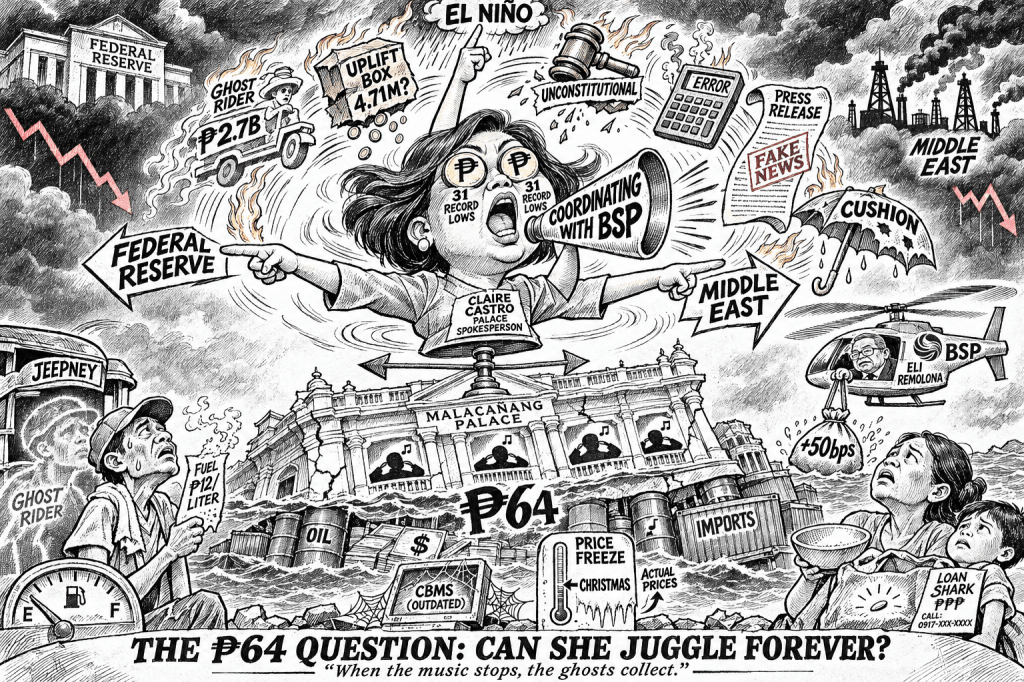
LET us begin with genuine appreciation. Claire Castro has mastered the meteorological explanation for economic failure. Peso sinking? Middle East. Inflation eating budgets? The Federal Reserve. Balance of payments bleeding? Geopolitical tensions.
Elegant in its simplicity: attribute every domestic vulnerability to an external shock, and you never answer for the decades of policy choices that made the country so exquisitely sensitive to those shocks.

The Arithmetic the Palace Would Rather You Skip
But here is the arithmetic the Palace would prefer you not perform. The peso set 31 record lows in 2026 before breaching ₱64 to the dollar. Inflation hit 7.2 percent in September, well above the Bangko Sentral ng Pilipinas (BSP)‘s 2-4 percent target. The current account deficit is projected at $19.1 billion, or 3.8 percent of Gross Domestic Product (GDP). Gross international reserves slid to a three-year low of roughly $100 billion, down over eight percent year-on-year.
These are not abstractions. They determine whether a jeepney driver can afford diesel and whether a mother in Tondo can buy rice.
And what is the Palace’s response? A press briefing.
The BSP Independence Shell Game
Yes, Article XII, Section 20 of the 1987 Construction establishes an independent central monetary authority. Yes, RA 7653 (New Central Bank Act) vests exchange-rate policy in the Monetary Board. The Palace cannot legally order Eli Remolona to defend a peso level.
But here is what the Palace can do: articulate a coherent fiscal and structural strategy that reduces import dependence and gives the central bank room to maneuver without being the only adult in the room.
Instead, Castro’s statement that the government is “coordinating with the BSP” is a masterpiece of passive voice. It sounds like action. It is an admission that the executive has outsourced macroeconomic management to an institution it is constitutionally prohibited from controlling.
Meanwhile, the BSP has done the heavy lifting alone, raising rates by 50 basis points to 5.5 percent in October—its fourth consecutive hike—explicitly not to defend the peso but to contain inflation. Remolona has been candid: the central bank intervenes “a little bit” only to prevent inflationary swings, not to prop up a currency level. Translation: the peso is on its own, and so are you.
This is not a criticism of the BSP. It is a criticism of a Palace that treats monetary policy as a spectator sport while distributing cash assistance like a government that has run out of ideas.
The Ghost Rider Economy
Nowhere is the administration’s combination of good intentions and catastrophic execution more visible than in the fuel subsidy program.
The numbers are impressive on paper: over 93,000 Public Utility Vehicle (PUV) drivers received a P10-per-liter subsidy, later raised to P12. Billions were disbursed. Photos were taken.
And then, in a moment of accidental honesty that should have ended several careers, Department of Social Welfare and Development (DSWD) Secretary Rex Gatchalian admitted that approximately P2.7 billion in cash assistance may have been lost to “ghost riders” and duplicate beneficiaries.
Two point seven billion pesos. That is more than the entire annual budget of several government agencies. Money meant for drivers who cannot afford diesel instead reached—what? Fictitious names? Dead people? The same beneficiary registered eleven times across different municipalities?
The Palace’s response was not a forensic audit, not a public accounting, and not a single resignation. It was to continue announcing new tranches.
This is not social protection. It is a patronage delivery system with a social justice veneer. The ghost riders are not a glitch; they are a feature of a disbursement architecture designed for speed and political visibility rather than accuracy and accountability.
UPLIFT: The Acronym That Explains Everything
The flagship Unified Package for Livelihoods, Industry, Food, and Transport—UPLIFT, because of course it needed a feel-good acronym—is a case study in the difference between announcing policy and implementing it.
The DSWD reported ₱9.42 billion distributed to 4.71 million beneficiaries in August. A genuinely substantial figure. Also entirely unverifiable from the outside. How many were already Pantawid Pamilyang Pilipino Program (4Ps) beneficiaries? How many received assistance twice under overlapping programs? How many were excluded for lacking a Community-Based Monitoring System (CBMS) record or a bank account?
The Palace does not say. It says “4.71 million beneficiaries” and expects that to be the end of the conversation.
Here is the question for every congressional hearing until the 2027 budget deliberations: Did the real purchasing power of UPLIFT beneficiaries increase, decrease, or remain flat after accounting for inflation?
If the answer is “we don’t know,” then the program is not social protection. It is a disbursement exercise with a communications strategy.
The Agricultural Assistance Arithmetic
The Department of Agriculture (DA)‘s ₱10-billion Presidential Assistance for Farmers and Fisherfolk is, by the Palace’s own numbers, a masterclass in tokenism.
4.17 million beneficiaries. ₱2,325 each. Total direct payout: approximately ₱9.695 billion.
₱2,325. For a rice farmer cultivating two hectares or less, in a year when diesel has spiked, fertilizer costs have risen with the peso, and El Niño has threatened yields.
This is not agricultural development. This is a rounding error in the household budget of a farmer who needs irrigation, post-harvest facilities, affordable credit, and a functioning value chain—none of which are delivered by a one-time cash transfer arriving months after the planting season was financed by a loan shark.
IBON Foundation‘s critique, which the Palace dismissed as “fake news,” was not that assistance is unwelcome. It is that the assistance is structurally inadequate and politically convenient. The ₱10-billion program was, per IBON, “a new program inserted by Congress” during the budget process—designed for announceability, not agricultural transformation.
And the Palace’s response to this substantive critique was to call it fake news. This is not debate. It is the rhetorical equivalent of putting your fingers in your ears and humming.
The Supreme Court’s October Surprise
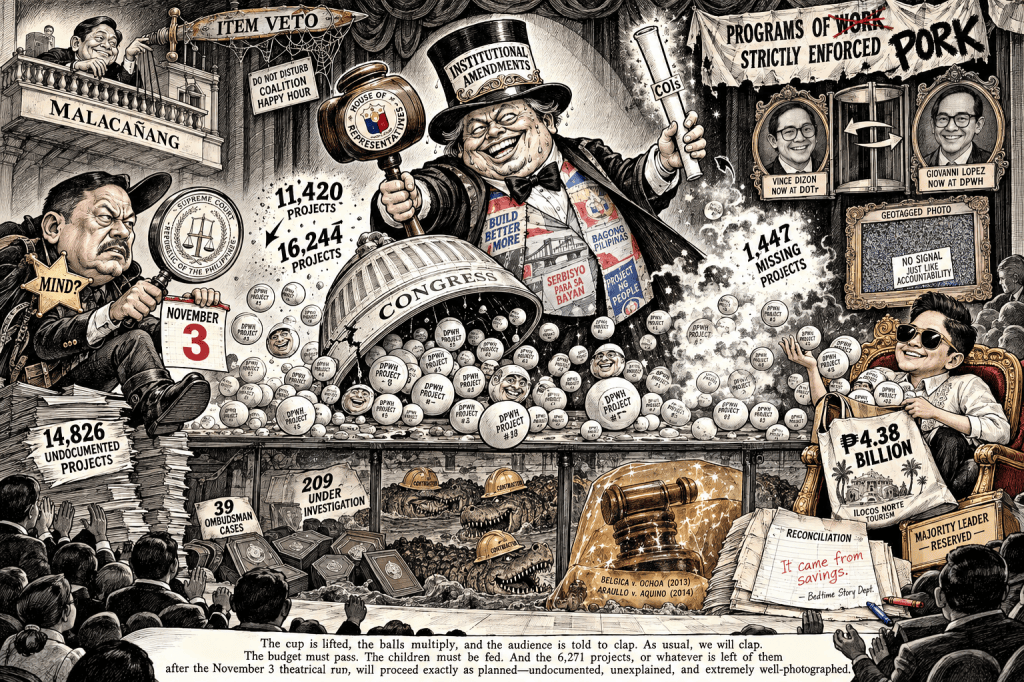
The most interesting development has nothing to do with the peso or the subsidies. It is the Supreme Court’s October 20, 2026 ruling declaring unconstitutional key provisions of the 2024, 2025, and 2026 General Appropriations Acts (GAAs).
The Court voided ₱449.5 billion in unprogrammed appropriations from the 2024 GAA, ₱17.99 billion in Special Road Fund insertions from 2025, and the unprogrammed appropriations provisions of the 2026 budget.
Then, in a doctrinal move that should terrify every official who touched those budgets, the Court held that the doctrine of operative fact “does not automatically shield those who authored, proposed or implemented the invalid provisions.”
Read that again. The Court is saying that the people who inserted unconstitutional appropriations—and the people who implemented them—may be personally liable.
This is not a peso problem. This is a constitutional accountability problem that peso depreciation has conveniently obscured. While the Palace was blaming the Federal Reserve, the Supreme Court was quietly dismantling the fiscal architecture the administration had been using to fund discretionary spending.
And what was the Palace’s response? Solicitor General Darlene Berberabe advised the Department of Budget and Management (DBM) to “withhold for now” implementation of some 2026 programs. Withhold. As in, pause. As in, we’ll get back to you.
This is the same government promising “accelerated government spending” to stimulate the economy. It cannot spend what it has already appropriated because the Supreme Court ruled those appropriations unconstitutional. Its solution is to accelerate spending on projects whose funding is now legally void.
You cannot make this up. Actually, someone probably did make it up, which is precisely the problem.
The Political Economy of Blame
The Marcos Jr. administration inherited an economy with deep structural weaknesses: import dependence, weak agricultural productivity, inadequate infrastructure, and a social protection system better at disbursing than protecting. These weaknesses were decades in the making and are not solely the current occupant’s fault.
But here is what the administration is responsible for: responding to every crisis with a press conference and a cash transfer rather than a structural reform agenda.
The peso’s depreciation is not a natural disaster. It is the market’s assessment of the country’s external position. The current account deficit, the balance of payments (BOP) shortfall, the reserve drawdown—these signal an economy consuming more than it produces, importing more than it exports, borrowing more than it earns.
The Palace’s response is to subsidize consumption and call it economic policy.
Fuel subsidies for drivers. Cash transfers for households. Price freezes for Christmas. Agricultural assistance for farmers. Each measure is individually defensible as short-term relief. Collectively, they constitute a strategy of managing symptoms of a disease the administration refuses to name.
The disease: the Philippines has spent decades building an economy structurally vulnerable to external shocks, and the current administration has no plan to change that.
The Accountability Vacuum
The Palace’s communications strategy is allergic to accountability. Every question about domestic policy failure is redirected to external factors. Every critique is “fake news” or “politics.” Every demand for data is met with a beneficiary count.
The Supreme Court’s ruling has created a legal mechanism for accountability that did not exist before. The doctrine of operative fact, as interpreted by the Court, does not protect officials who implemented unconstitutional budgets. The Ombudsman, the Commission on Audit (COA), and potentially the courts now have a pathway to investigate and prosecute those responsible for the pork-barrel insertions the Court invalidated.
The Palace should be terrified. Instead, it promises to accelerate spending.
What Would Actually Work
If the administration were serious, it would do three things it is not doing.
First, publish a consolidated price and supply dashboard—weekly, granular, independently verifiable—allowing citizens and analysts to distinguish inflation caused by external shocks from inflation caused by domestic supply failures, profiteering, or logistics bottlenecks. The Department of Trade and Industry (DTI)‘s suggested retail prices (SRPs) are not this. They are suggestions, not data.
Second, make every peso of assistance traceable. Beneficiary lists, disbursement dates, regional distributions, audit findings—all public, subject only to the Data Privacy Act‘s narrow exceptions. If the government can find 4.71 million beneficiaries to pay, it can tell the public who they are and whether the money arrived.
Third, stop pretending monetary policy is someone else’s job. The Palace cannot control the BSP. But it controls fiscal, trade, agricultural, and energy policy. It can reduce the import content of domestic production. It can invest in irrigation and post-harvest facilities instead of one-time cash transfers. It can diversify energy sources instead of subsidizing fuel consumption. It can do the unglamorous, structurally transformative work that generates no press release but does generate resilience.
None of these things are happening. Instead, the Palace is coordinating with manufacturers to “encourage” price stability, distributing cash through a system that loses billions to ghosts, and blaming the weather.
The ₱64 Question, Answered
The Palace’s defenders will say the administration cannot be blamed for global oil prices, Federal Reserve policy, or geopolitical tensions. Correct. No Philippine president controls these things.
But the Palace’s critics are not asking the President to control the world. We are asking him to control what he can control: the domestic policies determining how painfully external shocks are transmitted to Filipino households.
On that measure, the record is not mixed. It is consistently compensatory rather than transformative. It treats every crisis as an emergency to be managed rather than a symptom to be addressed. It measures success in beneficiaries reached rather than vulnerability reduced.
The peso may stabilize. Oil may fall. The Fed may pivot. And when that happens, the Palace will declare victory and move to the next press briefing.
But the structural vulnerabilities will remain. Import dependence will remain. Agricultural underinvestment will remain. The disbursement systems that leak billions will remain. The constitutional budget violations will remain, now with a Supreme Court opinion attached.
And the next time the peso depreciates—and there will be a next time—Claire Castro will stand at a podium and explain, with perfect sincerity, that it is all someone else’s fault.
The ₱64 question is not whether the Palace can cushion the peso’s fall. It is whether the Palace has any intention of building an economy that does not need cushioning every time the world sneezes.
The answer, based on the evidence, is no.
Key Citations
A. Reports & Official Data
- “BSP Forecasts BOP Deficit for 2026, 2027.” Philippine Information Agency, 13 Oct. 2026, pia.gov.ph/news/bsp-forecasts-bop-deficit-for-2026-2027/.
- “Consumer Price Index and Inflation Rate: Summary Inflation Report, September 2026.” Philippine Statistics Authority, 5 Oct. 2026, psa.gov.ph/price-indices/cpi-ir?page=3.
B. News Articles
- “BSP: Philippines’ Twin Deficits to Persist on Oil Shocks.” BusinessWorld Online, 13 Oct. 2026, bworldonline.com/top-stories/2026/10/13/786664/bsp-philippines-twin-deficits-to-persist-on-oil-shocks/.
- “External Headwinds Complicate BSP’s Bid to Temper Peso Volatility.” BusinessWorld Online, 28 Oct. 2026, bworldonline.com/top-stories/2026/10/28/789968/external-headwinds-complicate-bsps-bid-to-temper-peso-volatility/.
- “Peso Nears 64-per-Dollar Level on Foreign Pressures.” Manila Standard, 25 Oct. 2026, manilastandard.net/business/314810858/peso-nears-64-per-dollar-level-on-foreign-pressures.html.
- “Peso sa Pilipinas Miabot sa Bag-ong Rekord nga Labing Ubos nga P63.95 Batok sa $1.” Bombo Radyo Gensan, 25 Oct. 2026, gensan.bomboradyo.com/ang-peso-sa-pilipinas-miabot-sa-bag-ong-rekord-nga-labing-ubos-nga-p63-95-batok-sa-1/.
- “Philippine Peso Sinks to 31st Record Low at P63.615.” Philstar.com, 23 Oct. 2026, qa.philstar.com/headlines/2026/10/23/2565242/philippine-peso-sinks-31st-record-low-p63615.
- “PH Payments Position Reverses to Deficit at $1.5B in July 2026.” GMA Network, 19 Aug. 2026, gmanetwork.com/news_duplicate/money/economy/999215/ph-payments-position-reverses-to-deficit-at-1-5b-in-july-2026/story/.
- “Surprise 50-bp Rate Hike.” BusinessWorld Online, 23 Oct. 2026, bworld-x.com/bw_digital/october-23-2026/.
- Oliquino, Edjen. “P2.7B Fuel Subsidy Nearly Lost to Duplicates, Ghost Drivers — Gatchalian.” Daily Tribune, 29 Apr. 2026, tribune.net.ph/2026/04/29/p27b-fuel-subsidy-nearly-lost-to-duplicates-ghost-drivers-gatchalian.
- “OSG Seeks Hold on Use of 2026 Appropriations.” Philstar.com, 23 Oct. 2026, http://www.philstar.com/headlines/2026/10/23/2565121/osg-seeks-hold-use-2026-appropriations.
C. Official Websites & Legal Sources
- 1987 Constitution of the Philippines. Lawphil, lawphil.net/consti/cons1987.html.
- Republic Act No. 7653 (New Central Bank Act). Lawphil, lawphil.net/statutes/repacts/ra1993/ra_7653_1993.html.
- Lagman v. Congress of the Philippines. G.R. Nos. 271059, 271347, E-02472, and E-04036, Supreme Court of the Philippines, 2026, sc.judiciary.gov.ph/g-r-no-271059-g-r-no-271347-g-r-no-e-02472-g-r-no-e-04036/.
- Bangko Sentral ng Pilipinas, bsp.gov.ph.
- Department of Social Welfare and Development, dswd.gov.ph.
- Department of Agriculture, da.gov.ph.
- Supreme Court of the Philippines, sc.judiciary.gov.ph.
- Office of the Ombudsman, ombudsman.gov.ph.
- National Privacy Commission. “Data Privacy Act of 2012.” privacy.gov.ph/data-privacy-act/.
- “Ang Hirap Maging Mahirap”: The PAO Scandal That Proves Government Contempt Is Nothing New
- “Far-Off” My Axx: Malacañang’s Claire Castro Drowns in Her Own Legal Gaslighting
- “Forthwith” to Farce: How the Senate is Killing Impeachment—And Why Enrile’s Right (Even If You Can’t Trust Him)
- “HINDI AKO NAG-RESIGN!”

- “I Know Nothing”: Baste Duterte’s Amnesia Defense Meets ₱33M in GenCorp Contracts
- “I’m calling you from my new Globe SIM. Send load!”

- “Mahiya Naman Kayo!” Marcos’ Anti-Corruption Vow Faces a Flood of Doubt

- “Manageable” Debt, Unmanageable Lies: DBM’s ₱21 Trillion Fairy Tale
- “Meow, I’m calling you from my new Globe SIM!”

- “Natrabaho”: One Word, One Ombudsman, and a Judiciary on Trial
- “No Special Jail for Crooks!” Boying Remulla Slams VIP Perks for Flood Scammers
- “Philippine-Controlled” or Yankee Gas Station? The Davao Fuel Depot Farce Exposed




Leave a Reply