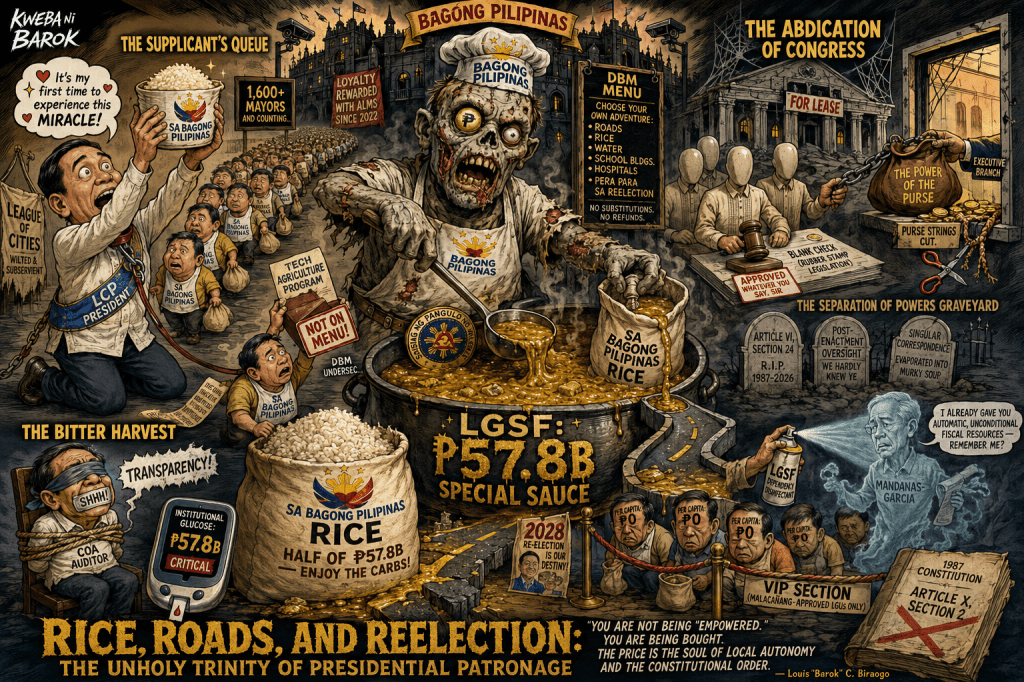
Rice, Roads, and Reelection: The Unholy Trinity of Presidential Patronage
By Louis ‘Barok‘ C. Biraogo — July 22, 2026
Mayor Francis Zamora, the glad-handing president of the League of Cities of the Philippines (LCP), wants you to believe he’s just seen a miracle. “It’s my first time to experience this,” he gushed to reporters in Iloilo, clutching his rice buckets and infrastructure wishlist like a kid who just discovered Christmas. The gift-giver? Malacañang Palace. The present? A P57.87-billion lump of discretionary coal called the Local Government Support Fund (LGSF), delivered directly, efficiently, and without all that pesky congressional oversight gumming up the works.
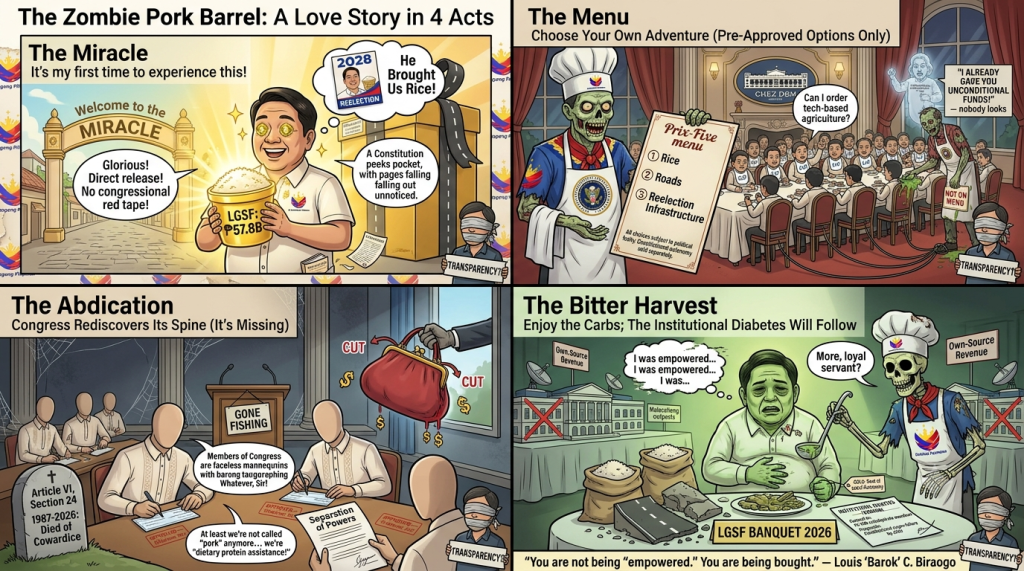
The Zombie Pork Barrel in a “Bagong Pilipinas” Costume
Forgive us if we don’t join the standing ovation. We’ve seen this movie before. It was called the Priority Development Assistance Fund (PDAF), and the Supreme Court burned the reel in 2013’s Belgica v. Ochoa. What’s happening now isn’t local empowerment; it’s the political zombie of the pork barrel system, shambling back to life in a “Bagong Pilipinas” costume.
The 2019 Belgica II ruling may have given the LGSF a clean bill of health on paper, but its current implementation—a toxic cocktail of direct presidential release, a Department of Budget and Management (DBM)-controlled “menu,” and explicit political branding—has metastasized into a de facto Presidential Pork Barrel, resurrecting every constitutional defect the Court thought it had buried.
The Prix-Fixe Menu of Executive Discretion
Let’s start with the legal fiction that this is a programmed fund. The Supreme Court in Belgica II (G.R. No. 210503) upheld the LGSF as a legitimate “programmed Special Purpose Fund” with specific purposes, a far cry from the post-enactment, legislator-controlled PDAF. But look at the implementation.
The DBM’s “menu” from which Local Government Units (LGUs) must choose reads less like a buffet of local choice and more like a prix-fixe meal dictated by the central executive. You can have roads, school buildings, or water systems. Want to invest in a specialized public health initiative or a tech-based agricultural program not on the menu? Too bad.
This isn’t autonomy; it’s a leash dressed up as a lifeline. The 2013 Belgica decision defined an unconstitutional lump-sum by the absence of “singular correspondence”—a specified amount for a specified purpose. When a P57.87 billion pot can be ladled out by Malacañang to a shifting list of projects for 1,600+ LGUs, the singularity evaporates into a murky soup of executive discretion.
The constitutional standard requires Congress, not a DBM undersecretary, to set the specific parameters of an appropriation.
Abdicating the Power of the Purse
This brings us to the most glaring casualty: the separation of powers. Article VI, Section 24 of the 1987 Constitution doesn’t mince words: all appropriation bills must originate from Congress. Yet here, we see the political branches engaging in a coordinated abdication. Congress, eager to secure a slice of political goodwill or simply cowed into submission, has effectively handed the executive a blank check.
The direct release from Malacañang bypasses not just the bureaucratic red tape at the Department of Public Works and Highways (DPWH), as Mayor Zamora celebrates, but the post-enactment oversight that is the legislature’s constitutional duty. This is the reverse of the PDAF evil, but it’s an evil nonetheless.
Instead of legislators meddling in execution, we have the President usurping the power of the purse entirely. The structural check crumbles. Congress, in its eagerness to avoid the “pork” label, has starved itself of its core institutional function.
Rice, Roads, and Political Fealty
And what is this slush fund being used for? Half for rice, half for infrastructure. The political optics are so blatant they’re practically a campaign ad—the same “Sa Bagong Pilipinas” branding stamped on every sack. This isn’t a social welfare program; it’s a patronage delivery system, brilliantly disguised.
The looming question, which the Commission on Audit (COA) should be desperately trying to answer with real-time data, is whether these funds are flowing to LGUs based on need or on political fealty. In the wake of the UniTeam’s collapse and with 2028 on the horizon, is a single opposition stronghold receiving the same per capita windfall as a political ally like San Juan? We demand full transparency, but we already know the answer.
This funding mechanism violates the spirit, if not yet the specific letter, of the equal protection principle cited in Belgica, which condemned the PDAF for making fund access contingent on political connections. A DBM-controlled menu with presidential release is the epitome of such a connection.
The Mandanas-Garcia Reality Check
Mayor Zamora’s self-congratulation also conveniently ignores a fiscal reality check: the Mandanas-Garcia ruling. The Supreme Court’s 2019 decision already massively expanded the National Tax Allotment (NTA) precisely to empower LGUs with automatic, unconditional fiscal resources. So why the need for a separate, conditional P57.87 billion fund administered from Malacañang? The logical answer isn’t a need for more money; it’s a political imperative for more control.
The LGSF is a calculated tool to foster dependency, not autonomy. It conditions local officials to look to the Palace for their projects, turning constitutionally recognized political subdivisions into supplicants. It systematically reverses the principle of fiscal autonomy enshrined in Article X, Section 2 of the 1987 Constitution, in favor of a feudal political economy where loyalty is rewarded with alms.
Glorified Administrative Outposts
Let’s dispense with the euphemisms. Mayor Zamora says this “strengthens” LGUs. It does nothing of the sort. It weakens their fiscal muscles, atrophies their capacity for own-source revenue generation, and transforms them into glorified administrative outposts for Malacañang’s political agenda.
The “menu” system doesn’t build local capacity; it teaches compliance. The direct release mechanism doesn’t foster accountability to constituents; it redirects it upwards to the patron in the Palace, violating the very Republic Act No. 6713 (The Code of Conduct and Ethical Standards for Public Officials and Employees) which demands loyalty to the Constitution and the public interest, not to a political benefactor.
The Bitter Harvest of Selective Amnesia
This is the bitter harvest of our selective amnesia. We eviscerated the PDAF only to resurrect it in a presidential robe. The solutions are clear. Congress must rediscover its constitutional spine, legislate a clear, purpose-specific framework for any such funds, and reassert its oversight authority.
The Supreme Court must be prepared to revisit Belgica II with a fact-specific analysis that sees the corrupt practice through the facially valid law. And to every LGU official being seduced by this river of cash: you are not being “empowered.” You are being bought. The price is the soul of local autonomy and the constitutional order.
Institutional Diabetes
Genuine public service demands a better future for our youth than a system of gilded patronage. It demands not a “menu” of pre-approved projects from a political king, but a blank canvas on which local leaders, funded by their rightful automatic share and accountable to their people, can paint their own vision of progress.
That’s not the Philippines being served up today. What we’re getting is just a very expensive, constitutionally dubious rice delivery. Enjoy the carbs; the institutional diabetes will follow.
Key Citations
A. Legal & Official Sources
- 1987 Constitution of the Republic of the Philippines. Official Gazette of the Republic of the Philippines, 1987, http://www.officialgazette.gov.ph/constitutions/1987-constitution/.
- Belgica v. Ochoa. G.R. No. 208566, Supreme Court of the Philippines, 19 Nov. 2013, lawphil.net/judjuris/juri2013/nov2013/gr_208566_2013.html.
- Belgica v. Executive Secretary (Belgica II). G.R. No. 210503, Supreme Court of the Philippines, 8 Oct. 2019, lawphil.net/judjuris/juri2019/oct2019/gr_210503_2019.html.
- Mandanas v. Ochoa. G.R. No. 199802, Supreme Court of the Philippines, 3 July 2018, lawphil.net/judjuris/juri2018/jul2018/gr_199802_2018.html.
- Republic Act No. 6713. Code of Conduct and Ethical Standards for Public Officials and Employees. Official Gazette of the Republic of the Philippines, 29 Mar. 1989, https://www.officialgazette.gov.ph/1989/02/20/republic-act-no-06713/.
B. News Reports
- “Marcos Orders Release of P58 Billion Local Gov’t Support Fund.” Philippine Daily Inquirer, Inquirer.net, n.d., newsinfo.inquirer.net/2186238/marcos-orders-direct-release-of-p58-billion-local-govt-support-fund.

- ₱8B BBM Pork: CCTV for Every Captain’s Kumpare?
- ₱8.4 Billion, 42,000 Barangays, 1 Election: The “Bawat Barangay Makikinabang” Vote-Buying Masterclass

- ₱75 Million Heist: Cops Gone Full Bandit

- ₱6.77B Ghost Haunts Duterte: RTC Dismisses Mans Carpio’s Desperate Plea
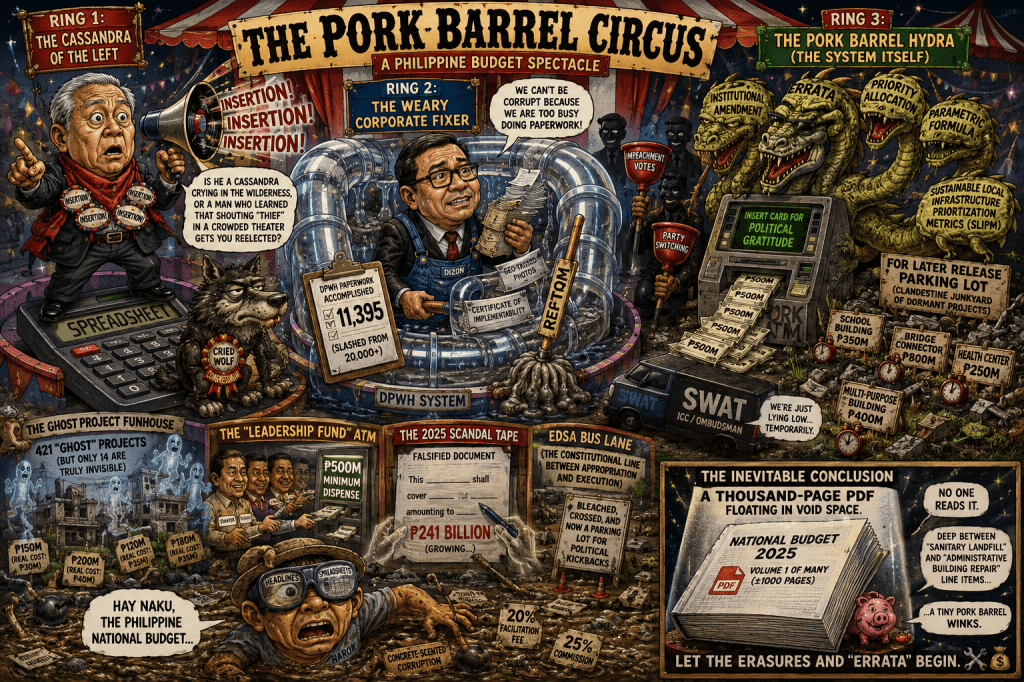
- ₱6.7-Trillion Temptation: The Great Pork Zombie Revival and the “Collegial” Vote-Buying Circus

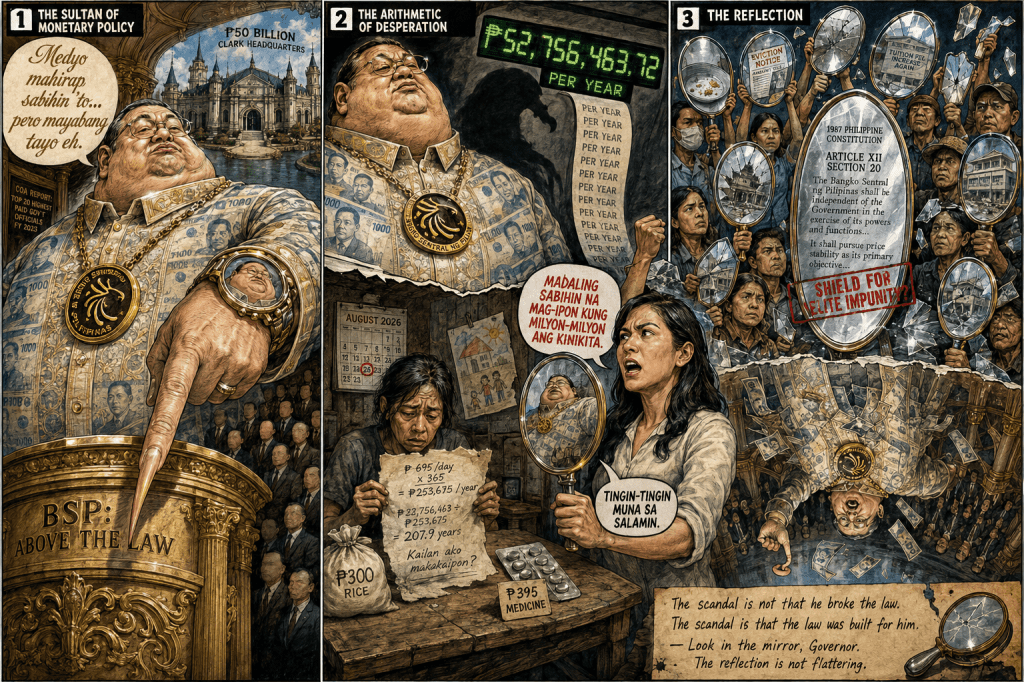
- ₱53 Million Man Tells ₱695-a-Day Workers to Stop Being ‘Mayabang’: The Audacity of BSP’s Remolona
- ₱3.06 Billion for Evacuation Centers—But Nobody Knows Where They’ll Stand (Or If They’ll Exist)
- ₱10B Ghost in New Clark City: Matibag’s Haunted Séance for Cayetano

- ₱1.9 Billion for 382 Units and a Rooftop Pool: Poverty Solved, Next Problem Please

- ₱1.35 Trillion for Education: Bigger Budget, Same Old Thieves’ Banquet

- ₱1 Billion Congressional Seat? Sorry, Sold Out Na Raw — Si Bello Raw Ang Hindi Bumili

- “Your Paperwork Is Wrong”: Sara Duterte’s Epic Non-Answer Defense


 KWEBA ni BAROK
Leave a comment