The Man Who Cried ‘Insertion!’—Why Tinio’s Alarm Bells Sound Suspiciously Like a Broken Record
By Louis ‘Barok‘ C. Biraogo — September 1, 2026
HAY NAKU, the Philippine national budget. That annual, multi-trillion-peso exercise in national aspiration, legislative sleight-of-hand, and the perennial question of whether the Department of Public Works and Highways (DPWH) is an infrastructure agency or a highly sophisticated money-laundering apparatus disguised as one.
It is a time for hope, a time for deliberation, and, if history is any guide, a time for certain individuals to figure out how to extract their 20 to 30 percent “facilitation fee” from the “Build, Build, More” program without ending up on the front page of the Inquirer.
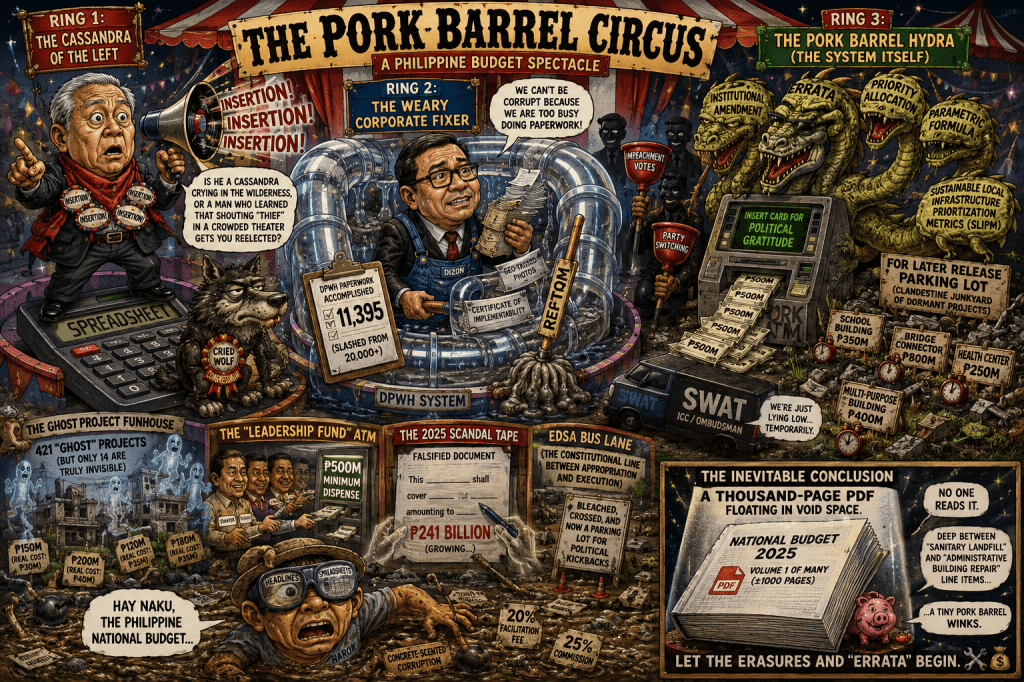
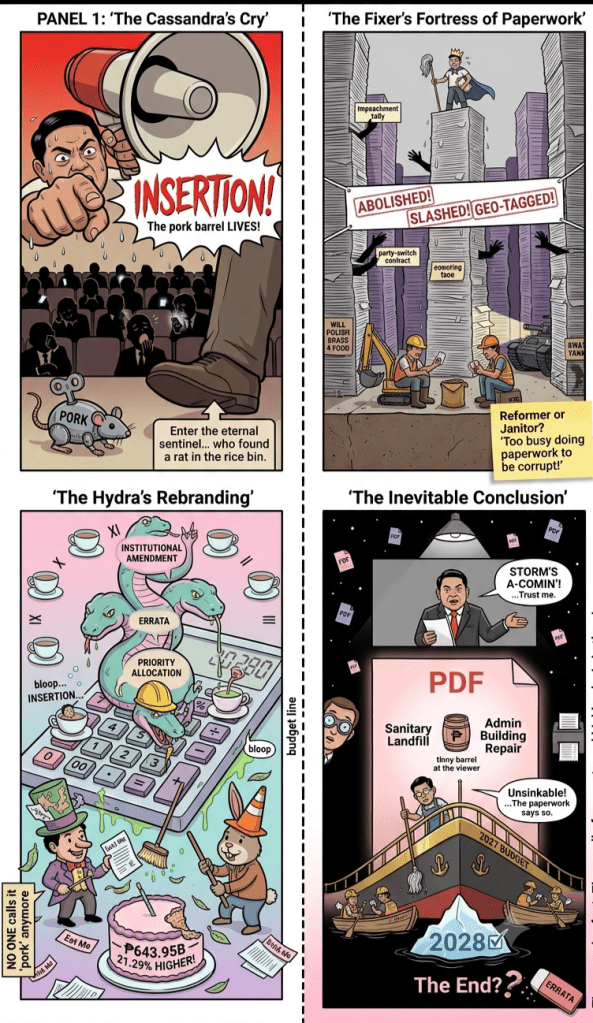
Enter Rep. Antonio Tinio of ACT Teachers, the eternal sentinel of the left, who has once again sounded the alarm with the enthusiasm of a man who has just found a rat in the rice bin.
Tinio warns of a “possible” resurrection of the pork barrel system through “institutional amendments” to the 2027 National Expenditure Program (NEP). He points a trembling finger at the “For Later Release” (FLR) mechanism, suggesting it’s not just a fiscal management tool but a clandestine parking lot for political kickbacks.
One must ask: Is Tinio a Cassandra crying in the wilderness of the Batasang Pambansa, or is he merely a political actor who has learned that shouting “thief” in a crowded theater full of congressmen is a surefire way to get reelected? Let us don our investigative goggles and wade through the muck.
The Legal Fiction of the “Amendment”
The first rule of Philippine budget politics is that no one calls it “pork” anymore. The term has been legally vaccinated by the Supreme Court in Belgica v. Ochoa.
Instead, we engage in semantic gymnastics. “Pork” has been rebranded, Alice in Wonderland-style, into “institutional amendments,” “errata,” or the ever-nebulous “priority allocations.”
Tinio argues that the distinction is meaningless: if it wasn’t in the NEP, and it ends up in the General Appropriations Act (GAA), it’s an insertion. Legally, however, he is dead wrong.
The Constitution grants Congress the power of the purse. The House can amend the President’s budget; that is their job.
If Congress were merely a rubber stamp for the Executive’s NEP, we could save billions by replacing the House Appropriations Committee with a photocopier and a man with a rubber stamp.
The Supreme Court in Belgica did not ban “insertions.” It banned the post-enactment control by legislators over the execution of those insertions.
It is the difference between a legislator saying “I vote for this flood control project in my district” versus “I vote for this project, and I will now dictate to Secretary Dizon which contractor gets the check and when the backhoe shows up.”
However, Tinio’s suspicion is not without historical foundation. The ghost of the 2025 scandal looms large.
The testimony of former DPWH Secretary Manuel Bonoan regarding the “Senate Leadership Fund”—a veritable ATM where senators reportedly got a minimum of ₱500 million each—proves that the constitutional line between appropriation and execution has been bleached and crossed so often it resembles the EDSA bus lane at rush hour.
The “parametric formula” used to distribute these funds wasn’t a scientific method for infrastructure gap analysis; it was a mathematical equation for political gratitude.
The “For Later Release” Conundrum
The FLR mechanism is the most intriguing—and suspicious—part of this drama. The Department of Budget and Management (DBM) allows it. It is legal.
But as the saying goes, the road to hell is paved with good intentions and unbudgeted line items.
Why would a project need to be “for later release”? Usually, because the documentary requirements aren’t met at the time of appropriation, or the revenue target is uncertain.
But in the hands of a skilled legislator, FLR is a time bomb. It’s a way to put a project in the law—thereby claiming political credit—while keeping the money inert, waiting for the exact moment when a friendly secretary or a pressured district engineer can be coerced into pushing the button.
Tinio’s argument that this creates a bottleneck is valid. We have data that only 32% of the 17,000+ projects were awarded by Q3 of 2026.
That is not just a delay; that is institutional constipation. Dizon blames stricter post-scandal requirements. Tinio blames the system. They are both right. The system is clogged because for years, it was designed to be a sieve, not a pipeline.
The Dizon Dilemma: Reformer or Janitor?
Secretary Vince Dizon is the man of the hour. He has the air of a weary corporate fixer brought in to salvage a sinking private equity fund.
He claims he has abolished the “leadership funds,” the “allocables,” and the “parametric formula.” He has slashed the project list from 20,000 to 11,395. He demands geo-tagged photos.
He is, in essence, trying to run the DPWH like a real government agency instead of a frat house for contractors.
His counter-argument is strong: “We can’t be corrupt because we are too busy doing paperwork.” The procurement delay he cites is a symptom of applying actual standards to a system that previously ran on a handshake and a brown envelope.
But Dizon serves at the pleasure of the President. And the President serves at the pleasure of the political coalition that keeps him in power.
The pressure to fund the political allies who deliver votes in the House is immense. Will Dizon hold the line against the “institutional amendments,” or will he discover that “strict documentary requirements” are mysteriously waived for the congressman holding the line on the impeachment or the party switching?
The brutal reality of Philippine politics is that infrastructure is the currency of power. A congressman cannot simply rely on his charm and intellectual prowess to get reelected; he needs a new road, a basketball court, or a flood control project (preferably one that actually controls flood, though historically, ghost versions were just as politically acceptable).
The Ghost Project Syndrome: A Cautionary Tale
Speaking of ghost projects, we must address the 421-vs-14 discrepancy. Initially, 421 projects were identified by Senate investigators as “ghost” projects—non-existent infrastructure that ate billions.
The Department of Justice, after actual investigation, validated only 14 as truly non-existent.
This does not mean the investigators were stupid. It means the labeling was lazy. A project that is overpriced, substandard, or redundant is not necessarily a “ghost”; it’s just “pork” or “corruption.”
The conflation of terms is a disservice to the public. It allows defenders of the system to say, “See? There was no massive ghost project scam! It was only 14!” while ignoring the hundreds of projects that were built poorly at three times the cost to generate kickbacks.
This is the classic Filipino legal defense: “Your Honor, my client is not a murderer! He merely shot the man forty-seven times, but the autopsy says the cause of death was lead poisoning, not the defendant.”
Tinio risks falling into the same trap. By shouting “insertion!” at every new line item, he desensitizes the public.
If the House leadership can prove that all new amendments are documented, geo-tagged, and technically sound, Tinio looks like the boy who cried wolf. The opposition must be surgical. You do not fight a monster with a shotgun; you use a scalpel to excise the tumor.
The Verdict on the Warning
Is Tinio a hero? He is performing his constitutional duty. He is raising a risk assessment that is backed by statistical probability and historical precedent.
The 2025 budget scandal involving Speaker Romualdez and the ₱241 billion in insertions was not a myth; it is a recent trauma.
The public has the right to suspect that the legislative vultures are circling the 2027 budget, salivating over the ₱643.95 billion DPWH allocation.
Is Tinio a hypocrite? He is a politician. But unlike many of his colleagues, his party-list group needs a national constituency, not a local one.
He doesn’t need a pork barrel to get elected; he needs headlines. This frees him to be intellectually honest about the system, even if it makes him look obstructionist.
The most likely scenario is that Dizon is largely telling the truth for the 2027 budget. The heat from the 2025 scandal is too intense. The Ombudsman is sniffing around. The International Criminal Court is in the news.
Even the most brazen crooks in Congress know that you don’t rob the bank while the SWAT team is parked outside. The “institutional amendments” Dizon is requesting are likely legitimate technical adjustments to deal with inflation and procurement delays—the fiscal equivalent of fixing a typo in a legal brief.
But this does not mean the system is fixed. It merely means the criminals are lying low.
The structural incentives—the desire for reelection, the need for campaign funds, the culture of patronage—remain fully intact. The “pork barrel system,” as Tinio rightly notes, is the “major bottleneck” to economic development.
But the day Dizon leaves the DPWH, or the day the scandal fades from memory, the “parametric formula” will return, perhaps disguised as “Sustainable Local Infrastructure Prioritization Metrics” (SLIPM).
The Inevitable Conclusion
The 2027 budget will pass. It will have thousands of pages. No one—not the senators, not the media, not even the DBM—will read every single line item in the annexes.
Buried deep within those PDF files, between the allocations for sanitary landfills and the repair of administrative buildings, will be a few things that shouldn’t be there. Whether they are called “institutional amendments” or “pork,” they are the lubricant that keeps the creaky machinery of Philippine democracy moving.
Barok’s advice to Rep. Tinio is simple: Keep shouting. But when you go to the podium, bring a spreadsheet, not just a speech. The public is tired of allegations; they want receipts.
Print out the specific line items. Name the district. Name the contractor who will benefit. If you can’t do that, you’re not a watchdog; you’re just a weatherman forecasting a storm that never arrives.
And to Secretary Dizon: We are watching. You have promised a transparent system. If you fail, you won’t just be remembered as the man who tried to fix the DPWH; you will be remembered as the man who polished the brass on the Titanic while the backhoe operators were still playing cards with the syndicates.
The game is afoot. The smell of concrete and kickbacks is in the air. Let the erasures and “errata” begin.
Key Citations
A. Legal and Official Sources
- Belgica v. Ochoa, G.R. No. 208566. Supreme Court of the Philippines, 19 Nov. 2013, https://jur.ph/jurisprudence/summary/belgica-v-ochoa-57694.
- The 1987 Constitution of the Republic of the Philippines – Article VI. Official Gazette of the Republic of the Philippines, https://www.officialgazette.gov.ph/constitutions/the-1987-constitution-of-the-republic-of-the-philippines/the-1987-constitution-of-the-republic-of-the-philippines-article-vi/.
B. News Articles
- Mangaluz, Jean. “DPWH awards only 32% of projects in 2026 amid bidding delays — Dizon.” GMA News Online, 26 Aug. 2026, https://www.gmanetwork.com/news/topstories/nation/999927/dpwh-awards-only-32-of-projects-in-2026-amid-bidding-delays-dizon/story/.
- Marasigan, Lorenz S. “Flood control returns as DPWH seeks ₱644B budget.” BusinessMirror, 26 Aug. 2026, https://businessmirror.com.ph/2026/08/26/flood-control-returns-as-dpwh-seeks-%E2%82%B1644b-budget/.
- Mendoza, John Eric. “Bonoan: All 2024 senators had at least P500M ‘leadership funds.’” Inquirer.net, 13 Aug. 2026, https://newsinfo.inquirer.net/2283100/bonoan-all-2024-senators-had-at-least-p500-m-leadership-funds.
- Mendoza, John Eric. “Only 14 of 421 ghost flood projects confirmed non-existent, says DOJ.” Cebu Daily News / Inquirer.net, 19 Jan. 2026, https://cebudailynews.inquirer.net/689941/only-14-of-421-ghost-flood-projects-confirmed-non-existent-says-doj.
- de Leon, Dwight. “2025 budget mess: Romualdez, House leaders accused of falsifying documents.” Rappler, 10 Feb. 2025, https://www.rappler.com/philippines/2025-budget-mess-romualdez-house-leaders-accused-of-falsifying-documents/.
- “Marcos admin’s infra budget set at P1.47-T for 2027—DBM.” GMA News Online, 27 Aug. 2026, https://www.gmanetwork.com/news/money/economy/1000028/marcos-admin-s-infra-budget-set-at-p1-47-t-for-2027-dbm/story/.
- Calalo, Arlie O. “DPWH eliminates duplicates, overlaps to cut project count.” The Manila Times, 27 Aug. 2026, https://www.manilatimes.net/2026/08/27/news/dpwh-eliminates-duplicates-overlaps-to-cut-project-count/2413059.
- “2027 budget: Bicam urged to block congressional insertions.” Inquirer.net, 16 Aug. 2026, https://newsinfo.inquirer.net/2285484/transparency-in-2027-budget-bicam-urged-to-block-congressional-insertions.
- “Build Better More.” Wikipedia, Wikimedia Foundation, 11 June 2026, https://en.wikipedia.org/wiki/Build_Better_More.
C. Official Websites
- Department of Public Works and Highways. Official Website, https://www.dpwh.gov.ph/.
- Department of Budget and Management. Official Website, https://www.dbm.gov.ph/.
- Office of the Ombudsman. Official Website, https://www.ombudsman.gov.ph/.
- International Criminal Court. Official Website, https://www.icc-cpi.int/.
- House of Representatives of the Philippines. Official Website, https://www.congress.gov.ph/.

- ₱9 Billion in ‘Savings’? DILG’s Fire Truck Deal Smells Like Smoke

- ₱8B BBM Pork: CCTV for Every Captain’s Kumpare?
- ₱8.9 Billion, 331 Ghost Police Stations: The TIKAS Scandal Explained

- ₱8.4 Billion, 42,000 Barangays, 1 Election: The “Bawat Barangay Makikinabang” Vote-Buying Masterclass

- ₱75 Million Heist: Cops Gone Full Bandit

- ₱6.77B Ghost Haunts Duterte: RTC Dismisses Mans Carpio’s Desperate Plea
- ₱6.77 Billion and Zero Cash: The Sara Duterte SALN Math That Doesn’t Add Up

- ₱6.7-Trillion Temptation: The Great Pork Zombie Revival and the “Collegial” Vote-Buying Circus

- ₱58.53B, Zero Receipts: The LGSF Pork Barrel Nobody Wants to Name
- ₱53 Million Man Tells ₱695-a-Day Workers to Stop Being ‘Mayabang’: The Audacity of BSP’s Remolona
- ₱4.4 Billion and a Witness Who Can’t Explain It: The Duterte Impeachment’s Most Expensive Non-Answer
- ₱3.06 Billion for Evacuation Centers—But Nobody Knows Where They’ll Stand (Or If They’ll Exist)





Leave a Reply