A Radio Rant Becomes a Constitutional Crisis
By Louis ‘Barok‘ C. Biraogo — September 1, 2026
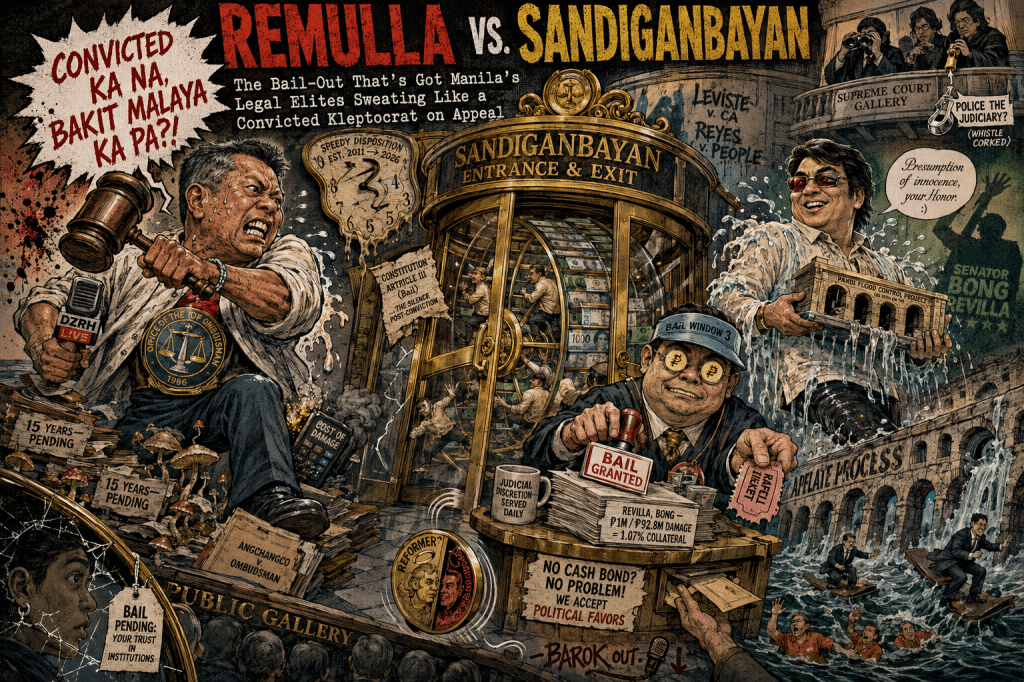
IF there is one thing we must grudgingly admire about Ombudsman Jesus Crispin “Boying” Remulla, it is his unerring instinct for the jugular. He does not dance around an issue with the delicate steps of a diplomat; he grabs it by the throat and shakes it until the loose change of legal pretension falls out of its pockets.
His recent broadside against the Sandiganbayan—delivered not in a dry pleading but from the cozy confines of his dzRH radio program—is a masterclass in political theater. It is part legal theory, part performance art, and part threat.
And yet, for all the bluster, one cannot simply dismiss the man. Because buried beneath the rhetorical rubble, the man has a point. A sharp one. The kind of point that makes magistrates shift uncomfortably in their high-backed chairs.
Let us dissect this with the precision of a prosecutor and the cynicism of a court watcher who has seen too many convictions evaporate into the thin air of appellate delay.
The Provocateur in the Pulpit
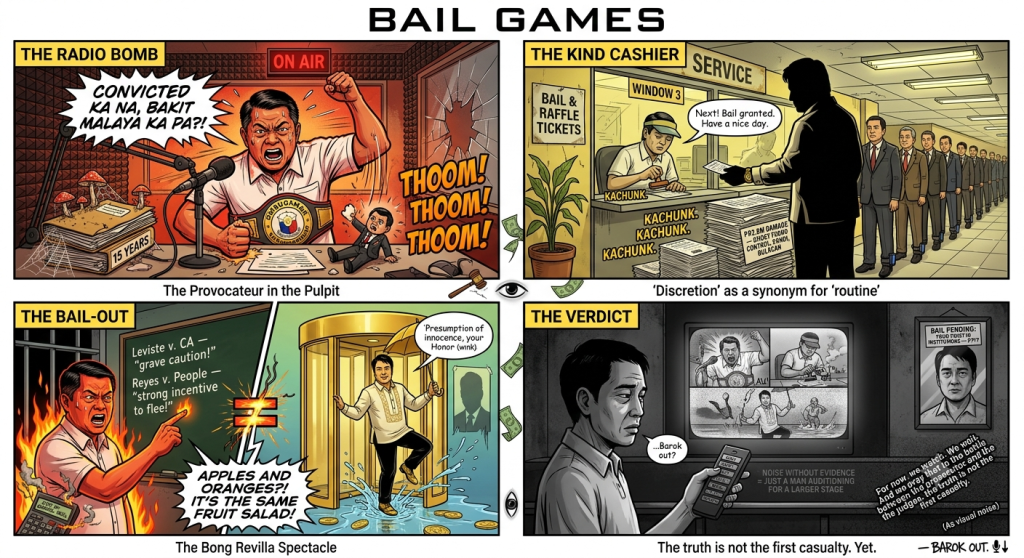
Remulla’s thesis is seductive in its simplicity: Convicted ka na, bakit malaya ka pa? (You’re convicted, why are you free?). His targets are the justices of the Sandiganbayan and lower courts who, in their infinite judicial mercy, allow convicted public officials to post bail pending appeal.
He calls the courts “too kind.” He demands bail amounts equivalent to the “cost of damage.” He laments appeals that stretch for 15 years. And he calls upon the Supreme Court—the apex of the judicial food chain—to “police the judiciary.”
This is not the language of a detached constitutional officer. This is the language of a street fighter who has grown tired of watching the corrupt walk out of the courtroom with a smile and a surety bond.
But before we crown Remulla as the people’s avenger, we must ask the uncomfortable question that hangs over this entire controversy like the scent of stale cigar smoke in a backroom: Is he right, or is he just loud?
The Law: A Sobering Splash of Cold Water
Here is the inconvenient truth that Remulla’s soundbite-friendly rhetoric glosses over: The Constitution guarantees bail before conviction, but it is silent after conviction. That silence is filled by Rule 114 of the Rules of Court, which makes post-conviction bail discretionary—not impossible, not mandatory, but discretionary.
And the Supreme Court has been emphatic about how that discretion should be exercised. In Leviste v. Court of Appeals, the Court declared that the presumption of innocence terminates upon conviction, and that bail pending appeal must be granted with “grave caution and for strong reasons.”
In Reyes v. People, the Court doubled down, warning that a convicted defendant faces actual punishment and therefore has a stronger incentive to flee.
So, on the surface, Remulla has the jurisprudential winds at his back. The High Court itself has said that courts should be stingy with post-conviction liberty. The problem is not the doctrine; the problem is the application.
The Sandiganbayan—and let us be honest, many lower courts—have treated “discretion” as a synonym for “routine.” They grant bail with the same enthusiasm a bored cashier hands out raffle tickets at a mall.
This is where Remulla’s fury finds fertile ground. He is not attacking the law; he is attacking the culture of judicial leniency that has turned the Sandiganbayan into a waystation rather than a terminus.
The Bong Revilla Spectacle
The immediate flashpoint is, of course, the case of former Senator Bong Revilla, who was granted ₱1 million bail in a ₱92.8-million ghost flood-control project case. Remulla’s reaction was visceral: he suggested the outcome was “expected” and hinted that someone may have “worked” to secure the bail.
Now, let us be precise. Revilla has not been convicted in that case. The bail granted was pre-conviction bail, governed by a different constitutional lens—one that still presumes innocence. So, legally, the Revilla case and Remulla’s post-conviction bail diatribe are apples and oranges. But politically, they are the same fruit salad.
The optics are toxic. A wealthy, politically connected former senator walks free on bail while the public watches. The Ombudsman, who must then turn around and prosecute other corruption cases, is left looking like a man trying to empty the ocean with a teaspoon while the tide keeps rolling in.
Remulla’s frustration is not merely understandable; it is justifiable. The anti-corruption machinery of the state cannot function if the judiciary is perceived as a leaky sieve through which the powerful easily slip.
The Weakness in the Warrior’s Armor
However, a critic must not become a sycophant. And Remulla’s proposal that bail should equal the “cost of damage” is legally indefensible and constitutionally suspect.
Bail is not restitution. It is not a fine. It is security for appearance. Rule 114, Section 9 lays out the factors for fixing bail: financial ability, nature of the offense, penalty, character, weight of evidence, probability of appearance, and so on. Notice what is not on that list: the alleged financial damage to the government.
If bail were tied to the “cost of damage,” a public official accused of causing ₱500 million in losses would face a ₱500 million bail—a figure that would effectively become a life sentence of pretrial detention regardless of guilt or innocence. That is not justice; that is wealth-based punishment. And it would run headfirst into the constitutional prohibition against excessive bail.
Remulla knows this. Or he should. His years in the Department of Justice and now as Ombudsman have given him a front-row seat to the delicate balance between public accountability and individual liberty. To propose a “damage equals bail” formula is to abandon that balance for the cheap thrill of a headline.
The Fifteen-Year Itch
Where Remulla is on far stronger ground is the issue of delay. The right to a speedy disposition of cases is enshrined in the Constitution—not just for the accused, but for the state and the people. Cases that languish for a decade and a half are a mockery of that right.
But here is the irony: the Ombudsman’s own office has been repeatedly slapped by the Supreme Court for inordinate delay in preliminary investigations. Cases like Angchangco v. Ombudsman and Tatad v. Sandiganbayan are reminders that the prosecutorial machinery can be just as sluggish as the judicial one.
If Remulla wants to inventory 15-year-old cases, he should also inventory the years his own office spent “investigating” before filing them.
The Dangerous Game
Now, let us address the most troubling aspect of this affair: Remulla’s call for the Supreme Court to “police the judiciary.” This is either a brilliant constitutional insight or a brazen attempt to intimidate the bench.
The Supreme Court does have administrative supervision over all courts. It can discipline judges, issue guidelines, and monitor performance. But it cannot—and must not—dictate outcomes in individual cases.
When the Ombudsman, who is simultaneously the chief prosecutor, publicly declares that courts are “too kind” and urges the high court to intervene, the line between legitimate criticism and improper pressure blurs. It is one thing to say, “The system is slow.” It is another to say, “The judges are too soft, and they should be policed.” The former is policy; the latter is perilous.
Judicial independence is not a luxury. It is the bedrock of a functioning democracy. And while judges must be accountable, they cannot be accountable to the prosecutor. That is not separation of powers; that is subjugation.
The Verdict: Remulla is Half-Right, But Undeniably Useful
In the end, we must render a verdict on the Ombudsman’s crusade.
On the law, he is partially correct: post-conviction bail should be exceptional, not routine. The Supreme Court’s own jurisprudence supports strict scrutiny. The Sandiganbayan’s apparent liberality is a legitimate concern that deserves empirical investigation.
On policy, his frustration is justified: convictions that do not result in incarceration—or that are appealed into oblivion—erode public trust in the entire anti-corruption framework. His call for an inventory of convicted officials is brilliant governance.
On rhetoric, he is reckless: equating bail with damages is legally ignorant. Demanding that convicted officials “go to jail” regardless of the merits of their appeal is constitutionally dangerous. And publicly implying that judges may have been “worked on” without evidence is the kind of insinuation that poisons the well.
But here is the thing about Remulla: he does not care about the backlash. He is playing a long game, and he knows that the public’s memory is short but its outrage is renewable. He has positioned himself as the hammer of the corrupt, the one man willing to say what others only whisper in private.
Is he a reformer or an opportunist? Is he a constitutional watchdog or a political animal dressed in sheep’s clothing? The answer is likely both—and that is precisely why he is so effective.
The Final Word
Boying Remulla has thrown a rock into the placid pond of the Philippine judiciary, and the ripples are only beginning to spread. Whether those ripples become a tidal wave of reform or a swamp of institutional warfare depends on what happens next.
The Supreme Court should not dismiss his concerns. It should audit post-conviction bail practices, track appellate delays, and hold judges accountable where misconduct is proven. But it must also resist the siren song of prosecutorial pressure masquerading as public interest.
As for Remulla, he should heed his own advice: let the evidence speak. Publish the inventory. Show us the numbers. Prove that the Sandiganbayan is a revolving door, not with fiery rhetoric, but with cold, hard data.
Because if he cannot, then his crusade is not justice—it is just noise. And in a democracy, noise without evidence is merely the sound of a man auditioning for a larger stage.
For now, we watch. We wait. And we pray that in the battle between the prosecutor and the judges, the truth is not the first casualty.
— Barok out.
Key Citations
A. Legal and Official Sources
- The 1987 Constitution of the Republic of the Philippines – Article III. Official Gazette of the Republic of the Philippines, https://www.officialgazette.gov.ph/constitutions/the-1987-constitution-of-the-republic-of-the-philippines/the-1987-constitution-of-the-republic-of-the-philippines-article-iii/.
- The 1987 Constitution of the Republic of the Philippines – Article VIII. Official Gazette of the Republic of the Philippines, https://www.officialgazette.gov.ph/constitutions/the-1987-constitution-of-the-republic-of-the-philippines/the-1987-constitution-of-the-republic-of-the-philippines-article-viii/.
- Rules of Court, Rule 114 (Bail). The Lawphil Project, https://www.lawphil.net/courts/rules/rc_110-127_1985.html.
- Leviste v. Court of Appeals, G.R. No. 189122. Supreme Court of the Philippines, 17 Mar. 2010, https://lawphil.net/judjuris/juri2010/mar2010/gr_189122_2010.html.
- Reyes v. People, G.R. No. 237172. Supreme Court of the Philippines, 18 Sept. 2019, https://lawphil.net/judjuris/juri2019/sep2019/gr_237172_2019.html.
- Angchangco, Jr. v. Ombudsman, G.R. No. 122728. Supreme Court of the Philippines, 13 Feb. 1997, https://www.chanrobles.com/scdecisions/jurisprudence1997/feb1997/gr_122728_1997.php.
- Tatad v. Sandiganbayan, G.R. Nos. L-72335-39. Supreme Court of the Philippines, 21 Mar. 1988, https://lawphil.net/judjuris/juri1988/mar1988/gr_l-72335_1988.html.
B. News Articles
- “Ombudsman Questions Bail for Convicted Officials.” Philstar.com, 30 Aug. 2026, https://www.philstar.com/headlines/2026/08/30/2552718/ombudsman-questions-bail-convicted-officials.
- “Bong Revilla Granted P1-Million Bail in P92.8-Million Malversation Case.” Philstar.com, 31 July 2026, https://www.philstar.com/headlines/2026/07/31/2546067/bong-revilla-granted-p1-million-bail-p928-million-malversation-case.
- “Ombudsman Questions Bail Grants to Graft Convicts.” GMA News Online, 30 Aug. 2026, https://www.gmanetwork.com/news/topstories/nation/1000372/ombudsman-questions-bail-grants-to-graft-convicts/story/.
C. Official Websites
- Office of the Ombudsman. https://www.ombudsman.gov.ph/.
- Sandiganbayan. https://sb.judiciary.gov.ph/.
- Supreme Court of the Philippines. https://sc.judiciary.gov.ph/.
- DZRH News. https://dzrh.com.ph/.

- “Ang Hirap Maging Mahirap”: The PAO Scandal That Proves Government Contempt Is Nothing New

- “Far-Off” My Axx: Malacañang’s Claire Castro Drowns in Her Own Legal Gaslighting

- “Forthwith” to Farce: How the Senate is Killing Impeachment—And Why Enrile’s Right (Even If You Can’t Trust Him)

- “HINDI AKO NAG-RESIGN!”

- “I Know Nothing”: Baste Duterte’s Amnesia Defense Meets ₱33M in GenCorp Contracts

- “I’m calling you from my new Globe SIM. Send load!”

- “Mahiya Naman Kayo!” Marcos’ Anti-Corruption Vow Faces a Flood of Doubt

- “Manageable” Debt, Unmanageable Lies: DBM’s ₱21 Trillion Fairy Tale

- “Meow, I’m calling you from my new Globe SIM!”

- “Natrabaho”: One Word, One Ombudsman, and a Judiciary on Trial

- “No Special Jail for Crooks!” Boying Remulla Slams VIP Perks for Flood Scammers

- “Philippine-Controlled” or Yankee Gas Station? The Davao Fuel Depot Farce Exposed





Leave a Reply