
Admission Is Free, But the Republic’s Faith in Impartial Justice Will Cost You Everything
By Louis “Barok” C. Biraogo — July 22, 2026
LET us be clear about what this ruling is not. It is not a conviction. It is not a finding of guilt. It is not even a determination that any single document will be admissible at trial.
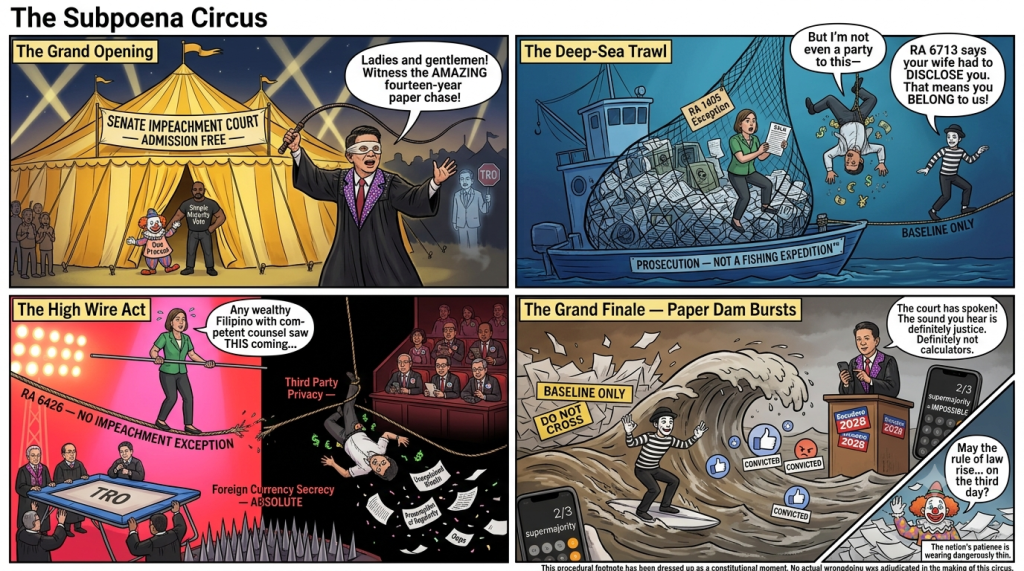
The Senate Impeachment Court has spoken, and the sound you hear is not the gavel of justice but the clatter of political calculators. On July 20, 2026, the senator-judges granted the House prosecution panel’s request to subpoena fourteen years of financial records belonging to Vice President Sara Duterte, her husband Manases Carpio, and twenty-two associated businesses. The court, channeling the ghost of the Corona trial, has decreed that records from 2007 to 2021 are a mere “baseline” for the unexplained wealth charge under Article II—the one that could actually end a vice presidency, if the evidence ever materializes. This is not a “fishing expedition,” the court insists—just a deep-sea trawling operation with a legally sanctioned net.
It is, stripped of its jurisprudential drapery, a discovery order. A procedural footnote dressed up as a constitutional moment. The prosecution still must prove its case; the two-thirds supermajority for conviction remains a political Everest that a simple majority subpoena vote does nothing to climb.
The real legal significance of this ruling hinges entirely on what—if anything—those bank vaults eventually disgorge. Yet you would not know this from the breathless coverage, which has already tried, convicted, and sentenced the Vice President in the court of public opinion based on a request for documents no one has seen.
This brings us to the fundamental flaw that makes this ruling both predictable and profoundly dangerous: the impeachment court’s prevailing “political first, judicial second” character.
The Unbearable Lightness of Senatorial Impartiality
Spare us the theater. The senator-judges are not blindfolded arbiters of constitutional justice; they are political gladiators whose votes on this subpoena were telegraphed long before the roll call. The Marcos-Duterte alliance lies in smoldering ruins, and the 2028 presidential race looms over this chamber like Banquo’s ghost.
Every senator-judge with presidential ambitions—and the line forms around the block—is calculating whether a vote for transparency strengthens or weakens their own positioning. Presiding Officer Francis “Chiz” Escudero, whose own Corona-era votes are now being cited as binding precedent by the prosecution, must pretend at Solomon-like neutrality while his younger self testifies against him from the congressional record. The irony is so thick it requires a machete.
This is not to say the subpoena is legally baseless. It is not. Republic Act No. 1405 (Bank Secrecy Law) explicitly carves out “cases of impeachment” as one of its four sacred exceptions to the confidentiality of peso deposits. On this narrow textual ground, the court stands on solid bedrock.
The prosecution’s invocation of Chief Justice Renato Corona’s 2012 trial—where pre-appointment financial records were admitted as a baseline for assessing unexplained wealth—provides genuine precedential cover. And the underlying logic of Republic Act No. 1379 (Forfeiture of Unlawfully Acquired Property Act), which defines unexplained wealth as property “manifestly out of proportion” to lawful income, requires a starting point for comparison. Without knowing what Duterte’s finances looked like before 2022, the court reasoned, it has no benchmark against which to measure alleged disproportionality during her vice presidency.
The legal architecture, however, is not a monolith. It is a patchwork riddled with seams, and one seam in particular is gaping wide enough to drive a certiorari petition through for grave abuse of discretion—the denial of Carpio’s due process rights in a forum where he is neither impeachable nor a party.
The Foreign Currency Bomb and the Carpio Conundrum
The ruling’s most legally precarious limb is its extension to records that sit beyond the Bank Secrecy Law’s impeachment exception. This is where the Corona precedent cuts against the court as sharply as it cuts for it. Republic Act No. 6426 (Foreign Currency Deposit Act) contains no impeachment exception.
Its confidentiality mandate is absolute, stating that “in no instance” may foreign currency deposits be examined without the depositor’s written consent. This is not a drafting oversight; it is a deliberate legislative promise to attract foreign capital by building a higher wall of secrecy than peso accounts enjoy.
In 2012, when the Senate subpoenaed Corona’s dollar accounts, the Supreme Court issued a temporary restraining order that blocked that specific examination dead in its tracks. If Duterte or Carpio hold foreign-currency deposits—and any wealthy Filipino with competent counsel almost certainly does—the same constitutional collision is inevitable. The impeachment court is barreling toward a Corona-style TRO with its eyes wide open.
Even more vulnerable is the subpoena directed at Manases Carpio. Carpio is not an impeachable officer. He is not a party respondent. He is, in the eyes of the 1987 Constitution, a private citizen whose financial privacy enjoys protections that the court’s Republic Act No. 6713 (Code of Conduct and Ethical Standards for Public Officials and Employees) rationale cannot effortlessly bulldoze.
The court argues that because Section 8 of the Code of Conduct requires Duterte to disclose her spouse’s assets in her Statement of Assets, Liabilities, and Net Worth (SALN), Carpio’s underlying bank records are fair game for compulsory production. This is a logical leap that would impress an Olympic long jumper.
A spousal disclosure duty under RA 6713 establishes that Duterte had an obligation to report Carpio’s assets truthfully; it does not, without more, grant the impeachment court plenary subpoena power over every business dealing a non-party spouse has conducted across twenty-two companies over fourteen years. This is the seam that skilled defense counsel will probe relentlessly, and it does not even require challenging the bank secrecy exception at all—only its application to a third party’s independent financial life.
The Fourteen-Year Paper Dam
Then there is the court’s self-imposed limiting instruction: that pre-2022 records may establish only a “baseline” and cannot be used to introduce new impeachable offenses. This is legally coherent and practically delusional.
Once fourteen years of financial history—encompassing her time as Davao City vice mayor, mayor, and now Vice President—is spread across the courtroom floor, who will police the line between baseline and substantive proof? The prosecution will tiptoe up to that line like a mime artist at the edge of an imaginary cliff.
The senator-judges, already swimming in political cross-currents, are unlikely to suddenly transform into evidentiary referees of Solomonic discipline. The limiting instruction is a paper dam, and the floodwaters of insinuation will not respect its boundaries.
This is precisely the “fatally overbroad” problem that defense counsel Michael Poa invoked, borrowing language from the Supreme Court’s own July 2025 ruling in Duterte v. House of Representatives. That ruling voided the first impeachment on due process grounds; its reasoning now haunts this second attempt like a jurisprudential poltergeist.
The Verdict That Isn’t
The subpoena ruling is, in the final analysis, a procedural placeholder. It adjudicates no wrongdoing. It exonerates no one.
Its full significance hinges on the contents, admissibility, and evidentiary weight of records that have not yet been produced, may never be fully produced, and will almost certainly be litigated up to the Supreme Court. The ultimate resolution still requires the prosecution to prove its charges under the constitutional standard for conviction—a two-thirds supermajority that remains light-years distant from this simple majority subpoena vote.
What then must be done? The prosecution must immediately secure presidential authorization for the Bureau of Internal Revenue (BIR) tax records, closing the loophole the Corona precedent so vividly exposed (Laqui).
The impeachment court should adopt an in-camera review process for any foreign-currency documents, insulating the most sensitive records from political spectacle while preserving their evidentiary utility. And the senator-judges must find the courage—if such a thing still exists in that chamber—to enforce their own baseline-only limitation with rigor, not rhetoric.
This is a call for an impeachment court that is impartial, evidence-driven, constitutionally faithful, and publicly accountable. A call for justice that does not depend on whose political ally sits in the dock. A call to strengthen the democratic institutions that are all that stand between this Republic and the abyss of raw power politics.
A call for genuine public service—not the performative variety that confuses a subpoena with a conviction. A call for hope, and a better future for Filipino youth who deserve a legal system that serves the law, not the powerful.
May the rule of law rise, not just on the third day, but on every day this trial drags on. The nation is watching, and its patience with judicial robes draped over political calculations is wearing dangerously thin. 🪨
Key Citations
A. Legal & Official Sources
- The 1987 Constitution of the Republic of the Philippines. Official Gazette of the Republic of the Philippines, 1987, http://www.officialgazette.gov.ph/constitutions/1987-constitution/.
- Republic Act No. 1405. An Act Prohibiting Disclosure of or Inquiry into, Deposits with Any Banking Institution and Providing Penalty Therefor. 1955, lawphil.net/statutes/repacts/ra1955/ra_1405_1955.html.
- Republic Act No. 1379. An Act Declaring Forfeiture in Favor of the State Any Property Found to Have Been Unlawfully Acquired by Any Public Officer or Employee and Providing for the Proceedings Therefor. 1955, lawphil.net/statutes/repacts/ra1955/ra_1379_1955.html.
- Republic Act No. 6426. An Act Instituting a Foreign Currency Deposit System in the Philippines, and for Other Purposes. 1972, lawphil.net/statutes/repacts/ra1972/ra_6426_1972.html.
- Republic Act No. 6713. An Act Establishing a Code of Conduct and Ethical Standards for Public Officials and Employees. 1989, lawphil.net/statutes/repacts/ra1989/ra_6713_1989.html.
- Supreme Court of the Philippines. 2019 Amendments to the 1997 Rules of Civil Procedure. A.M. No. 19-10-20-SC, 15 Oct. 2019. LawPhil, lawphil.net/courts/rules/am_19-10-20-sc_2019.html. Accessed 21 July 2026.
- Sara Z. Duterte v. House of Representatives, et al., G.R. Nos. 278353 & 278359. Supreme Court of the Philippines, 25 July 2025, sc.judiciary.gov.ph/sc-house-impeachment-complaint-vs-vp-duterte-barred-by-1-year-rule-due-process-or-fairness-applies-during-all-stages-of-impeachment-process/.
B. News Reports
- Ager, Maila. “Impeachment Court Grants Subpoena for Duterte’s Financial Records.” INQUIRER.net, Philippine Daily Inquirer, 20 July 2026, https://newsinfo.inquirer.net/2266745/impeachment-court-grants-subpoena-for-dutertes-financial-records..
- Laqui, Ian. “Sara Duterte’s Tax Records Need Marcos Approval for BIR Release.” Philstar.com, The Philippine Star, 21 July 2026, https://www.philstar.com/headlines/2026/07/21/2543462/sara-dutertes-tax-records-need-marcos-approval-bir-release.

- “Ang Hirap Maging Mahirap”: The PAO Scandal That Proves Government Contempt Is Nothing New

- “Far-Off” My Axx: Malacañang’s Claire Castro Drowns in Her Own Legal Gaslighting
- “Forthwith” to Farce: How the Senate is Killing Impeachment—And Why Enrile’s Right (Even If You Can’t Trust Him)

- “HINDI AKO NAG-RESIGN!”

- “I Know Nothing”: Baste Duterte’s Amnesia Defense Meets ₱33M in GenCorp Contracts

- “I’m calling you from my new Globe SIM. Send load!”

- “Mahiya Naman Kayo!” Marcos’ Anti-Corruption Vow Faces a Flood of Doubt

- “Manageable” Debt, Unmanageable Lies: DBM’s ₱21 Trillion Fairy Tale

- “Meow, I’m calling you from my new Globe SIM!”

- “Natrabaho”: One Word, One Ombudsman, and a Judiciary on Trial

- “No Special Jail for Crooks!” Boying Remulla Slams VIP Perks for Flood Scammers

- “Philippine-Controlled” or Yankee Gas Station? The Davao Fuel Depot Farce Exposed







Leave a Reply