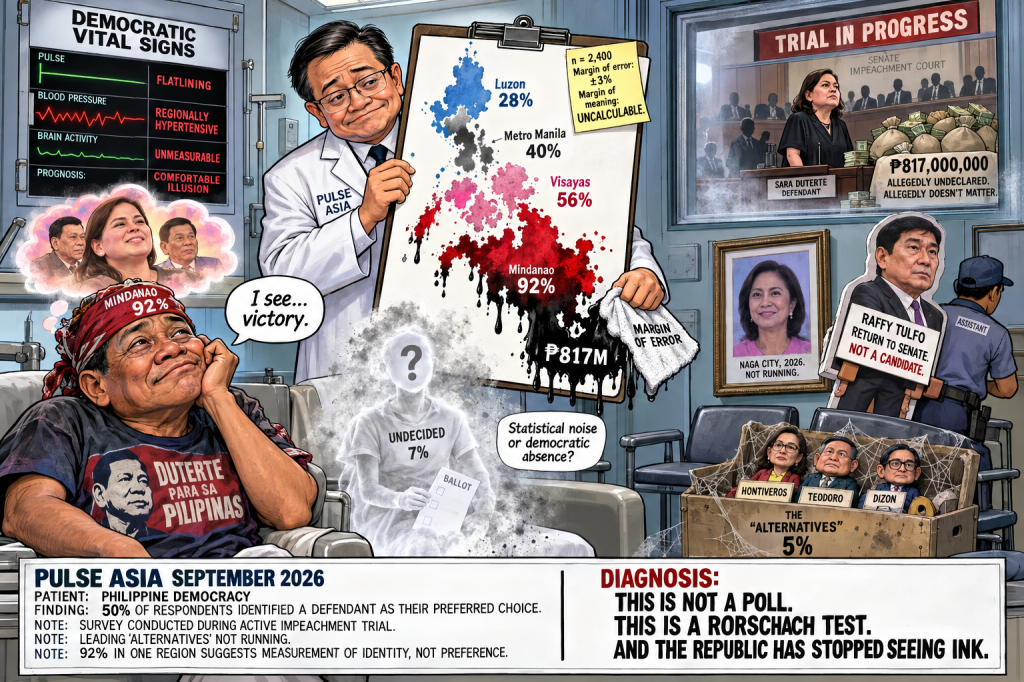
The Pulse Asia September 2026 survey didn’t measure support. It measured surrender.
By Louis ‘Barok’ C Biraogo — October 12, 2026
50 PERCENT. Not a preference. A white flag.
That is the share of Filipino adults who told Pulse Asia, in a face-to-face survey conducted from September 17 to 24, that they would vote for Vice President Sara Duterte if the 2028 presidential election were held during that window. Half the country. A commanding lead over Naga City Mayor Leni Robredo (26 percent) and Senator Raffy Tulfo (12 percent). A lead that holds across all five alternative scenarios Pulse Asia tested, ranging from 52 percent to 60 percent.
Now consider the context. This survey was conducted while Sara Duterte was on trial for her political life.
The Senate impeachment court was hearing evidence on Article II—allegations of unexplained wealth, undeclared assets, business interests that should have been divested. Just days before fieldwork began, the prosecution’s financial forensic expert had testified that he identified approximately ₱817.87 million in allegedly undeclared assets involving Duterte and her husband from 2022 to 2025. On September 23—in the middle of Pulse Asia’s fieldwork—the impeachment court ruled that senators physically unable to attend would be excluded from the vote count needed to convict.
And the response of the Filipino electorate, at least according to Pulse Asia’s 2,400 respondents, was essentially: So what?
This is not a poll. This is a Rorschach test. And what it reveals about Philippine democracy is far more disturbing than any single number.
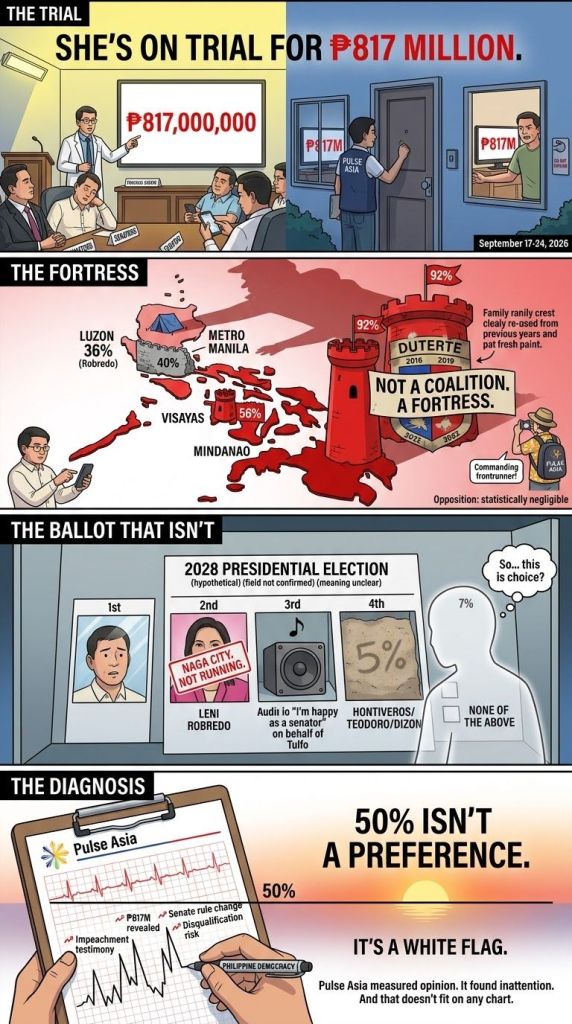
The Geography of a Country That Has Stopped Listening
Pulse Asia’s regional breakdowns are the most revealing part of the survey, and they tell a story that should worry anyone who believes in a national electorate.
- In Mindanao, Sara Duterte commands 92 percent support. In the head-to-head scenario against Robredo, that rises to 96 percent.
- In the Visayas, Duterte gets 56 percent.
- In Metro Manila, 40 percent.
- In the rest of Luzon—the only region where Robredo leads—Duterte still commands 28 percent against Robredo’s 36 percent.
Let that sink in. In the Duterte family’s home region, opposition to the Vice President is statistically negligible. You are more likely to find a Filipino who has never heard of adobo than to find a Mindanao voter who would choose Robredo over Duterte.
This is not a national coalition. This is a geographic fortress with outposts.
The Duterte political machine has done what machines do: it has consolidated a regional base so thoroughly that national surveys can no longer meaningfully measure its softness. A 92 percent figure in Mindanao is not a preference; it is an identity. It tells us nothing about persuasion, nothing about governance, nothing about the issues that might move voters in a real campaign.
What it does tell us is that Philippine politics has become so thoroughly regionalized, so dynastically entrenched, that a candidate can lose the rest of Luzon by eight points and still be described as the “commanding frontrunner” because her family owns one-third of the country’s landmass in electoral terms.
The Convenience of the Undecided
Look closely at the Pulse Asia numbers, and you will find a small but telling detail:
- 3 percent of respondents said they were undecided,
- 3 percent said they would support none of the candidates, and
- 1 percent refused to answer.
Seven percent of the electorate, in other words, has effectively checked out. They are not undecided in the sense of weighing options. They are undecided in the sense of having concluded that none of the options matter enough to choose.
And who can blame them? Consider what the “choice” looks like from the perspective of an ordinary Filipino in September 2026.
On one side, a Vice President facing impeachment for unexplained wealth, whose supporters view the proceedings as political persecution. On the other, a former Vice President who has repeatedly said she has no interest in running for national office again, who won the Naga City mayorship and has stated she intends to seek a second term. And in third place, a senator who has explicitly disclaimed presidential ambitions.
This is not a field of candidates. This is a lineup of people who either face disqualification, have disqualified themselves, or never qualified in the first place.
Pulse Asia’s decision to include Raffy Tulfo at 12 percent, despite his public disclaimers, is not a neutral methodological choice. It artificially inflates the perceived breadth of the field and, by extension, the apparent strength of Duterte’s lead. If Tulfo is not running—and he says he is not—then his 12 percent is not support for a candidate. It is noise. It is the political equivalent of a placeholder, a name that respondents recognize enough to say aloud when asked.
And Robredo? The survey includes her at 26 percent, even though she has said, in no uncertain terms, that she will not run for national office in 2028. What is being measured here is not electoral preference but name recognition and residual goodwill. It is a measurement of the past, not the future.
The Pollster’s Defense and the Skeptic’s Problem
Pulse Asia President Ronald Holmes has defended his firm’s methodology before, insisting that surveys remain “nationally representative” even when specific demographic groups are overrepresented or underrepresented.
His defense, in a 2022 interview, was revealing: “It is pretty difficult to come up with a survey that would really match the proportion based on educational attainment. In the first place, it’s difficult to come up with a sampling frame where you have knowledge of the people who have graduated from elementary school or the people who completed college”.
This is an honest admission of a real methodological constraint. But it is also an admission that Pulse Asia’s surveys systematically overrepresent less-educated respondents and underrepresent the college-educated—a skew that, if anything, should help a populist candidate like Duterte, not hurt her.
The problem is not that Pulse Asia is rigging its surveys. There is no evidence of that in the September 2026 data. The problem is that even a methodologically imperfect survey can produce a result that is technically accurate and politically meaningless.
A 50 percent preference rating for a candidate under impeachment is not a prediction of electoral victory. It is a measurement of a moment. And that moment is defined by three things that no survey can capture: the outcome of the impeachment trial, the actual composition of the 2028 candidate field, and the willingness of Filipino voters to change their minds.
The Impeachment Paradox
Here is the central puzzle: Why has the impeachment trial not dented Sara Duterte’s numbers?
The survey was conducted during some of the most damaging testimony of the trial. The prosecution’s financial expert had just testified about ₱817 million in allegedly undeclared assets. The impeachment court was making procedural rulings that the defense viewed as unfavorable. And yet Duterte’s preference rating remained stable—50 percent, essentially unchanged from the 49 percent she received in May.
Political analyst Cleve Arguelles of WR Numero Research offered one explanation in November 2024: “There is already a mobilizing effect on the Duterte supporters because they feel that they are the underdog”.
This is the persecution narrative in action. For Duterte’s base, the impeachment is not evidence of wrongdoing. It is evidence of a system rigged against their candidate. Every hearing, every subpoena, every financial record introduced into evidence is filtered through a pre-existing belief that the Marcos administration is using state institutions to destroy a political rival.
The survey cannot tell us how many Duterte supporters have actually engaged with the substance of the allegations. It cannot tell us how many know about the ₱817 million figure. It cannot tell us how many would change their minds if they did.
What it can tell us is that in a deeply polarized media environment, information does not persuade. It mobilizes.
The Opposition That Isn’t
If the Pulse Asia survey reveals anything about the state of Philippine democracy, it is the near-total collapse of a coherent opposition.
Robredo, the only figure who even approaches Duterte’s name recognition, has said she is not running. Tulfo, the third-place finisher, has said the same. The remaining candidates—Hontiveros at 3 percent, Teodoro and Dizon at 1 percent each—are not opposition figures. They are either administration officials or marginal players with no national infrastructure.
This is not a political landscape. It is a vacuum with a single occupant.
And into that vacuum, the survey injects the illusion of competition. A 50-26-12 split looks like a race. It looks like a field. It looks like democracy.
It is none of those things.
It is a measurement of the absence of alternatives. It is a snapshot of a country where the only nationally recognizable opposition figure has chosen local governance over national confrontation, and where the third-place “contender” is a senator who has explicitly ruled out running.
What the Survey Actually Measures
Let me be precise about what the Pulse Asia September 2026 survey can and cannot tell us.
It can tell us that, at a specific moment in time, when asked a hypothetical question about a hypothetical election, half of Filipino adults named Sara Duterte.
It cannot tell us whether those respondents understand the allegations against her. It cannot tell us whether they believe those allegations. It cannot tell us whether those beliefs would survive a real campaign, with real scrutiny, and real alternatives.
It cannot tell us whether Duterte will be eligible to run. The impeachment trial’s outcome is the single most important variable in the 2028 race, and it is entirely absent from the survey’s framing. If the Senate convicts and disqualifies her, her 50 percent becomes the electoral equivalent of a mirage.
It cannot tell us who will actually be on the ballot. Robredo says she is not running. Tulfo says he is not running. The “field” Pulse Asia tested is a hypothetical constructed from names that may never appear on a real ballot.
What the survey does tell us is that Philippine politics has reached a point where a candidate can face credible allegations of massive unexplained wealth and still command the support of half the electorate—not because voters have weighed the evidence and found it wanting, but because the evidence never reached them in a way that mattered.
That is not a poll result. That is a failure of democratic deliberation.
The Comfortable Illusion
I have covered enough Philippine elections to know that surveys are not prophecies. In 2016, early surveys showed Robredo trailing in the vice-presidential race; she won narrowly. In 2022, Marcos Jr.’s massive lead held—but that was a unique case of dynastic consolidation, not a general rule.
The Pulse Asia September survey is a snapshot. It is a well-executed snapshot of a poorly functioning democracy.
It shows a country where regional identity trumps national interest. Where a single family’s political brand is so dominant in one-third of the country that opposition is statistically invisible. Where the only nationally recognized alternative to that brand has chosen to step away from national politics. Where the third-place finisher has said he does not want the job.
And where, in the middle of an impeachment trial for unexplained wealth, half the country looks at the defendant and says: Yes, her.
This is not a prediction of 2028. It is a portrait of 2026. And it is not flattering.
The real question is not whether Sara Duterte can maintain 50 percent through the impeachment trial, the campaign, and the election. The real question is whether the Philippines can sustain a democracy in which 50 percent is enough—in which a commanding lead is built not on persuasion but on geography, not on argument but on absence, not on hope but on the simple fact that no one else is there.
Pulse Asia measured public opinion. What it revealed was public inattention. And that is a much harder problem to poll.
Louis ‘Barok’ C Biraogo writes the Kweba ni Barok blog. He has covered Philippine politics and governance for over a decade.
Key Citations
A. Reports & Studies
- Pulse Asia Research. “September 2026 Ulat ng Bayan Survey.” Pulse Asia, 12 Oct. 2026, pulseasia.ph.
- House of Representatives. “House prosecution concludes evidence presentation in VP Duterte impeachment trial.” Congress.gov.ph, 8 Oct. 2026, congress.gov.ph.
- Philippine News Agency. “Senate court drops fixed 16-vote threshold in VP trial.” PNA, 23 Sept. 2026, pna.gov.ph.
B. News Articles
- Manila Bulletin. “VP Sara still leads 2028 presidential race in September 2026 Pulse Asia survey.” Manila Bulletin, 12 Oct. 2026, mb.com.ph.
- Inquirer.net. “Pulse Asia defends sampling methods amid criticisms on latest survey.” Inquirer.net, 2 May 2022, newsinfo.inquirer.net.
- Inquirer.net. “Leni Robredo rules out national run in 2028.” Inquirer.net, 21 Apr. 2026, newsinfo.inquirer.net.
- Philstar.com. “Leni rules out 2028 presidential run, eyes second term in Naga.” Philstar.com, 21 Apr. 2026, philstar.com.
- Manila Bulletin. “Raffy Tulfo rules out 2028 presidential bid: ‘I’m very happy as a senator’.” Manila Bulletin, 5 May 2026, mb.com.ph.
- Daily Tribune. “VP Sara unexplained wealth at P817M – witness.” Daily Tribune, 9 Oct. 2026, tribune.net.ph.
- Reuters. “Philippine Senate lowers threshold for conviction in VP Duterte’s impeachment trial.” Reuters, 23 Sept. 2026, reuters.com.
- The Manila Times. “No clear challenger to presidential survey frontrunner Sara.” The Manila Times, 12 Oct. 2026, manilatimes.net.
C. Official Websites
- Congress of the Philippines. congress.gov.ph.
- Philippine News Agency. pna.gov.ph.
- Pulse Asia Research. pulseasia.ph.
- “Ang Hirap Maging Mahirap”: The PAO Scandal That Proves Government Contempt Is Nothing New

- “Far-Off” My Axx: Malacañang’s Claire Castro Drowns in Her Own Legal Gaslighting
- “Forthwith” to Farce: How the Senate is Killing Impeachment—And Why Enrile’s Right (Even If You Can’t Trust Him)

- “HINDI AKO NAG-RESIGN!”

- “I Know Nothing”: Baste Duterte’s Amnesia Defense Meets ₱33M in GenCorp Contracts

- “I’m calling you from my new Globe SIM. Send load!”

- “Mahiya Naman Kayo!” Marcos’ Anti-Corruption Vow Faces a Flood of Doubt

- “Manageable” Debt, Unmanageable Lies: DBM’s ₱21 Trillion Fairy Tale

- “Meow, I’m calling you from my new Globe SIM!”

- “Natrabaho”: One Word, One Ombudsman, and a Judiciary on Trial

- “No Special Jail for Crooks!” Boying Remulla Slams VIP Perks for Flood Scammers

- “Philippine-Controlled” or Yankee Gas Station? The Davao Fuel Depot Farce Exposed







Leave a Reply