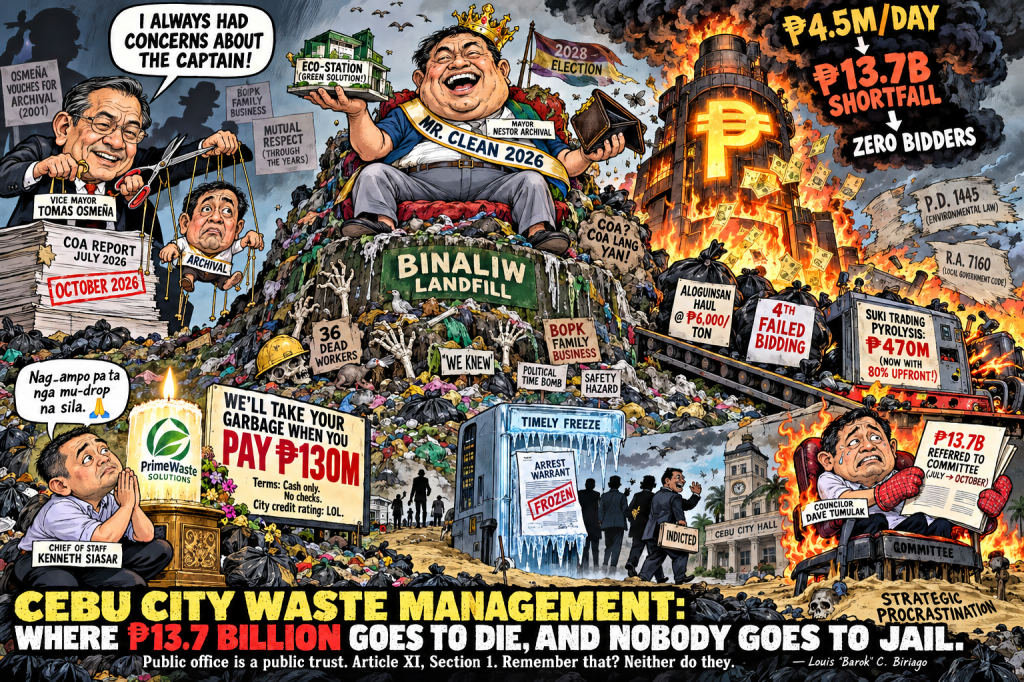
Four failed biddings, a P470 million pyrolysis pipe dream, and a mayor who can’t pay his own garbage bills—welcome to governance, Cebu style.
By Louis ‘Barok’ C. Biraogo — October 13, 2026
LET’S review the timeline, since no one in authority seems to have.
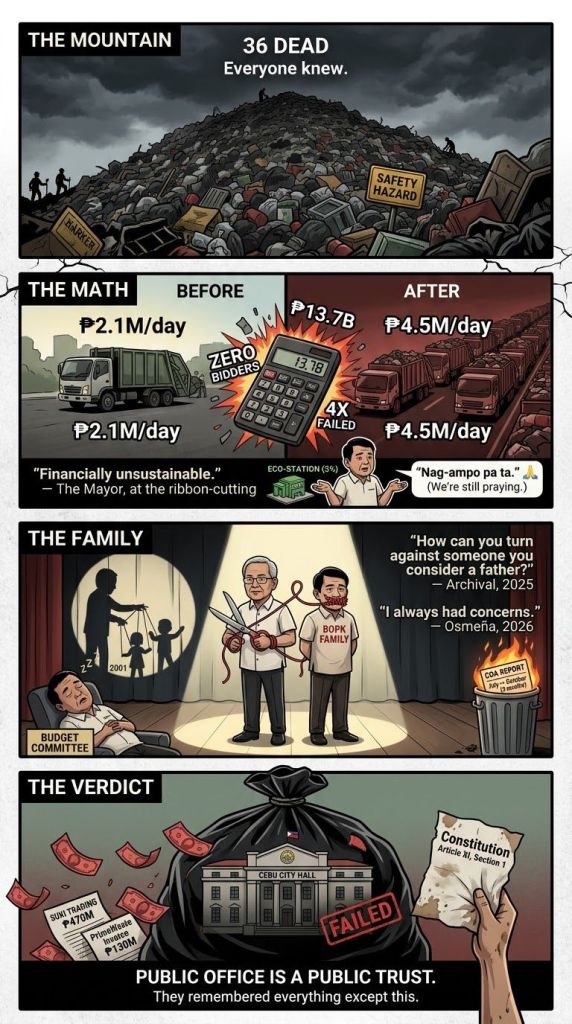
Thirty-six people died on January 8, 2026, when a mountain of garbage collapsed at the Binaliw landfill. The facility had been flagged as a safety hazard and a “political time bomb” long before the tragedy. The city knew. The operator knew. Everyone with a clipboard and a pulse apparently knew.
Nine months later, Cebu City is spending P4.2 million to P4.5 million per day hauling its trash 61 kilometers to Aloguinsan. The cost per ton has tripled from P1,100 to over P3,900. The city has held four separate biddings for a disposal facility. All four failed. Zero bidders. The city is now eyeing another P100 million supplemental budget because, apparently, the P400 million they already got is evaporating faster than accountability in Philippine politics.
And Vice Mayor Tomas Osmeña—the same Osmeña who recruited Mayor Nestor Archival into politics, who vouched for him, who called their relationship one of “mutual respect”—is now publicly lamenting a P13.7 billion cash shortfall while simultaneously throwing his own protégé under the garbage truck.
This isn’t a governance crisis. This is performance art.
The Anatomy of a Perfect Storm (Or: How to Make P13 Billion Disappear Without Really Trying)
Let’s start with the numbers, because they’re deliciously absurd.
Before Binaliw collapsed, Cebu City spent roughly P2.1 million daily on garbage disposal. After the landslide, that figure doubled to P4.2–4.5 million daily. The city’s annual waste management budget ballooned from P500 million to nearly P1 billion. The mayor himself admitted the system is “financially unsustainable.”
You know what else is unsustainable? Paying P6,000 per ton to haul garbage to a facility 61 kilometers away because you failed to maintain the one you had.
But wait—there’s more. The Commission on Audit (COA) found a P13.7 billion cash shortfall. The city’s cash and equivalents as of December 31, 2025: P4.76 billion. That’s not a gap. That’s the Grand Canyon.
COA helpfully pointed out that this violates Presidential Decree No. 1445 (Government Auditing Code) and the fiscal management principles of Republic Act No. 7160 (Local Government Code of 1991). The audit team warned the imbalance could “derail other programs” and disable the city from “regularly paying its valid debts”.
Translation: Cebu City is broke. Not “we need to tighten our belts” broke. Not “let’s defer some capital projects” broke. We-can’t-pay-our-bills broke.
And here’s the kicker: Vice Mayor Osmeña revealed that the COA report was received by City Hall in mid-July 2026. It didn’t surface in the Sanggunian until October. That’s a three-month delay. Councilor Dave Tumulak, who chairs the Budget Committee, sat on a P13.7 billion problem like it was a hot potato that might explode.
Osmeña’s response? “Why have you not brought up this matter before this body when it first came out? We’re not talking about 13 million”.
No, Tomas, we’re not. We’re talking about a city government that apparently thought fiscal catastrophe was a problem best handled through strategic procrastination.
The Four Failed Biddings: A Case Study in Market Non-Existence (Or Deliberate Design)
Let’s talk about the biddings. The city tried to procure a licensed solid waste disposal facility. Four times. Four failures.
- May 5: Prime Integrated Waste Solutions participated but was disqualified because its PhilGEPS registration had expired.
- July 2: No bidders.
- July 21: No bidders.
- September 10: No bidders.
Zero proposals. Four times in a row.
Now, I’m just a humble writer, but I’ve seen enough procurement scandals to know that when zero bidders show up for a government contract worth P99.3 million, something is deeply wrong. Either:
- (a) The terms of reference were so restrictive that no rational bidder could qualify,
- (b) The market genuinely doesn’t exist (unlikely, given that Aloguinsan is somehow handling the waste),
- (c) Potential bidders knew something they didn’t want to touch with a ten-foot pole, or
- (d) The fix was in, and everyone knew who was supposed to win.
The mayor’s chief of staff, Kenneth Siasar, expressed hope that PrimeWaste would participate in a fifth attempt. “Naghuwat pa ta, nag-ampo pa ta nga mu-drop na sila,” he said. We’re waiting, we’re praying they’ll drop.
Praying. That’s the procurement strategy now. Prayer.
Meanwhile, PrimeWaste says it won’t accept Cebu City’s garbage because the city owes it P130 million. The operator—the same one whose facility killed 36 people—is holding the city hostage over unpaid bills. And the city, which apparently can’t pay its garbage bills, is somehow supposed to negotiate from a position of strength?
This is not procurement. This is a hostage situation with extra steps.
The Eco-Station: A Feel-Good Distraction from Structural Rot
In June 2026, Mayor Archival proudly inaugurated an eco-station at the South Road Properties, aimed at diverting 15 tons of waste daily. It has a composting facility, plastic shredders, black soldier fly breeding, and even an “ionization reactor chamber” to extract fresh water from seawater. Very impressive. Very green. Very photogenic.
The eco-station processes around 20 tons of waste daily.
Cebu City generates 600 to 700 tons of garbage daily.
Let me do the math for you: the eco-station handles roughly 3% of the city’s waste. The remaining 97% still goes to Aloguinsan at P6,000 per ton.
But hey—at least the mayor got a photo op.
Archival admitted the city’s waste management system “remains financially unsustainable” while standing in front of a facility that processes a rounding error’s worth of garbage. The long-term goal is to involve all 51 urban barangays and reduce landfill-bound waste by 30 percent before 2028.
Thirty percent. In two years. When they’re currently at three.
I’ll believe it when I see the audit.
The Binaliw Question: A Landfill Too Dangerous to Use, Too Expensive to Abandon
Here’s the beautiful Catch-22 at the heart of this disaster.
Binaliw is closed because it killed 36 people. The Department of Environment and Natural Resources (DENR) issued a cease-and-desist order, then lifted it, then said “monitoring and compliance issues remain”. The Office of the Building Official and the City Disaster Risk Reduction and Management Office inspected the facility and stopped short of declaring it safe, citing unresolved issues with slope stabilization, methane venting, and leachate management.
So the landfill is unsafe. Great.
But the city owes PrimeWaste P130 million, so even if it were safe, PrimeWaste won’t take the garbage.
And the city can’t pay because—say it with me—P13.7 billion cash shortfall.
So Cebu City is stuck. It can’t use its own landfill (unsafe). It can’t pay to reopen it (broke). It can’t find another landfill (four failed biddings). And it’s hemorrhaging P4.5 million per day hauling trash to a facility that’s also been flagged for environmental violations.
This is what happens when you spend decades kicking the can down the road—except the road is littered with garbage, and the can is now a P13.7 billion liability.
The Political Kabuki: Osmeña vs. Archival, or How to Distance Yourself from Your Own Creation
The most entertaining part of this whole sordid affair is watching Vice Mayor Tomas Osmeña publicly flay Mayor Nestor Archival while pretending he had nothing to do with any of it.
Let’s review the relationship. Osmeña recruited Archival into politics in 2001. Archival has called BOPK “like a family—a father, a mother.” He acknowledged being called Osmeña’s “puppet” but defended the relationship: “How can you turn against someone you consider a father?”
That’s sweet. Also, deeply problematic for accountability purposes.
Osmeña is the BOPK leader. He vouched for Archival. He carried him in the 2025 election. And now, with the garbage crisis metastasizing into a full-blown fiscal catastrophe, Osmeña is positioning himself as the critic-in-chief, demanding transparency and accountability from the very administration he midwifed into existence.
It’s a classic move: when your protégé fails spectacularly, you don’t go down with the ship. You stand on the pier, point at the sinking vessel, and say, “I always had concerns about the captain.”
But here’s the thing: Osmeña knows where the bodies are buried. Literally—at Binaliw. If he genuinely wanted accountability, he could have demanded it months ago. Instead, he waited until the scandal was public, the COA report was out, and the media was circling.
This isn’t accountability. This is political survival.
And Mayor Archival? He’s the one left holding the bag. He’s the one who has to explain why the city is spending P4.5 million a day on garbage disposal while facing a P13.7 billion shortfall. He’s the one who has to justify another supplemental budget request while the city’s creditworthiness circles the drain.
But Archival isn’t innocent either. He’s the chief executive. He’s responsible for the city’s fiscal management. And the COA report—the one that sat in Tumulak’s committee for three months—was addressed to him.
So the question becomes: Did Archival know about the P13.7 billion problem in July and do nothing? Or did he know and hope it wouldn’t become public?
Either way, it’s not a good look.
The Suki Trading Proposal: P470 Million for a Machine That Might Work
Let’s not forget the P470 million pyrolysis proposal from Suki Trading Corp. The price started at P250 million but mysteriously escalated after Vice Mayor Osmeña started asking questions.
The proposed system would process up to 700 tons of mixed waste daily. The payment schedule: 15% at signing, 30% on delivery, 35% on installation (before testing), and 20% on acceptance.
So the city would pay 80% of the price before the machine is proven to work.
Suki’s Dumaguete facility was suspended in July 2025 due to hazardous emissions exceeding standards. The owner admitted emissions were “most likely due to poor maintenance.”
This is the technology Cebu City is considering as a solution to its P4.5-million-per-day problem. A machine from a company with a track record of environmental non-compliance, at a price that escalated by nearly P220 million after scrutiny, with a payment schedule that transfers almost all the risk to the city.
I’m sure it’ll be fine.
The Uncomfortable Truth: This Is What Impunity Looks Like
Here’s what bothers me most about this entire saga.
The Binaliw landfill was known to be unsafe. It was described as a “safety hazard” and a “political time bomb” before it collapsed and killed 36 people. The city knew. The operator knew. And nobody did anything.
Now, nine months later, the people responsible for that oversight—or lack thereof—are the same people debating how to spend P100 million more on a disposal system that costs more than it should because they failed to maintain the one they had.
The indicted persons “still have to be arrested,” according to reports, “miraculously saved by the timely freezing of the warrants.” Arrest warrants. Frozen. Timely. For people connected to a landfill that killed 36 workers.
And the public is supposed to trust that this same system will deliver accountability?
The COA flagged a P13.7 billion shortfall. The city’s response was to “correct” the figure from P14.44 billion and pretend that P13.7 billion is somehow less catastrophic. The council referred the matter to committee. The mayor asked for more money. The vice mayor criticized the mayor. Everyone blamed everyone else.
Meanwhile, Cebu City burns through P4.5 million a day on garbage. That’s P31.5 million a week. P126 million a month. P1.5 billion a year—at least—for a service that was supposed to cost P500 million.
That’s P1 billion in avoidable waste—and I use the term “waste” deliberately.
The 1987 Constitution says public office is a public trust. Article XI, Section 1. The people of Cebu City are entitled to officials who treat their money like it matters. Instead, they got a landfill collapse, a fiscal catastrophe, four failed biddings, a P470 million proposal from a company with a suspended facility, and a political class more interested in positioning for 2028 than solving the crisis in front of them.
What Should Happen (But Probably Won’t)
Ideally, here’s what would happen:
- First, the Ombudsman would investigate the Binaliw disaster—not just the collapse itself, but the foreknowledge. Who knew the landfill was unsafe? When did they know? Why didn’t they act? If the answer is “everyone knew and nobody acted,” then we have a problem that goes beyond gross negligence into something approaching criminal indifference.
- Second, COA would conduct a transaction-level audit of every peso spent on garbage disposal since January 8. Not just the big numbers—the invoices, the delivery receipts, the weighbridge records, the payment vouchers. If there’s “tampering” of volume records, as alleged, the audit trail will show it. If there isn’t, then the city owes the public a clear explanation of why disposal costs tripled.
- Third, the procurement process needs to be opened up. Four failed biddings isn’t a market problem—it’s a signal that something about the terms, the timeline, or the underlying assumptions is fundamentally broken. The city should publish the terms of reference, explain why bidders didn’t participate, and revise the process to attract genuine competition.
- Fourth, the Suki proposal should be independently evaluated—not by the city, not by the proponent, but by a third-party technical and financial auditor with no stake in the outcome. If the pyrolysis system works, great. If it doesn’t, the city shouldn’t spend P470 million finding out the hard way.
- Fifth, and most importantly, the people responsible for this mess—from the mayor’s office to the council to the landfill operator—should face consequences. Not committee referrals. Not “we’ll look into it.” Actual consequences. Disallowances. Charges. Prosecutions.
But this is the Philippines. And in the Philippines, accountability is often a spectator sport—something we watch happen to other people while we wait for the next scandal to distract us.
The Final Verdict
Cebu City’s garbage crisis is not a story about waste management. It’s a story about governance failure at every level.
It’s a story about a landfill that killed 36 people because nobody enforced safety standards.
It’s a story about a city that spent P4.5 million a day on garbage disposal because it couldn’t maintain its own infrastructure.
It’s a story about a P13.7 billion cash shortfall that was “corrected” from P14.44 billion and then sat in a council committee for three months.
It’s a story about four failed biddings that left the city dependent on a facility owned by a family with a history of procurement fraud convictions.
It’s a story about a mayor who inherited a mess and a vice mayor who helped create it, both now performing accountability theater for an audience that’s tired of being lied to.
And it’s a story about 36 dead workers whose deaths were preventable, whose warnings were ignored, and whose memory is now being used as a political prop in a fight over who gets to control the narrative.
The taxpayers of Cebu City deserve better. They deserve a government that treats P13.7 billion like it matters. They deserve a procurement system that actually procures. They deserve officials who don’t wait three months to disclose a fiscal catastrophe.
But more than anything, they deserve leaders who understand that public office is not a family business and that the dead at Binaliw are not a campaign talking point.
Until then, Cebu City will keep hauling its garbage to Aloguinsan, keep asking for supplemental budgets, keep praying for bidders who never come, and keep pretending that P13.7 billion is just a number.
It’s not a number. It’s a verdict.
And the verdict is: failed.
Key Citations
A. Legal & Official Sources
- The 1987 Constitution of the Republic of the Philippines. Official Gazette of the Republic of the Philippines, 1987, http://www.officialgazette.gov.ph/constitutions/1987-constitution/.
- Presidential Decree No. 1445. Government Auditing Code of the Philippines. 1978, http://www.officialgazette.gov.ph/1978/06/11/presidential-decree-no-1445/.
- Republic Act No. 7160. An Act Providing for a Local Government Code of 1991. 1991, http://www.officialgazette.gov.ph/1991/10/10/republic-act-no-7160/.
B. News Reports
- Magsumbol, Caecent No-ot. “CH faces P13 billion ‘cash shortfall’.” The Freeman, Philstar.com, 5 Oct. 2026, http://www.philstar.com/the-freeman/cebu-news/2026/10/05/2561057/ch-faces-p13-billion-cash-shortfall.
- Boton, Christine. “DENR Shuts Down Collapsed Cebu Landfill.” The Philippine Star, 13 Jan. 2026, http://www.philstar.com/nation/2026/01/13/2500548/denr-shuts-down-collapsed-cebu-landfill/
- Moaje, Marita. “DENR shuts down Binaliw landfill after landslide, vows impartial probe.” Philippine News Agency, 12 Jan. 2026, http://www.pna.gov.ph/articles/1266722.
- Bongcac, Doris C. “Binaliw landfill collapse: Body count now at 36.” Cebu Daily News, Inquirer.net, 18 Jan. 2026, cebudailynews.inquirer.net/689511/binaliw-landfill-collapse-body-count-now-at-36.
- Virador, Cherry Ann. “Cebu City opens SRP eco-station to cut landfill waste by 15 tons.” SunStar Cebu, 7 June 2026, http://www.sunstar.com.ph/cebu/cebu-city-opens-srp-eco-station-to-cut-landfill-waste-by-15-tons.
- “Binaliw landfill rejects garbage from Cebu City.” SunStar Cebu, 5 Oct. 2026, http://www.sunstar.com.ph/cebu/binaliw-landfill-rejects-garbage-from-cebu-city.

- ₱9 Billion in ‘Savings’? DILG’s Fire Truck Deal Smells Like Smoke
- ₱8B BBM Pork: CCTV for Every Captain’s Kumpare?
- ₱8.9 Billion, 331 Ghost Police Stations: The TIKAS Scandal Explained

- ₱8.4 Billion, 42,000 Barangays, 1 Election: The “Bawat Barangay Makikinabang” Vote-Buying Masterclass
- ₱75 Million Heist: Cops Gone Full Bandit

- ₱6.77B Ghost Haunts Duterte: RTC Dismisses Mans Carpio’s Desperate Plea
- ₱6.77 Billion and Zero Cash: The Sara Duterte SALN Math That Doesn’t Add Up

- ₱6.7-Trillion Temptation: The Great Pork Zombie Revival and the “Collegial” Vote-Buying Circus

- ₱58.53B, Zero Receipts: The LGSF Pork Barrel Nobody Wants to Name
- ₱53 Million Man Tells ₱695-a-Day Workers to Stop Being ‘Mayabang’: The Audacity of BSP’s Remolona
- ₱4.4 Billion and a Witness Who Can’t Explain It: The Duterte Impeachment’s Most Expensive Non-Answer
- ₱3.06 Billion for Evacuation Centers—But Nobody Knows Where They’ll Stand (Or If They’ll Exist)





Leave a Reply