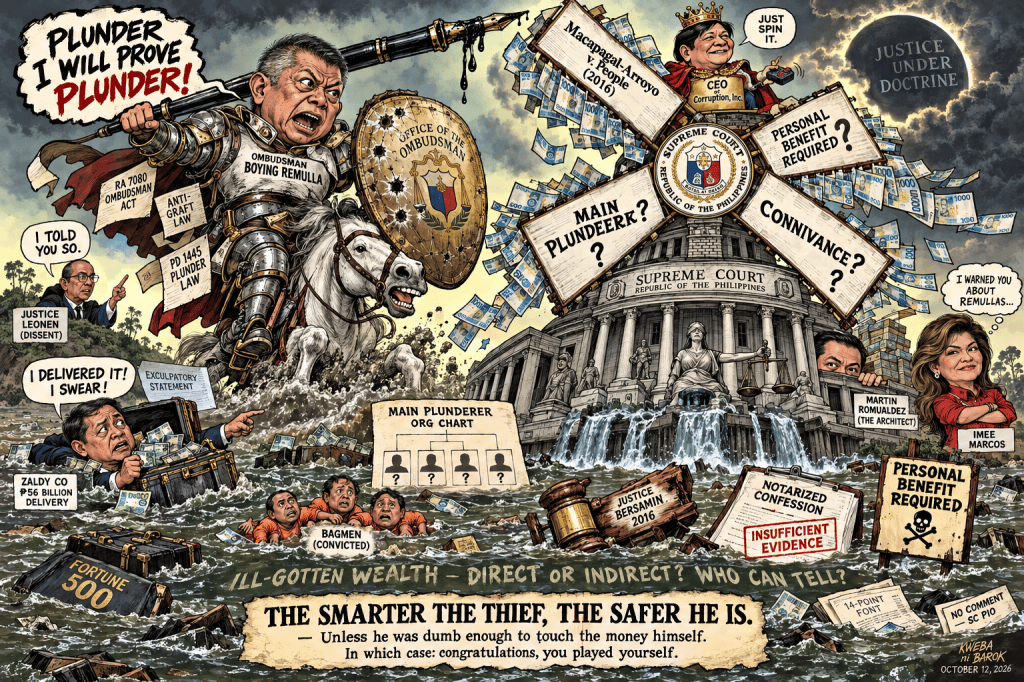
The Doctrine That Rewards the Mastermind and Punishes the Bagman
By Louis ‘Barok’ C. Biraogo — October 13, 2026
LET me say this with all the sincerity of a man who has spent years documenting the theological absurdities of Philippine governance: Jesus Crispin “Boying” Remulla is the first Ombudsman in recent memory to have actually read Republic Act No. 7080 (The Anti-Plunder Law). This is not a compliment. It is a scandal.
His predecessors, after all, presided over the institutional slumber that allowed the biggest heist in Philippine history—the ₱1.14 trillion flood control scandal—to be prosecuted under a legal framework that practically requires the thieves to have signed a notarized confession before anyone can be convicted.
And now Remulla, in his first annual report, has done what no Ombudsman before him had the audacity to do: he has publicly called out the Supreme Court for constructing a doctrinal shield around the very criminals the law was designed to catch.
“The smarter the thief, the safer he is,” Remulla said, with the kind of bluntness that makes Malacañang’s speechwriters wince and the Supreme Court’s public information office issue terse “no comment” statements.
He is right. And the fact that he is right should terrify every plunderer who has ever passed a bribe through a shell company, a dummy, or a congressman’s cousin.
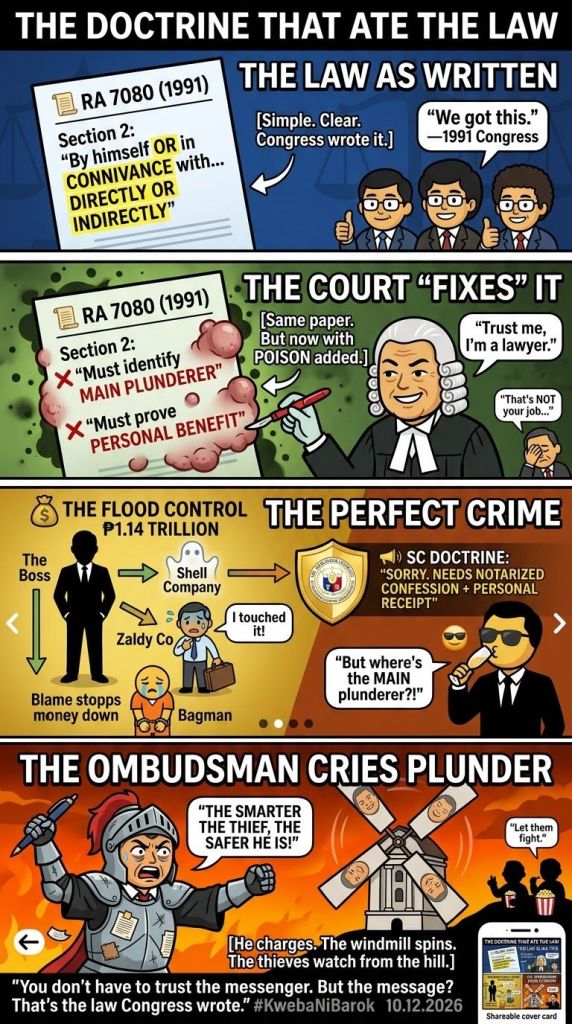
We made it into a comic because the Supreme Court made it into a shield. 🛡️💰 #PlunderLaw #Philippines #Corruption
The Doctrine That Ate the Anti-Plunder Law
Let us revisit the crime scene.
In 2016, the Supreme Court, in Macapagal-Arroyo v. People, did something extraordinary. It read into the Anti-Plunder Law two requirements that Congress—in its infinite, occasionally coherent wisdom—never wrote into the statute.
- First: the prosecution must identify a “main plunderer.” Not just any plunderer. The main one. The CEO of Corruption, Inc. The Big Boss. Because apparently, criminal syndicates operate with the organizational clarity of a Fortune 500 company, complete with an org chart that lists “Mastermind” in bold, 14-point font.
- Second: the prosecution must prove that the accused personally received or benefited from the stolen money.
Now, let us pause to appreciate the sheer, breathtaking naivety of this requirement. In the real world—the one where corruption actually happens, not the one where Supreme Court justices apparently believe it happens—money does not travel with a name tag. It travels through accounts in the names of cousins, drivers, mistresses, fake NGOs, and a shell company registered in the name of a security guard who doesn’t know he owns it.
The Macapagal-Arroyo doctrine, as Remulla correctly notes, effectively requires prosecutors to prove that the mastermind personally reached into the treasury and stuffed the cash into his own pocket. If he used an intermediary—a congressman, a budget official, a suitcase courier—then congratulations, you have proven nothing.
This is not justice. This is a legal maze designed by someone who has never had to trace a single peso through the Philippine banking system. And I say this with the deepest respect for the Supreme Court, which, as an institution, has given us many fine decisions that I am sure were written by very intelligent people who have never had to file a suspicious transaction report in their lives.
The Flood Control Scandal: A Case Study in Doctrine-Enabled Impunity
Consider what Remulla is actually dealing with.
The flood control scandal—the one that brought down a House Speaker and has implicated everyone from former Department of Public Works and Highways (DPWH) officials to sitting senators to the President’s own cousin—involved an estimated ₱1.14 trillion in alleged losses. Money moved through layers of contractors. Kickbacks were delivered in suitcases. Accounts were opened in names that belonged to people who existed primarily on paper.
If Remulla’s prosecutors must identify a single “main plunderer” and prove that this person personally benefited, then the Zaldy Co narrative—in which the former Ako Bicol congressman claims he delivered ₱56 billion in cash to Romualdez and Marcos through intermediaries—becomes legally irrelevant. Co says the money passed through him. He says he was just a conduit. He says he didn’t keep any of it.
Under the Macapagal-Arroyo doctrine, that confession is not a roadmap to conviction. It is an exculpatory statement.
The person who actually touched the money—the courier, the bagman, the staffer who carried the suitcases—may be guilty. But the person who ordered the deliveries, who set the percentages, who built the system? Under the doctrine, that person is protected. The law, as the Supreme Court has interpreted it, rewards the architect and punishes the mason.
This is what Remulla means when he says “the biggest syndicate is the hardest to catch.” It is not a rhetorical flourish. It is a precise description of the doctrine’s operational effect.
The Ghost of Bersamin Past
There is a certain poetic irony in the fact that the doctrine Remulla is challenging was penned by Lucas Bersamin—the same jurist who would go on to lead the Supreme Court as Chief Justice. Now retired, Bersamin’s doctrinal legacy still binds the Court that must decide whether to overturn it.
This is the kind of institutional awkwardness that Philippine politics specializes in. It is not quite a conflict of interest. It is more like a conflict of ego. Reversing Macapagal-Arroyo would be an implicit admission that the Court’s 2016 decision was wrong—not just wrong in outcome, but wrong in reasoning. It would require the current justices to declare that a former Chief Justice’s landmark ruling created a loophole big enough to drive a convoy of dump trucks through.
And not just any dump trucks. Dump trucks filled with flood control funds that were supposed to prevent the kind of flooding that killed people while the money was being diverted.
The Supreme Court, to its credit, has not yet responded to Remulla’s challenge. It is probably still trying to figure out how to overturn a doctrine without admitting that the doctrine was a mistake. This is the judicial equivalent of trying to unring a bell while maintaining plausible deniability about the ringing.
The Dissent That Should Have Been the Majority
Here is what makes Remulla’s position legally compelling, not just rhetorically effective: the Macapagal-Arroyo decision was not unanimous. Justice Marvic Leonen, in a dissent that should be required reading for every prosecutor in the country, argued that the majority was effectively amending the statute.
His textual argument was devastating in its simplicity. Section 2 of the Anti-Plunder Law explicitly covers a public officer who acts “by himself or in connivance with members of his family, relatives by affinity or consanguinity, business associates, subordinates or other persons.” Section 1(d) explicitly defines ill-gotten wealth as including assets acquired “directly or indirectly” through dummies, nominees, agents, and business associates.
The law already contemplates exactly the kind of layered, intermediary-heavy corruption that the Macapagal-Arroyo doctrine claims to address. The majority’s additional requirements are not interpretations of the statute. They are additions to the statute. And as Leonen pointed out, that is Congress’s job, not the Court’s.
But the majority prevailed. And so, for a decade, plunder prosecutions have been governed by a doctrine that requires prosecutors to do the impossible: prove that the person who orchestrated the theft actually touched the money, in a system specifically designed to ensure that the person who orchestrates the theft never touches the money.
It is, as Remulla says, a shield.
The Remulla Paradox
Here is where I must confess to a certain ambivalence about the Ombudsman—not about his argument, which is sound, but about the man making it.
Boying Remulla is not a saint. He is a Remulla. His family has been a fixture in Cavite politics for decades. His brother Jonvic is the Interior Secretary and, until recently, was openly positioning himself for a presidential run. His appointment as Ombudsman was controversial, opposed by no less than Senator Imee Marcos, who had her own reasons for opposing anyone with Remulla’s last name.
Critics have accused the Remulla family of using the anti-corruption drive as a political weapon—a way to consolidate power, eliminate rivals, and position Jonvic for higher office. The Philippine Offshore Gaming Operator (POGO) controversy, which touched the family’s Island Cove property, remains a convenient talking point for those who prefer their anti-corruption crusaders to be untainted by anything more controversial than a parking ticket.
And yet.
And yet, the argument Remulla is making is correct. It is correct on the text of the statute. It is correct on the practical realities of corruption. It is correct on the constitutional principle that Congress, not the Supreme Court, writes the elements of crimes.
You do not have to trust Boying Remulla’s motives to recognize that he has identified a genuine legal problem. You do not have to believe he is a saint to acknowledge that he is, in this instance, fighting the right fight.
This is the uncomfortable truth about Philippine governance: sometimes the people making the right arguments are the people you least want to agree with. Sometimes the reformer has a family interest. Sometimes the crusader has a conflict. And sometimes, the Ombudsman who cries plunder is the same Ombudsman whose brother wants to be president.
But the law does not care about motives. It cares about text, and precedent, and whether the doctrine that currently governs plunder prosecutions actually reflects what Congress wrote in 1991.
It does not.
What Remulla Gets Right
Let us be precise about what Remulla is arguing, because the Supreme Court will almost certainly try to mischaracterize it as a plea to make convictions easier.
He is not saying that plunder should be easier to prove. He is saying that the Court should not have added elements to the crime that Congress did not enact.
This is a basic separation-of-powers argument. It is also a basic textual argument. The Anti-Plunder Law does not mention a “main plunderer.” It does not require proof of personal benefit for every accused. It requires proof of a public officer, acting alone or in connivance with others, who amasses ill-gotten wealth through a combination of criminal acts, in an aggregate amount of at least ₱50 million.
The Macapagal-Arroyo doctrine grafted two additional requirements onto this statutory framework. And in doing so, it created a roadmap for sophisticated corruption: use intermediaries, conceal the money trail, ensure that the person at the top never personally touches the proceeds, and you are immune from prosecution.
This is not a theoretical problem. It is the flood control scandal. It is the Zaldy Co narrative. It is the ₱56 billion question of who actually benefited from the kickbacks that Co says he delivered.
Under the current doctrine, the answer might be: nobody provably did. And that is precisely the problem.
The Court’s Dilemma
The Supreme Court now faces a choice that is as politically fraught as it is legally significant.
- Option one: Uphold Macapagal-Arroyo. This preserves judicial stability and avoids the embarrassment of overturning a landmark ruling. It also sends a clear signal that the Court is comfortable with a doctrine that critics—including a sitting Ombudsman—say shields the most sophisticated plunderers. The public perception cost would be enormous, particularly in the context of a scandal that has already toppled a House Speaker.
- Option two: Overturn or modify the doctrine. This would correct what Remulla and Leonen argue is a textual error. It would make plunder prosecutions more viable in complex cases. But it would also raise retroactivity concerns, potentially affecting past acquittals, and would embarrass the Chief Justice who authored the original decision.
- Option three: Punt to Congress. The Court could acknowledge the problem and invite legislative amendment. This respects separation of powers but leaves the flood control prosecutions in limbo for years while Congress—which is not exactly a profile in courage on anti-corruption legislation—dithers.
Remulla, to his credit, has taken his case to the public, not just to the Court. His annual report is a political document as much as a legal one. He is building pressure, creating a record, and daring the Court to explain why a doctrine that makes “the biggest syndicate the hardest to catch” is somehow consistent with the Anti-Plunder Law’s purpose.
The Verdict
Ombudsman Boying Remulla is not a saint, and his political lineage and family’s broader ambitions are matters of public record. Yet even imperfect messengers can carry a righteous argument.
And on this issue—this one, specific, legally precise issue—he is right.
The Macapagal-Arroyo doctrine is not a shield. It is a sieve. It is a legal framework that was constructed, perhaps inadvertently, perhaps intentionally, to protect the architects of grand corruption from the consequences of their grand designs. It requires prosecutors to prove something that sophisticated criminals are specifically structured to prevent: direct, traceable, personal benefit.
The flood control scandal is the test case. If the doctrine stands, the people who orchestrated the largest theft in Philippine history—whoever they turn out to be—may escape because they were smart enough to use intermediaries. And the intermediaries, the bagmen, the suitcase carriers, will take the fall.
That is not justice.
And for once, the Ombudsman is willing to say so out loud.
Louis ‘Barok’ C. Biraogo is a writer and policy analyst. He writes the Kweba ni Barok blog, where he documents the absurdities of Philippine governance with the grim humor of someone who has been watching for far too long.
Key Citations
A. Legal & Official Sources
- The 1987 Constitution of the Republic of the Philippines. Official Gazette of the Republic of the Philippines, 1987, http://www.officialgazette.gov.ph/constitutions/1987-constitution/.
- Republic Act No. 7080. An Act Defining and Penalizing the Crime of Plunder. Official Gazette of the Republic of the Philippines, 12 July 1991, http://www.officialgazette.gov.ph/1991/07/12/republic-act-no-7080/.
- Republic Act No. 7659. An Act to Impose the Death Penalty on Certain Heinous Crimes. Official Gazette of the Republic of the Philippines, 13 Dec. 1993, http://www.officialgazette.gov.ph/1993/12/13/republic-act-no-7659/.
- Macapagal-Arroyo v. People, G.R. Nos. 220598 & 220953. Supreme Court of the Philippines, 19 July 2016, lawphil.net/judjuris/juri2016/jul2016/gr_220598_2016.html.
- Macapagal-Arroyo v. People, G.R. Nos. 220598 & 220953. Resolution, Supreme Court of the Philippines, 18 Apr. 2017, lawphil.net/judjuris/juri2017/apr2017/gr_220598_2017.html.
- Leonen, Marvic M.V.F. Dissenting Opinion. Macapagal-Arroyo v. People, G.R. Nos. 220598 & 220953, Supreme Court of the Philippines, 19 July 2016, lawphil.net/judjuris/juri2016/jul2016/pdf/gr_220598_leonen.pdf.
- Estrada v. Sandiganbayan, G.R. No. 148560. Supreme Court of the Philippines, 19 Nov. 2001, lawphil.net/judjuris/juri2001/nov2001/gr_148560_2001.html.
B. News Reports
- Laqui, Ian. “Remulla to Supreme Court: Time to Review Anti-Plunder Law amid Flood Control Scandal.” Philstar.com, 12 Oct. 2026, http://www.philstar.com/headlines/2026/10/12/2562655/remulla-supreme-court-time-review-anti-plunder-law-amid-flood-control-scandal.
- Locus, Sundy. “Zaldy Co: Marcos Jr., Romualdez Took P56B in Flood Control Kickbacks.” GMA News Online, 16 Nov. 2025, http://www.gmanetwork.com/news/topstories/nation/966325/zaldy-co-marcos-jr-romualdez-took-p56b-in-flood-control-kickbacks/story/.
- Porcalla, Delon, and Jose Rodel Clapano. “Romualdez Resigns as Speaker.” Philstar.com, 18 Sept. 2025, http://www.philstar.com/headlines/2025/09/18/2473640/romualdez-resigns-speaker.
- “Imee Marcos to Oppose Boying Remulla’s Ombudsman Bid.” GMA News Online, 2 Sept. 2025, http://www.gmanetwork.com/news/topstories/nation/957753/imee-marcos-to-oppose-boying-remulla-s-ombudsman-bid/story/.
- “Marcos Promised a Crackdown on Flood Control Corruption. What Happened a Year Later?” Rappler, 26 July 2026, http://www.rappler.com/philippines/marcos-promise-crackdown-flood-control-corruption-year-later/.
- ₱9 Billion in ‘Savings’? DILG’s Fire Truck Deal Smells Like Smoke

- ₱8B BBM Pork: CCTV for Every Captain’s Kumpare?

- ₱8.9 Billion, 331 Ghost Police Stations: The TIKAS Scandal Explained

- ₱8.4 Billion, 42,000 Barangays, 1 Election: The “Bawat Barangay Makikinabang” Vote-Buying Masterclass

- ₱75 Million Heist: Cops Gone Full Bandit

- ₱6.77B Ghost Haunts Duterte: RTC Dismisses Mans Carpio’s Desperate Plea

- ₱6.77 Billion and Zero Cash: The Sara Duterte SALN Math That Doesn’t Add Up

- ₱6.7-Trillion Temptation: The Great Pork Zombie Revival and the “Collegial” Vote-Buying Circus

- ₱58.53B, Zero Receipts: The LGSF Pork Barrel Nobody Wants to Name
- ₱53 Million Man Tells ₱695-a-Day Workers to Stop Being ‘Mayabang’: The Audacity of BSP’s Remolona

- ₱4.4 Billion and a Witness Who Can’t Explain It: The Duterte Impeachment’s Most Expensive Non-Answer

- ₱3.06 Billion for Evacuation Centers—But Nobody Knows Where They’ll Stand (Or If They’ll Exist)






Leave a Reply