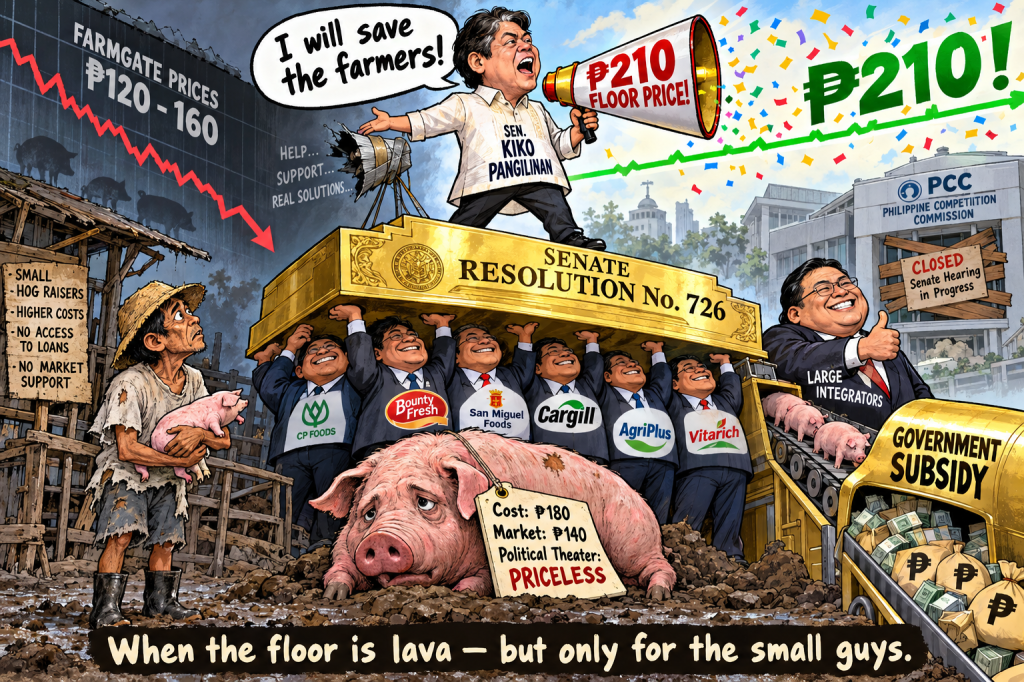
The farmgate price crisis has a villain problem—and it’s not who Pangilinan wants you to think.
By Louis ‘Barok‘ C. Biraogo — October 14, 2026
Senate Resolution No. 726 sounds noble enough. Filed October 8, it directs the Senate Committee on Agriculture to investigate why hog and poultry raisers are selling at a loss—₱120 to ₱160 per kilo for hogs against a production cost of ₱180 to ₱190, and broilers bottoming out at ₱65 per kilo—while retail pork barely budged. The resolution warns of farmers exiting the industry, deepening import dependence, and undermining food security.
Pangilinan, chair of the agriculture committee, is doing what committee chairs do: holding hearings, generating headlines, and positioning himself as the farmer’s champion.
The problem is that the numbers he cites may not support the conclusion he seems to be building toward—that something nefarious is afoot. And if he’s not careful, he’ll end up advocating for a price floor that helps the wrong people and hurts the ones he claims to protect.
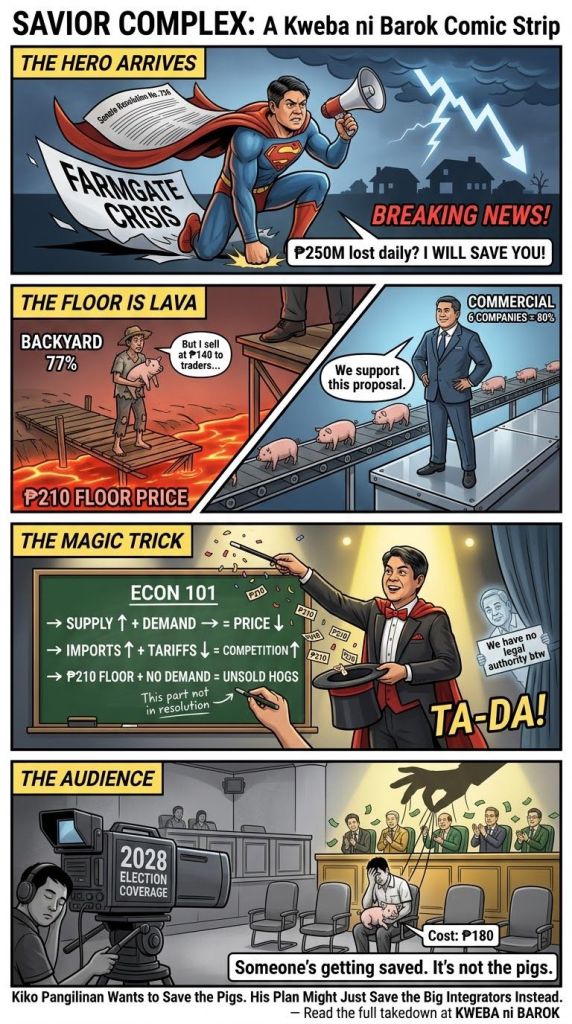
The Floor Price Fantasy
The Department of Agriculture (DA) and hog industry groups have coalesced around a ₱210 per kilo minimum farmgate price. It sounds great on paper: farmers get paid more, rural livelihoods are preserved, and the country maintains domestic production capacity.
Except the DA apparently knows it can’t actually impose this. Here’s what the DA won’t say too loudly: it has no statutory power to mandate a floor price. It just likes talking about one. That’s the kind of admission that should end the conversation before it starts, but in Philippine agricultural policy, inconvenient legal details rarely stop a good headline.
Here’s the thing about price floors: they don’t create demand. They just make it illegal to sell below a certain point. If the market clearing price is ₱140 and you mandate ₱210, you don’t get ₱210—you get unsold hogs, black markets, and farmers who still can’t move their product because buyers refuse to pay above market value.
Unless, of course, the government plans to buy all the excess supply. And unless Congress appropriates funds for that. And unless someone explains why taxpayers should subsidize an industry that produced too much in the first place.
The Supply Story Nobody Wants to Tell
Look at the actual numbers. Hog production is recovering. Imports remain elevated. Inventories are high. Consumer demand is weak because fuel costs are eating household budgets.
What happens when supply recovers while demand stays flat? Prices fall. That’s not a cartel. That’s Econ 101.
The poultry sector tells the same story. Broiler production increased 5.8% year-on-year in Q1 2026. Farmgate prices collapsed to ₱65 per kilo in April. The United Broiler Raisers Association blamed weak demand and oversupply.
None of this requires a conspiracy. It requires a market doing what markets do when too much product chases too few buyers.
Pangilinan’s resolution acknowledges “competition from imported products” as a factor. Lower tariffs under Executive Order No. 62 brought in cheaper pork, which is exactly what tariff reductions are supposed to do: lower consumer prices by increasing supply. The farmgate collapse is the predictable consequence for domestic producers who can’t compete on cost.
You can argue that the tariff policy was poorly timed or poorly calibrated. You can argue that the government should have sequenced trade liberalization with support for domestic producers. But you can’t call it a cartel when it’s a policy choice.
The Real Cartel Question
If Pangilinan wants to investigate market power, he should look at buyer concentration—not producer prices.
Republic Act No. 10667 (Philippine Competition Act)’s Section 15(g) specifically prohibits “directly or indirectly imposing unfairly low purchase prices upon goods or services provided by marginalised service providers and producers.” That’s the provision that matters here.
Six companies. Eighty percent of commercial poultry output. FAO figures. That’s not a market—that’s an oligopoly with a chicken logo, and it has every incentive to squeeze contract growers and independent raisers. They set the terms, control the day-old chick supply, and can absorb losses that would bankrupt smaller operations.
If the probe finds evidence that these buyers are coordinating to suppress farmgate prices, that’s a competition case, not a price-control case. And the proper forum is the Philippine Competition Commission (PCC), which has the mandate and expertise to investigate.
But here’s the uncomfortable question Pangilinan should ask: do the large integrators actually want a price floor? A mandatory minimum would disproportionately benefit the biggest producers, who sell the most volume. Small backyard raisers—77% of hog inventory, according to the FAO data—might not even have the scale to access formal markets where the floor is enforced.
A ₱210 floor that helps commercial integrators while backyard farmers still sell at ₱140 to traders in the barangay is not a win for small producers. It’s a subsidy for the consolidated players who already dominate the market.
The Missing Cost Analysis
The ₱180 to ₱190 per kilo production cost figure comes from industry groups. That’s not an independent audit. It’s an advocacy position.
Production costs vary wildly by farm size, efficiency, feed access, and biosecurity. A commercial integrator with its own feed mill and contract growers has a very different cost structure than a backyard raiser buying feed at retail prices. A price floor set at the average cost of production will be too low for inefficient farms and too high for efficient ones.
What Pangilinan’s committee should demand is an independent, farm-level cost study that separates cash operating costs from full economic costs—including depreciation, financing, and the opportunity cost of family labor. A backyard raiser who “loses money” on paper may still be cash-flow positive because they aren’t paying themselves a salary. A commercial farm reporting losses may be carrying debt from expansion during the high-price years.
Without that granularity, the committee is just picking a number that sounds fair and hoping it doesn’t cause too much damage.
The Smuggling Distraction
Pangilinan has also raised the specter of smuggling, citing past scandals and warning that Bureau of Customs, Local Government Unit (LGU), DA, and Department of Public Works and Highways (DPWH) officials may be “enablers.” There’s no question that agricultural smuggling is a real problem—Republic Act No. 12022 (Anti-Agricultural Economic Sabotage Act), was passed precisely because existing enforcement was inadequate.
But smuggling doesn’t explain the current price collapse. Legal imports under EO 62 are more than sufficient to depress farmgate prices. The tariff reduction was the policy; the price effect was the intended outcome.
If Pangilinan wants to investigate smuggling, he should do it separately from the farmgate price inquiry. Conflating the two muddies the analytical waters and allows everyone to avoid the hard question: was the tariff reduction a mistake, and if so, what should replace it?
What Pangilinan Should Actually Do
The Senate resolution is constitutionally grounded. Article VI, Section 21 of the 1987 Constitution gives Congress broad authority to conduct inquiries in aid of legislation, and farmgate prices are a legitimate subject for legislative review.
But authority isn’t the same as wisdom.
If Pangilinan wants to help small farmers, he should focus on three things his committee can actually accomplish:
- First, refer competition concerns to the PCC. If there’s evidence of buyer power abuse under Section 15(g), let the agency with the mandate investigate and prosecute. Senate hearings are not trials, and senators are not prosecutors.
- Second, demand transparent cost data. Before recommending any price intervention, the committee should commission an independent study that distinguishes between efficient and inefficient producers, commercial and backyard operations, and cash versus economic costs. The ₱210 figure is an industry wish, not a policy analysis.
- Third, examine the tariff decision honestly. EO 62 reduced pork tariffs from 40% to 25%. That wasn’t an accident. It was a deliberate policy choice to lower consumer prices. If that choice was wrong, say so. If it was right, acknowledge that some farmgate pain was the cost of cheaper protein for Filipino households.
The worst outcome would be a price floor that doesn’t work, a smuggling investigation that goes nowhere, and a legislative report that blames “cartels” without naming anyone or proving anything.
The Political Elephant
Pangilinan is chair of the agriculture committee, a position he secured after aligning with the Senate majority in July 2025. He’s also Liberal Party chair emeritus and reportedly eyeing a 2028 run.
There’s nothing wrong with a politician using committee hearings to build a national profile. That’s how the game is played. But the farmers who are actually losing money don’t need another hearing that produces headlines and no legislation.
They need cheaper feed, better access to credit, functioning animal health systems, and a market that doesn’t treat them as disposable inputs in someone else’s supply chain.
A Senate investigation can expose problems. It can generate recommendations. It can pressure agencies to act.
What it can’t do is change the fundamental arithmetic: if it costs ₱180 to produce a kilo of pork and the market will only pay ₱140, someone is going to lose money. The question is whether public policy should socialize that loss through subsidies, allocate it to consumers through higher prices, or let the market work and accept that some farms will fail.
Pangilinan’s resolution implies the government should prevent those failures. That’s a defensible position. But he should be honest about the costs, the tradeoffs, and who actually benefits from the intervention he’s building toward.
Because if the answer is “large integrators and politically connected producer groups,” he’s not protecting small farmers. He’s just rearranging the deck chairs.
Louis ‘Barok’ C. Biraogo is a writer and policy analyst who reads Senate resolutions so you don’t have to—and then asks the questions senators hope nobody notices. This commentary reflects his personal views and his ongoing suspicion that Philippine governance is a comedy written by someone with a grudge.
Key Citations
A. Legal & Official Sources
- The 1987 Constitution of the Republic of the Philippines, Article VI, Section 21. Official Gazette of the Republic of the Philippines, 1987, http://www.officialgazette.gov.ph/constitutions/the-1987-constitution-of-the-republic-of-the-philippines/the-1987-constitution-of-the-republic-of-the-philippines-article-vi/.
- Republic Act No. 10667. An Act Providing for a National Competition Policy Prohibiting Anti-Competitive Agreements, Abuse of Dominant Position and Anti-Competitive Mergers and Acquisitions, Establishing the Philippine Competition Commission and Appropriating Funds Therefor. Official Gazette of the Republic of the Philippines, 21 July 2015, http://www.officialgazette.gov.ph/2015/07/21/republic-act-no-10667/.
- Republic Act No. 12022. An Act Defining the Crimes of Agricultural Economic Sabotage, Prescribing Penalties Therefor, Vesting Jurisdiction Over Such Offenses with the Court of Tax Appeals, Providing Mechanisms for Its Implementation and Enforcement, Repealing for the Purpose Republic Act No. 10845 or the “Anti-Smuggling Act of 2016.” Lawphil Project, 26 Sept. 2024, lawphil.net/statutes/repacts/ra2024/ra_12022_2024.html.
- Executive Order No. 62, s. 2024. Modifying the Nomenclature and Rates of Import Duty on Various Products. Official Gazette of the Republic of the Philippines, 20 June 2024, http://www.officialgazette.gov.ph/2024/06/20/executive-order-no-62-s-2024/.
B. News Reports
- “P250M lost daily? Kiko Pangilinan seeks probe into hog, poultry industry.” Politiko, 9 Oct. 2026, politiko.com.ph/p250m-lost-daily-kiko-pangilinan-seeks-probe-into-hog-poultry-industry/.
- Department of Agriculture. “DA backs industry P210 hog floor price proposal.” Official Portal of the Department of Agriculture, 20 Sept. 2026, http://www.da.gov.ph/da-backs-industry-p210-hog-floor-price-proposal/.
- Halili, Adrian Kenneth. “Poultry farmgate prices pulled down by soft demand, oversupply – UBRA.” The Philippine Star, 25 May 2026, http://www.philstar.com/business/2026/05/25/2530226/poultry-farmgate-prices-pulled-down-soft-demand-oversupply-ubra.
- ₱9 Billion in ‘Savings’? DILG’s Fire Truck Deal Smells Like Smoke
- ₱8B BBM Pork: CCTV for Every Captain’s Kumpare?
- ₱8.9 Billion, 331 Ghost Police Stations: The TIKAS Scandal Explained

- ₱8.4 Billion, 42,000 Barangays, 1 Election: The “Bawat Barangay Makikinabang” Vote-Buying Masterclass

- ₱75 Million Heist: Cops Gone Full Bandit

- ₱6.77B Ghost Haunts Duterte: RTC Dismisses Mans Carpio’s Desperate Plea
- ₱6.77 Billion and Zero Cash: The Sara Duterte SALN Math That Doesn’t Add Up

- ₱6.7-Trillion Temptation: The Great Pork Zombie Revival and the “Collegial” Vote-Buying Circus

- ₱58.53B, Zero Receipts: The LGSF Pork Barrel Nobody Wants to Name
- ₱53 Million Man Tells ₱695-a-Day Workers to Stop Being ‘Mayabang’: The Audacity of BSP’s Remolona
- ₱4.4 Billion and a Witness Who Can’t Explain It: The Duterte Impeachment’s Most Expensive Non-Answer
- ₱3.06 Billion for Evacuation Centers—But Nobody Knows Where They’ll Stand (Or If They’ll Exist)



Leave a Reply