A Political Dynasty, a Coal Moratorium, and the Graft Complaint That Says It All
By Louis ‘Barok’ C. Biraogo — October 14, 2026
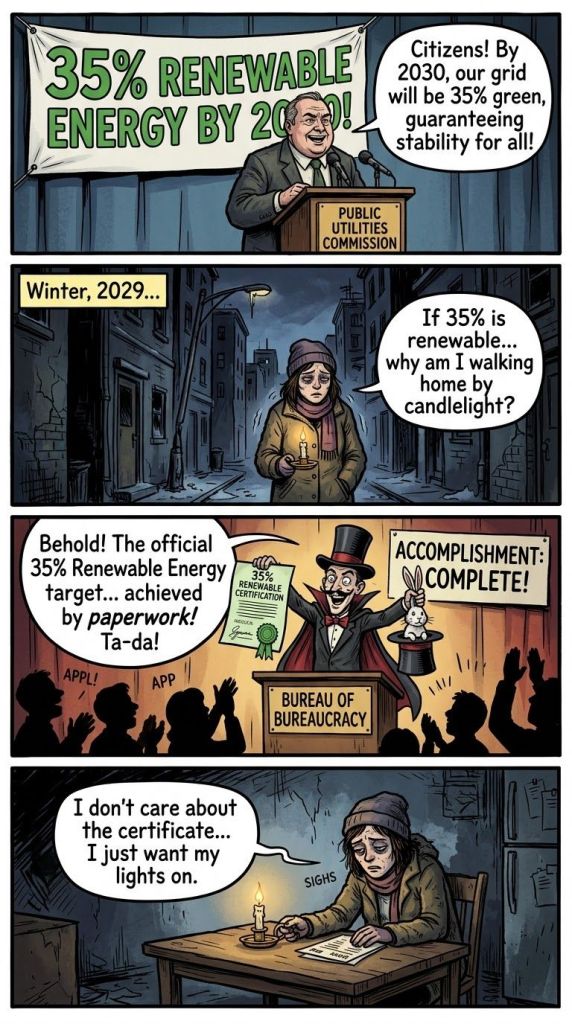
IT IS a truth universally acknowledged in Philippine energy circles that when a government official says they are “very confident” about hitting a renewable energy target, what they actually mean is “please don’t look too closely at the numbers, the contracts, or the grid.”
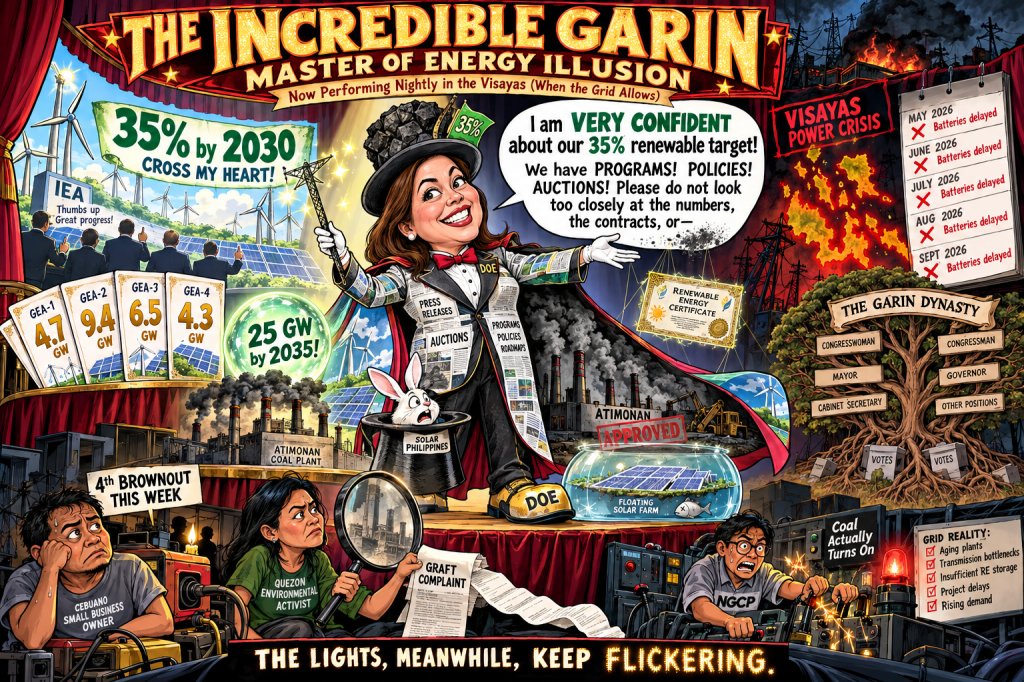
Energy Secretary Sharon Garin—yes, the same Sharon Garin whose family has controlled Iloilo’s First District since the days when the only thing “renewable” in Philippine politics was the same surnames appearing on ballots—took to the stage at the Joint Foreign Chambers forum on October 9, 2026, to declare that the Philippines will absolutely, positively, cross-my-heart-and-hope-to-die reach 35% renewable energy by 2030. She said this with the unshakeable confidence of someone who has never had to explain to a Cebuano small business owner why the lights just went out for the fourth time that week.
Let’s be clear about what Garin is selling. The Philippines currently sits at roughly 25% renewable energy in its generation mix. Coal, the fuel source that environmentalists love to hate and that grid operators secretly love because it actually turns on, still dominates at around 60%. The gap to 35% is a 40% relative increase in renewable share in just four years. That is not a stretch goal. That is a “hold my beer while I set the power system on fire” goal.
And yet Garin is “very confident.” Because of “all the programs that we have”. Programs. Policies. Auctions. Announcements. Press releases. A 25 GW auction pipeline extending to 2035. Roughly 20 GW awarded through the first four Green Energy Auctions. It all sounds terribly impressive—until you realize that announced capacity is not the same as generated electricity, and awarded contracts are not the same as operational power plants.
But this is not really about renewable energy. This is about Sharon Garin, political dynasty scion, former party-list representative, and now the Philippines’ top energy official. And it is about a fundamental question:
Can a government that cannot keep the lights on in the Visayas credibly promise to power the entire archipelago with sunshine and wind?
#AtimonanCoalPlant #Ombudsman #PoliticalDynasty #PHpolitics”
The Visayas Crisis: A Case Study in “Energy Resiliency”
Let’s start with the most glaring contradiction in Garin’s narrative. In the same breath that she promises a renewable energy revolution, the Visayas has been living through a power crisis of almost comic proportions since May 2026.
Yellow alerts. Red alerts. Rotational brownouts lasting an hour per area. Businesses running diesel generators. Residential consumers being told to avoid “unnecessary appliances, especially during nighttime”.
This is the Visayas. Cebu. Iloilo. Negros. The economic heartland of the central Philippines. A region with 520,000 connections in Metro Cebu alone. And the grid cannot meet demand.
Garin’s response? Battery-powered facilities that were supposed to be installed by June, then delayed, then promised for “within the month” as of September. Diesel-powered barges. Show-cause orders to generation companies. These are not solutions. These are rearranging deck chairs on the Titanic while promising that next year’s ship will be made of solar panels.
The Power for People Coalition (P4P) has been calling for Garin’s resignation since at least late March 2026, and the call intensified as the crisis entered its fifth month. Bishop Gerardo Alminaza of Caritas Philippines asked the question that Garin has never adequately answered: “Is the Department of Energy able to make corporations accountable for their failure to deliver on their contracted obligations?”.
The answer, based on the evidence, is: Not really. And that is the heart of the renewable energy credibility problem.
The Atimonan Coal Plant: When “Renewable Energy Champion” Meets Coal
If you want to understand the Garin Department of Energy (DOE), you do not need to study the Green Energy Auction program. You need to study the Atimonan One Energy coal-fired power plant.
In 2020, the DOE issued a coal moratorium. No new greenfield coal plants. This was supposed to be the Philippines’ signal to the world that it was serious about climate change, serious about renewables, serious about moving beyond the fuel source that has powered—and polluted—the archipelago for decades.
In July 2025, just two months after Garin became DOE officer-in-charge, the department approved the 1,200-MW Atimonan coal plant. The complainants—including the Philippine Movement for Climate Justice, Quezon for Environment, church leaders, and local residents—allege that Atimonan One Energy Inc. did not meet the exemption criteria. They also allege that the project lacked a Health Impact Clearance Certificate required by joint DOH-DILG administrative order.
And here is the part that really deserves scrutiny: In October 2025—after the July approval—the DOE issued an advisory expanding the exemptions to the coal moratorium. The complainants argue, correctly, that this advisory cannot be applied retroactively to justify an approval that happened three months earlier.
Garin now faces criminal and administrative complaints before the Ombudsman for violation of the Anti-Graft and Corrupt Practices Act (RA 3019), grave misconduct, gross neglect of duty, and conduct prejudicial to the best interest of the service.
The PMCJ’s chief legal counsel, Atty. Aaron Pedrosa, put it bluntly: “Secretary Garin clearly violated her own department’s coal moratorium when she conveniently greenlighted the Atimonan coal plant despite DOE’s previous decision to bar the long-stalled project. Her approval bears the hallmarks of corruption by accommodating a project to the point of breaking existing regulations”.
This is the same Sharon Garin who is now promising a renewable energy revolution. The same Sharon Garin whose department is supposed to be enforcing non-performing renewable contracts. The same Sharon Garin who says “energy resiliency remains a priority”.
It would be funny if it were not so infuriating.
The Non-Performing Contract Crackdown: Enforcement or Performance Art?
Let’s give Garin credit where credit is due. Her DOE has been terminating renewable energy service contracts at a pace that would make a foreclosure lawyer proud. In 2024 and 2025, 163 renewable energy service contracts were terminated or relinquished. The Solar Philippines group alone lost 33 contracts covering 11,427 MW, with the DOE seeking P24 billion in penalties.
The DOE frames this as enforcement—clearing out speculative developers who were sitting on contracts without building anything. And there is a legitimate argument here. If you award a renewable energy service contract to a developer who never builds the project, you have not advanced the renewable energy transition. You have just given someone a paper asset and blocked a serious competitor from developing the site.
But here is the problem: The DOE’s own auction program has been awarding capacity that is not being delivered. The Green Energy Auction program has awarded roughly 20 GW through four rounds. How much of that is operational? The DOE says “most of the committed projects are now running”. But that is not a number. That is a public relations statement.
If the DOE is terminating 163 contracts because developers are not performing, what does that say about the auction design? What does that say about the feasibility studies, the grid connection assessments, the financial close requirements? If developers are winning auctions and then failing to build, either the auction is attracting bad actors, or the requirements are unrealistic, or both.
And the Solar Philippines case raises a particularly uncomfortable question. Solar Philippines is associated with Batangas Representative Leandro Leviste—a political figure. The DOE has filed a complaint with the Department of Justice against Leviste and five other officials. Is this enforcement or is this political? The answer requires evidence, not speculation. But the optics are not great when a political appointee is aggressively pursuing a political rival’s business interests while simultaneously claiming to champion the same renewable energy sector.
The Numbers Game: What 35% Actually Means
Let’s do some arithmetic, because the DOE seems allergic to it.
The Philippines currently gets about 25% of its electricity from renewables. Coal is around 60%. The target is 35% by 2030.
If total electricity demand grows—and it will, because the economy is supposed to grow—then renewable generation must grow faster than total demand just to maintain its current share. To increase the share to 35%, renewable generation must grow substantially faster than demand.
How much faster? That depends on demand growth. If demand grows 4% annually—a reasonable assumption for a developing economy—and renewables need to go from 25% to 35% in four years, the required renewable generation growth rate is roughly 15% annually. That is achievable in theory. Solar and wind can be built quickly. But it requires everything to go right.
And everything is not going right. Grid connection backlogs. Permitting delays. Transmission constraints. The National Grid Corporation of the Philippines (NGCP) is a monopoly that has historically struggled to keep pace with generation additions. The Energy Regulatory Commission (ERC) approved new rules in June 2026 to allow third parties to finance and construct transmission facilities—which is an admission that the existing system is not working.
Then there is the storage problem. Solar and wind are intermittent. The Visayas crisis has demonstrated that the grid cannot reliably meet peak demand even with existing capacity. Adding intermittent renewables without adequate storage and grid flexibility does not solve the reliability problem. It may make it worse.
The DOE talks about battery storage. It talks about agri-solar and canal-top solar and floating solar. It talks about offshore wind. These are all real technologies. They are all promising. They are not a substitute for a grid that actually works.
The IEA Approval: A Double-Edged Endorsement
The International Energy Agency (IEA) has cited the Philippines’ “growing momentum” on energy transition. The DOE has adopted 22 energy policies between February and August 2026—more than any other Southeast Asian country. This is genuinely impressive from a policy-production standpoint.
But policy production is not the same as policy implementation. The Green Energy Option Program, which allows electricity consumers to choose 100% renewable energy, remained essentially unenforced for over a decade. The Renewable Energy Market, where Renewable Energy Certificates are traded, only began operations in December 2023. These are not minor implementation gaps. These are fundamental failures of the renewable energy framework that have persisted through multiple administrations.
The IEA’s endorsement is also carefully hedged. It cites “promising signs” and “growing momentum.” It does not say the Philippines will hit 35% by 2030. It does not say the grid is ready. It does not say the auction program is delivering. It says the direction is positive. That is a much lower bar than Garin’s “very confident.”
The Political Dynasty Problem
We cannot discuss Sharon Garin without discussing the Garin political dynasty. The family has controlled Iloilo’s First District since 1987. Oscar Garin Sr., Ninfa Garin, Janette Garin, Richard Garin, Sharon Garin, Jennifer Garin-Colada, Lex Anthony Colada. It is a family business masquerading as public service.
Article II, Section 26 of the 1987 Constitution states: “The State shall guarantee equal access to opportunities for public service, and prohibit political dynasties as may be defined by law.” No enabling law has ever been passed. The constitutional provision is a dead letter, and the Garins are one of the reasons why.
Does this matter for energy policy? Directly, perhaps not. Sharon Garin’s credentials are real—CPA, lawyer, MBA, twelve years in Congress, DOE undersecretary. She knows the legislative process, she knows the agency, she has the technical background to understand the policy issues.
But indirectly, it matters enormously. When a political dynasty scion is appointed to a cabinet post, the appointment is never purely merit-based. It is a political transaction. The President appoints Garin because she is a Garin—because the Garin political network delivers votes, because Iloilo is a political battleground, because party-list representatives and dynastic families are part of the coalition that keeps Marcos in power.
This does not mean Garin is incompetent. It means her incentives are not purely about good energy policy. They are also about political survival, family interests, and maintaining the favor of the President. When she approves a coal plant that violates her own department’s moratorium, the question is not just whether the approval is legally defensible. The question is whether it serves political interests that have nothing to do with energy.
What Would Real Accountability Look Like?
If Garin truly wanted to demonstrate that her renewable energy optimism is grounded in reality rather than public relations, she would publish some basic information:
- How much of the 20 GW awarded through GEA-1 to GEA-4 is actually operational? Not “most of the committed projects are now running.” A specific number. A project-by-project accounting. How many megawatts are generating electricity today?
- How much of the 25 GW auction pipeline is expected to be operational by 2030? Not by 2035. By 2030. Because capacity delivered between 2031 and 2035 does not help the 35% target. It helps the 50% target for 2040. Different target, different year, different set of excuses.
- What is the actual generation forecast? Capacity is not generation. A 100 MW solar farm does not generate 100 MW of electricity 24/7. The DOE should publish a year-by-year forecast of renewable generation in megawatt-hours, not just installed capacity.
- What transmission projects are required, and when will they be completed? If the grid cannot accommodate the renewable capacity being auctioned, the auctions are meaningless. The DOE should identify the specific transmission facilities needed for each major project cluster.
- What is the status of the Atimonan coal plant approval? If the Ombudsman finds probable cause, what happens? Does the plant proceed? Does the approval get revoked? The DOE’s silence on this is deafening.
These are not hostile questions. They are the questions that any serious energy regulator should be able to answer. The fact that they are not being answered—that the DOE communicates in press releases and auction announcements rather than operational data—tells you something about the gap between the narrative and the reality.
The Verdict: Confidence Is Not a Policy
Sharon Garin is confident. She is “very confident.” She works at the pleasure of the President, and she will follow whatever direction he gives. This is not a profile in courage. This is a political appointee doing what political appointees do: projecting confidence, managing perceptions, and hoping that the gap between promise and delivery does not become too embarrassing before the next election cycle.
The Philippine renewable energy transition is real. The GEA program has attracted genuine investment. The policy framework, for all its flaws, is more advanced than it was a decade ago. But the transition is also fragile, underfunded, and undermined by a grid that cannot keep up and a government that cannot resist approving coal plants when politically convenient.
Garin’s 35% target is achievable in principle. It is not achievable through confidence alone. It requires transmission investment, grid modernization, storage deployment, permitting reform, and—most fundamentally—a government that prioritizes actual electricity delivery over auction announcements and press conferences.
Until then, the Visayas will keep having red alerts. Coal will keep dominating the grid. And Sharon Garin will keep being “very confident” about a future that keeps receding into the distance.
The lights, meanwhile, will keep flickering.
Louis ‘Barok’ C. Biraogo is a writer, policy analyst, and recovering believer in government press releases. He blogs at Kweba ni Barok.
Key Citations
A. Reports & Studies
- Department of Energy Philippines. “DOE advances 10-Year Green Energy Auction plan, targeting 25 GW of new renewable capacity by 2035.” DOE.gov.ph, 13 Feb. 2026.
B. News Articles
- Philippine Information Agency. “PH targets 35% renewable energy mix by 2030 driven by expanded auctions.” PIA.gov.ph, 2 Aug. 2026.
- bne IntelliNews. “Philippines plans 25-GW renewable energy auctions to hit 2030 goal.” IntelliNews, 9 Oct. 2026.
- Philippine News Agency. “DOE seeks ‘tougher’ stance in energy governance to protect consumers.” PNA.gov.ph, 10 Aug. 2026.
- Inquirer.net. “Energy Sec. Garin faces graft, other raps before Ombudsman.” Inquirer.net, 2 Nov. 2025.
- News 5. “Complaints filed vs DOE’s Garin over coal plant approval in Quezon.” News 5, 3 Nov. 2025.
- Power Philippines. “DOE rejects calls to lift coal moratorium.” PowerPhilippines.com, 7 May 2026.
- Philippine News Agency. “Visayas lawmakers seek probe on brownouts, power reserves charges.” PNA.gov.ph, 7 Sept. 2026.
C. Official Websites
- Department of Energy Philippines. “Secretary’s Corner.” DOE.gov.ph.
- Senate of the Philippines. “eClips Senate News Updates: Energy Sec. Garin faces graft, other raps before Ombudsman.” Senate.gov.ph, 3 Nov. 2025.
- Philippine Information Agency. “DOE, RDC 6 consider measures to address W. Visayas power concerns.” PIA.gov.ph, 20 Sept. 2026.
- ₱9 Billion in ‘Savings’? DILG’s Fire Truck Deal Smells Like Smoke

- ₱8B BBM Pork: CCTV for Every Captain’s Kumpare?
- ₱8.9 Billion, 331 Ghost Police Stations: The TIKAS Scandal Explained

- ₱8.4 Billion, 42,000 Barangays, 1 Election: The “Bawat Barangay Makikinabang” Vote-Buying Masterclass

- ₱75 Million Heist: Cops Gone Full Bandit

- ₱6.77B Ghost Haunts Duterte: RTC Dismisses Mans Carpio’s Desperate Plea
- ₱6.77 Billion and Zero Cash: The Sara Duterte SALN Math That Doesn’t Add Up

- ₱6.7-Trillion Temptation: The Great Pork Zombie Revival and the “Collegial” Vote-Buying Circus

- ₱58.53B, Zero Receipts: The LGSF Pork Barrel Nobody Wants to Name
- ₱53 Million Man Tells ₱695-a-Day Workers to Stop Being ‘Mayabang’: The Audacity of BSP’s Remolona

- ₱4.4 Billion and a Witness Who Can’t Explain It: The Duterte Impeachment’s Most Expensive Non-Answer
- ₱3.06 Billion for Evacuation Centers—But Nobody Knows Where They’ll Stand (Or If They’ll Exist)





Leave a Reply