
Inside PEZA’s Math: How ₱297 Billion Becomes a ₱500-Billion Prophecy
By Louis ‘Barok‘ C. Biraogo | October 12, 2026
IF YOU squint hard enough at the number—₱500 billion—it starts to look less like an investment target and more like a religious proposition. An article of faith, delivered not from a pulpit but from the Arangkada Forum of the Joint Foreign Chambers, that annual congregation of foreign businessmen where Philippine economic officials come to testify about their good works.
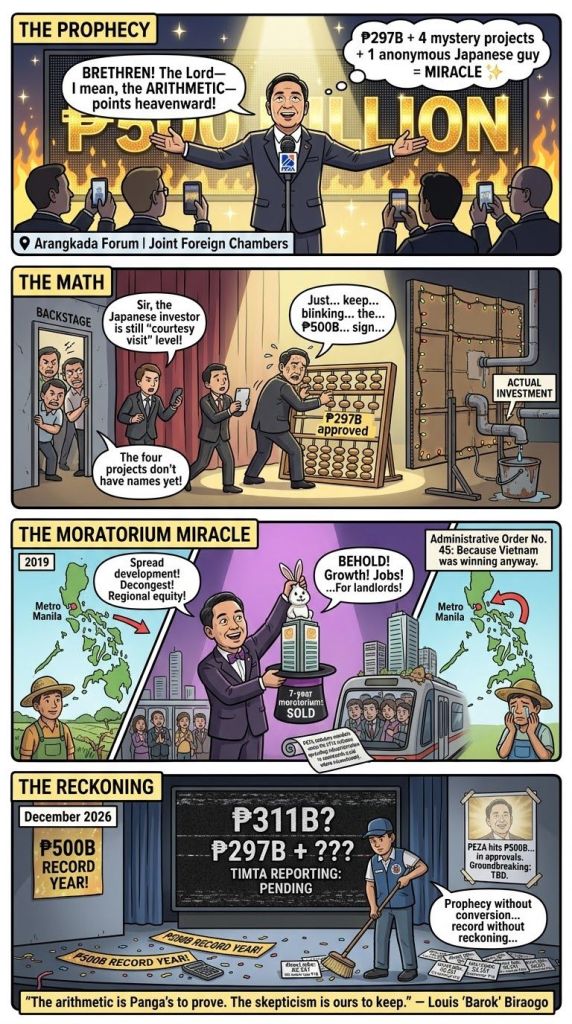
Philippine Economic Zone Authority (PEZA) Director General Tereso Panga stood before that congregation on a recent morning and prophesied. Four pending projects, each worth at least ₱50 billion. A one-billion-dollar Japanese electronics complex rising in Laguna. A seven-year moratorium on Metro Manila IT parks, lifted at last by Administrative Order No. 45. And the arithmetic, he suggested, points heavenward: with ₱297.14 billion already approved through September, this could be the year PEZA breaks its own 2012 record of ₱311 billion, and perhaps—perhaps—touches ₱500 billion.
Let me say plainly what is admirable here. Panga is doing something rare in Philippine economic governance: he is attaching his name to a falsifiable number. In a bureaucracy that prefers the fog of “ongoing studies” and “coordinated efforts,” the Director General has drawn a line. That takes a certain nerve, and nerve is a commodity in short supply along Roxas Boulevard.
But prophecy is not performance. And the gap between the two is where the real story lives.
The Arithmetic of Optimism
Run the numbers yourself, as I did.
Approved through September: ₱297.14 billion. The 2012 record: ₱311 billion—a gap of ₱13.86 billion, trivially closeable. The ₱500-billion summit, however, requires another ₱202.86 billion in the fourth quarter alone. That is 68 percent of everything approved in the preceding nine months, compressed into three.
The four pending projects supply, at minimum, ₱200 billion of that. Add it up and you get ₱497.14 billion. Panga’s prophecy falls ₱2.86 billion short of its own scripture—a rounding error, perhaps, unless it isn’t.
This is not a scandal. It is a forecast, and forecasts are permitted to be ambitious. But note what the headline number actually represents: approvals. Not shovels in the ground. Not payrolls. Not exports. The difference between an approved investment and a realized one is the difference between a wedding announcement and a marriage, and Philippine economic history is littered with engagements that never reached the altar.
The report itself concedes the essential limitation: the four projects are unnamed, their financing structures undisclosed, their operating timetables unknown, their incentive packages unexamined. We are asked to trust the pipeline without inspecting the pipe.
The Japanese Investor and Other Ghosts
The one-billion-dollar Japanese investment is the crown jewel of the narrative—two facilities, at Carmelray Industrial Park and Laguna Technopark, in semiconductors and electronics. If real and if built, this is precisely the kind of capital-intensive, export-oriented, skill-generating project the Philippines has chased for decades.
But consider the sourcing. The investment was mentioned in connection with a “courtesy visit to Trade Secretary Cristina Roque.” That is the language of courtship, not consummation. The investor remains unnamed, which is standard practice during negotiations but also convenient: an anonymous commitment cannot be embarrassed by follow-up questions.
I do not allege the project is fictitious. I note only that PEZA’s own history counsels skepticism about announcements that precede board resolutions.
- Recall the Balili property in Cebu—approved as an economic zone despite being underwater and classified as coastal timberland, later becoming the center of a graft case.
- Recall the smuggling allegations of 2013, when Subic and Clark were described as backdoors for undervalued goods.
- Recall the Commission on Audit (COA)‘s disallowance of ₱664.36 million in cash perks and ₱20.4 million in Christmas bonuses—a pattern, as the Supreme Court itself held in PEZA v. COA (G.R. No. 210903), of an agency whose “corporate autonomy is not unlimited.”
An agency with that record does not get the benefit of the doubt for free. It earns it, project by project, audit by audit.
The Moratorium: Whose Growth Is It Anyway?
The lifting of the IT park moratorium in Metro Manila is the most consequential item in Panga’s bag, and the one most deserving of scrutiny.
The original moratorium had a rationale: decongest the capital, spread development to the regions. It was an instrument of spatial equity, however imperfectly enforced. Administrative Order No. 45 reverses it, and Panga frames the reversal as the removal of a “long-standing policy constraint” that drove high-value Information Technology-Business Process Management (IT-BPM) investment to Vietnam, Thailand, and Malaysia.
Maybe. But who benefits most immediately from new IT parks in the National Capital Region?
- Not the provinces that spent seven years waiting for the promised dispersion.
- Not the commuters who will now face additional office towers without additional trains.
- The immediate beneficiaries are the property developers who own the land, the estate operators who collect the leases, and the landlords who will price the congestion into their rents.
This is the recurring hypocrisy of Philippine industrial policy: the rhetoric of regional development, the reality of Metro Manila concentration. PEZA’s statutory mandate under Republic Act No. 7916 explicitly includes spreading industrialization to the countryside. When the agency celebrates the reversal of a dispersion policy, it is celebrating the abandonment of its own founding purpose. Panga can call it growth. The provinces may call it something else.
The Jobs Ratio and the Value-Added Question
PEZA projects 33,331 direct jobs from its January–September approvals, against ₱297.14 billion in investment. That is roughly 112 jobs per billion pesos.
Sit with that ratio. For every billion pesos of approved capital, the economy is promised about 112 direct positions. A hyperscale data center costing ₱50 billion might employ a few hundred people permanently. An electronics assembly plant might employ thousands but import nearly all its components and machinery. The headline investment figure and the actual domestic economic value are related but not identical—sometimes not even close.
The government’s own reporting framework, the Tax Incentives Management and Transparency Act (TIMTA), exists precisely to close this gap: to measure whether the incentives granted actually produced the investment, employment, and exports promised.
And it was under TIMTA that the Fiscal Incentives Review Board (FIRB) publicly clashed with PEZA in 2022 over incomplete reporting on actual investments. That dispute was never a finding of wrongdoing. It was, however, a warning: the agency’s promotional instincts and its accountability obligations are not always the same instinct.
Panga should publish a companion dashboard—realized capital expenditure, actual employment, net exports, domestic procurement, post-incentive survival—alongside the approvals. He would be the first PEZA chief to do so. That would be a legacy worth more than any single record year.
A Word on the Man
I have been critical, so let me be fair to Panga personally.
He inherited an agency in institutional chaos. His predecessor, Charito Plaza, refused to vacate; employees filed usurpation complaints; a congressman publicly questioned his designation. The Department of Justice eventually affirmed his position, and the employees, whatever their initial resistance, ultimately backed him. He has since advocated—publicly, and against his own agency’s comfort—for amending the 28-year-old PEZA Law that governs him.
That is not the profile of a caretaker. It is the profile of a man who intends to be judged, and who understands that the judgment will come.
Which is precisely why the ₱500-billion prophecy matters. Panga has chosen to be measured. He has given his critics a number to hold against him. In a political culture where officials speak in fog and retire in obscurity, that is a kind of courage. The question is whether the number is a strategy or a slogan—whether the machinery exists to convert announcement into asset, approval into employment, prophecy into payroll.
The Real Test
The decisive question is not whether PEZA can announce ₱500 billion. It is whether the Philippines can absorb it.
- Can the grid carry a hyperscale data center’s load without shifting costs to households?
- Can Laguna de Bay’s already-stressed basin supply the water that semiconductor fabrication demands?
- Can the workforce meet the skill requirements of advanced electronics, or will the best jobs go to foreign technicians?
- Can local suppliers gain entry to multinational supply chains, or will the value-added remain as thin as the imported components arriving at Manila’s ports?
Panga’s four pending projects—semiconductor, aviation, data centers, electronics—are precisely the sectors where these questions are hardest.
- A data center is capital-rich and job-poor.
- A semiconductor fab is water-intensive and skill-intensive.
- An aviation project is energy-hungry.
- None of them is a simple good.
The government’s regulatory apparatus—Department of Environment and Natural Resources (DENR) for environmental compliance, Department of Energy (DOE) for power, Department of Information and Communications Technology (DICT) for digital infrastructure, the FIRB for fiscal accountability—must be as energetic as the promoter. Otherwise, the Philippines will not be attracting investment; it will be subsidizing it.
The Verdict
Panga’s forecast is credible enough to be taken seriously and fragile enough to be watched closely. The ₱500-billion figure is arithmetically possible, politically useful, and evidentially unproven. It rests on four unnamed projects, one anonymous investor, a moratorium reversal of dubious equity, and the historical tendency of Philippine economic agencies to mistake announcement for achievement.
I want him to succeed. Not because he is likable—though as a fellow Upsilon Sigma Phi brother, I can attest the man is not without charm—but because the country needs the kind of growth he describes: durable, export-oriented, technologically ambitious.
If the four projects materialize, if the jobs are real, if the suppliers develop, if the power and water hold, then Panga will have earned more than a record. He will have earned vindication.
And if they don’t, I will be the first to say so—brotherhood notwithstanding. That is what fraternal loyalty actually requires: not silence, but honesty sharpened by affection. The bonds of Upsilon Sigma Phi are not a shield from scrutiny. They are a reason to hold the standard higher.
But if the year ends with ₱500 billion on the ledger and nothing in the ground, then we will have witnessed something else: the oldest trick in Philippine economic governance, dressed in a new number. Prophecy without conversion. A record without a reckoning.
The arithmetic is Panga’s to prove.
The skepticism is ours to keep.
Louis ‘Barok’ C. Biraogo is a writer and policy analyst. He blogs at Kweba ni Barok. The views expressed are his own, and the bets are hedged.
Key Citations
A. Legal & Official Sources
- Philippine Economic Zone Authority. “PEZA Investment Approvals Reach PHP 297 B, Poised for Strong 2026 Finish.” PEZA.gov.ph, 6 Oct. 2026, http://www.peza.gov.ph/press-releases/peza-investment-approvals-reach-php-297-b-poised-strong-2026-finish.
- Fiscal Incentives Review Board. “Available Incentives under CREATE MORE.” FIRB.gov.ph, 2024, firb.gov.ph/e-services/apply-for-tax-incentives/available-incentives/.
- Republic of the Philippines. “Republic Act No. 10708: Tax Incentives Management and Transparency Act.” LawPhil.net, 2015, lawphil.net/statutes/repacts/ra2015/ra_10708_2015.html.
- Republic of the Philippines. “Republic Act No. 7916: Special Economic Zone Act of 1995.” Judiciary.gov.ph, 1995, elibrary.judiciary.gov.ph/thebookshelf/showdocs/2/3021.
B. News Articles
- Inquirer Business. “Big-Ticket Projects in 2026 to Propel PEZA to Record Year, Says Panga.” Inquirer.net, 2026, business.inquirer.net/615127/big-ticket-projects-in-2026-to-propel-peza-to-record-year-says-panga.
- Castro, Mariano D. “Peza Blind to Unrestrained Smuggling in Ecozones.” Inquirer.net, 19 Feb. 2013, https://opinion.inquirer.net/47237/peza-blind-to-unrestrained-smuggling-in-ecozones.
- Inquirer News. “Sandiganbayan Orders Ex-Capitol Officials to Answer Graft Raps over Balili Lot.” Inquirer.net, 2023, newsinfo.inquirer.net/1834281/sandiganbayan-orders-ex-capitol-officials-to-answer-graft-raps-over-balili-lot.
- Presidential Communications Office. “President Marcos Allows New IT Parks, Centers in Metro Manila to Boost Investments, Jobs.” PCO.gov.ph, 2026, pco.gov.ph/news_releases/president-marcos-allows-new-it-parks-centers-in-metro-manila-to-boost-investments-jobs/.
C. Official Websites
- Philippine Economic Zone Authority. PEZA.gov.ph, 2026, http://www.peza.gov.ph.
- Fiscal Incentives Review Board. FIRB.gov.ph, 2026, firb.gov.ph.
- Department of Environment and Natural Resources. DENR.gov.ph, 2026, http://www.denr.gov.ph.
- Department of Energy. DOE.gov.ph, 2026, http://www.doe.gov.ph.
- Department of Information and Communications Technology. DICT.gov.ph, 2026, dict.gov.ph.
- Department of Justice. DOJ.gov.ph, 2026, http://www.doj.gov.ph.
- Arangkada Forum. ArangkadaForum.ph, 2026, http://www.arangkadaphilippines.com/.

- “Ang Hirap Maging Mahirap”: The PAO Scandal That Proves Government Contempt Is Nothing New

- “Far-Off” My Axx: Malacañang’s Claire Castro Drowns in Her Own Legal Gaslighting
- “Forthwith” to Farce: How the Senate is Killing Impeachment—And Why Enrile’s Right (Even If You Can’t Trust Him)

- “HINDI AKO NAG-RESIGN!”

- “I Know Nothing”: Baste Duterte’s Amnesia Defense Meets ₱33M in GenCorp Contracts

- “I’m calling you from my new Globe SIM. Send load!”

- “Mahiya Naman Kayo!” Marcos’ Anti-Corruption Vow Faces a Flood of Doubt

- “Manageable” Debt, Unmanageable Lies: DBM’s ₱21 Trillion Fairy Tale

- “Meow, I’m calling you from my new Globe SIM!”

- “Natrabaho”: One Word, One Ombudsman, and a Judiciary on Trial

- “No Special Jail for Crooks!” Boying Remulla Slams VIP Perks for Flood Scammers

- “Philippine-Controlled” or Yankee Gas Station? The Davao Fuel Depot Farce Exposed








Leave a Reply