
Robin Padilla Says He’s Fighting for the Constitution. He’s Actually Just Fighting for Sara Duterte.
By Louis “Barok” C. Biraogo — Oct 12, 2026
Let me get this straight.
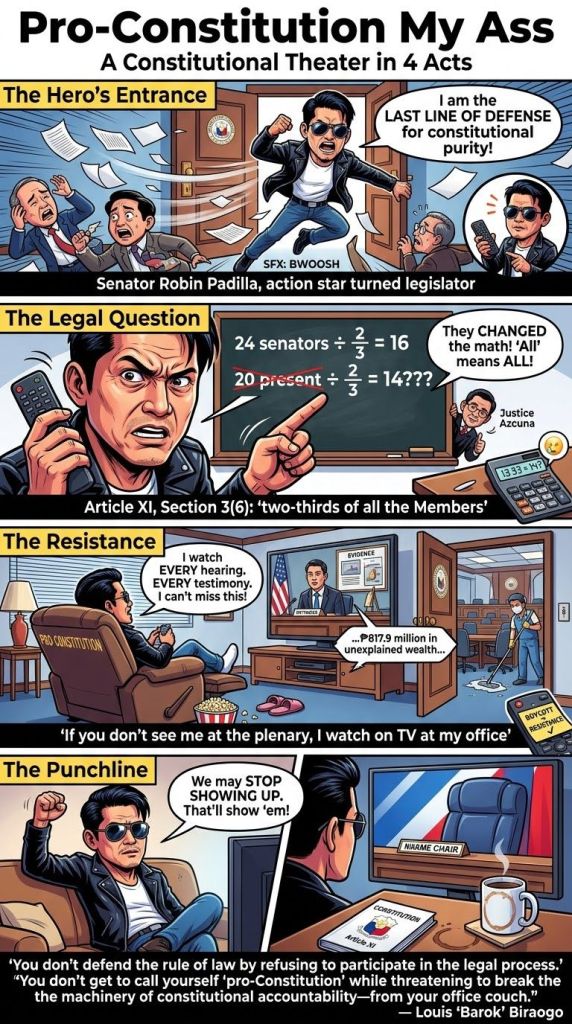
Senator Robin Padilla—yes, that Robin Padilla, the action star turned legislator who once famously said he wanted to punch a fellow senator—is now positioning himself as the last line of defense for constitutional purity. His weapon of choice? Threatening to skip work.
In an interview with dzBB on Sunday, Padilla floated the possibility that the Senate minority bloc—sorry, the ”pro-Constitution bloc”—might just stop showing up to the impeachment trial of Vice President Sara Duterte because the Senate impeachment court had the audacity to interpret the Constitution in a way he doesn’t like.
“There has been no such discussion yet, but it may happen soon,” he said, presumably while monitoring the proceedings on television from the comfort of his office.
Ah yes. The revolutionary tactics of the 21st century: watching C-SPAN from your couch and calling it resistance.
The Legal Question Everyone Is Yelling About
Let’s do the boring part first, because someone has to.
Article XI, Section 3(6) of the 1987 Constitution says: “No person shall be convicted without the concurrence of two-thirds of all the Members of the Senate”.
The Senate has 24 members. Two-thirds of 24 is 16. Simple, right?
Not according to the Senate impeachment court, which ruled 13-1 on September 23 that the two-thirds requirement should be computed from senators who are “legally and factually capable of participating” when judgment is rendered. Four senators are currently unavailable—two detained on plunder charges, one in hiding amid an International Criminal Court (ICC) arrest warrant, and one on medical leave abroad.
Do the math: 24 minus 4 equals 20. Two-thirds of 20 is 13.33, which rounds up to 14 votes to convict.
The prosecution’s response? “We didn’t change the two-thirds requirement. We just changed the denominator”.
That’s like saying you didn’t change the speed limit, you just changed what counts as a mile.
Padilla’s Legal Argument Is Actually Not Crazy
Here’s the uncomfortable part for those of us who enjoy mocking Padilla: his textual argument is stronger than the Senate majority’s.
The framers of the 1987 Constitution deliberately used different language from the U.S. Constitution, which requires “two-thirds of the Members present.” The Philippine version says “two-thirds of all the Members”—and “all” doesn’t mean “some,” “present,” or “convenient”.
Retired Associate Justice Adolfo Azcuna, who actually helped draft the 1987 Constitution, testified that “all” means the full 24, and that absent senators could still vote from the record. The Senate’s own initial ruling on July 6 set the threshold at 16. Then, 79 days later, after the trial had already proceeded under the 16-vote standard, the court reversed itself.
The defense prepared its case expecting 16 votes. Now it’s 14. That’s not a procedural tweak. That’s moving the goalposts while the game is being played.
But Padilla’s Solution Is Constitutional Arson
Here’s where Padilla loses me—and should lose anyone who actually cares about the Constitution he claims to champion.
You don’t defend the rule of law by refusing to participate in the legal process.
Padilla has already admitted he’s been skipping the trial sessions, watching them on TV “at his office” while entertaining guests and attending to “other legislative duties”. His justification? He’s waiting for the Supreme Court to rule on his petition challenging the threshold.
Let me translate: Robin Padilla has decided that until the judiciary gives him the answer he wants, he’s going to take his ball and go home.
This is not constitutional resistance. This is a tantrum with a legal vocabulary.
The Supreme Court Already Told Him to Sit Down
On September 30, the Supreme Court dismissed three petitions challenging the Senate’s threshold ruling on procedural grounds—lack of standing and prematurity. Those petitions were filed by Victor D. Rodriguez, Ernesto B. Francisco Jr., and Berteni Cataluña Causing. Padilla and Go’s separate petition, filed September 29, was not among them and remained pending.
The impeachment court’s spokesperson, Reginald Tongol, called the dismissal a confirmation that the Senate’s interpretation is “constitutionally bulletproof”.
That may be overstating things (the Court didn’t rule on the merits), but the message is clear: the judicial branch isn’t rushing to rescue Padilla from his procedural predicament.
So what does Padilla do? He threatens to boycott the entire trial.
The “Pro-Constitution” Label Is an Insult to Actual Constitutionalists
Padilla insists on calling his bloc “pro-Constitution” rather than “minority”. This is branding, not principle.
If Padilla genuinely believed the Senate was violating the Constitution, he would have one obvious remedy: stay in the room, object formally, build a record, and let the courts decide. That’s what lawyers do. That’s what legislators do when they actually respect institutional processes.
Instead, Padilla is threatening to disable the impeachment court by withholding participation—a tactic that looks less like constitutional defense and more like procedural sabotage on behalf of a political ally.
Let’s not pretend otherwise: Padilla is widely perceived as a Duterte ally. His co-petitioner, Senator Bong Go, is a longtime aide to former President Rodrigo Duterte. The timing of the boycott threat—after the prosecution presented evidence of ₱817.9 million in allegedly undeclared assets and ₱319.33 million in remittances from mainland China and Hong Kong—is not a coincidence.
The “I’m Watching on TV” Defense Is an Admission, Not a Shield
Perhaps the most revealing moment in this entire saga is Padilla’s admission that he doesn’t actually attend the trial when he doesn’t “need to speak”.
“If you don’t see me at the plenary, I watch the proceedings on TV at my office,” he said. “I watch every hearing, I monitor all the things being said there, every witness’s testimonies. I can’t miss that”.
You can’t miss it? You’re literally missing it.
A senator-judge’s duty isn’t to watch the trial like it’s a telenovela. It’s to be present, to hear testimony firsthand, to evaluate witnesses, to deliberate. The Constitution requires senators to be “on oath or affirmation” when sitting for impeachment. It doesn’t say “on oath or affirmation, unless you have guests from the mountains.”
If Padilla genuinely believed the proceedings were unconstitutional, the principled response would be to attend and object, not to absent himself and complain from the sidelines.
The Real Question: What Is Padilla Actually Protecting?
Let’s be clear about what’s at stake.
If the Senate convicts Vice President Duterte, she is removed from office and permanently disqualified from holding public office. She is widely seen as a leading contender for the 2028 presidential election. Her conviction would fundamentally reshape Philippine politics.
Padilla’s “pro-Constitution” stance conveniently aligns with the political interests of the Duterte family and their allies. That doesn’t make his legal argument wrong—but it does make his claimed neutrality laughable.
The Senate majority’s interpretation also conveniently aligns with the political interests of the Marcos administration. That doesn’t make their interpretation correct—but it does make their claims of pure constitutional fidelity equally suspect.
Everyone here is playing politics. The only difference is who’s winning.
What Padilla Should Do (But Won’t)
If Robin Padilla actually cared about the Constitution—and not just about using it as a shield for a political ally—he would:
- Show up. Attend every session. Object formally. Build a record.
- Argue the merits. Make the textual case for 16 votes in the Senate, not on the radio.
- Accept the Supreme Court’s ruling. If the Court dismisses his petition, that’s the system working, not the system failing.
- Stop calling himself “pro-Constitution” while actively undermining the institution the Constitution empowers to try impeachments.
Instead, we get threats, boycotts, and TV monitoring from the office.
The Bottom Line
Robin Padilla’s constitutional objections have merit. The Senate’s threshold ruling is legally vulnerable. The Supreme Court may eventually need to resolve this.
But Padilla’s proposed response—boycotting the trial—is not constitutional resistance. It’s constitutional vandalism dressed up as principle.
You don’t defend the rule of law by refusing to participate in the legal process. You don’t uphold the Constitution by abandoning the institution it created. And you don’t get to call yourself “pro-Constitution” while threatening to break the machinery of constitutional accountability.
If Padilla wants to fight for 16 votes, he should fight for it in the Senate, on the record, with his colleagues—not from his office couch, watching the trial he’s too principled to attend.
But hey, what do I know? I’m just a blogger who thinks “all” means “all”—silly me.
Key Citations
A. Legal & Official Sources
- The 1987 Constitution of the Republic of the Philippines, Article XI, Section 3(6). Official Gazette of the Republic of the Philippines, 1987, http://www.officialgazette.gov.ph/constitutions/the-1987-constitution-of-the-republic-of-the-philippines/the-1987-constitution-of-the-republic-of-the-philippines-article-xi/.
B. News Reports
- Serquiña, Mariel Celine. “Robin Padilla, Allied Senators May Skip Duterte Impeachment Trial over ‘Disregard for Law’.” GMA News Online, GMA Network, 11 Oct. 2026, http://www.gmanetwork.com/news/topstories/nation/1005521/robin-padilla-allied-senators-may-skip-duterte-impeachment-trial-over-disregard-for-law/story/.
- Panti, Llanesca T. “Sara Duterte Impeachment Trial Day 29: Court Overturns Initial 16-Conviction Threshold in VP Trial.” GMA News Online, GMA Network, 23 Sept. 2026, http://www.gmanetwork.com/news/topstories/nation/1003477/sara-duterte-impeachment-trial-day-29-court-overturns-initial-16-conviction-threshold-in-vp-trial/story/.
- “Azcuna Maintains Two-Thirds Conviction Vote in Impeachment Trial.” The Manila Times, 16 Sept. 2026, http://www.manilatimes.net/2026/09/16/news/azcuna-maintains-two-thirds-conviction-vote-in-impeachment-trial/2426226.
- Bolledo, Jairo. “Supreme Court Junks Petitions vs Adjusted Impeachment Voting Threshold.” Rappler, 30 Sept. 2026, http://www.rappler.com/philippines/supreme-court-decision-dismissed-petitions-impeachment-voting-threshold/.
- Punzalan, Jamaine, and Adrian Ayalin. “Padilla, Go Challenge Impeachment Voting Rule Before Supreme Court.” ABS-CBN News, 7 Oct. 2026, http://www.abs-cbn.com/news/nation/2026/10/7/padilla-go-ask-supreme-court-to-strike-down-impeachment-court-s-voting-rule-1423.
- Rita, Joviland. “No Abuse of Discretion in New Sara Duterte Impeachment Threshold Rule — Tongol.” GMA News Online, GMA Network, 24 Sept. 2026, http://www.gmanetwork.com/news/topstories/nation/1003509/no-abuse-of-discretion-in-new-sara-duterte-impeachment-threshold-rule-tongol/story/.
- “VP’s Total Unexplained Wealth at P817.87M – Witness’ Report.” Inquirer.net, 10 Oct. 2026, newsinfo.inquirer.net/2320698/vp-dutertes-total-unexplained-wealth-at-p817-87m-witness-report-2.
- “AMLC Records Show P319M China Remittances to Sara Duterte’s Husband-Linked Firms.” Politiko, 6 Oct. 2026, politiko.com.ph/amlc-records-show-p319m-china-remittances-to-sara-dutertes-husband-linked-firms/.
- “Ang Hirap Maging Mahirap”: The PAO Scandal That Proves Government Contempt Is Nothing New

- “Far-Off” My Axx: Malacañang’s Claire Castro Drowns in Her Own Legal Gaslighting

- “Forthwith” to Farce: How the Senate is Killing Impeachment—And Why Enrile’s Right (Even If You Can’t Trust Him)

- “HINDI AKO NAG-RESIGN!”

- “I Know Nothing”: Baste Duterte’s Amnesia Defense Meets ₱33M in GenCorp Contracts

- “I’m calling you from my new Globe SIM. Send load!”

- “Mahiya Naman Kayo!” Marcos’ Anti-Corruption Vow Faces a Flood of Doubt

- “Manageable” Debt, Unmanageable Lies: DBM’s ₱21 Trillion Fairy Tale

- “Meow, I’m calling you from my new Globe SIM!”

- “Natrabaho”: One Word, One Ombudsman, and a Judiciary on Trial

- “No Special Jail for Crooks!” Boying Remulla Slams VIP Perks for Flood Scammers

- “Philippine-Controlled” or Yankee Gas Station? The Davao Fuel Depot Farce Exposed







Leave a Reply