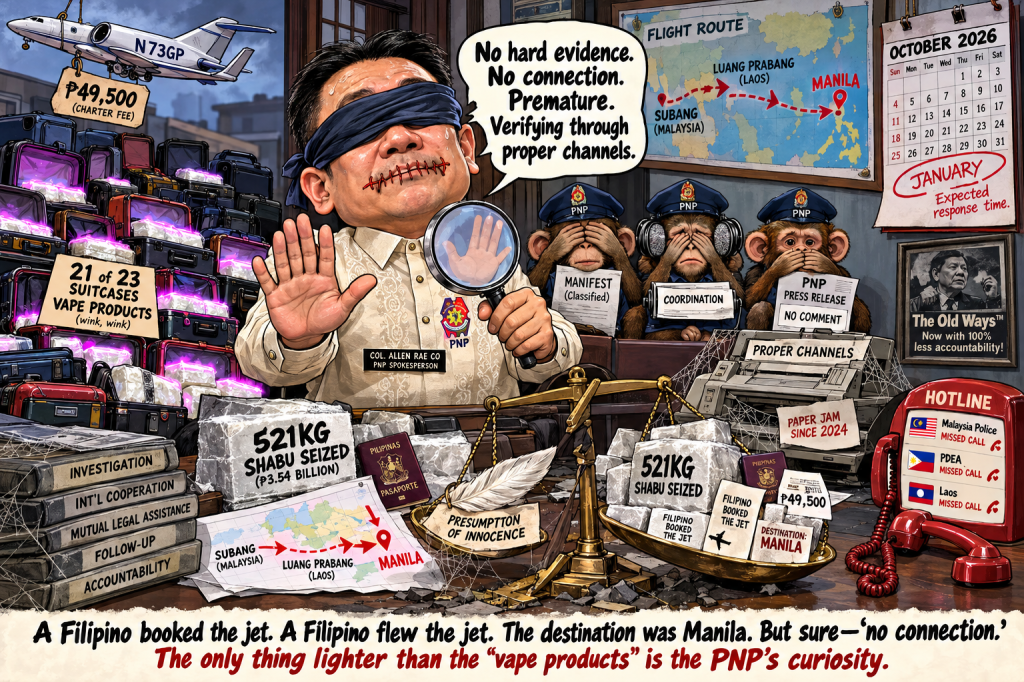
A Filipino booked the jet, a Filipino was on the jet, and the destination was Manila—but sure, ‘no connection.’
By Louis ‘Barok‘ C. Biraogo — October 11, 2026
A Learjet, a Filipino, and 521 Kilos of “Vape Products”
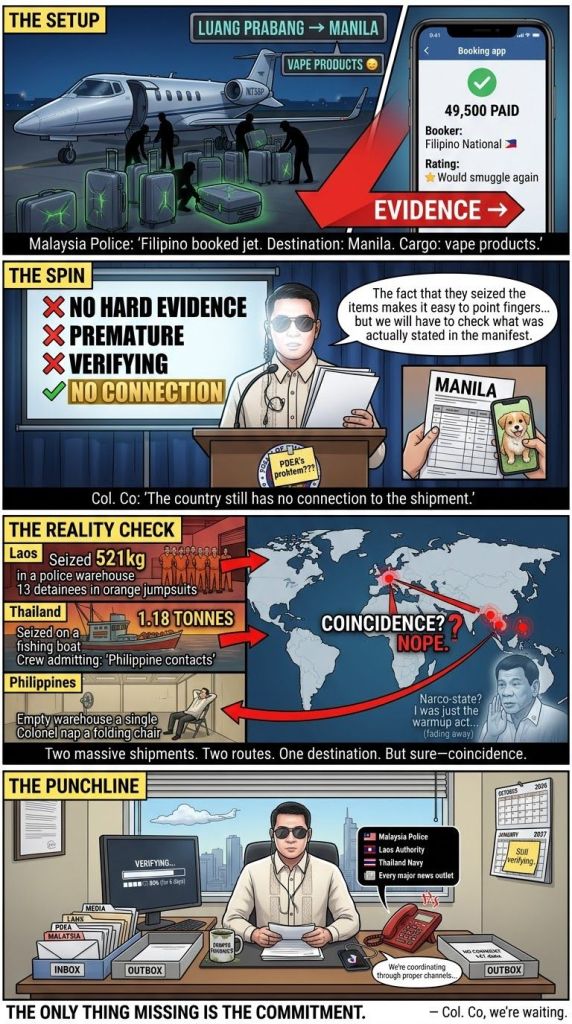
Let me walk you through this masterpiece of plausible deniability, mga ka-kweba. A Learjet 55B—registration N73GP, because nothing says “legitimate business trip” like a 1986 aircraft owned by a Utah trust—departs Subang Airport in Malaysia with exactly one passenger: a Filipino. This passenger boards without carry-on baggage. The jet flies to Luang Prabang, Laos. Two vehicles arrive carrying 23 suitcases. The crew, presumably possessing at least two brain cells between them, refuses to load uninspected bags because, you know, weight-and-balance and dangerous goods regulations.
Laotian authorities then discover 521 kilograms of methamphetamine inside 21 of those suitcases. Five hundred packages of shabu, valued at ₱3.54 billion, allegedly bound for Manila.
And the Philippine National Police (PNP) official response, delivered with the institutional gravity of a spokesperson reading yesterday’s weather report? “No hard evidence yet.”
Col. Allen Rae Co, PNP Public Information Office chief, told reporters: “The fact that they seized the items makes it easy to point fingers and speculate about where they were headed. But we will have to check what was actually stated in the manifest and where the shipment was supposed to be delivered” (Philippine Star). He added that the information remains “premature” and that the PNP is “verifying” through “proper channels” (Manila Times).
Translation: We haven’t received the memo yet, and until someone faxes it to Camp Crame, we’re going to pretend this is somebody else’s problem.
Here’s the thing, Colonel. When Malaysian police publicly announce that a Filipino national booked the charter for US$49,500, that the cargo was declared as “vape products,” and that the information has already been shared with the Philippine Drug Enforcement Agency (PDEA)—your own sister agency under the drug enforcement framework—saying “no hard evidence” doesn’t sound like prudent caution. It sounds like willful blindness dressed in a barong.
#PNP #ShabuSeizure #NoConnection #DrugWarPH #Satire
The “No Documents” Defense: A Masterclass in Institutional Whatever
Let’s dissect the PNP’s position with the precision of a scalpel and the glee of a satirist watching bureaucrats trip over their own shoelaces.
First, the PNP claims it lacks documents establishing the drugs were Manila-bound. But Malaysian police—the Royal Malaysia Police’s Narcotics Crime Investigation Department, no less—have publicly stated that the Filipino booked the jet on September 23 for a flight from Laos to Manila, with the cargo declared as vape products (Malay Mail). They’ve also reportedly shared this information with PDEA.
So either:
- (a) PDEA has the documents and hasn’t shared them with the PNP, which suggests a coordination failure of epic proportions;
- (b) The PNP has the documents and is lying, which would be worse; or
- (c) The PNP genuinely doesn’t have them because nobody bothered to pick up the phone, which is the most charitable interpretation and still inexcusable.
Under Republic Act 9165, also known as the Comprehensive Dangerous Drugs Act of 2002, PDEA is the lead agency for drug enforcement. If the PNP is fronting this case while PDEA remains silent, either PDEA is asleep at the wheel or there’s a turf war happening behind the scenes that the public isn’t being told about.
Second, the PNP says the manifest and flight plan need verification. Fine. But here’s a wild idea: go get them. Malaysia has the booking records. Laos has the seized drugs and 13 detainees. The Chicago Convention guarantees that a foreign private jet needs authorization to land in Manila—if such a permit was ever filed, the Civil Aviation Authority of the Philippines (CAAP) has it. If no permit was filed, that absence is itself evidence of something.
The PNP’s passive posture—”we are verifying and coordinating through proper channels”—ignores the fact that proper channels move at the speed of molasses in January unless someone kicks them. Former Lt. Gen. Orlando De Leon and former Executive Secretary Victor Rodriguez have both demanded transparency, with Rodriguez stating bluntly: “The Filipino people have the right to know” (Daily Tribune). They’re right. The PNP’s “premature” refrain sounds less like legal caution and more like institutional self-preservation.
Third, and most damning: the PNP’s skepticism exists in a vacuum. This isn’t an isolated incident. Thai authorities simultaneously seized over a metric ton of methamphetamine from a fishing vessel in the Gulf of Thailand, with crew members reportedly admitting they were delivering to Philippine-linked contacts (Nation Thailand). Two massive shipments, two different routes—air and sea—both pointing to the Philippines in the same week.
At what point does “coincidence” become “pattern”? At what point does “no hard evidence” become “we don’t want to find any”?
The Ghost of Drug Wars Past
Here’s why this matters beyond the immediate legal technicalities. The Philippines has spent years being lectured about its drug war—first by the international community horrified by extrajudicial killings, then by the International Criminal Court (ICC) pursuing former President Duterte for crimes against humanity. The Marcos administration promised a “bloodless” pivot, a kinder, gentler approach to narcotics.
And now this.
A private jet, a Filipino “mastermind,” and 521 kilos of shabu allegedly destined for Manila’s streets. If true, it suggests that the same syndicates that were supposedly decimated by Duterte’s war have simply adapted—moving from maritime mother vessels to private aviation, from street-level dealing to corporate logistics. The drug economy didn’t die; it got an upgrade.
The PNP’s public skepticism may be legally sound—presumption of innocence applies, foreign allegations aren’t judicial findings, yada yada yada. But it’s politically tone-deaf. You don’t respond to a 521-kilogram shabu seizure allegedly bound for your capital by essentially shrugging and saying “prove it.” You respond by investigating—aggressively, transparently, and in coordination with the countries that just handed you a massive intelligence windfall.
Instead, we get Col. Co explaining that “the country still has no connection to the shipment.” A Filipino passenger, a Filipino booker, a Filipino destination—and “no connection.” The grammatical gymnastics required to make that sentence work could qualify for an Olympic medal.
The “Narco-State” Whisper
Let’s address the elephant in the room, the one that Duterte spent six years weaponizing: the fear of the Philippines becoming a narco-state.
Dr. Edilberto de Jesus, in a piece published earlier this year, systematically dismantled the comparison between Philippine drug cartels and Mexico’s (Inquirer). The Philippines has a relatively small drug-using population. The syndicates lack the military-grade weaponry, the territorial control, the manpower of the Jalisco New Generation Cartel. Duterte inflated the threat to justify his war.
But here’s the uncomfortable corollary: if the threat was inflated to justify mass killings, and the killings didn’t actually dismantle the syndicates, then what was the point? And if international syndicates still view Manila as a viable market for half a billion pesos worth of meth, what does that say about the current state of enforcement?
The “narco-state” label may be hyperbolic. But the pattern of seizures—Laos, Thailand, the recurring maritime routes from Sabah, the Western Asia and Mexico origins of past Philippine hauls—suggests that someone, somewhere, still believes the Philippine market is worth the risk (UNODC). The PNP’s reflexive defensiveness doesn’t reassure anyone. It just makes the institution look like it’s protecting something other than the public interest.
What the PNP Should Be Doing (But Probably Isn’t)
If I were writing the PNP’s talking points, they’d look like this:
- Announce a joint PNP-PDEA-DOJ investigation immediately. Not a press briefing about “verifying.” An actual task force with a name, a mandate, and a daily progress report.
- File formal mutual legal assistance requests with Laos and Malaysia. The ASEAN Mutual Legal Assistance Treaty (MLAT) exists precisely for this. Use it. Demand the booking records, the payment trail, the flight plan, the manifest. If the Malaysians have shared information with PDEA, PDEA should be in the room, not relegated to the sidelines.
- Trace the money. US$49,500 for a charter flight isn’t walking-around money. Who paid? From where? Through what channels? The Anti-Money Laundering Council (AMLC) should already be looking at this. Drug proceeds are predicate offenses under the Anti-Money Laundering Act (AMLA).
- Check the aviation records. Did anyone file a flight plan for Manila? Did the Learjet have landing rights? What does CAAP have? The Chicago Convention requires authorization for non-scheduled flights—there should be a paper trail, or its absence should be explained.
- Stop saying “no hard evidence” and start saying “here’s what we’re doing to get it.” The public doesn’t need premature conclusions. It needs to know that the government is taking a 521-kilogram seizure seriously.
Instead, we get “premature” and “verifying” and “no hard evidence.” The PNP has essentially adopted the posture of a teenager caught with questionable search history: “I didn’t do anything” before anyone even asked.
The Ghost of PDEA
Where, in all of this, is the Philippine Drug Enforcement Agency?
Under RA 9165, PDEA is the lead agency for drug enforcement. The PNP has an investigative role, sure. But when a foreign police force says it has shared information with PDEA, and PDEA is radio silent, and the PNP is fronting the media response—something is off.
Either PDEA is working quietly and the PNP’s public skepticism is freelancing, or there’s a coordination breakdown that should terrify anyone who cares about drug enforcement. Neither possibility reflects well on the institutional architecture that’s supposed to protect Filipinos from exactly this kind of shipment.
The PNP’s Col. Co said the Drug Enforcement Group, local police units, and PDEA are “coordinating” with foreign counterparts. Coordinate faster. The drugs are already seized. The suspects are already detained. The only question is whether the Philippines will step up or shrug.
The Verdict
The PNP’s insistence on verification is legally defensible. The presumption of innocence is constitutionally mandated. Foreign allegations are not judicial findings. All true.
But here’s what the PNP seems to miss: skepticism is not the same as paralysis, and caution is not the same as indifference. When Malaysian police publicly identify a Filipino booker, when Thai police report Philippine-linked contacts, when two massive shipments appear in one week, the appropriate response is not a press conference about how everything is “premature.” It’s a full-court press—diplomatic, investigative, financial, and institutional—to determine what the hell is going on.
The PNP’s “no hard evidence” refrain might protect the institution from premature embarrassment. It might preserve the presumption of innocence for whoever booked that jet. But it also sends a message: We’re not really looking.
And in the drug trade, the only thing more dangerous than a syndicate that operates in the open is a government that looks the other way.
The Learjet is in Laos. The drugs are seized. The Filipino passenger is detained. The only thing missing is the Philippine government’s full-throated commitment to finding out the truth.
Col. Co, we’re waiting.
Louis ‘Barok’ C. Biraogo is a Davao-born, UP Diliman-educated columnist and the driving force behind Kweba ni Barok Blog. He writes in English, Tagalog, and Cebuano because discourse should never be monolingual.
Key Citations
A. Reports & Studies
- United Nations Office on Drugs and Crime. Southeast Asia Opium Survey 2023: Cultivation, Production, and Implications. UNODC, 2023, www.unodc.org.
- International Criminal Court. Situation in the Republic of the Philippines. ICC, 2026, www.icc-cpi.int.
B. News Articles
- “NCID: Filipino National Paid US$49,500 to Book Private Jet Linked to 521kg Meth Seizure in Laos.” Malay Mail, 9 Oct. 2026, www.malaymail.com.
- “PNP Verifying Claim 521 Kg of Shabu Headed for PH.” Manila Times, 11 Oct. 2026, www.manilatimes.net.
- “PNP Probes P3.54-Billion Shabu Shipment from Laos, Thailand.” Philippine Star, 10 Oct. 2026, www.philstar.com.
- “Thai Police Seize 1.18 Tonnes of Meth in Gulf Drug Trafficking Case.” Nation Thailand, 8 Oct. 2026, www.nationthailand.com.
- “Two Major Drug Hauls Bound for Philippines Spark Security Alarm.” Daily Tribune, 9 Oct. 2026, tribune.net.ph.
- De Jesus, Edilberto. “Becoming a Narco-State?” Philippine Daily Inquirer, 12 Mar. 2026, plus.inquirer.net.
C. Legal & Official Sources
- “Republic Act No. 9165.” Official Gazette of the Republic of the Philippines, 7 June 2002, www.officialgazette.gov.ph.
- “Republic Act No. 9160.” Official Gazette of the Republic of the Philippines, 29 Sept. 2001, www.officialgazette.gov.ph.
- “Treaty on Mutual Legal Assistance in Criminal Matters.” ASEAN, 2004, asean.org.
- “Convention on International Civil Aviation.” 7 Dec. 1944. Supreme Court E-Library, Supreme Court of the Philippines, elibrary.judiciary.gov.ph/thebookshelf/showdocs/36/12752.
- “Anti-Money Laundering Council.” AMLC, www.amlc.gov.ph.
- ₱9 Billion in ‘Savings’? DILG’s Fire Truck Deal Smells Like Smoke
- ₱8B BBM Pork: CCTV for Every Captain’s Kumpare?
- ₱8.9 Billion, 331 Ghost Police Stations: The TIKAS Scandal Explained

- ₱8.4 Billion, 42,000 Barangays, 1 Election: The “Bawat Barangay Makikinabang” Vote-Buying Masterclass
- ₱75 Million Heist: Cops Gone Full Bandit

- ₱6.77B Ghost Haunts Duterte: RTC Dismisses Mans Carpio’s Desperate Plea
- ₱6.77 Billion and Zero Cash: The Sara Duterte SALN Math That Doesn’t Add Up

- ₱6.7-Trillion Temptation: The Great Pork Zombie Revival and the “Collegial” Vote-Buying Circus

- ₱58.53B, Zero Receipts: The LGSF Pork Barrel Nobody Wants to Name
- ₱53 Million Man Tells ₱695-a-Day Workers to Stop Being ‘Mayabang’: The Audacity of BSP’s Remolona
- ₱4.4 Billion and a Witness Who Can’t Explain It: The Duterte Impeachment’s Most Expensive Non-Answer
- ₱3.06 Billion for Evacuation Centers—But Nobody Knows Where They’ll Stand (Or If They’ll Exist)




Leave a Reply