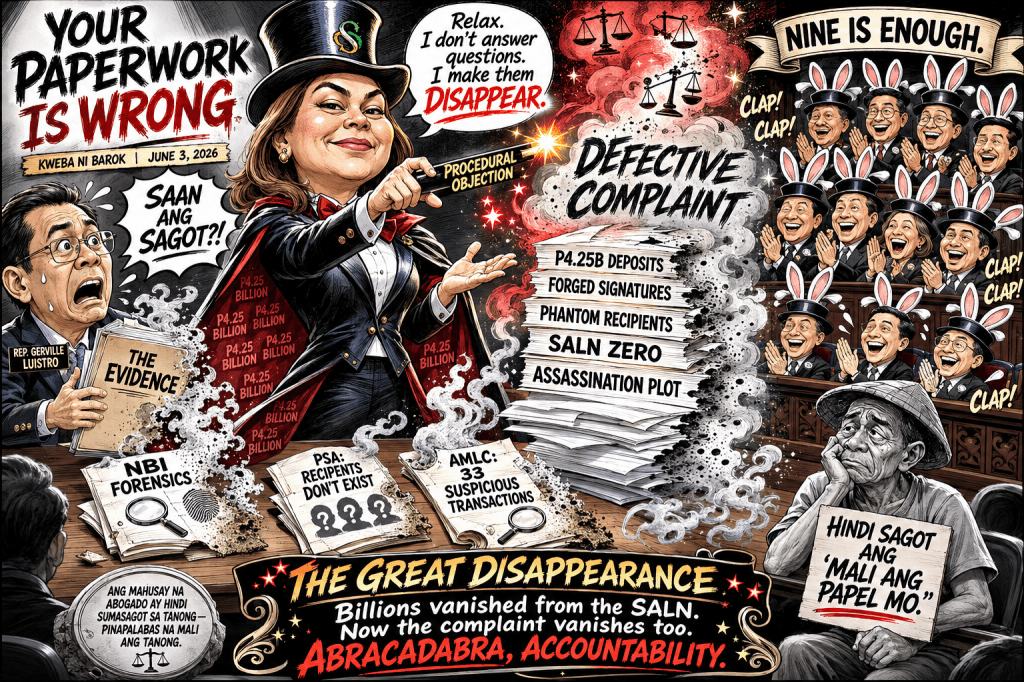
Billions in Deposits, Zero Straight Answers: The Legal Magic Trick That Might Work
By Louis ‘Barok‘ C. Biraogo — June 3, 2026
VICE PRESIDENT Sara Duterte filed her answer to the Articles of Impeachment on June 1, 2026, and did something remarkable: she submitted a document responding to allegations of gargantuan corruption—billions in unexplained wealth, ghost recipients of confidential funds, bribery, and an assassination plot against the First Family—by essentially saying, “Nice try, but your paperwork is wrong.”
This isn’t a defense. It’s a magic trick. And it might actually work.
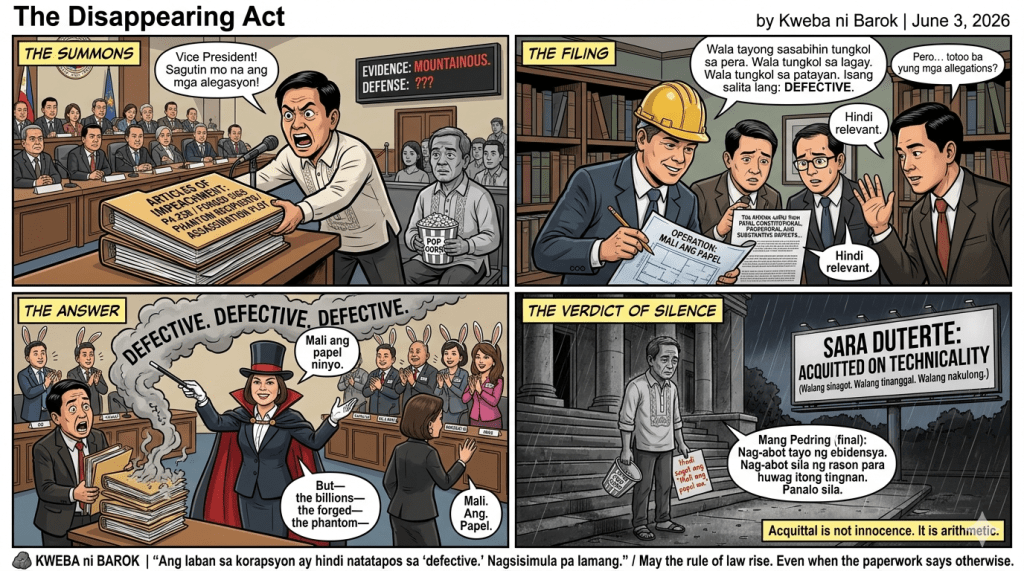
The Non-Answer Answer: “Nice Try, But Your Paperwork Is Defective”
House prosecution chief Rep. Gerville Luistro expressed theatrical disappointment: “We anticipated we’d finally see her answers on confidential funds, bribery, unexplained wealth and threats. Apparently, her reply consisted once more of constitutional issues.”
Duterte’s lawyers argued the articles “suffer from fatal constitutional, procedural and substantive defects” and relied on “erroneous conclusions, speculation, political rhetoric and materials gathered through an unauthorized evidentiary fishing expedition.” Translation: Even if the allegations are true, your complaint is defective, so we don’t have to address them.
Legally, this is classic litigation strategy—attack jurisdiction and constitutionality before touching the facts. If the case is dismissed on procedural grounds, the defense never needs to prove innocence. Politically? It’s a gamble of breathtaking proportions.
The Four Pillars of Avoidance: Building a Legal Fortress Against Accountability
Pillar One: Constitutional Infirmity – Usurping the Senate’s Power
The defense invokes Francisco v. House of Representatives (G.R. No. 160261, 2003), arguing the House committee’s subpoena-powered investigation usurped the Senate’s exclusive power to “try and decide” impeachment under Article XI, Section 3(6) of the 1987 Constitution of the Republic of the Philippines. The House’s proper role is gatekeeping—determining “sufficient form and substance”—not conducting a full evidentiary trial complete with bank records, forensic reports, and certifications. The evidence gathered, they argue, is fruit of a constitutionally impermissible process.
Pillar Two: Procedural Defectiveness – The Consolidation Trap
Four complaints were consolidated into one. Citing Gutierrez v. House of Representatives (G.R. No. 193459, 2011), the defense contends each complaint must independently satisfy threshold requirements before consolidation. Procedural shortcuts, they argue, fatally taint the entire proceeding.
Pillar Three: Evidentiary Fishing Expedition – The Rhetorical Powerhouse
This is the rhetorical powerhouse. The defense characterizes the House hearings as “an unauthorized evidentiary fishing expedition”—a phrase designed to evoke overzealous prosecutors ransacking bank vaults without legal authority. Duterte boycotted the hearings, arguing she was denied meaningful opportunity to confront witnesses and present evidence at a proceeding she contends was a trial disguised as a committee hearing.
Pillar Four: The Supreme Court Nuclear Option – Betting on Technical Nullification
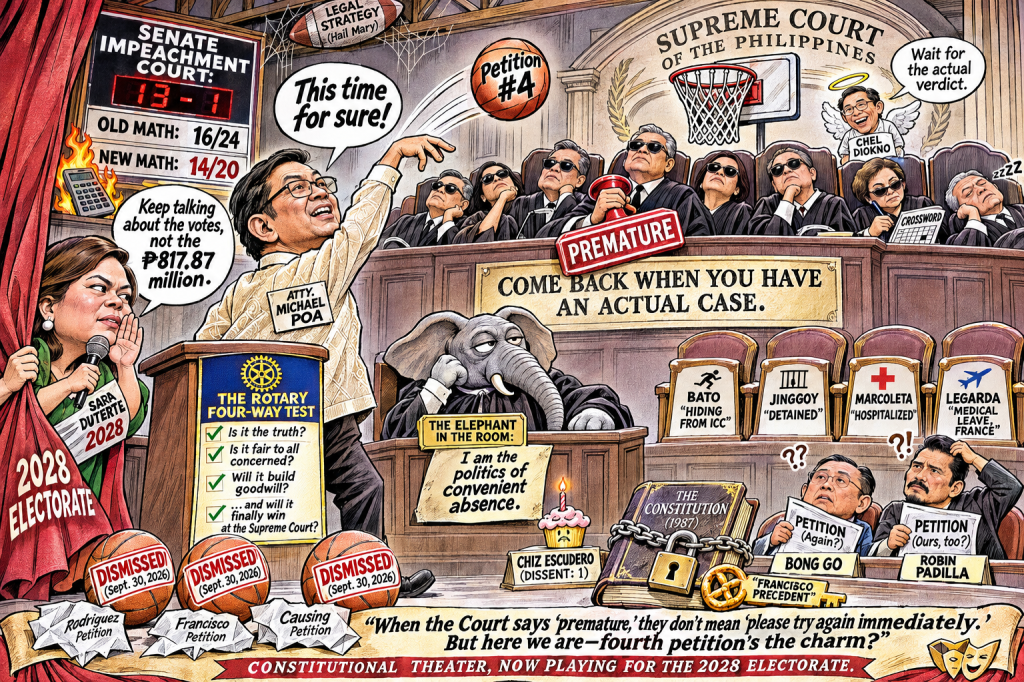
Duterte’s answer was filed “without prejudice to constitutional issues presently pending before the Supreme Court.” This preserves her right to seek a TRO halting the Senate trial. The Court nullified the first impeachment in July 2025 on one-year-bar grounds. The defense is betting the justices may prefer ending this destabilizing process through technical ruling rather than allowing a divisive trial.
What the Answer Didn’t Say: The Silence That Speaks Volumes
Here’s what makes the prosecution’s narrative politically potent: Duterte hasn’t denied anything. She hasn’t explained why her accounts registered P4.25 billion in deposits while her Statement of Assets, Liabilities, and Net Worth (SALN) declared zero cash on hand from 2019 to 2024. She hasn’t identified a single legitimate recipient of confidential funds whose signatures the NBI determined were forged. She hasn’t explained why PSA certified that several named recipients had no civil registry records—meaning they may not exist. She hasn’t directly addressed the alleged assassination threat against President Marcos, First Lady Liza Araneta-Marcos, and former Speaker Martin Romualdez.
Representative Renee Co suggested the manner of Duterte’s non-response could “bolster the case against her”—an implied-admission theory echoing the maxim falsus in uno, falsus in omnibus (false in one, false in all)..
The prosecution’s narrative is devastating in its simplicity: If she had convincing answers, she would have given them. She didn’t. Therefore, she doesn’t.
This isn’t strictly legal reasoning. The Constitution guarantees the right against self-incrimination. Due process places the burden of proof on the prosecution. But impeachment isn’t a criminal trial—the Senate isn’t bound by technical rules of evidence, and the standard isn’t “beyond reasonable doubt” but rather the political judgment of two-thirds of senator-judges. Public perception matters enormously, and the perception that Duterte hides behind technicalities rather than confronting allegations could prove politically fatal.
The Evidentiary Earthquake: Billions in Deposits, Forged Signatures, and Phantom Recipients
The House committee built a formidable record:
The Anti-Money Laundering Council (AMLC) Executive Director Ronel Buenaventura testified Duterte’s accounts registered P4.25 billion in deposits from 2006 to 2025, with 33 suspicious transaction reports filed by banks. Her husband Manases Carpio’s accounts added P2.9 billion in flagged transactions. When asked whether moving money “in and out” to make it appear legitimate constitutes money laundering, Buenaventura answered affirmatively.
The Duterte camp’s response—that aggregating inflows and outflows over two decades naturally produces bloated numbers—has partial validity. But it can’t explain the gulf between P88 million declared net worth and P4.25 billion in deposits, nor the 33 independent bank compliance determinations of suspicious activity. Their citation of a bank’s “system bug” requesting deletion of P2.3 billion in reports is a legitimate data integrity challenge the prosecution must address.
National Bureau of Investigation forensic examinations concluded signatures on confidential fund acknowledgment receipts were fictitious or forged. Philippine Statistics Authority certified several named recipients had no civil registry records. Under Republic Act No. 3019 (The Anti-Graft and Corrupt Practices Act), Section 3(e), causing undue injury through manifest partiality or gross inexcusable negligence is criminal. Under Republic Act No. 6713 (The Code of Conduct and Ethical Standards for Public Officials and Employees), the SALN disparity alone constitutes a prima facie violation punishable by imprisonment, fine, and disqualification.
The Senate Math Problem: Nine Votes to Save the Day (Or Not)
Conviction requires 16 votes—two-thirds of 24 senators. Duterte needs only nine to block it. The May 11, 2026 Senate leadership coup—executed the same day the House voted to impeach—installed Duterte ally Alan Peter Cayetano as Senate President. Reliable pro-Duterte votes include Imee Marcos, Robin Padilla, Bong Go, Rodante Marcoleta, and Ronald dela Rosa—a near-certain floor of five. Several more from Cayetano and Villar blocs are sympathetic. Sixteen votes is a mathematical fantasy absent dramatic new evidence.
But Philstar.com identifies a more nuanced scenario: the “hung jury.” Without 16 votes to convict and without 9 votes for formal acquittal, the trial ends inconclusively. Duterte remains legally viable for 2028 but carries permanent political and legal baggage from unresolved allegations.
This is the bitter paradox: Duterte’s allies can save her legally while destroying her politically. An acquittal by a Senate whose presiding officer owes his position to a coup executed on impeachment day will be seen as a rigged verdict. The Senate’s institutional credibility lies in ruins either way.
The Dynastic War Beneath: Marcos vs. Duterte in Impeachment’s Shadow
This impeachment is the latest battle in the Marcos-Duterte cold war following the UniTeam collapse. Marcos benefits from Duterte’s disqualification as a 2028 rival but risks being seen using state power for political liquidation. Duterte’s calculus is survival at all costs—conviction means permanent disqualification under Article XI, killing her presidential ambitions.
The deeper tragedy: impeachment in the Philippines now functions primarily as a political weapon, not a constitutional accountability mechanism. A House controlled by one faction initiates for political reasons; a Senate controlled by another blocks conviction regardless of evidence; the Supreme Court intervenes repeatedly through stretched doctrinal frameworks. No legal reform can cure this without addressing the underlying political economy of patronage-based governance.
Barok’s Recommendations: How to Salvage Integrity from This Political Theater
- For the Senate: Rule on procedural objections expeditiously with reasoned analysis—summary dismissal confirms public suspicion of rigging. Senator-judges with personal or political ties to the respondent should consider recusal under RA 6713 ethical standards. Conduct the trial with maximum public transparency.
- For the Prosecution: Present all evidence regardless of vote math. The impeachment trial creates a public record for subsequent criminal prosecutions before Sandiganbayan and Ombudsman—prosecutions not subject to Senate political arithmetic. As Estrada v. Desierto (G.R. No. 146710, 2001) affirmed, Senate acquittal doesn’t bar criminal liability.
- For the Supreme Court: Exercise restraint. A second nullification would render the impeachment mechanism functionally inoperative—creating a constitutional paradox where officials can be impeached but never tried.
- For the Filipino People: Demand answers. When officials accused of corruption respond with procedural objections rather than substantive denials, citizens have both the right and duty to ask: What are they hiding?
Barok’s Final Verdict: Technical Acquittal Is Not Vindication – The Cave Grows Darker
The Vice President’s answer is a masterclass in saying nothing by saying everything about jurisdiction and due process. The AMLC said billions moved through her accounts. The NBI said signatures were forged. The PSA said recipients don’t exist. Her answer? “Your complaint is defective.”
This is her right. But rights cut both ways—and public judgment doesn’t await procedural niceties.
The Senate will likely save her. But acquittal by a rigged court is not vindication—it’s a verdict without a witness, clearance signed by allies rather than by truth. The hung jury scenario leaves allegations unresolved, the Senate’s credibility shattered, and the Filipino people with justice denied by technicality.
This is not governance. This is survivalism in legal robes. The rule of law demands public officials answer allegations, not evade them. It demands impeachment courts judge evidence, not count political allies.
May the rule of law rise. But the cave grows darker with each passing hour. 🪨
Key Citations
A. Legal & Official Sources
- The 1987 Constitution of the Republic of the Philippines. Official Gazette of the Republic of the Philippines, 1987, http://www.officialgazette.gov.ph/constitutions/1987-constitution/.
- Republic Act No. 3019. The Anti-Graft and Corrupt Practices Act. 1960. lawphil.net/statutes/repacts/ra1960/ra_3019_1960.html.
- Republic Act No. 6713. An Act Establishing a Code of Conduct and Ethical Standards for Public Officials and Employees. 1989. lawphil.net/statutes/repacts/ra1989/ra_6713_1989.html.
- Republic Act No. 9160. The Anti-Money Laundering Act of 2001. 2001. lawphil.net/statutes/repacts/ra2001/ra_9160_2001.html.
- Francisco v. House of Representatives. G.R. No. 160261. Supreme Court of the Philippines, 10 Nov. 2003. lawphil.net/judjuris/juri2003/nov2003/gr_160261_2003.html.
- Gutierrez v. House of Representatives. G.R. No. 193459. Supreme Court of the Philippines, 15 Feb. 2011. lawphil.net/judjuris/juri2011/feb2011/gr_193459_2011.html.
- Estrada v. Desierto. G.R. No. 146710. Supreme Court of the Philippines, 2 Mar. 2001. lawphil.net/judjuris/juri2001/mar2001/gr_146710_2001.html.
B. News Reports
- Basilio, Kenneth. “Sara Duterte Sidesteps Allegations in Reply to Impeachment Case.” Inquirer.net, 3 June 2026, newsinfo.inquirer.net/2239130/sara-duterte-sidesteps-allegations-in-reply-to-impeachment-case.
- Bondoc, Jarius. “Marcoleta’s ‘Remote Voting’ Aims to Thwart Evidence Against Sara.” Philstar.com, The Philippine Star, 29 May 2026, http://www.philstar.com/opinion/2026/05/29/2531223/marcoletas-remote-voting-aims-thwart-evidence-against-sara.
- de Leon, Dwight. “IN NUMBERS: What Impeachment Hearings Unveiled about Sara Duterte’s Wealth.” Rappler, 6 May 2026, http://www.rappler.com/newsbreak/data-documents/sara-duterte-wealth-findings-house-impeachment-hearings/.

- ₱9 Billion in ‘Savings’? DILG’s Fire Truck Deal Smells Like Smoke

- ₱8B BBM Pork: CCTV for Every Captain’s Kumpare?

- ₱8.9 Billion, 331 Ghost Police Stations: The TIKAS Scandal Explained

- ₱8.4 Billion, 42,000 Barangays, 1 Election: The “Bawat Barangay Makikinabang” Vote-Buying Masterclass

- ₱75 Million Heist: Cops Gone Full Bandit

- ₱63 to the Dollar: The Only Thing Falling Faster Than the Peso Is the Government’s Credibility

- ₱6.77B Ghost Haunts Duterte: RTC Dismisses Mans Carpio’s Desperate Plea

- ₱6.77 Billion and Zero Cash: The Sara Duterte SALN Math That Doesn’t Add Up

- ₱6.7-Trillion Temptation: The Great Pork Zombie Revival and the “Collegial” Vote-Buying Circus

- ₱58.53B, Zero Receipts: The LGSF Pork Barrel Nobody Wants to Name
- ₱53 Million Man Tells ₱695-a-Day Workers to Stop Being ‘Mayabang’: The Audacity of BSP’s Remolona
- ₱4.4 Billion and a Witness Who Can’t Explain It: The Duterte Impeachment’s Most Expensive Non-Answer




Leave a Reply