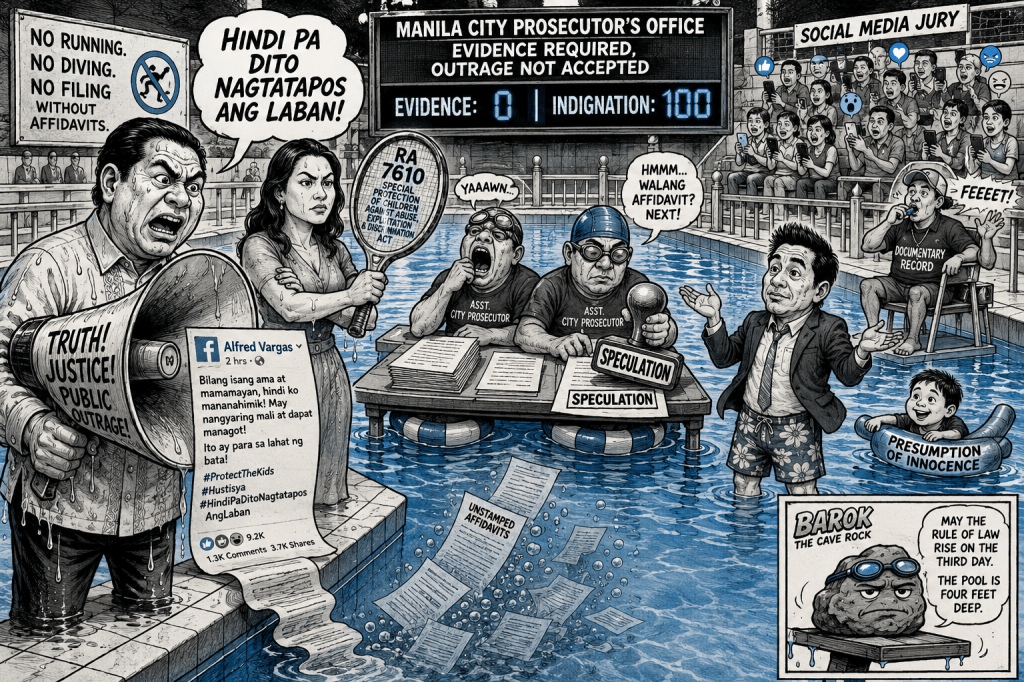
Barok’s Scalpel Exposes When “Rough Play” Becomes Criminal Parental Neglect
By Louis ‘Barok‘ C. Biraogo — May 30, 2926
Dunked in Court: Vargases’ Righteous War on Lazy Parenting
SWEET chlorine, bitter justice — welcome to the shallow end of Philippine parenting. On Valentine’s Day 2026, at the hallowed tiles of Rizal Memorial Stadium, two minor gladiators turned a swimming drill into a proxy war for their parents’ egos, lawyers, and Facebook followings. Alfred and Yasmine Vargas, armed with a righteous fury any parent would recognize, marched into the Manila City Prosecutor’s Office on April 13 alleging that Rob Sy and Juvelle Bacosa’s progeny repeatedly pushed and submerged their son underwater. The legal theory? Not mere horseplay, but a violation of Republic Act No. 7610 (Special Protection of Children Against Abuse, Exploitation and Discrimination Act)—that capacious dragnet punishing “other acts of child abuse, cruelty or exploitation or [being] responsible for other conditions prejudicial to the child’s development.”
The prosecutors, in their May 12 resolution, yawned and dismissed it as “merely based on speculation.” “Allegation is not in itself evidence,” they intoned, channeling Rule 112, Section 1 of the Revised Rules of Criminal Procedure (2000). Cue Vargas’s Facebook dispatch: “Hindi pa po dito nagtatapos ang laban.” Indeed, counselor. The pool war rages on.
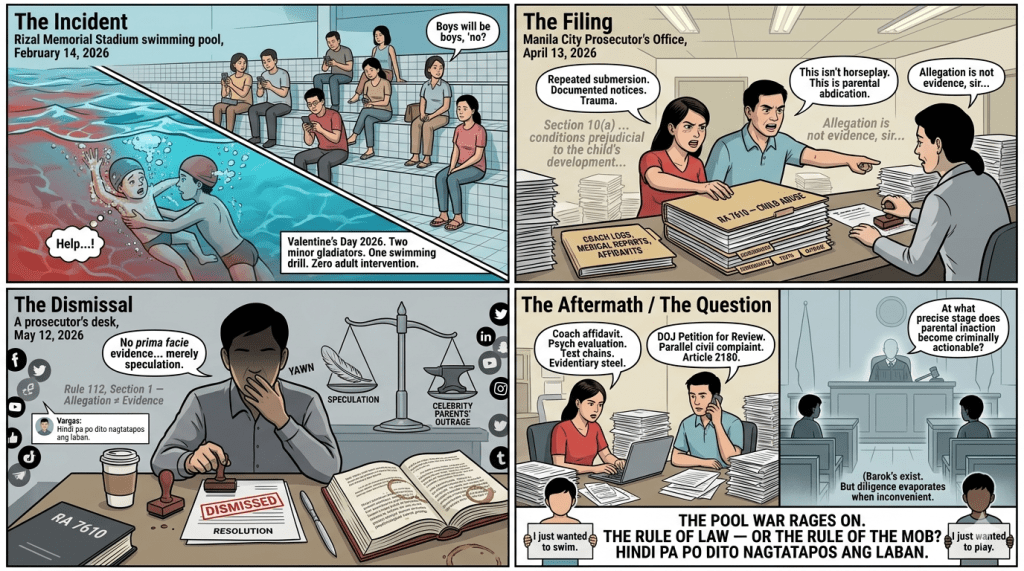
Linchpin Question: When Does Parental Inaction Become Criminally Actionable?
The linchpin question that should haunt every parent, prosecutor, and pontificator in this republic is this:
At what precise stage does parental inaction or failure to intervene in cases of bullying become legally punishable and criminally actionable?
Not the vague “be a good parent” sermonizing, but the surgical demarcation under Philippine legal architecture where negligence graduates into a crime against a child’s development. This autopsy will flay every flank—complainants, respondents, prosecutors, the political overlay, and the cyberlibel sideshow—while wielding Article 209 of Executive Order No. 209 (The Family Code of the Philippines), Article 218, and Article 220 of the Family Code, Article 2180 of the Civil Code, Section 3(b) and 10(a) of RA 7610, and precedents like Malto v. People (G.R. No. 164733, 2007), Tamargo v. Court of Appeals (G.R. No. 85044, 1992), and the Supreme Court’s recent clarifications on RA 7610’s psychological harm prong.
Factual Petri Dish: Speculation vs. Evidence in the Pool
The Vargas narrative: repeated underwater assaults during training, specific urgings to the Sy-Bacosa camp to rein in their offspring, and a pattern of abdication that left their child traumatized. The Sy-Bacosa counter: narrative reversal, harassment by a “public servant,” and a child raised “properly” with discipline when mistakes occur. Prosecutors sided with the latter’s evidentiary vacuum. Fair enough on the papers presented. But “speculation” is a prosecutor’s favorite escape hatch when the emotional stakes involve celebrity parents and social media juries.
Under Section 3(b) of RA 7610, child abuse includes any act “by deeds or words which debases, degrades or demeans the intrinsic worth and dignity of a child.” Repeated submersion—framed as “play”—can easily slide into psychological cruelty if it instills fear. Malto teaches liberal construction in favor of the child. The Vargases’ theory of vicarious parental liability via omission is audacious but not fanciful: parents hold concurrent authority under Family Code Article 218, even outside school. When notice is given and ignored, does that omission create the ‘condition prejudicial to the child’s development’ under Section 10(a) of RA 7610?
This catch-all provision penalizes not only direct acts of child abuse, cruelty, or exploitation, but also being responsible for other conditions prejudicial to the child’s development — a broad clause intended to cover omissions and situations that undermine a child’s physical, emotional, psychological, or social growth, even if not specifically enumerated elsewhere in the law.
Here lies the scalpel’s edge. Inaction Stage 1: Ignorance of isolated roughhousing—civilly regrettable, criminally inert. Stage 2: Single notice without immediate escalation—parental lapse, perhaps administrative via the swimming federation, but not yet RA 7610 territory. Stage 3: Repeated, documented notice + reckless disregard + continued harm—this is where the criminal threshold arguably crystallizes. The prosecutor demanded affirmative proof of each link in the chain. The Vargases, per the resolution, supplied indignation where affidavits, coach logs, text chains, and psychological evaluations were needed. Moral victory does not equal prima facie case. Yet dismissing the cumulative trauma angle without deeper grappling with RA 7610’s protective spirit risks turning the law into a shield for negligent guardians.
The Sy-Bacosa defense gleams with Tamargo’s presumption rebuttal logic in reverse: they claim diligence of a bonus pater familias. Under Article 2180 of the Civil Code, parents face presumptive vicarious liability for their minor’s torts, overcome only by proving extraordinary diligence. Their public slogan—”we raise him properly”—is courtroom poetry, not evidence. Produce the logs, or the presumption bites.
Flaying Both Sides: No Saints, Strategic Flaws Abound
The Vargases wage a righteous crusade against parental abdication. In a nation where Republic Act No. 10627 (Anti-Bullying Act) remains school-centric and leaves community sports in a regulatory dead zone, their filing forces the conversation. Bravo for refusing to normalize “boys will be boys” when it means one child fearing the water. Yet tactics invite the scalpel: the 20-count cyberlibel barrage against Sy (under Section 4(c)(4) of Republic Act No. 10175 (Cybercrime Prevention Act of 2012) in relation to RPC Articles 353-355) smells of escalation therapy. Disini v. Secretary of Justice (G.R. No. 203335, 2014) upholds the law, but Borjal v. Court of Appeals (G.R. No. 126466, 1999) and fair comment privilege protect robust defense of one’s child. Filing twenty counts risks the “SLAPP” aroma—Strategic Lawsuit Against Public Participation—chilling the very discourse child protection needs. Strategic? Perhaps. Overkill that undermines the moral high ground? Undeniably.
Sy and Bacosa, meanwhile, play victim-of-the-narrative with cinematic flair. Their “witnesses and documents” teased but withheld until the “proper forum” is classic litigation jujitsu. Denying bullying while decrying “emotional theatrics” is defensible self-help under US v. Bustos (37 Phil. 731, 1918) public interest privilege—especially against a sitting Quezon City councilor. Yet premature Facebook publication of the prosecutor’s resolution before formal service to Vargas raises Rule 112 procedural hygiene concerns. Transparency or victory dance? The stench lingers. Both sides risk turning minors into props in adult reputational combat. Alfred Vargas, wife Yasmine to pursue legal remedies following Rob Sy complaint dismissal
The political dimension? Vargas as councilor wielding the megaphone frames this as universal advocacy: “for my child and all children afraid to speak.” Admirable, and consistent with Family Code Article 220 duties and the Philippines’ obligations under the Convention on the Rights of the Child (Article 19). But when a public servant files against private citizens, optics of leverage invite scrutiny. Bacosa’s “public servant” shading adds fuel. Neither extinguishes the core parental duty.
A Formal Call to the Vargases: You approached the Prosecutor’s Office with indignation and a novel framework. Now furnish the complete documentary record—every text, voice note, swimming club incident log, coach affidavit, and independent medical/psychological evaluation of your son. Transform moral suasion into evidentiary steel. Without it, DOJ review under Department Circular No. 70 will echo the Manila dismissal.
A Formal Call to the Prosecutors: Follow the evidence relentlessly, wherever it leads, untainted by celebrity, political whispers, or institutional timidity. This is your test of spine. Apply Malto’s liberal lens to RA 7610’s psychological frontier, not rote boilerplate.
Broader Impacts: Rule of Law Over Mob and Celebrity
Consequences cascade. A successful elevation could birth precedent defining the “inaction threshold”: documented multi-notice + failure to correct = reckless endangerment under 10(a). Failure reinforces impunity for extracurricular bullying. Civilly, Articles 19-21, 2176, and 2180 offer the Vargases a lower preponderance standard for damages and exemplary relief under 2229—far more promising than the criminal route. Psychologically, both children suffer collateral reputational shrapnel in this social media coliseum. Institutionally, it exposes gaps: RA 10627 needs extension to sports clubs; Family Courts (RA 8369) should mandate mediation (A.M. No. 01-10-5-SC).
Above all, this demands supremacy of the rule of law, not the rule of the mob, social media pile-ons, or celebrity halo. Prosecutors are not TikTok arbiters. Evidence, not outrage, decides.
A resounding call for responsible parenting: The active, often painful exercise of social responsibility—intervening early, documenting, cooperating with coaches, and yes, sometimes disciplining one’s own—is the only true antidote. Abdication dressed as defense is complicity. Society cannot outsource conscience to prosecutors.
Concrete Recommendations: Legally Sound Paths Forward
- Vargases: File DOJ Petition for Review immediately upon receipt, supplementing with the full dossier demanded above. Parallel civil complaint under Article 2180 for moral/exemplary damages—presumption favors you. Consider court-annexed mediation before escalation.
- Sy-Bacosa: Produce supervision evidence transparently rather than teasing it. Defend cyberlibel on qualified privilege grounds, but refrain from procedural gamesmanship that invites ethics scrutiny.
- Prosecutors/DOJ: Treat the review as de novo, explicitly analyzing cumulative psychological harm per recent SC RA 7610 jurisprudence.
- Legislature/Supreme Court: Amend RA 10627 for non-school settings. Issue guidelines clarifying parental criminal thresholds in peer harm cases. Prioritize child privacy protections under RA 10173.
- All Parties: For the children’s sake, de-escalate publicly. The pool should teach strokes, not scars.
This mess exposes our collective failure: laws exist, but diligence evaporates when inconvenient. The Vargases’ crusade, flaws and all, prods that wound. May the rule of law—not performative parenting—prevail. Hindi pa dito nagtatapos ang laban. Neither does the duty to parent like it matters.
Hindi pa dito nagtatapos ang laban. Neither does the obligation to tell it straight. May the rule of law rise.
(Word count preserved in core analysis)
— Barok
Key Citations
A. Legal & Official Sources
- Supreme Court of the Philippines. Revised Rules of Criminal Procedure (2000). Rule 112, Section 1. 1 Dec. 2000, https://elibrary.judiciary.gov.ph/thebookshelf/showdocs/11/369.
- Philippines. Republic Act No. 7610: Special Protection of Children Against Abuse, Exploitation and Discrimination Act. 17 June 1992. LawPhil Project, https://lawphil.net/statutes/repacts/ra1992/ra_7610_1992.html.
- Philippines, Office of the President. Executive Order No. 209: The Family Code of the Philippines. 6 July 1987. LawPhil Project, https://lawphil.net/executive/execord/eo1987/eo_209_1987.html.
- Philippines, Supreme Court. Tamargo v. Court of Appeals. G.R. No. 85044, 3 June 1992, LawPhil Project, https://lawphil.net/judjuris/juri1992/jun1992/gr_85044_1992.html.
- Philippines, Supreme Court. Malto v. People. G.R. No. 164733, 21 Sept. 2007. LawPhil Project, https://lawphil.net/judjuris/juri2007/sep2007/gr_164733_2007.html.
- Philippines, Supreme Court. United States v. Bustos. G.R. No. L-12592, 8 Mar. 1918, LawPhil Project, https://lawphil.net/judjuris/juri1918/mar1918/gr_l-12592_1918.html.
- Philippines. Republic Act No. 10175: Cybercrime Prevention Act of 2012. 12 Sept. 2012. LawPhil Project, https://lawphil.net/statutes/repacts/ra2012/ra_10175_2012.html.
- Philippines. The 1987 Constitution of the Republic of the Philippines. 2 Feb. 1987. Official Gazette, http://www.officialgazette.gov.ph/constitutions/1987-constitution/.
B. News Reports
- GMA News. “Alfred Vargas, Wife Yasmine to Pursue Legal Remedies Following Rob Sy Complaint Dismissal.” GMA Network, 28 May 2026, http://www.gmanetwork.com/news/showbiz/chikaminute/989267/alfred-vargas-wife-yasmine-to-pursue-legal-remedies-following-rob-sy-complaint-dismissal/story/.
- GMA News. “Alfred Vargas, Wife Yasmine to Pursue Legal Remedies Following Rob Sy Complaint Dismissal.” GMA Network, 28 May 2026, https://www.gmanetwork.com/news/showbiz/chikaminute/989267/alfred-vargas-wife-yasmine-to-pursue-legal-remedies-following-rob-sy-complaint-dismissal/story/.

- “Ang Hirap Maging Mahirap”: The PAO Scandal That Proves Government Contempt Is Nothing New
- “Far-Off” My Axx: Malacañang’s Claire Castro Drowns in Her Own Legal Gaslighting
- “Forthwith” to Farce: How the Senate is Killing Impeachment—And Why Enrile’s Right (Even If You Can’t Trust Him)

- “HINDI AKO NAG-RESIGN!”

- “I Know Nothing”: Baste Duterte’s Amnesia Defense Meets ₱33M in GenCorp Contracts
- “I’m calling you from my new Globe SIM. Send load!”

- “Mahiya Naman Kayo!” Marcos’ Anti-Corruption Vow Faces a Flood of Doubt

- “Manageable” Debt, Unmanageable Lies: DBM’s ₱21 Trillion Fairy Tale
- “Meow, I’m calling you from my new Globe SIM!”

- “Natrabaho”: One Word, One Ombudsman, and a Judiciary on Trial
- “No Special Jail for Crooks!” Boying Remulla Slams VIP Perks for Flood Scammers

- “Philippine-Controlled” or Yankee Gas Station? The Davao Fuel Depot Farce Exposed








Leave a Reply