Glass Houses, Borrowed Money, and Fake Tears: Why Herbosa’s Move Isn’t the Real Scandal
By Louis ‘Barok‘ C. Biraogo — May 39, 2026
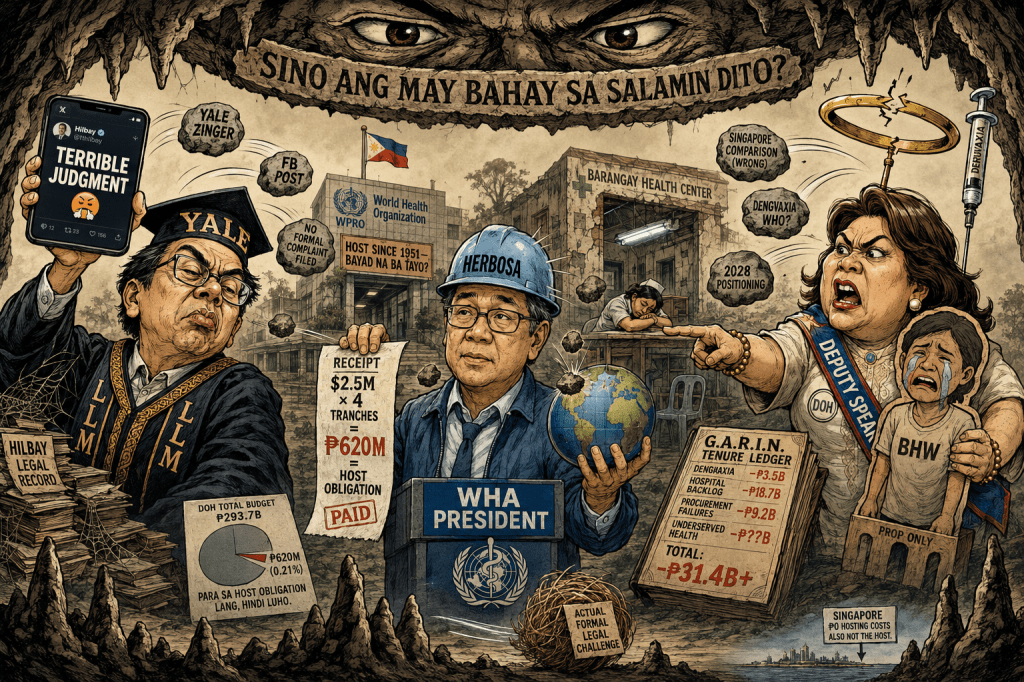
MGA ka-kweba, gather ’round the digital fireside. Another day, another manufactured outrage in the eternal Philippine tragicomedy titled Public Funds: Who Gets to Play Santa? This time, the script features Health Secretary Teodoro “Ted” Herbosa committing the Republic to a phased $10 million (roughly ₱620 million) contribution to the WHO Regional Office for the Western Pacific (WPRO) secretariat—our very own houseguest in Manila—dribbled out in sensible tranches of $2.5 million. Not a buhusan, mind you, but a diplomatic subscription fee to the club where the Philippines isn’t just a member, but the bloody host and recent president of the 78th World Health Assembly.
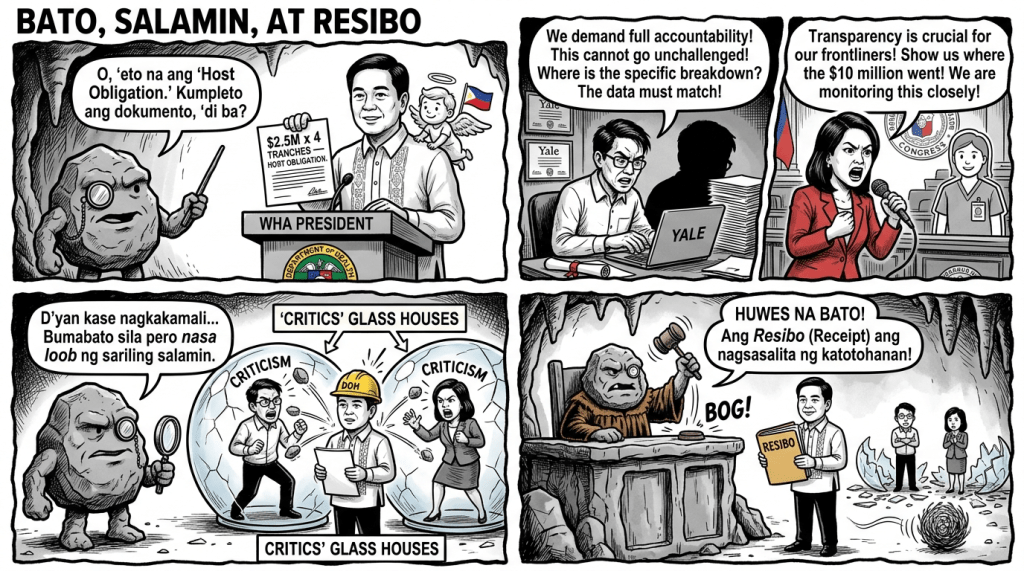
The usual suspects have predictably clutched their pearls: former SolGen Florin Hilbay branding it “terrible judgment,” Deputy Speaker Janette Garin wailing about barangay health workers, and the UHC Collective tut-tutting about agency turf. The abogado.com.ph framing is classic: Concerned Experts Slam Reckless Bureaucrat Amid Suffering Masses. How noble. How utterly predictable. Let us, with the cold scalpel of analysis and the acid of satire, perform the required autopsy.
Exposing the Script: Manufactured Fury and Shielded Hypocrites
The news report’s framing is a masterclass in selective outrage porn. It casts Herbosa as the profligate technocrat air-dropping borrowed pesos onto a faceless UN bureaucracy while HIV antiretrovirals allegedly expire and nurses starve. Unstated motive? Paint the Marcos DOH as tone-deaf globalists disconnected from the masa, thereby shielding the critics’ own institutional corpses and fueling opposition narratives ahead of whatever 2028 realignment is brewing.
Who benefits? The political opposition and their legal auxiliaries (Hilbay’s orbit) get fresh ammunition to portray the administration as fiscally irresponsible amid other DOH headaches (expired stocks, procurement raps). Media outlets feast on the clicks from “P620M abroad vs. sick Filipinos at home.” Garin rehabilitates her health credentials while conveniently forgetting her own tenure’s ledger. Hilbay burnishes his “principled constitutionalist” brand for future appointments or academic glory.
Who is being shielded? The critics’ selective amnesia and the deeper truth that public health in a middle-income archipelago has always required multilateral lubrication. The narrative airbrushes the 1951 Host Country Agreement obligations, the soft-power dividends of WHA leadership, and the fact that Singapore ($100k) isn’t hosting the damn secretariat nor did it just chair the global assembly. It also shields the structural reality: much of the DOH budget drama involves inherited messes and the inevitable trade-offs of diplomacy. Rhetorical maneuvers abound—Garin’s “no benefit” claim is a strawman ignoring indirect gains (tech transfer, surveillance, training); Hilbay’s “terrible judgment” is moralizing devoid of the full treaty/executive agreement context. The real shielding? Protecting the fiction that health policy can be purely domestic in a world of pandemics, while critics posture as fiscal virgins.
This isn’t journalism; it’s political ventilation therapy. The beneficiaries are clear: anyone invested in weakening Herbosa/Marcos health diplomacy. The shielded are the glass-house residents throwing stones.
Shredding the Critics: Hilbay, Garin & the Art of Selective Outrage
Let us now take the sacred cows of criticism and turn them into hamburger with the merciless efficiency of a San Beda-trained litigator on a bad day.
Florin Hilbay’s “Terrible Judgment”
Factually: The man omits the tranche structure (no lump-sum giveaway), the Philippines’ hosting of WPRO (with its local economic footprint—salaries spent in Manila, not Geneva), and Herbosa’s WHA presidency role, which positions us for reciprocal technical assistance far exceeding ₱620M in value. He ignores that contributions secure influence in disease surveillance and emergency protocols from which we benefited in COVID, SARS, and avian flu. Inconvenient truth: wealthier nations calibrate contributions; as host and founding member, our stake is structurally higher.
Policy-Based: This aligns perfectly with RA 11223 (Universal Health Care Act) imperatives for international cooperation, the State’s duty under Article II, Section 15 of the 1987 Constitution of the Republic of the Philippines (1987 Constitution) to promote health consciousness (which includes global equity advocacy), and an independent foreign policy (Article II, Section 7). Global health is not charity; it’s national security infrastructure. Denying this is like complaining about dues to Interpol while criminals roam free.
Politically: Hilbay’s sudden fiscal piety is rich coming from a figure aligned with eras that left their own procurement and spending legacies. The hypocrisy reeks of selective amnesia—critiquing Marcos-era diplomacy while the broader establishment he hails from rarely applied such rigor to favored initiatives. Ulterior motive: positioning as the erudite conscience against “this administration.”
Bad Faith/Malicious Intent: It’s careerist catnip. A Facebook zinger from a Yale LLM holder carries gravitas without the burden of filing a formal complaint with evidence. Subtext: revive relevance via opposition-adjacent soundbites, hoping the “principled critic” label sticks for future roles. Not graft accusation—just “judgment” shade—classic calibrated deniability.
Janette Garin’s Barangay Health Worker Lament and Singapore Comparison
Factually: Errors galore. Singapore isn’t the host; we are. The comparison is apples-to-iguana. She misrepresents potential redirection—funds are often earmarked. Omits documented benefits: WHO programs directly aid Filipino health workers and surveillance. Her own tenure saw massive HFEP expenditures and Dengvaxia controversies; the P620M pales.
Policy-Based: The donation advances UHC by bolstering regional capacity that rebounds to us (pandemic prep, vaccine policy). It fulfills host obligations and pacta sunt servanda principles. Redirecting every cent domestically ignores how diplomacy multiplies resources.
Politically: Selective amnesia of epic proportions. Garin, ex-DOH chief, now questions Herbosa’s priorities while her record invites scrutiny. This is 2028 positioning dressed as oversight—hypocrisy in deputy speaker robes.
Bad Faith: Pure opportunism and possible score-settling. Privilege speech and probes amplify her visibility while shielding her legacy. The subtext is revenge politics and constituency signaling in Iloilo.
UHC Collective/DFA Turf Argument (and sundry others)
Factually weak (DOH has clear health diplomacy mandate under its charter); policy-blind (specialized agencies routinely engage); politically opportunistic (turf wars as cover for broader attacks); bad faith evident in ignoring executive coordination realities.
In sum: Their arguments collapse under scrutiny like a poorly procured mobile clinic. Herbosa’s move is prudent statecraft.
Sunlight Now: Full Disclosure or Bust — Ditch the Posturing
Enough theater. Full disclosure now: DOH must release the exact commitment instrument, WHA resolution or executive agreement basis, every GAA line item and DBM allotment for each tranche (2024–present), all DFA coordination memoranda, any cost-benefit analysis quantifying returns (training slots, project funding, influence metrics), and WHO acknowledgment/receipts. DFA and DBM must certify inter-agency process compliance. COA should receive everything for immediate special audit, with public findings.
Abandon the posturing. Hilbay, file a proper suit or opinion with evidence instead of quips. Garin, lead a bipartisan, non-grandstanding inquiry. Herbosa, brief the nation with documents, not deflection. All parties: prioritize verifiable welfare—accelerate UHC zero-balance billing, fix supply chains, pay health workers—over scoring points. Serve every Filipino, not the 2028 chessboard.
Marching Orders: Concrete Next Steps for Real Accountability
- Immediate: Herbosa convenes a transparent press conference with full documentation packet within 72 hours. COA launches special audit on authorization and value-for-money.
- Political: House forms a select oversight panel (not Garin solo) for “in aid of legislation” hearings compelling testimony and papers; Senate Blue Ribbon runs parallel if warranted, but focused on systemic fixes.
- Legal/Institutional: Taxpayer suit or declaratory relief petition to SC for clarity on executive international health commitments. Ombudsman fast-tracks all DOH complaints with due process, avoiding selective persecution.
- Diplomatic: DFA assumes formal lead on future tranches if needed, formalizing via note verbale to preserve credibility. Explore matching grants or in-kind reciprocity from WHO.
- Institutional: DBM issues clear guidelines on earmarked international lines; DOH establishes public dashboard for major commitments.
Fortified by Steel: Law, Constitution & Precedent as Weapons
This analysis rests on bedrock: the 1987 Constitution of the Republic of the Philippines, Article VI, Section 29(1)—no money from Treasury absent appropriation (satisfied if GAA line items cover tranches); Article VII, Section 21—treaties need Senate, but executive agreements on implementation fall within presidential foreign affairs prerogative (Article VII, Section 1). Article II, Sections 7 and 15 bolster independent foreign policy and health promotion.
Substantive: Republic Act No. 3019 (Anti-Graft and Corrupt Practices Act) Sections 3(e) and 3(g) require bad faith or gross disadvantage—absent here, as diplomacy yields diffuse benefits (Tanada v. Angara). Revised Penal Code Article 217 malversation demands misappropriation, not authorized phased commitments. Presidential Decree No. 1445 (Government Auditing Code of the Philippines) and Administrative Code of 1987 (Executive Order No. 292) demand lawful purpose—hosting obligations qualify. Republic Act No. 11223 (An Act Instituting Universal Health Care for All Filipinos, Prescribing Reforms in the Health Care System, and Appropriating Funds Therefor) explicitly contemplates global cooperation.
Doctrinal weapons: Araullo v. Aquino III (G.R. No. 209287, July 1, 2014) limits executive overreach on appropriations but affirms bounds don’t cripple foreign affairs discretion. Belgica v. Ochoa (G.R. No. 208566, November 19, 2013) demands specificity, yet phased GAA items meet the test. Tanada v. Angara (G.R. No. 118295, May 2, 1997), Bayan Muna v. Romulo (G.R. No. 159618, February 1, 2011) and Oposa v. Factoran (G.R. No. 101083, July 30, 1993) affirm broad executive latitude in international commitments, tempered by law but not paralyzed by domestic optics. Agan v. PIATCO voids grossly disadvantageous deals, but this isn’t one.
Barok’s Verdict: The critics’ edifice is cant and opportunism—hollow, hypocritical, and eviscerated. Herbosa’s judgment, while demanding sunlight, stands as calculated statecraft vindicated by law, precedent, and geopolitical reality. The real dereliction is the politicized noise shielding accountability theater while real health gaps fester. Release the documents. Enforce the law evenly. Prioritize Filipinos through smarter, not louder, governance. Until then, the pearl-clutchers deserve nothing but contemptuous laughter from the Kweba.
May the rule of law, stripped bare and merciless, crush every pearl-clutching hypocrite. 🪨
Public interest analysis as of 29 May 2026. Documents, not drama.
Key Citations
A. Legal & Official Sources
- Philippines, Supreme Court. Araullo v. Aquino III. G.R. No. 209287, 1 July 2014, lawphil.net/judjuris/juri2014/jul2014/gr_209287_2014.html.
- Philippines, Supreme Court. Belgica v. Ochoa. G.R. No. 208566, 19 Nov. 2013, lawphil.net/judjuris/juri2013/nov2013/gr_208566_2013.html.
- Philippines, Supreme Court. Bayan Muna v. Romulo. G.R. No. 159618, 1 Feb. 2011, lawphil.net/judjuris/juri2011/feb2011/gr_159618_2011.html.
- Philippines, Supreme Court. Oposa v. Factoran. G.R. No. 101083, 30 July 1993, lawphil.net/judjuris/juri1993/jul1993/gr_101083_1993.html.
- Philippines, Supreme Court. Tañada v. Angara. G.R. No. 118295, 2 May 1997, lawphil.net/judjuris/juri1997/may1997/gr_118295_1997.html.
- Philippines, Supreme Court. Agan, Jr. v. Philippine International Air Terminals Co., Inc. G.R. No. 155001, 5 May 2003, lawphil.net/judjuris/juri2003/may2003/gr_155001_2003.html.
- “The 1987 Constitution of the Republic of the Philippines.” Official Gazette of the Republic of the Philippines, 1987, www.officialgazette.gov.ph/constitutions/1987-constitution/.
- “Republic Act No. 3019: Anti-Graft and Corrupt Practices Act.” 17 Aug. 1960, lawphil.net/statutes/repacts/ra1960/ra_3019_1960.html.
- Republic of the Philippines and World Health Organization. Host Agreement Between the Republic of the Philippines and the World Health Organization. 22 July 1951, elibrary.judiciary.gov.ph/thebookshelf/showdocs/35/11846.
B. News Reports
- “Florin Hilbay Calls DOH $10M WHO Donation ‘Terrible Judgment’.” Abogado, abogado.com.ph/florin-hilbay-calls-doh-10m-who-donation-terrible-judgment/.
- ₱8B BBM Pork: CCTV for Every Captain’s Kumpare?
- ₱8.9 Billion, 331 Ghost Police Stations: The TIKAS Scandal Explained

- ₱8.4 Billion, 42,000 Barangays, 1 Election: The “Bawat Barangay Makikinabang” Vote-Buying Masterclass
- ₱75 Million Heist: Cops Gone Full Bandit

- ₱6.77B Ghost Haunts Duterte: RTC Dismisses Mans Carpio’s Desperate Plea
- ₱6.7-Trillion Temptation: The Great Pork Zombie Revival and the “Collegial” Vote-Buying Circus

- ₱53 Million Man Tells ₱695-a-Day Workers to Stop Being ‘Mayabang’: The Audacity of BSP’s Remolona
- ₱3.06 Billion for Evacuation Centers—But Nobody Knows Where They’ll Stand (Or If They’ll Exist)
- ₱10B Ghost in New Clark City: Matibag’s Haunted Séance for Cayetano

- ₱1.9 Billion for 382 Units and a Rooftop Pool: Poverty Solved, Next Problem Please

- ₱1.35 Trillion for Education: Bigger Budget, Same Old Thieves’ Banquet
- ₱1 Billion Congressional Seat? Sorry, Sold Out Na Raw — Si Bello Raw Ang Hindi Bumili




 KWEBA ni BAROK
Leave a comment