
Staff Salaries Over Public Sanity: The Payroll Excuse That Rewrote Senate Ethics
By Louis ‘Barok‘ C. Biraogo — July 31, 2026
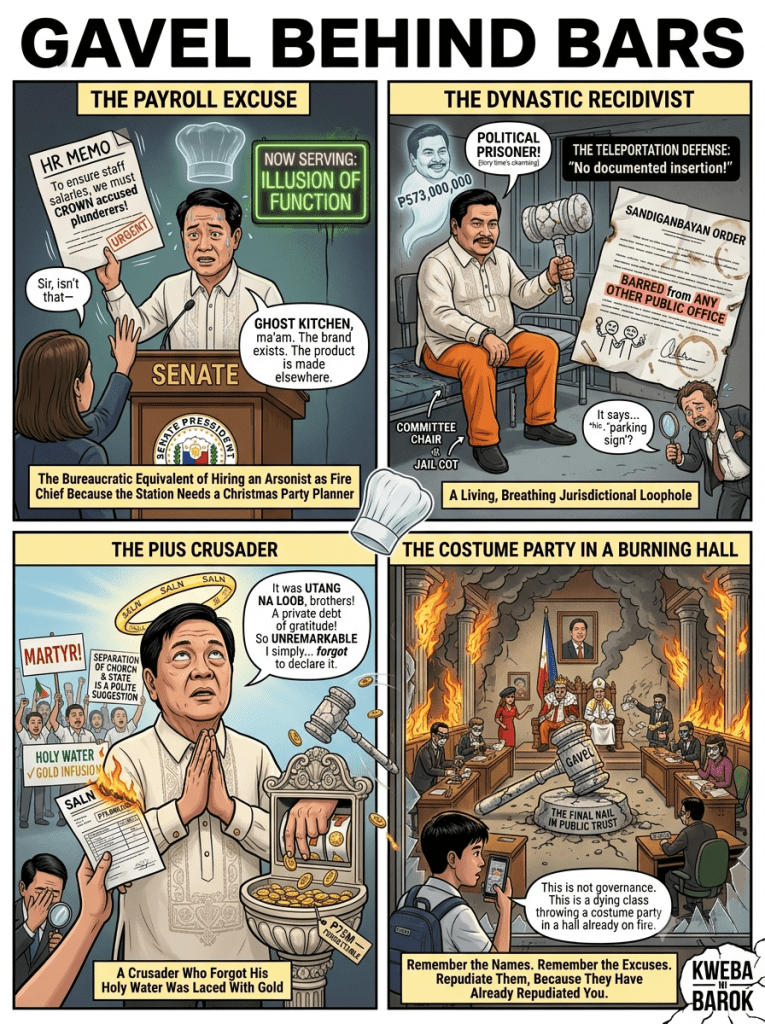
IN THE grand theater of Philippine politics, where farce routinely masquerades as governance, the 20th Congress has delivered a new masterpiece of institutional self-sabotage. Senators Jinggoy Estrada and Rodante Marcoleta, both presently enjoying the state’s hospitality at the New Quezon City Jail on non-bailable plunder charges, have just been handed committee chairmanships. And what, exactly, had these two done to deserve detention? According to Senate President Pro Tempore Vicente Sotto III, the move ensures committee staff can draw their salaries. Let that sink in: to fund a payroll, the Senate had to crown accused plunderers. It’s the bureaucratic equivalent of hiring an arsonist as fire chief because the station needs a Christmas party planner. This is the immaculate perception of impunity, a dogma held sacred by a political class that sees accountability not as a principle, but as a scheduling conflict.
Jinggoy Estrada: Dynastic Recidivist on His Third Helping
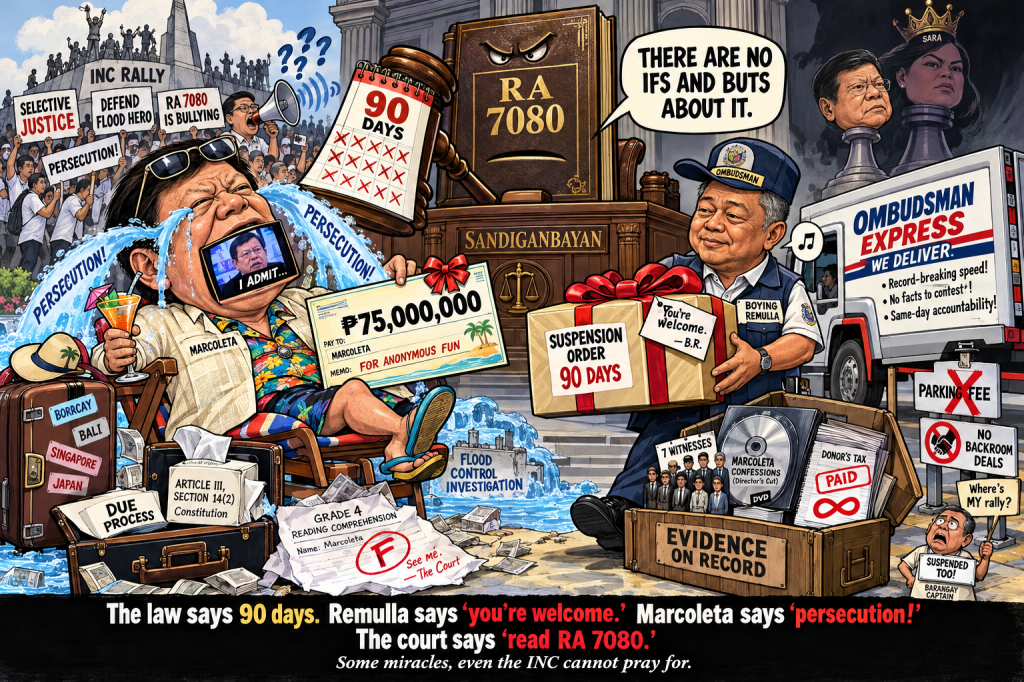
Let us first genuflect before the twin pillars of this new order. Senator Jinggoy Estrada is not a mere defendant; he is a dynastic recidivist, a plunder connoisseur tasting his third major legal entrée in less than three decades. The current flavor is a P573-million flood-control kickback scheme, a brazen act of looting public works funds. His defense parrots a valid legal technicality—a Legislative Budget Research and Monitoring Office certification showing no documented insertion by him personally. Yet, the Ombudsman speaks of a “layered method,” a shadow budget process invisible to standard audits. We are asked to believe that half a billion pesos simply teleported into the right pockets. Estrada cries “political prisoner,” a term so cynically deployed it should make the marble floors of the Senate weep. The Sandiganbayan’s 90-day suspension order explicitly bars him from “any other public office,” a judicial command the Senate interprets with all the rigor of a drunk deciphering a parking sign. Jinggoy isn’t a victim of justice; he’s a living, breathing jurisdictional loophole.
Rodante Marcoleta: Crusader Whose Holy Water Was Laced with Gold
Then there is the pious crusader, Senator Rodante Marcoleta. As chair of the Blue Ribbon probe, he was the grand inquisitor of the flood-control scandal—until the investigation stared back and the Ombudsman found a neat P75 million in undeclared campaign donations sitting in his own pocket. His defense is a theological-legal chimera: the cash was a private “utang na loob” (debt of gratitude), so unremarkable that he simply forgot to list it on his Statement of Assets, Liabilities, and Net Worth (SALN). The Commission on Elections (COMELEC) cleared him of election offenses for the same non-disclosure, yet the Ombudsman, with a distinct talent for spotting the obvious, saw a plunder case. His vaunted Iglesia ni Cristo support base staged a three-day rally for him, proving that for a chosen few, the separation of church and state is merely a polite suggestion. Marcoleta is the martyr who was caught red-handed, a crusader who forgot that his holy water was laced with gold.
The Enablers’ Ghost Kitchen: Sotto, Gatchalian, and the Nothing-to-See-Here Caucus
Behind every great absurdity stands a dutiful squad of enablers, a hierarchy of accommodation dedicated to laundering the dirty linen in plain sight. At its apex is the “Nothing to See Here” Caucus, led by Senators Sotto and Sherwin Gatchalian. Sotto’s payroll justification is a stroke of genius only a career politician could muster, reducing a profound constitutional ethics crisis to a minor HR memorandum. Gatchalian, the new Senate President, assures a weary public that “vice chairs will handle it.” This is the governance equivalent of a ghost kitchen: the brand exists, but the product is made elsewhere. This arrangement allows the Senate to maintain a grubby illusion of function while gutting its remaining moral authority.
Cayetano’s Alchemy and the Family Feud Artillery
Yet the master puppeteer is Minority Leader Alan Peter Cayetano. Fresh from a coup that briefly installed him as Senate President, he now frames Estrada and Marcoleta as “political prisoners.” This grotesque comparison, rightly lacerated by the martial-law-era support group Kapatid, is not analysis but political alchemy—a transparent attempt to transmute common criminal charges into a badge of elite persecution. Why? Because a cohesive, aggrieved minority bloc—anchored by two martyr-figures—is Cayetano’s only remaining power base, a shield to deflect the Marcos administration’s blows. This explains the theater’s most exquisite paradox: Senator Imee Marcos, the President’s own sister and a vocal critic of his administration, has been named Deputy Minority Leader. She is now an institutional rebel with dynastic immunity, a living symbol of the fact that the “toxic Marcos-Duterte war” is not a battle for the nation’s soul but a family feud being fought with national institutions as the weapons. Estrada and Marcoleta are not just committee chairs; they are artillery pieces in a clan war disguised as governance.
From Jalosjos to Gavel-Behind-Bars: Rewriting the Rule of Law
The law, in this swamp, is not a framework but a prop to be bludgeoned over an opponent’s head. The Senate’s defenders point to the 2008 precedent of Senator Antonio Trillanes IV, who chaired a committee while detained on coup d’état charges. But that arrangement, absurd as it was, required the committee to meet inside his detention cell. Is this the new gold standard—that the committee room must now include a guard tower and a pat-down search? The Jalosjos doctrine held that lawful imprisonment necessarily curtails a legislator’s rights. Today, the Senate rewrites that doctrine with a macabre twist: detention doesn’t just fail to curtail your power; it gets you a promotion. The Sandiganbayan invokes Republic Act No. 3019 (Anti-Graft and Corrupt Practices Act) and Republic Act No. 7080 (An Act Defining and Penalizing the Crime of Plunder) to suspend officials and prevent them from wielding power. The Senate’s response, crystallized in Beroña, is a slapstick retort: “Here, hold this gavel, preside over a budget, command a staff—just don’t use it.” It’s a direct assault on the rule of law, a legislative revolt against judicial order disguised as collegial accommodation.
Clarion Call from the Kweba: Bar the Detained from Leadership
This institutional self-own demands more than cynical laughter. It demands a clarion call from the Kweba. The Senate must place the welfare of the nation above the payroll of its members’ staff and the political futures of its accused. The rule of law must be supreme, starting with an immediate amendment to Senate rules to explicitly bar any member detained on non-bailable charges from holding any leadership post—period. Civil society must challenge the validity of these chairmanships as a direct violation of the Sandiganbayan’s suspension order barring appointment to “any other public office.” And to the youth watching this tragicomedy: remember the names, the excuses, and the sheer contempt for your intelligence. This is not governance; it is a dying class throwing a costume party in a hall that is already on fire. Repudiate them, because they have already repudiated you. The gavel in an accused plunderer’s hand is not a symbol of authority; it is the final nail in the coffin of public trust.
Key Citations
A. Legal & Official Sources
- People of the Philippines v. Romeo G. Jalosjos. G.R. Nos. 132875-76. Supreme Court of the Philippines, 3 Feb. 2000, lawphil.net/judjuris/juri2000/feb2000/gr_132875_2000.html.
- Republic Act No. 3019. Anti-Graft and Corrupt Practices Act. 1960, lawphil.net/statutes/repacts/ra1960/ra_3019_1960.html.
- Republic Act No. 6713. An Act Establishing a Code of Conduct and Ethical Standards for Public Officials and Employees. 1989, lawphil.net/statutes/repacts/ra1989/ra_6713_1989.html.
- Republic Act No. 7080. An Act Defining and Penalizing the Crime of Plunder. 1991, lawphil.net/statutes/repacts/ra1991/ra_7080_1991.html.
- Antonio F. Trillanes IV v. Hon. Oscar Pimentel, Sr., et al. G.R. No. 179817. Supreme Court of the Philippines, 27 June 2008, lawphil.net/judjuris/juri2008/jun2008/gr_179817_2008.html.
- The 1987 Constitution of the Republic of the Philippines. Official Gazette of the Republic of the Philippines, 1987, http://www.officialgazette.gov.ph/constitutions/1987-constitution/.
B. News Reports
- “Estrada, Marcoleta Given Committee Chairmanships Despite Detention.” Inquirer.net, Philippine Daily Inquirer, [Date of publication], https://newsinfo.inquirer.net/2273772/estrada-marcoleta-given-committee-chairmanships-despite-detention.
- “Sandiganbayan places Jinggoy Estrada under 90-day suspension.” Inquirer.net, Philippine Daily Inquirer, 16 June 2026, newsinfo.inquirer.net/2247416/sandiganbayan-places-jinggoy-estrada-under-90-day-suspension.
- Calica, Aurea. “Trillanes Files Complaint vs Military Officials.” The Philippine Star, 3 Oct. 2007, http://www.philstar.com/metro/2007/10/03/18140/trillanes-files-complaint-vs-military-officials.

- “Ang Hirap Maging Mahirap”: The PAO Scandal That Proves Government Contempt Is Nothing New
- “Far-Off” My Axx: Malacañang’s Claire Castro Drowns in Her Own Legal Gaslighting
- “Forthwith” to Farce: How the Senate is Killing Impeachment—And Why Enrile’s Right (Even If You Can’t Trust Him)
- “HINDI AKO NAG-RESIGN!”

- “I Know Nothing”: Baste Duterte’s Amnesia Defense Meets ₱33M in GenCorp Contracts

- “I’m calling you from my new Globe SIM. Send load!”

- “Mahiya Naman Kayo!” Marcos’ Anti-Corruption Vow Faces a Flood of Doubt

- “Manageable” Debt, Unmanageable Lies: DBM’s ₱21 Trillion Fairy Tale
- “Meow, I’m calling you from my new Globe SIM!”

- “Natrabaho”: One Word, One Ombudsman, and a Judiciary on Trial
- “No Special Jail for Crooks!” Boying Remulla Slams VIP Perks for Flood Scammers

- “Philippine-Controlled” or Yankee Gas Station? The Davao Fuel Depot Farce Exposed





Leave a Reply