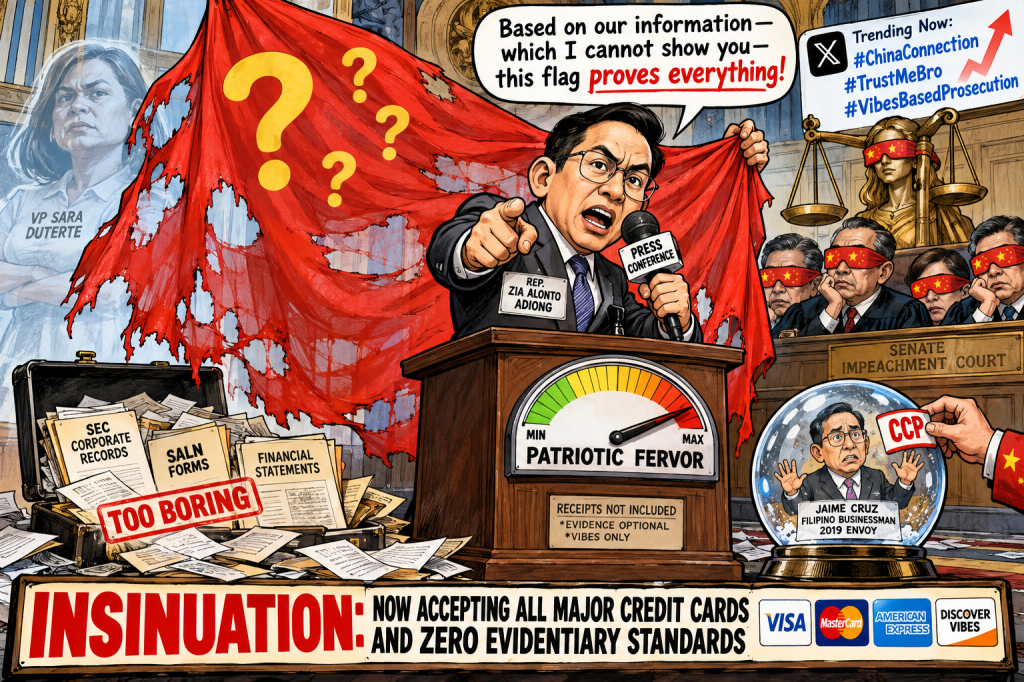
Somewhere Between ‘Chinese National’ and ‘Trust Me, Bro’ Lies the Evidence Adiong Forgot to Bring.
By Louis ‘Barok’ C. Biraogo — September 28, 2026
The prosecution in Vice President Sara Duterte’s impeachment trial has apparently decided that the best way to prove “betrayal of public trust” is to replace evidence with insinuation, corporate records with geopolitics, and the Constitution with a vibes-based foreign policy litmus test.
An Unsourced Claim
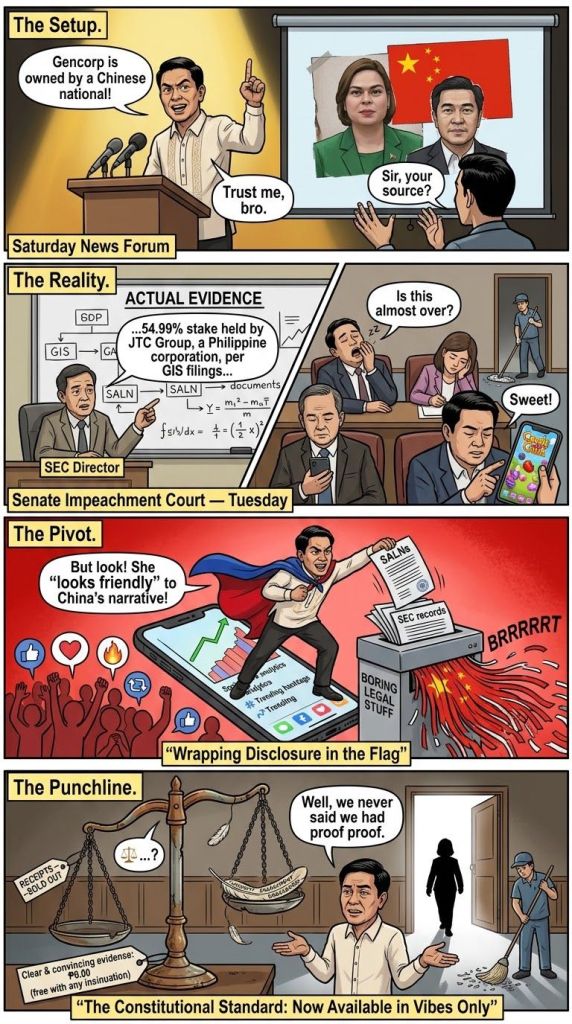
Enter Rep. Zia Alonto Adiong, prosecution spokesperson and self-appointed guardian of Philippine sovereignty, who announced at a Saturday news forum that Gencorp Industries—the company Sara Duterte listed as a business interest in her Statements of Assets, Liabilities and Net Worth (SALNs)—is “owned by a Chinese national”. The source document? Unnamed. The specific individual? Unidentified. The legal relevance? Unclear.
But hey, why let evidentiary standards ruin a perfectly good narrative?
What the Senate Record Actually Shows
Here’s what the Senate impeachment court has actually established through Securities and Exchange Commission (SEC) testimony: Jaime T. Cruz, a businessman appointed by former President Rodrigo Duterte as special envoy to China in 2019, appears in the corporate records of several companies linked to Sara Duterte.
Cruz’s JTC Group of Companies holds a 54.99% stake in Gencorp. The Vice President’s name does not appear in Gencorp’s incorporation papers or General Information Sheets (GIS), though she declared a business interest in the company in her 2024 and 2025 SALNs.
That’s the evidentiary chain. It raises legitimate questions about beneficial ownership, disclosure accuracy, and potential conflicts of interest. It does not—I repeat, does not—establish that Gencorp is a Chinese government asset, that Sara Duterte is Beijing’s puppet, or that the Duterte family has been running a covert influence operation for the Chinese Communist Party.
“Looks Friendly” as a Standard
But Adiong isn’t letting a little thing like proof get in the way of a good headline. “Based on our information, this company is owned by a Chinese national,” he said, without producing the information in question. He then pivoted to the real accusation: the Duterte camp “looks friendly to China’s narrative”.
Ah yes. The “looks friendly” standard of constitutional accountability. Impeachable offense: having a foreign policy position the Marcos administration disagrees with.
The Case That Is Legally Serious
Let’s be clear about what’s happening here. The prosecution’s actual case on Article II—unexplained wealth, failure to disclose, failure to divest—is complicated.
The SEC testimony created genuine puzzles: Duterte declared a business interest that doesn’t appear in corporate records, a company she described as “formerly” two other corporations that are, in fact, separate juridical entities, and a net worth that increased substantially while her companies reportedly declared no dividends.
Those are the facts worth prosecuting. They’re technical, they’re documentary, they’re boring—and they’re legally serious.
But “boring” doesn’t trend on social media. So the prosecution has wrapped its corporate disclosure case in the flag and sprinkled it with the magic word: China.
Wrapping Disclosure in the Flag
The strategic logic is transparent. The Philippines is in the middle of a geopolitical realignment. The Marcos administration has adopted a hawkish posture toward Beijing. Being “soft on China” is politically toxic. What better way to delegitimize the Vice President than to paint her family’s business network as a foreign influence operation?
The problem is that the evidence doesn’t support the rhetoric. Jaime Tan Cruz is a Filipino businessman. JTC Group is a Philippine corporation. Gencorp is a Philippine corporation. There is no evidence—none—that the Chinese government controls any of them. Adiong himself stopped short of declaring Beijing control, retreating to the vague claim of “proximity in terms of engagement”.
Proximity. Engagement. Vibes.
This is not impeachment. This is opposition research with a subpoena.
Testing the Logic
Consider what the prosecution is asking the Senate to believe: that because a businessman who once served as a trade envoy to China holds a controlling stake in a company the Vice President declared as a business interest—a declaration, by the way, that she made voluntarily under oath—the Vice President is somehow compromised in her loyalty to the Philippines.
Let’s test that logic. If a Filipino businessman served as special envoy to the United States, would his corporate connections to a public official prove that official was an American asset? If the answer is no, then the “China connection” framing is not evidence—it’s ethnic and geopolitical profiling dressed up as national security concern.
The Anti-Dummy Law and Beneficial Ownership
The Anti-Dummy Law exists precisely to prevent foreign nationals from using Filipino nominees to circumvent ownership restrictions. If Adiong has evidence that Gencorp is a dummy arrangement for a Chinese national, he should produce it. File charges. Present the documents. Name the person. Let the legal process determine whether the Anti-Dummy Law was violated.
But that’s not what’s happening. Instead, we’re getting press conferences where unverified allegations are framed as prosecution “information,” and policy disagreements are recast as potential treason.
The defense’s response—that Duterte’s name doesn’t appear in Gencorp’s SEC records, therefore she has no connection—is equally incomplete. As SEC Director Gerardo del Rosario acknowledged, beneficial ownership can exist through corporate subscribers, trust arrangements, or nominee structures that don’t appear in public filings. The absence of Duterte’s name from Gencorp’s GIS doesn’t prove she has no interest; it simply means the nature of that interest requires further investigation.
The Questions That Matter
That investigation should focus on the actual legal questions:
- What was Sara Duterte’s beneficial interest in Gencorp?
- Did it constitute prohibited participation in business under Article VII, Section 13 of the Constitution?
- Did Gencorp’s government contracts during her vice presidency create a conflict of interest?
- Did the company’s revenues flow to her personally, and if not, what explains her wealth increase?
Those questions have answers. They’re in financial records, corporate documents, and tax filings. They do not require invoking the Chinese Communist Party.
How Guilt by Association Works
But invoking China serves a different purpose. It transforms a technical compliance case into a national security spectacle. It makes the prosecution look patriotic rather than partisan. It gives senator-judges who might be inclined to acquit a reason to hesitate: who wants to be the senator who voted to protect someone “friendly to China’s narrative”?
This is how guilt by association works. You start with a fact—a business connection to a former China envoy. You add an inference—that the connection implies foreign influence. You layer on a broader narrative—that the Duterte family has always been too close to Beijing. And you end with a conclusion that no individual piece of evidence supports: that the Vice President is a threat to Philippine sovereignty.
The Constitutional Standard
The burden of proof in impeachment is not “sounds suspicious when you put it next to China.” It is not “her family’s foreign policy views make me uncomfortable.” It is not “a Chinese national might be somewhere in the corporate chain.”
It is clear and convincing evidence that the Vice President committed culpable violation of the Constitution, treason, bribery, graft and corruption, other high crimes, or betrayal of public trust.
Adiong may believe the Duterte camp is “friendly to China.” He may disagree with their foreign policy positions. He may even suspect, in his heart of hearts, that something nefarious is afoot.
But suspicion is not evidence. Proximity is not proof. And wrapping a corporate disclosure case in the flag does not make it a national security case.
If the prosecution has evidence that Gencorp is Chinese-owned, that Sara Duterte is a Chinese asset, or that the Duterte family has been acting on Beijing’s behalf, they should present it. Name the owner. Produce the documents. Let the Senate evaluate the proof.
If they don’t have that evidence—if “China connection” is a rhetorical device rather than a factual claim—then they should stop pretending that geopolitical innuendo is a substitute for the constitutional standard the Senate is bound to apply.
The Vice President may or may not have violated the divestment requirement. She may or may not have misdeclared her assets. Those are serious questions that deserve serious answers based on serious evidence.
But the prosecution’s China narrative is not serious. It’s a distraction, a smear, and an insult to the intelligence of anyone who understands the difference between a trade envoy’s corporate ties and a foreign government’s control.
The Senate should demand better. The public should expect better. And Rep. Adiong should either produce his evidence or stop pretending he has a case he hasn’t made.
The impeachment court is not a venue for foreign policy debates. It is a venue for proof. And so far, on the China question, the prosecution has offered plenty of insinuation—and precious little of anything else.
Key Citations
A. Legal & Official Sources
- “General Information Sheet (GIS).” Securities and Exchange Commission, http://www.sec.gov.ph/privacy-policy-3/general-information-sheet-gis/.
- “The 1987 Constitution of the Republic of the Philippines – Article VII.” Official Gazette of the Republic of the Philippines, http://www.officialgazette.gov.ph/constitutions/the-1987-constitution-of-the-republic-of-the-philippines/the-1987-constitution-of-the-republic-of-the-philippines-article-vii/.
- “The 1987 Constitution of the Republic of the Philippines – Article XI.” Official Gazette of the Republic of the Philippines, http://www.officialgazette.gov.ph/constitutions/the-1987-constitution-of-the-republic-of-the-philippines/the-1987-constitution-of-the-republic-of-the-philippines-article-xi/.
- Commonwealth Act No. 108. “An Act to Punish Acts of Evasion of the Laws on the Nationalization of Certain Rights, Franchises or Privileges.” Supreme Court E-Library, 30 Oct. 1936, elibrary.judiciary.gov.ph/thebookshelf/showdocs/29/17830.
B. News Articles
- Quismorio, Ellson. “What Is This Alleged ‘China Connection’ in VP Sara Trial?” Manila Bulletin, 26 Sept. 2026, https://mb.com.ph/2026/09/26/what-is-this-alleged-china-connection-in-vp-sara-trial. Accessed 27 Sept. 2026.
- Bacelonia, Wilnard. “Ex-Duterte Envoy Emerges as VP Trial Traces GenCorp Control.” Philippine News Agency, 22 Sept. 2026, http://www.pna.gov.ph/articles/1284555.
- Cantos, Joy. “Pro-China Stand ni VP Sara, Kinuwestiyon.” Pilipino Star Ngayon, 27 Sept. 2026, http://www.philstar.com/pilipino-star-ngayon/bansa/2026/09/27/2559196/pro-china-stand-ni-vp-sara-kinuwestiyon.
- Cruz, James Patrick. “Sara Duterte’s Company Won Millions’ Worth of Contracts from Davao City Hall.” Rappler, 15 Sept. 2026, http://www.rappler.com/newsbreak/investigative/sara-duterte-company-food-contractor-davao-city/.
- Gasgonia, Dennis. “Prosecution Spox: Sara Duterte-Linked Gencorp Industries Is Chinese-Owned.” ABS-CBN News, 26 Sept. 2026, http://www.abs-cbn.com/news/nation/2026/9/26/prosecution-spox-questions-duterte-camp-s-china-posture-2336.
- Nazario, Dhel. “Duterte-Appointed China Envoy Linked to Firms in VP Sara Impeachment Trial.” Manila Bulletin, 22 Sept. 2026, mb.com.ph/2026/09/22/duterte-appointed-china-envoy-linked-to-firms-in-vp-sara-impeachment-trial.
C. Official Websites
- “HON. ZIAUR-RAHMAN ‘ZIA’ ALONTO ADIONG.” House of Representatives of the Philippines, http://www.congress.gov.ph/house-members/view/?member=K002&page=0.
- “The Vice President.” Office of the Vice President of the Republic of the Philippines, http://www.ovp.gov.ph/thevicepresident.
- Securities and Exchange Commission, http://www.sec.gov.ph/.
- “Chinese Communist Party.” Encyclopaedia Britannica, http://www.britannica.com/topic/Chinese-Communist-Party.
- ₱9 Billion in ‘Savings’? DILG’s Fire Truck Deal Smells Like Smoke
- ₱8B BBM Pork: CCTV for Every Captain’s Kumpare?
- ₱8.9 Billion, 331 Ghost Police Stations: The TIKAS Scandal Explained

- ₱8.4 Billion, 42,000 Barangays, 1 Election: The “Bawat Barangay Makikinabang” Vote-Buying Masterclass

- ₱75 Million Heist: Cops Gone Full Bandit

- ₱6.77B Ghost Haunts Duterte: RTC Dismisses Mans Carpio’s Desperate Plea
- ₱6.77 Billion and Zero Cash: The Sara Duterte SALN Math That Doesn’t Add Up

- ₱6.7-Trillion Temptation: The Great Pork Zombie Revival and the “Collegial” Vote-Buying Circus

- ₱58.53B, Zero Receipts: The LGSF Pork Barrel Nobody Wants to Name
- ₱53 Million Man Tells ₱695-a-Day Workers to Stop Being ‘Mayabang’: The Audacity of BSP’s Remolona
- ₱4.4 Billion and a Witness Who Can’t Explain It: The Duterte Impeachment’s Most Expensive Non-Answer
- ₱3.06 Billion for Evacuation Centers—But Nobody Knows Where They’ll Stand (Or If They’ll Exist)






Leave a Reply