The Ombudsman Went on Radio to Expose the LTO. What He Actually Exposed Was a Broken Bureaucracy That Fails Accident Victims With or Without a Conspiracy.
Louis “Barok” C. Biraogo — September 28, 2026
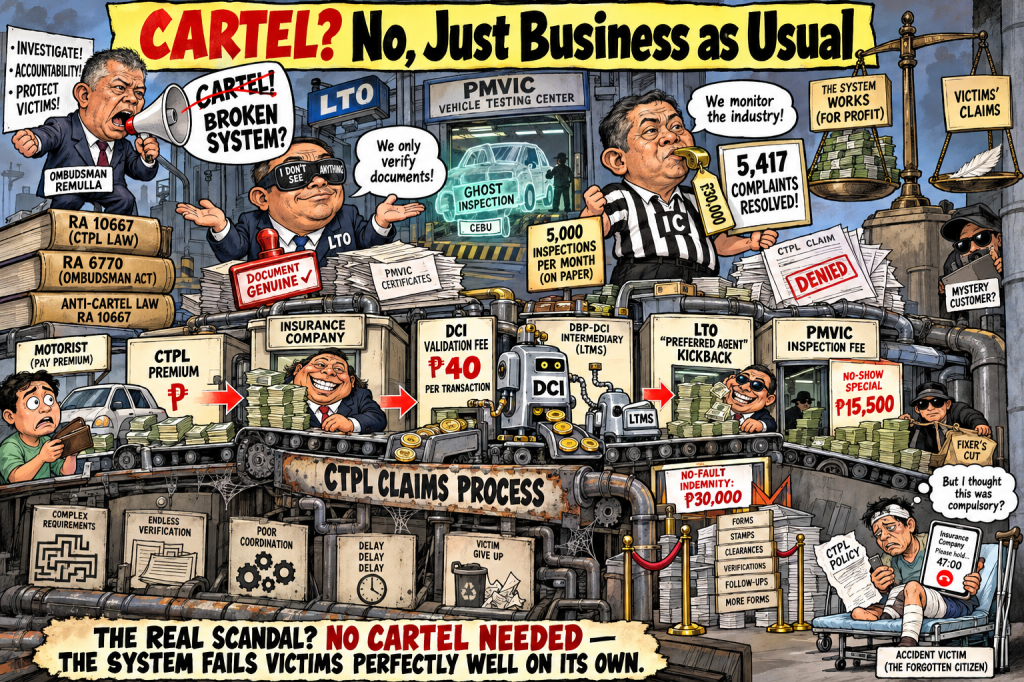
LET’S start with the most brilliant part of this news cycle: Remulla went on the radio and spent twenty minutes painting a picture of an unholy alliance of the LTO, the Insurance Commission, and insurance companies conspiring to victimize the Filipino people. A “cartel.” “It’s all about money.” These phrases sound harsh and true—everyone who has been through a car accident and tried to claim CTPL insurance knows the system is broken. But the problem is, when an Ombudsman uses the word “cartel” in public, he should know it has a very precise legal definition.
Let me quote the Philippine Competition Act (RA 10667): a cartel is an agreement between competitors to fix prices, rig bids, allocate markets, or restrict output. Note the key word—competitors. The LTO is a government regulator, not a competitor of insurance companies. The Insurance Commission is a regulator, not a competitor. Even if what they’re doing is ugly, corrupt, or collusive, it doesn’t automatically constitute a “cartel” under competition law.
This is like calling the barangay captain a “syndicate leader” because he takes a cut from every sari-sari store. It might be corruption, it might be extortion, but it’s not a “cartel” in the legal sense.

The Hidden Treasure in Remulla’s Accusations
But don’t be too quick to dismiss the Ombudsman. His legal theory may require tightening, but his political instinct is unmistakable.
Look at what he actually said:
First, accident victims cannot claim insurance benefits. This is empirically verifiable. In the Philippines, after an accident, the police won’t tell you “go claim your no-fault indemnity.” Hospitals won’t help you track down insurers. The LTO only cares about one thing when collecting your CTPL certificate—whether the document is genuine. Once you drive off the lot, you’re on your own.
Second, the DCI validation fee. Remulla specifically named DBP Data Center Inc. (DCI) and said every CTPL transaction goes through them, P40 per transaction. His question is: the Land Transportation Management System (LTMS) can already do data validation, so why add an intermediary? Why does this intermediary charge? What’s the legal basis for this fee?
This question is devastating. Because it shifts the discussion from the vague “there’s a cartel” to the specific “who receives this money, and by what authority?”
Third, PMVIC “ghost inspections.” Remulla said some testing centers report 5,000 inspections per month, but the actual number of vehicles that show up is much lower. This is not speculation—this is an auditable allegation. You don’t need undercover informants; you just need to compare CCTV footage, license plate recognition data, inspection equipment logs, and LTMS transaction records.
These three points, taken together, form a coherent narrative: the government has created a compulsory insurance system, but the design of this system allows money to flow through multiple unnecessary nodes (insurers, DCI, fixers, LTO personnel), while the people the system is supposed to protect—accident victims—are the last to benefit.
The LTO’s Defense: Technically Correct, Morally Indefensible
The LTO’s defense of itself will likely be: we are not the insurer, we don’t process claims, the Insurance Commission regulates insurance, we only check documents. This is technically correct. The Insurance Code clearly stipulates that CTPL claims are the responsibility of insurance companies; the LTO’s job is registration.
But this defense sounds hollow when you look at the actual records.
Back in March 2025, LTO chief Vigor Mendoza issued a public warning to his own staff: do not refuse CTPL certificates that were not purchased from “preferred” insurance companies. Think about what this means. He is acknowledging that LTO front-line personnel are steering people to specific insurance agents, and these agents are likely giving kickbacks to LTO personnel. This isn’t a “regulatory blind spot”—this is institutionalized racketeering.
More ironically, just a week after the National Bureau of Investigation (NBI) arrested a fixer in Cebu for a “no-show” vehicle registration scheme, where the fixer charged P15,500 to bypass emission testing and physical inspection entirely, and used a PMVIC testing center located in Luzon to process transactions for vehicles that never left Cebu. This is exactly the “non-appearance” testing scheme Remulla described, just with a different label.
So when the LTO says “we only verify documents,” the reality is: they verify fraudulent documents issued by PMVICs in collusion with fixers.
The “Pro-Money” Problem of the Insurance Commission
Remulla lumped the Insurance Commission into his criticism, saying they’re “also all about money.” Is that fair? The Insurance Commission will point to their Claims Adjudication Division, their complaint resolution mechanisms, and the fact that they resolved 5,417 complaints in 2023.
But here’s a question: if the Insurance Commission is so effective, why can’t accident victims get a P30,000 no-fault indemnity?
The answer lies in incentive structures. The Insurance Commission’s primary function is to ensure the solvency of insurance companies, not to ensure that every victim gets their money. These two goals are often in conflict. If the Commission aggressively punishes insurers for denying claims, premiums may rise, insurers may exit the market, and the CTPL system may collapse.
So they take the path of least resistance: let the claims process be “self-service.” If the victim is smart enough, patient enough, and lucky enough to find the right insurer and the right form, they can get their money. If not—well, the system is not “broken,” it’s just “inefficient.”
The Real Question: What Is the Ombudsman Going to Do?
This is where the story gets interesting. Remulla is the Ombudsman. He is not an ordinary radio commentator. He has subpoena power, investigative power, and the power to prosecute public officials. He doesn’t need to prove a “cartel” before he can investigate.
Under RA 6770, Section 15(1), the Ombudsman can investigate, on his own initiative, any act or omission of a public official that appears “illegal, unjust, improper, or inefficient.” Note the word “inefficient.” Remulla doesn’t need to prove a cartel. He doesn’t even need to prove corruption. He just needs to show that this system is inefficient and unjust to the public.
And on this point, he’s already won in the court of public opinion.
What remains to be seen is whether he will translate the radio rhetoric into formal investigative action. If he does, the DCI arrangement is the most concrete entry point. Who authorized that P40 fee? Why was DCI chosen instead of LTMS? Is there a contract? Was it procured competitively? Who received the money?
If he doesn’t, this whole thing is just another episode of “radio ombudsman”—loud noise, zero consequences, and next week someone else will be the villain.
Final Verdict
Remulla is right to be angry. The CTPL system is a racket. It exploits a mandatory requirement to funnel money to insurers, intermediaries, and corrupt officials, while the people the system is supposed to protect—accident victims—are treated as an afterthought.
But calling it a “cartel” is the lazy way out. A cartel is a specific legal concept that requires proof of an agreement between competitors, proof of market impact, proof of a mechanism that restricts competition. Remulla has presented none of these things. What he has presented is a system that is broken by design—where nobody has an incentive to help victims, and everyone has an incentive to extract fees.
The real scandal is not that there’s a cartel. The real scandal is that there doesn’t need to be one. The system is perfectly capable of failing accident victims on its own, without anyone conspiring to make it happen.
Key Citations
A. Legal & Official Sources
- Congress of the Philippines. Philippine Competition Act. Republic Act No. 10667, 21 July 2015, www.officialgazette.gov.ph/2015/07/21/republic-act-no-10667/.
- Congress of the Philippines. The Ombudsman Act of 1989. Republic Act No. 6770, 17 Nov. 1989, https://lawphil.net/statutes/repacts/ra1989/ra_6770_1989a.html.
- Insurance Commission. Increase in the Benefits for Compulsory Motor Vehicle Insurance Coverage. Insurance Memorandum Circular No. 2024-01, 2024, www.insurance.gov.ph/wp-content/uploads/2024/04/IMC-2024-01_Increase-in-the-Benefits-for-Compulsory-Motor-Vehicle-Insurance-Coverage.pdf.
- Insurance Commission. “IC Resolves All 5,417 Complaints from Insuring Public in 2023.” Press release, 29 Jan. 2024, www.insurance.gov.ph/wp-content/uploads/2024/01/PR_IC-resolves-all-complaints-in-2023.pdf.
- Philippine Competition Commission. “Philippine Competition Law (R.A. 10667).” Philippine Competition Commission, www.phcc.gov.ph/philippine-competition-law-ra-10667.
B. News Articles
- Dela Cruz, Raymond Carl. “LTO to Crack Down on Illegal Insurance Agents.” Philippine News Agency, 17 Mar. 2025, www.pna.gov.ph/articles/1246193.
- Erram, Morexette Marie B. “Fixer Nabbed in Talisay City for ‘No-Show’ Scam.” Cebu Daily News, 19 Mar. 2026, cebudailynews.inquirer.net/707307/fixer-nabbed-in-talisay-city-for-no-show-scam.
- “LTO Warns Personnel vs Promoting ‘Preferred’ Car Insurance Firms.” Inquirer Plus, 18 Mar. 2025, plus.inquirer.net/news/lto-warns-personnel-vs-promoting-preferred-car-insurance-firms/.
- “Ombudsman Ibinunyag Umano’y Isyu sa Third-Party Liability Insurance sa LTO.” Abante TNT, 26 Sept. 2026, tnt.abante.com.ph/2026/09/26/ombudsman-ibinunyag-umanoy-isyu-sa-third-party-liability-insurance-sa-lto/news/.
- Santos, Jamil. “Remulla Slams LTO over Alleged Third-Party Insurance Scheme.” GMA News Online, 26 Sept. 2026, www.gmanetwork.com/news/topstories/nation/1003818/remulla-slams-lto-over-alleged-third-party-insurance-scheme/story/.
- Simeon, Louise Maureen. “Insurance Complaints Rise in 2023.” Philstar.com, 30 Jan. 2024, http://www.philstar.com/business/2024/01/30/2329427/insurance-complaints-rise-2023.
C. Official Websites
- Development Bank of the Philippines. “Subsidiaries.” DBP, www.dbp.ph/about-dbp/subsidiaries/.
- Insurance Commission. “FAQs.” Insurance Commission, www.insurance.gov.ph/faqs/.
- Land Transportation Office. Land Transportation Office, lto.gov.ph.
- Land Transportation Office. Land Transportation Management System Portal, portal.lto.gov.ph.
- Office of the Ombudsman. Office of the Ombudsman Philippines, www.ombudsman.gov.ph.



Leave a comment